Solution
Related Formula
Shortest distance between perpendicular axes vectors:
S.D. = |( a₂ - a₁) · ( b₁ × b₂)|| b₁ × b₂|Core Logic
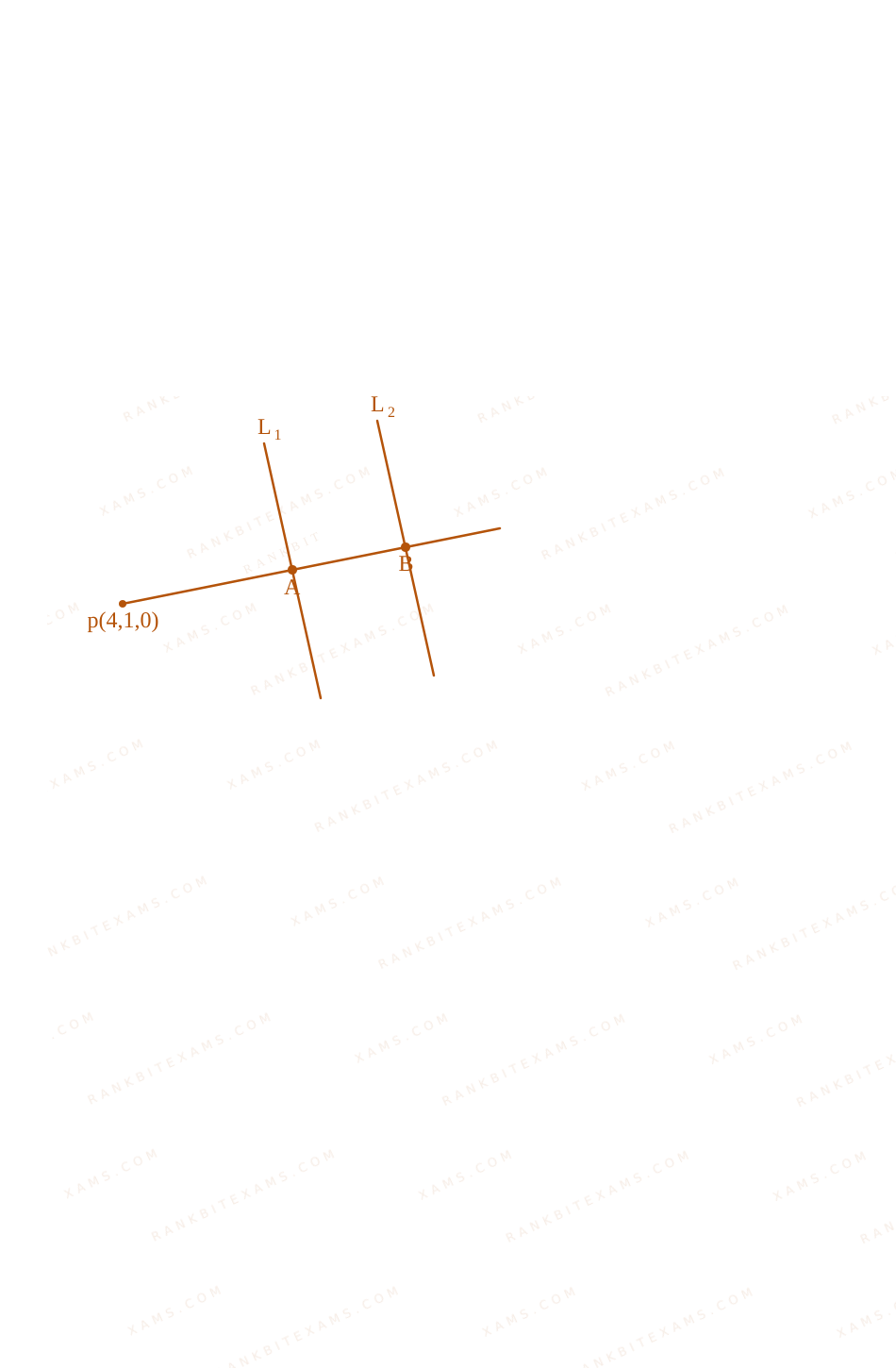
Represent equations of straight lines symmetrically using vector directions [cite: 1418]: L₁: (x-1)/(0) = (y-2)/(0) = (z-3)/(1) [cite: 1418] L₂: (x-λ)/(0) = (y-5)/(1) = (z-6)/(0) [cite: 1418]
Evaluating the standard shortest distance configuration formula[cite: 1419, 1420]: S.D. = |λ - 1| = 3 λ - 1 = ± 3 [cite: 1420] λ = 4 or λ = -2 [cite: 1420]
Given the condition λ₂ < λ₁ [cite: 698]: λ₁ = 4, λ₂ = -2 [cite: 1421, 1422]
Step 1: Distance calculation from line
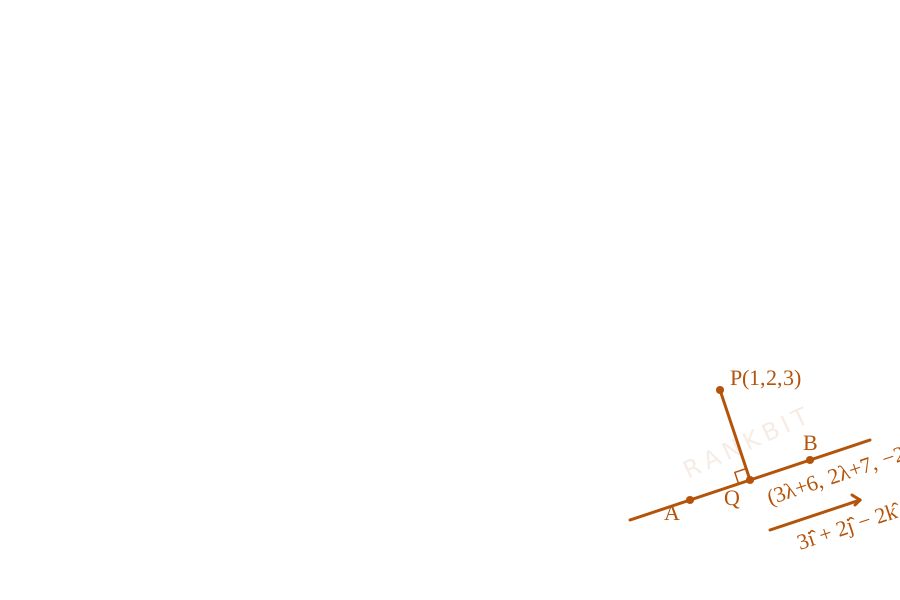
We need to find the square of distance from point P(4, -2, 7) to line L₁ [cite: 1424]. Any general matching point coordinates tracking along path L₁ look like Q(1, 2, t+3) [cite: 1424].
Form a perpendicular projection vector condition [cite: 1425]: PQ = (-3, 4, t-4) [cite: 1425] Since PQ · k = 0 t-4 = 0 t=4 [cite: 1425, 1426].
Thus, the foot of perpendicular is Q(1, 2, 7) [cite: 1427].
Evaluate the squared distance component magnitude [cite: 1427]: PQ² = (4-1)² + (-2-2)² + (7-7)² = 3² + (-4)² + 0 = 9 + 16 = 25 [cite: 1427, 1428]
Pattern Recognition
For lines parallel directly to independent Cartesian coordinate grid lines, the shortest paths are simply direct plane projections.
Chapter Mix
Class 12 Mathematics: Three Dimensional Geometry