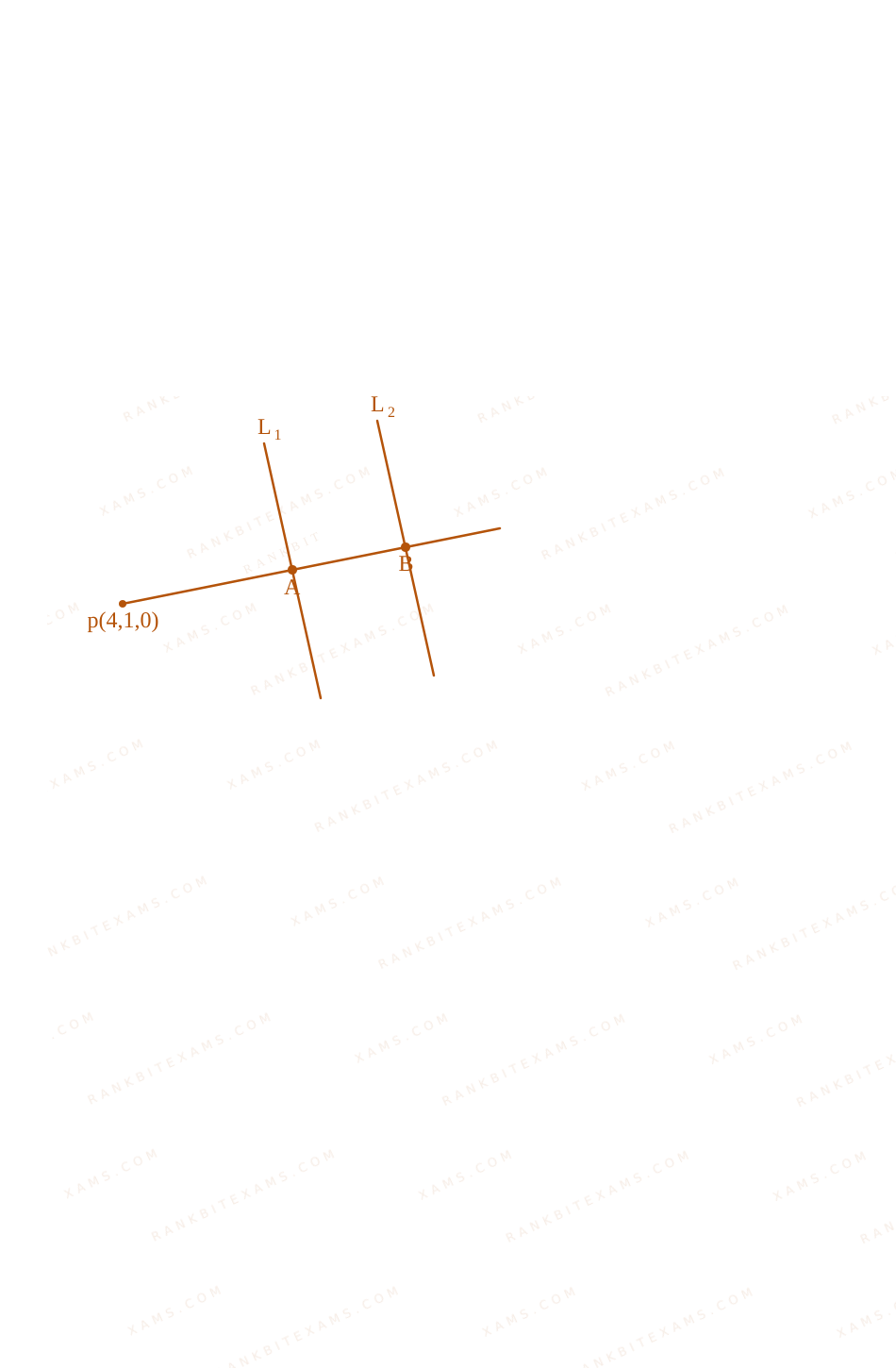
Let a line passing through the point (4,1,0) [cite: 520] intersect the line L_1:fracx-12=fracy-23=fracz-34 at the point A(alpha, beta, gamma) [cite: 522, 523, 524] and the line L_2:x-6=y=-z+4 at the point B(a, b, c)[cite: 525]. Then the value of the determinant beginvmatrix 1 & 0 & 1 \\ alpha & beta & gamma \\ a & b & c endvmatrix is equal to[cite: 527]:

Solution & Explanation

### Related Formula For three points P, A, and B to be collinear, their direction vectors must be proportional: vecPA parallel vecPB implies fracx_A - x_Px_B - x_P = fracy_A - y_Py_B - y_P = fracz_A - z_Pz_B - z_P
Intersection of Lines diagram for Q52 - JEE Main 2025 Morning
### Core Logic Express general coordinates for A on L_1 and B on L_2 [cite: 1204]: L_1: fracx-12=fracy-23=fracz-34=p implies A(2p+1, 3p+2, 4p+3) [cite: 1204, 1206] L_2: fracx-61=fracy1=fracz-4-1=q implies B(q+6, q, 4-q) [cite: 1204, 1207] Direction ratios (D.R.) from P(4,1,0) [cite: 1208, 1209]: textD.R. of PA = (2p-3, 3p+1, 4p+3) [cite: 1208] textD.R. of PB = (q+2, q-1, 4-q) [cite: 1209] Since P, A, B lie on the same line [cite: 1210]: frac2p-3q+2 = frac3p+1q-1 = frac4p+34-q [cite: 1210] ### Step 1: Solving the system of equations Equating expressions to solve for parameters p and q [cite: 1211, 1212]: From first two [cite: 1211]: 2pq - 2p - 3q + 3 = 3pq + 6p + q + 2 implies pq + 8p + 4q - 1 = 0 [cite: 1211, 1212] From second and third components [cite: 1212]: 12p - 3pq + 4 - q = 4pq + 3q - 4p - 3 implies 7pq - 16p + 4q - 7 = 0 [cite: 1212] Solving equations simultaneously gives [cite: 1234]: p = -1, quad q = 3 [cite: 1234] Substituting parameters back yields the points [cite: 1236]: A(-1, -1, -1), quad B(9, 3, 1) [cite: 1236] ### Step 2: Evaluating the Determinant Substitute values of A and B into the matrix grid [cite: 1244]: beginvmatrix 1 & 0 & 1 \\ -1 & -1 & -1 \\ 9 & 3 & 1 endvmatrix [cite: 1244] Applying row/column operations (C_3 rightarrow C_3 - C_1) [cite: 1244]: beginvmatrix 1 & 0 & 0 \\ -1 & -1 & 0 \\ 9 & 3 & -8 endvmatrix = 1((-1)(-8) - 0) = 8 [cite: 1244] ### Pattern Recognition Collinearity problem involving parameter matches across skew line orientations. Reducing fractions systematically prevents higher-degree calculation mistakes. ### Evaluation Rubric / Model Answer null ### Chapter Mix Class 12 Mathematics: Three Dimensional Geometry Class 12 Mathematics: Determinants

Reference Study Guides

More Three Dimensional Geometry Previous-Year Questions — Page 2

Q jee_main_2025_02_april_morning Properties of Tetrahedron
Let ABCD be a tetrahedron such that the edges AB, AC and AD are mutually perpendicular. Let the areas of the triangles ABC, ACD and ADB be 5, 6 and 7 square units respectively. Then the area (in square units) of the Delta BCD is equal to:
  • A. sqrt340
  • B. 12
  • C. sqrt110
  • D. 7sqrt3

Solution

### Related Formula De Gua's Theorem (3D extension of Pythagorean theorem) for right corner tetrahedron states: [textArea(Delta BCD)]^2 = [textArea(Delta ABC)]^2 + [textArea(Delta ACD)]^2 + [textArea(Delta ADB)]^2 ### Core Logic Since the three edges meeting at vertex A are mutually perpendicular, we can align them directly with orthogonal coordinate axes to compute the slanted face area. ### Step 1: Apply Square Area Summation Let the target area be Delta. Delta^2 = 5^2 + 6^2 + 7^2 Delta^2 = 25 + 36 + 49 = 110 Delta = sqrt110 ### Pattern Recognition This is exactly analogous to finding the length of a vector given three perpendicular component lengths. Squaring, adding, and taking the square root yields the value immediately. ### Evaluation Rubric / Model Answer null ### Chapter Mix Class 12 Mathematics: Three Dimensional Geometry Class 12 Mathematics: Vector Algebra
Q jee_main_2025_03_april_evening Direction Cosines and Direction Ratios
Each of the angles beta and gamma that a given line makes with the positive y- and z-axes, respectively, is half of the angle that this line makes with the positive x-axis. Then the sum of all possible values of the angle beta is
  • A. frac3pi4
  • B. pi
  • C. fracpi2
  • D. frac3pi2

Solution

### Related Formula For any line making angles alpha, beta, gamma with the coordinate axes, the direction cosines satisfy: cos^2 alpha + cos^2 beta + cos^2 gamma = 1 ### Core Logic Given that: beta = fracalpha2 quad textand quad gamma = fracalpha2 Substituting these values into the identity: cos^2 alpha + 2cos^2left(fracalpha2right) = 1 ### Step 1: Solving the Trigonometric Equation Using the half-angle identity 2cos^2left(fracalpha2right) = 1 + cos alpha: cos^2 alpha + 1 + cos alpha = 1 cos^2 alpha + cos alpha = 0 cos alpha (cos alpha + 1) = 0 This yields two possible cases: 1. cos alpha = 0 implies alpha = fracpi2 2. cos alpha = -1 implies alpha = pi ### Step 2: Finding Values of beta and their Sum Now we find corresponding values for beta = fracalpha2: - If alpha = fracpi2 implies beta_1 = fracpi4 - If alpha = pi implies beta_2 = fracpi2 Sum of all possible values: beta_1 + beta_2 = fracpi4 + fracpi2 = frac3pi4 ### Pattern Recognition Direction cosines are bounded between [-1, 1]. Always utilize the identities relating double angles or half angles (2cos^2theta = 1 + cos 2theta) to simplify quadratic forms involving different multiples of the coordinate angles. ### Evaluation Rubric / Model Answer null ### Chapter Mix Class 12 Mathematics: Three Dimensional Geometry Class 11 Mathematics: Trigonometric Functions
Q69 jee_main_2025_03_april_evening Lines in 3D Space
The distance of the point (7, 10, 11) from the line fracx-41 = fracy-40 = fracz-23 along the line fracx-92 = fracy-133 = fracz-176 is
  • A. 18
  • B. 14
  • C. 12
  • D. 16

Solution

### Related Formula Distance 'along a line' means the direction vector of the line segment joining target point P to intersecting point Q must be parallel to the given direction ratios: vecPQ = k cdot vecd ### Core Logic Let point P = (7, 10, 11). Any general point Q on the first line fracx-41 = fracy-40 = fracz-23 = lambda is: Q = (lambda + 4, 4, 3lambda + 2) Direction ratios of PQ: vecPQ = (lambda + 4 - 7, 4 - 10, 3lambda + 2 - 11) = (lambda - 3, -6, 3lambda - 9) ### Step 1: Equating direction vectors Since distance is measured parallel to the line with direction vector (2, 3, 6), vecPQ must be parallel to (2, 3, 6): fraclambda - 32 = frac-63 = frac3lambda - 96 From the middle term: fraclambda - 32 = -2 implies lambda - 3 = -4 implies lambda = -1 Let's check consistency with the third term: frac3(-1) - 96 = -2 quad (textConsistent!)
3D Lines diagram for Q69 - JEE Main 2025 Evening Shift
### Step 2: Distance calculation For lambda = -1, the intersection point Q is: Q = (3, 4, -1) Distance PQ: PQ = sqrt(7 - 3)^2 + (10 - 4)^2 + (11 - (-1))^2 PQ = sqrt4^2 + 6^2 + 12^2 = sqrt16 + 36 + 144 = sqrt196 = 14 ### Pattern Recognition When solving distance parallel to a line in 3D, always write down the parametric coordinates of the general point first. Match the ratio of direction cosines directly to avoid setting up complicated systems of coordinate planes. ### Evaluation Rubric / Model Answer null ### Chapter Mix Class 12 Mathematics: Three Dimensional Geometry Class 12 Mathematics: Vector Algebra
Q52 jee_main_2025_07_april_morning Shortest Distance Between Two Lines
If the shortest distance between the lines fracx - 12 = fracy - 23 = fracz - 34 and fracx1 = fracyalpha = fracz - 51 is frac5sqrt6 , then the sum of all possible values of alpha is
  • A. frac32
  • B. -frac32
  • C. 3
  • D. -3

Solution

### Related Formula Shortest distance between two skewed lines with vector equations vecr = veca_1 + lambda vecb_1 and \vec{r} = \vec{a}_2 + \mu \vec{b}_2 is: S.D. = left| frac(veca_2 - veca_1) cdot (vecb_1 times vecb_2)|vecb_1 times vecb_2| right| ### Core Logic From the given lines: Line 1 passes through A(1, 2, 3) with direction vector vecb_1 = 2hati + 3hatj + 4hatk. Line 2 passes through B(0, 0, 5) with direction vector vecb_2 = hati + alphahatj + hatk. The vector connecting the two fixed points is: vecBA = (1-0)hati + (2-0)hatj + (3-5)hatk = hati + 2hatj - 2hatk ### Step 1: Compute Cross Product of Direction Vectors vecn = vecb_1 times vecb_2 = left| beginmatrix hati & hatj & hatk \\ 2 & 3 & 4 \\ 1 & alpha & 1 endmatrix right| = hati(3 - 4alpha) - hatj(2 - 4) + hatk(2alpha - 3) vecn = (3 - 4alpha)hati + 2hatj + (2alpha - 3)hatk ### Step 2: Apply Shortest Distance Formula
Shortest Distance Between Two Lines diagram for Q52 - JEE Main 2025 Morning
S.D. = left| frac(hati + 2hatj - 2hatk) cdot vecn|vecn| right| = frac5sqrt6 Taking dot product in numerator: (hati + 2hatj - 2hatk) cdot vecn = 1(3-4alpha) + 2(2) - 2(2alpha-3) = 3 - 4alpha + 4 - 4alpha + 6 = 13 - 8alpha Squaring both sides: frac(13 - 8alpha)^2(3 - 4alpha)^2 + 4 + (2alpha - 3)^2 = frac256 6(64alpha^2 - 208alpha + 169) = 25(16alpha^2 - 24alpha + 9 + 4 + 4alpha^2 - 12alpha + 9) 6(64alpha^2 - 208alpha + 169) = 25(20alpha^2 - 36alpha + 22) 384alpha^2 - 1248alpha + 1014 = 500alpha^2 - 900alpha + 550 116alpha^2 + 348alpha - 464 = 0 alpha^2 + 3alpha - 4 = 0 ### Step 3: Calculate the Sum of Roots The sum of all possible values of alpha is given by the relation: alpha_1 + alpha_2 = -frac31 = -3 ### Pattern Recognition Whenever asked for the sum of all possible parameter values resulting from a vector condition, look to directly read the linear term coefficient via Vieta's relations rather than explicitly factoring or computing the roots individually. ### Evaluation Rubric / Model Answer null ### Chapter Mix Class 12 Mathematics: Three Dimensional Geometry Class 12 Mathematics: Vector Algebra
Q68 jee_main_2025_07_april_morning Line Intersecting Two Lines
Let the line L pass through (1, 1, 1) and intersect the lines fracx - 12 = fracy + 13 = fracz - 14 and fracx - 31 = fracy - 42 = fracz1 . Then, which of the following points lies on the line L?
  • A. (4,22,7)
  • B. (5, 4, 3)
  • C. (10, -29, -50)
  • D. (7, 15, 13)

Solution

### Related Formula General coordinates of any variable point on a 3D line given symmetric form equations: P_1 = (2lambda + 1, \, 3lambda - 1, \, 4lambda + 1) P_2 = (mu + 3, \, 2mu + 4, \, mu) ### Core Logic Let line L intersect Line 1 at point A(2lambda + 1, 3lambda - 1, 4lambda + 1) and Line 2 at point B(mu + 3, 2mu + 4, mu). Since line L passes through C(1, 1, 1), the direction ratios computed from vector segment AC must be proportional to the direction ratios computed from vector segment BC. ### Step 1: Determine Direction Ratio Parameters
Line Intersecting Two Lines diagram for Q68 - JEE Main 2025 Morning
Direction ratios of AC segment: vecAC = (2lambda + 1 - 1, \, 3lambda - 1 - 1, \, 4lambda + 1 - 1) = (2lambda, \, 3lambda - 2, \, 4lambda) Direction ratios of BC segment: vecBC = (mu + 3 - 1, \, 2mu + 4 - 1, \, mu - 1) = (mu + 2, \, 2mu + 3, \, mu - 1) Equating directional proportionality ratios: fracmu + 22lambda = frac2mu + 33lambda - 2 = fracmu - 14lambda ### Step 2: Solve for Parameter Intersection values From the first and third fractional groups: fracmu + 22lambda = fracmu - 14lambda implies 2(mu + 2) = mu - 1 2mu + 4 = mu - 1 implies mu = -5 Substitute mu = -5 back into the second parameter group linkage to evaluate the target structural direction indicators, which gives the simplified direction ratio vector for BC as: textD.R.s = (-5 + 2, \, 2(-5) + 3, \, -5 - 1) = (-3, \, -7, \, -6) equiv (3, \, 7, \, 6) ### Step 3: Construct Line Equation and Verify Choice Equation of line L passing through C(1, 1, 1) with direction vector (3, 7, 6): fracx - 13 = fracy - 17 = fracz - 16 Let's check option (7, 15, 13): frac7 - 13 = frac63 = 2 frac15 - 17 = frac147 = 2 frac13 - 16 = frac126 = 2 Since all values match perfectly, (7, 15, 13) lies on the line L. ### Pattern Recognition By comparing the first and third fractional terms containing lambda in the denominator, you can solve for mu independently without tracking complex cross-multiplied quadratic lambdamu variations. ### Evaluation Rubric / Model Answer null ### Chapter Mix Class 12 Mathematics: Three Dimensional Geometry

More Three Dimensional Geometry Questions — jee_main_2025_03_april_morning

Practice all Three Dimensional Geometry previous-year questions →

Rankbit System
JEE Physics: Waves (+15.5%) | Electrostatics: Concentric Shells (-29.7%) | Modern Physics: Photoelectric Clones (+34.2%) | Mathematics: Definite Integrals (+18.1%) | Chemistry: Coordination Splitting (-11.4%) | JEE Physics: Waves (+15.5%) | Electrostatics: Concentric Shells (-29.7%) | Modern Physics: Photoelectric Clones (+34.2%) | Mathematics: Definite Integrals (+18.1%) | Chemistry: Coordination Splitting (-11.4%)