Organic Chemistry - Some Basic Principles and Techniques appeared 101 times across 3 years — 11.8% of Chemistry.
This question is from Quantitative Analysis - Dumas Method.
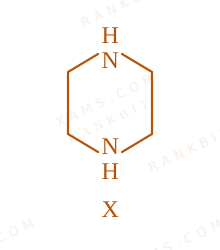
During estimation of nitrogen by Dumas' method of compound X (0.42 g):
The image shows the molecular skeletal architecture of compound X with structural parameters revealing a formula corresponding to a molecular mass of 86 g/mol.
mL of N2$N{2}$ gas will be liberated at STP. (nearest integer)
(Given molar mass in g mol: C: 12, H: 1, N: 14)
The image shows the molecular skeletal architecture of compound X with structural parameters revealing a formula corresponding to a molecular mass of 86 g/mol.
Numerical Answer Type:
Enter a numerical valueAnswer: 111 to 111+4 marks
Solution & Explanation
Related Formula
Using the Principle of Atom Conservation (POAC) for Nitrogen:
ncompound × (atoms of N per molecule) = 2 × nN₂$$n_{\text{compound}} \times (\text{atoms of N per molecule}) = 2 \times n_{\text{N}_2}$$
Core Logic
The molecular weight of the given heterocyclic amine organic structure X$X$ (piperazine, C₄H₁₀N₂$\text{C}_4\text{H}_{10}\text{N}_2$) is calculated as:
The image shows the molecular skeletal architecture of compound X with structural parameters revealing a formula corresponding to a molecular mass of 86 g/mol.
Given mass of compound = 0.42 g$= 0.42\text{ g}$:
Moles of compound X = (0.42)/(86) mol$$\text{Moles of compound } X = \frac{0.42}{86}\text{ mol}$$
Step 1: Calculating STP Volume
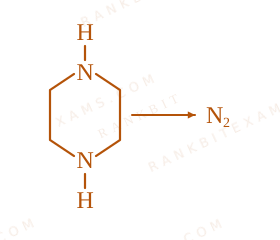
Since each molecule contains 2$2$ nitrogen atoms, 1 mol$1\text{ mol}$ of compound produces 1 mol$1\text{ mol}$ of N₂$\text{N}_2$ gas:
Using standard molar volume at STP (22700 mL/mol$22700\text{ mL/mol}$ per IUPAC convention, or 22400 mL/mol$22400\text{ mL/mol}$ in traditional calculations):
Volume of N₂ at STP = (0.42)/(86) × 22700 mL ≈ 110.86 mL ≈ 111 mL$$\text{Volume of } \text{N}_2\text{ at STP} = \frac{0.42}{86} \times 22700\text{ mL} \approx 110.86\text{ mL} \approx 111\text{ mL}$$
(Note: If calculated using 22400 mL/mol$22400\text{ mL/mol}$, Volume = (0.42)/(86) × 22400 ≈ 109.4 mL ≈ 109 mL$\text{Volume} = \frac{0.42}{86} \times 22400 \approx 109.4\text{ mL} \approx 109\text{ mL}$.)
Rounding to the nearest integer gives 111 (official accepted range: 109 to 111).
Pattern Recognition
Shortcut: Determine the molar mass (M = 86 g/mol$M = 86\text{ g/mol}$) and nitrogen atom count (2 N atoms 1 mol N₂ per mol of compound$2\text{ N atoms} \implies 1\text{ mol } \text{N}_2\text{ per mol of compound}$). Multiply moles directly by molar volume at STP to find the liberated gas volume.
Evaluation Rubric / Model Answer
111
Chapter Mix
Class 11 Chemistry: Organic Chemistry - Some Basic Principles and Techniques
The image shows the molecular skeletal architecture of compound X with structural parameters revealing a formula corresponding to a molecular mass of 86 g/mol.
Keywords:#Dumas method quantitative#Molar weight tracking#Nitrogen gas evolution
More Organic Chemistry - Some Basic Principles and Techniques Previous-Year Questions — Page 6
Qjee_main_2025_02_april_morningAromaticity and Huckel's Rule
Designate whether each of the following compounds is aromatic or not aromatic:
The diagram displays eight different cyclic conjugated hydrocarbon compounds labeled (a) through (h) to evaluate for aromatic character.
Choose the correct answer from the options given below:
A.(1) e, g aromatic and a, b, c, d, f, h not aromatic$\text{(1) e, g aromatic and a, b, c, d, f, h not aromatic}$
B.(2) b, e, f, g aromatic and a, c, d, h not aromatic$\text{(2) b, e, f, g aromatic and a, c, d, h not aromatic}$
C.(3) a, b, c, d aromatic and e, f, g, h not aromatic$\text{(3) a, b, c, d aromatic and e, f, g, h not aromatic}$
D.(4) a, c, d, e, h aromatic and b, f, g not aromatic$\text{(4) a, c, d, e, h aromatic and b, f, g not aromatic}$
Solution
Related Formula
According to Huckel's Rule, a planar, monocyclic, completely conjugated system is aromatic if it contains:
The diagram displays eight different cyclic conjugated hydrocarbon compounds labeled (a) through (h) to evaluate for aromatic character.The diagram displays eight different cyclic conjugated hydrocarbon compounds labeled (a) through (h) to evaluate for aromatic character.
Step 1: Classification
Hence, compounds a, c, d, e, and h follow Huckel's rule and are aromatic, whereas b, f, and g are not aromatic.
Pattern Recognition
Quick check for aromaticity: Count the pairs of localized/delocalized π$\pi$ electrons moving through the continuous loop. Odd number of pairs (1, 3, 5...) means aromatic (2π, 6π, 10π$2\pi, 6\pi, 10\pi$). Even pairs mean anti-aromatic/non-aromatic.
Chapter Mix
Class 11 Chemistry: Organic Chemistry - Some Basic Principles and Techniques
Class 11 Chemistry: Hydrocarbons
Consider the following compound (X)
arrayc I H - C ≡ C - C H _ 2 - C H - C H _ 3 I C H _ 3 array$$\begin{array}{c} \mathrm {I} \\ \mathrm {H} - \mathrm {C} \equiv \mathrm {C} - \mathrm {C H} _ {2} - \mathrm {C H} - \mathrm {C H} _ {3} \\ \mathrm {I} \\ \mathrm {C H} _ {3} \end{array}$$
The most stable and least stable carbon radicals, respectively, produced by homolytic cleavage of corresponding C - H$\mathrm{C - H}$ bond are :
Let's analyze individual cleavage points across the carbon backbone skeleton:
Position II yields a propargyl intermediate radical directly adjacent to the alkyne bond. This allows strong resonance stabilization across the π$\pi$ system, making it the most stable radical position.
Position I places the radical directly on an sp$\mathrm{sp}$-hybridized carbon center. The high electronegativity of sp$\mathrm{sp}$ orbitals tightly holds the unpaired electron, making homolytic cleavage extremely difficult and rendering this intermediate the least stable radical position.
Free Radical Stability
Step 1: Verdict
Therefore, the most stable and least stable positions are II and I, respectively.
Pattern Recognition
Radicals located on sp$\mathrm{sp}$ carbons (vinylic/alkynic) are highly unstable due to poor orbital overlap, while positions next to triple bonds (propargylic) are exceptionally stable due to active resonance delocalization.
Chapter Mix
Class 11 Chemistry: Organic Chemistry - Some Basic Principles and Techniques
Qjee_main_2025_02_april_morningNucleophilic Acyl Substitution and Hydrolysis
Consider the following molecules :
Nucleophilic Acyl Substitution and Hydrolysis
The correct order of rate of hydrolysis is :
A.(1) r > q > p > s$(1)\ r > q > p > s$
B.(2) q > p > r > s$(2)\ q > p > r > s$
C.(3) p > r > q > s$(3)\ p > r > q > s$
D.(4) p > q > r > s$(4)\ p > q > r > s$
Solution
Related Formula
The relative rate of nucleophilic acyl substitution follows the leaving group ability:
Rate of Hydrolysis ∝ Leaving Group Ability ∝ 1Basic Strength of Leaving Group$$\text{Rate of Hydrolysis} \propto \text{Leaving Group Ability} \propto \frac{1}{\text{Basic Strength of Leaving Group}}$$
Nucleophilic Acyl Substitution and Hydrolysis
Core Logic
Let's analyze the leaving groups across all choices layout-by-row:
For (p), the leaving group is Cl^-$\mathrm{Cl^-}$ (Very weak base, excellent leaving group).
For (q), the leaving group is RCOO^-$\mathrm{RCOO^-}$ (Resonance stabilized carboxylate, good leaving group).
For (r), the leaving group is RO^-$\mathrm{RO^-}$ (Alkoxide, strong base, poor leaving group).
For (s), the leaving group is NH₂^-$\mathrm{NH_2^-}$ (Extremely strong base, exceptionally poor leaving group due to nitrogen lone pair resonance into the carbonyl).
This structural comparison yields the final sequence: p > q > r > s$\mathrm{p > q > r > s}$.
Pattern Recognition
Acyl chlorides (p) are always the most reactive acid derivatives, while amides (s) are consistently the least reactive due to strong amide resonance stabilizing the carbonyl group.
Chapter Mix
Class 11 Chemistry: Organic Chemistry - Some Basic Principles and Techniques
Class 12 Chemistry: Aldehydes, Ketones and Carboxylic Acids
Q42jee_main_2025_02_april_morningEmpirical Formula Derivation
On complete combustion 1.0~g$1.0\mathrm{~g}$ of an organic compound (X) gave 1.46~g$1.46\mathrm{~g}$ of CO₂$\mathrm{CO}_{2}$ and 0.567~g$0.567\mathrm{~g}$ of H₂O$\mathrm{H}_{2}\mathrm{O}$. The empirical formula mass of compound (X) is ________ g.
Given molar mass in g · mol⁻¹ C:12, H:1, O:16$\mathrm{g \cdot mol^{-1}\ C:12,\ H:1,\ O:16}$
A.(1) 30$(1)\ 30$
B.(2) 45$(2)\ 45$
C.(3) 60$(3)\ 60$
D.(4) 15$(4)\ 15$
Solution
Related Formula
Elemental content calculation system equations:
Moles of C = Mass of CO₂44$$\text{Moles of C} = \frac{\text{Mass of } \mathrm{CO_2}}{44}$$Moles of H = 2 × Mass of H₂O18$$\text{Moles of H} = 2 \times \frac{\text{Mass of } \mathrm{H_2O}}{18}$$
Core Logic
Let's perform the stoichiometry layout step-by-step:
Moles of C$\mathrm{C}$ inside sample system:
nC = (1.46)/(44) = 0.033~mol$$\mathrm{n_C} = \frac{1.46}{44} = 0.033\mathrm{~mol}$$Mass of C = 0.033 × 12 = 0.396~g$$\text{Mass of C} = 0.033 \times 12 = 0.396\mathrm{~g}$$
Moles of H$\mathrm{H}$ inside sample system:
nH = 2 × (0.567)/(18) = 0.063~mol$$\mathrm{n_H} = 2 \times \frac{0.567}{18} = 0.063\mathrm{~mol}$$Mass of H = 0.063 × 1 = 0.063~g$$\text{Mass of H} = 0.063 \times 1 = 0.063\mathrm{~g}$$
Determine Oxygen mass by subtracting values from total starting mass:
Mass of O = 1.0 - (0.396 + 0.063) = 0.541~g$$\text{Mass of O} = 1.0 - (0.396 + 0.063) = 0.541\mathrm{~g}$$nO = (0.541)/(16) = 0.033~mol$$\mathrm{n_O} = \frac{0.541}{16} = 0.033\mathrm{~mol}$$
Find atomic whole-number ratio profile: C : H : O = 0.033 : 0.063 : 0.033 ≈ 1 : 2 : 1$\mathrm{C : H : O} = 0.033 : 0.063 : 0.033 \approx 1 : 2 : 1$.
This gives an empirical configuration of CH₂O$\mathrm{CH_2O}$.
When calculated mole properties output identical numbers for two elements (0.033$0.033$ for both C and O), their structural subscript ratio is exactly 1:1$1:1$. This pattern significantly speeds up empirical calculations.
Chapter Mix
Class 11 Chemistry: Organic Chemistry - Some Basic Principles and Techniques
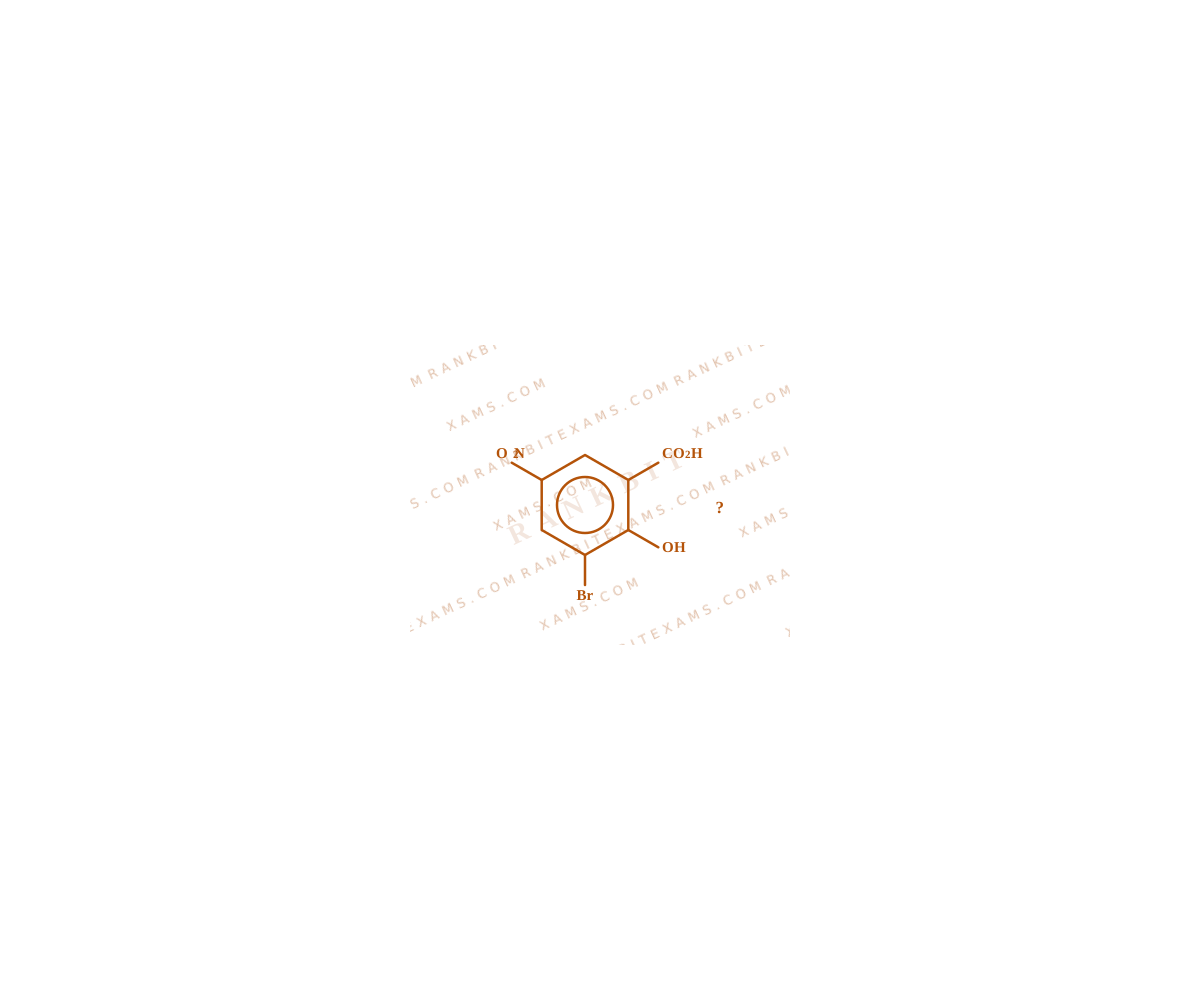
Qjee_main_2025_03_april_eveningIUPAC Nomenclature of Multi-substituted Benzenes
What is the correct IUPAC name of the compound given below? Substituted benzene derivative with carboxyl, hydroxyl, bromo, and nitro substituents.
A. 3-Bromo-2-hydroxy-5-nitrobenzoic acid
B. 3-Bromo-4-hydroxy-1-nitrobenzoic acid
C. 2-Hydroxy-3-bromo-5-nitrobenzoic acid
D. 5-Nitro-3-bromo-2-hydroxybenzoic acid
Solution
Related Formula
According to IUPAC rules for nomenclature of aromatic compounds:
Principal functional group has highest priority:
-COOH > -OH$$-\mathrm{COOH} > -\mathrm{OH}$$
The principal functional group carbon is designated as Carbon-1, and numbering is directed to give substituents the lowest possible locants.
Core Logic
Assign priority and number the ring:
Carbon-1: -COOH$-\mathrm{COOH}$ (Carboxyl carbon, parent name 'benzoic acid')
Carboxylic acid always dictates position 1 in ring numbering over alcohol. Numbering clockwise gives 2-hydroxy, 3-bromo, and 5-nitro, whereas counterclockwise numbering would yield much higher locants (2-nitro, 4-bromo, 5-hydroxy) which violates the lowest-locant rule.
Chapter Mix
Class 11 Chemistry: Organic Chemistry - Some Basic Principles and Techniques
Class 12 Chemistry: Aldehydes, Ketones and Carboxylic Acids
Practice past-year questions one chapter at a time. Pick an exam → subject → chapter and get every PYQ for that topic — pulled together from all past papers — with the chapter's key formulas alongside.
 "Dumas method quantitative, Molar weight tracking, Nitrogen gas evolution")
 "Dumas method quantitative, Molar weight tracking, Nitrogen gas evolution")
.svg "molecular structures, conjugated ring systems, Huckel rule analysis")
.svg "molecular structures, conjugated ring systems, Huckel rule analysis")
.svg "molecular structures, conjugated ring systems, Huckel rule analysis")
.svg)
.svg)
.svg)