Organic Chemistry - Some Basic Principles and Techniques appeared 101 times across 3 years — 11.8% of Chemistry.
This question is from Quantitative Analysis - Dumas Method.
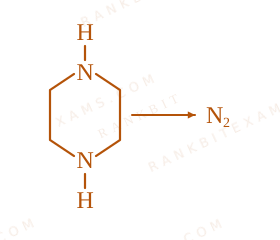
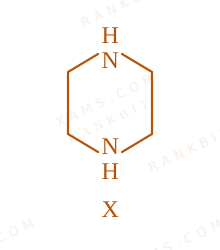
During estimation of nitrogen by Dumas' method of compound X (0.42 g):
The image shows the molecular skeletal architecture of compound X with structural parameters revealing a formula corresponding to a molecular mass of 86 g/mol.
mL of N2$N{2}$ gas will be liberated at STP. (nearest integer)
(Given molar mass in g mol: C: 12, H: 1, N: 14)
The image shows the molecular skeletal architecture of compound X with structural parameters revealing a formula corresponding to a molecular mass of 86 g/mol.
Numerical Answer Type:
Enter a numerical valueAnswer: 111 to 111+4 marks
Solution & Explanation
Related Formula
Using the Principle of Atom Conservation (POAC) for Nitrogen:
ncompound × (atoms of N per molecule) = 2 × nN₂$$n_{\text{compound}} \times (\text{atoms of N per molecule}) = 2 \times n_{\text{N}_2}$$
Core Logic
The molecular weight of the given heterocyclic amine organic structure X$X$ (piperazine, C₄H₁₀N₂$\text{C}_4\text{H}_{10}\text{N}_2$) is calculated as:
The image shows the molecular skeletal architecture of compound X with structural parameters revealing a formula corresponding to a molecular mass of 86 g/mol.
Given mass of compound = 0.42 g$= 0.42\text{ g}$:
Moles of compound X = (0.42)/(86) mol$$\text{Moles of compound } X = \frac{0.42}{86}\text{ mol}$$
Step 1: Calculating STP Volume
Since each molecule contains 2$2$ nitrogen atoms, 1 mol$1\text{ mol}$ of compound produces 1 mol$1\text{ mol}$ of N₂$\text{N}_2$ gas:
Using standard molar volume at STP (22700 mL/mol$22700\text{ mL/mol}$ per IUPAC convention, or 22400 mL/mol$22400\text{ mL/mol}$ in traditional calculations):
Volume of N₂ at STP = (0.42)/(86) × 22700 mL ≈ 110.86 mL ≈ 111 mL$$\text{Volume of } \text{N}_2\text{ at STP} = \frac{0.42}{86} \times 22700\text{ mL} \approx 110.86\text{ mL} \approx 111\text{ mL}$$
(Note: If calculated using 22400 mL/mol$22400\text{ mL/mol}$, Volume = (0.42)/(86) × 22400 ≈ 109.4 mL ≈ 109 mL$\text{Volume} = \frac{0.42}{86} \times 22400 \approx 109.4\text{ mL} \approx 109\text{ mL}$.)
Rounding to the nearest integer gives 111 (official accepted range: 109 to 111).
Pattern Recognition
Shortcut: Determine the molar mass (M = 86 g/mol$M = 86\text{ g/mol}$) and nitrogen atom count (2 N atoms 1 mol N₂ per mol of compound$2\text{ N atoms} \implies 1\text{ mol } \text{N}_2\text{ per mol of compound}$). Multiply moles directly by molar volume at STP to find the liberated gas volume.
Evaluation Rubric / Model Answer
111
Chapter Mix
Class 11 Chemistry: Organic Chemistry - Some Basic Principles and Techniques
The image shows the molecular skeletal architecture of compound X with structural parameters revealing a formula corresponding to a molecular mass of 86 g/mol.
Keywords:#Dumas method quantitative#Molar weight tracking#Nitrogen gas evolution
More Organic Chemistry - Some Basic Principles and Techniques Previous-Year Questions — Page 2
Q68jee_main_2026_21_jan_eveningHybridization, Chiral Centers, and Functional Groups
Given below are two statements:
Statement I: Compound (X), shown below, dissolves in NaHCO₃$\text{NaHCO}_3$ solution and has two chiral carbon atoms.
Structures of compound X and compound Y containing functional groups and chiral centers.
Statement II: Compound (Y), shown below, has two carbons with sp³$sp^3$ hybridization, one carbon with sp²$sp^2$ and one carbon with sp$sp$ hybridization.
Structures of compound X and compound Y containing functional groups and chiral centers.
In the light of the above statements, choose the correct answer from the options given below:
A.(1) Statement I is true but Statement II is false$(1) \text{ Statement I is true but Statement II is false}$
B.(2) Statement I is false but Statement II is true$(2) \text{ Statement I is false but Statement II is true}$
C.(3) Both Statement I and Statement II are true$(3) \text{ Both Statement I and Statement II are true}$
D.(4) Both Statement I and Statement II are false$(4) \text{ Both Statement I and Statement II are false}$
Solution
Core Logic
Statement I: Compound X contains a carboxylic acid group (which dissolves in NaHCO₃$\text{NaHCO}_3$) and possesses two chiral centers. Thus Statement I is true.
Statement II: Compound Y has specific carbon hybridization states matching sp³$sp^3$, sp²$sp^2$, and sp$sp$ carbons. Thus Statement II is true.
Step 1: Final Conclusion
Both Statement I and Statement II are true, matching option (3).
Pattern Recognition
Sees: identification of chiral centers and carbon hybridization in organic molecules.
Trap: Overlooking carboxylic acid solubility requirements in NaHCO₃$\text{NaHCO}_3$.
Chapter Mix
Class 11 Chemistry: Organic Chemistry - Some Basic Principles and Techniques
Sodium fusion extract of an organic compound (Y) with CHCl₃$CHCl_{3}$ and chlorine water gives violet color to the CHCl₃$CHCl_{3}$ layer. 0.15g of (Y) gave 0.12 g of the silver halide precipitate in Carius method. Percentage of halogen in the compound (Y) is ____. (Nearest integer).
(Given: molar mass g mol⁻¹$g\text{ mol}^{-1}$ C: 12, H: 1, Cl: 35.5, Br: 80, I: 127)
Numerical Answer.Answer: 43 to 43
Solution
Related Formula
% of Halogen (I) = Atomic weight of IMolecular weight of AgI × Mass of AgIMass of organic compound × 100$$\% \text{ of Halogen (I)} = \frac{\text{Atomic weight of I}}{\text{Molecular weight of AgI}} \times \frac{\text{Mass of AgI}}{\text{Mass of organic compound}} \times 100$$
Core Logic
Identify the halogen: The violet color in the chloroform layer upon addition of chlorine water is the classic test for Iodine (I₂$I_2$). Chlorine oxidizes I^-$I^-$ to I₂$I_2$, which dissolves in CHCl₃$CHCl_3$ with a violet/purple color.
Molar mass calculations:
Atomic weight of I = 127
Molar mass of AgI = 108 (Ag) + 127 (I) = 235 g mol⁻¹$108 (Ag) + 127 (I) = 235\text{ g mol}^{-1}$. (Since Ag is not provided in data, assume standard 108. The PDF explicitly uses 235).
Step 1: Apply Carius Method Formula
Given:
Mass of organic compound (w$w$) = 0.15 g
Mass of AgI precipitate (m$m$) = 0.12 g
% of I = (127)/(235) × (0.12)/(0.15) × 100$$\% \text{ of I} = \frac{127}{235} \times \frac{0.12}{0.15} \times 100$$% of I = (127)/(235) × 0.8 × 100$$\% \text{ of I} = \frac{127}{235} \times 0.8 \times 100$$% of I = 0.5404 × 80 = 43.234%$$\% \text{ of I} = 0.5404 \times 80 = 43.234\%$$
Step 2: Rounding
The nearest integer to 43.23 is 43.
Pattern Recognition
Always use the qualitative test (chloroform layer color) to definitively identify the halogen before executing the quantitative Carius formula.
Chapter Mix
Class 11 Chemistry: Organic Chemistry Some Basic Principles and Techniques
When 1 g$1\text{ g}$ of compound (X) is subjected to Kjeldahl's method for estimation of nitrogen, 15 mL$15\text{ mL}$, 1M H₂SO₄$1\text{M } \text{H}_2\text{SO}_4$ was neutralized by ammonia evolved. The percentage of nitrogen in compound (X) is:
A. 21
B. 0.42
C. 42
D. 0.21
Solution
Related Formula
% N = 1.4 × M × 2 × VMass of compound (g)$$\%\text{ N} = \frac{1.4 \times M \times 2 \times V}{\text{Mass of compound (g)}}$$
Alternatively:
Meq of H₂SO₄ = V × M × nfactor$$\text{Meq of } \text{H}_2\text{SO}_4 = V \times M \times n_{\text{factor}}$$
Core Logic
Step 1: Calculate equivalents of acid neutralized:
Moles of NH₃ = 0.03 Moles of N = 0.03$$\text{Moles of } \text{NH}_3 = 0.03 \implies \text{Moles of N} = 0.03$$Mass of N = 0.03 × 14 = 0.42 g$$\text{Mass of N} = 0.03 \times 14 = 0.42\text{ g}$$
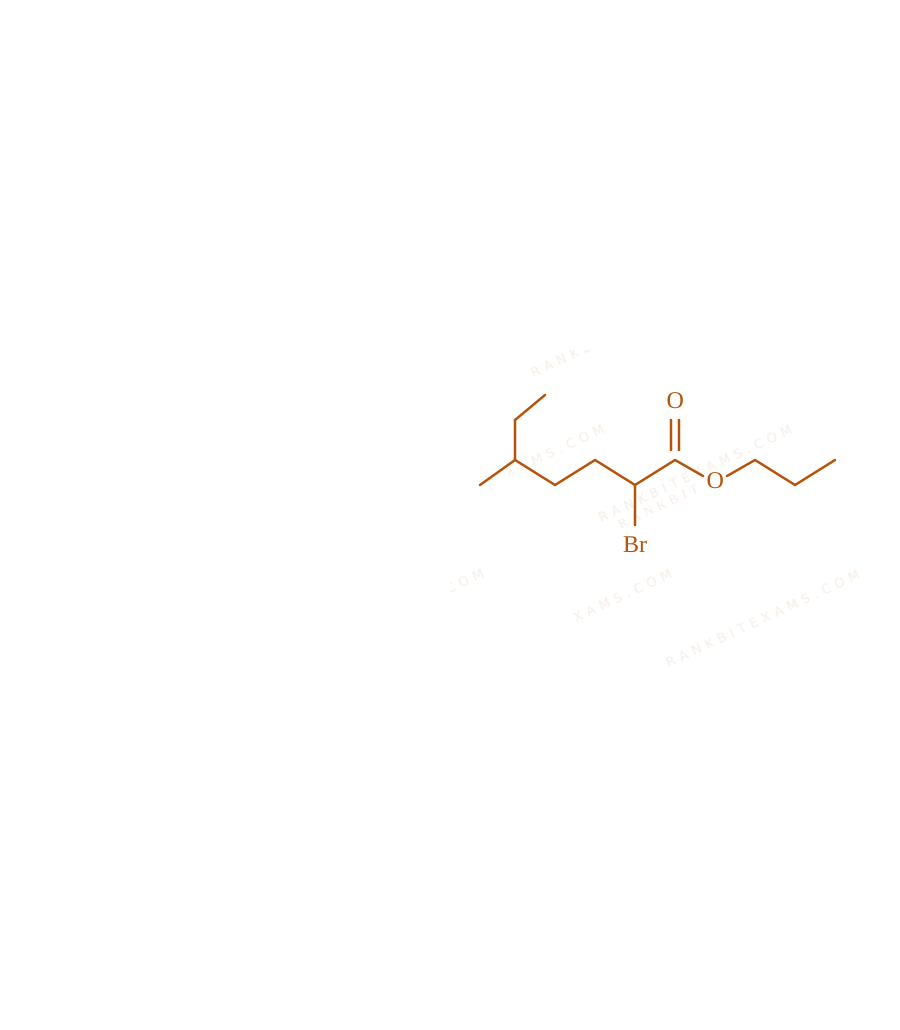
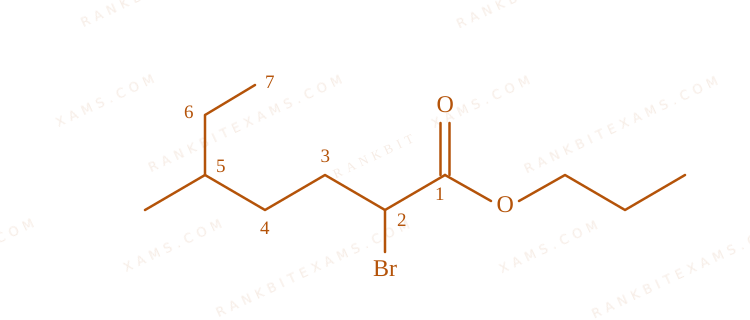
Step 1: Identify the alkyl group attached to oxygen: n-propyl$n\text{-propyl}$.
Step 2: Number the longest carbon chain containing the ester carbonyl carbon from C1 to C7.
Step 3: Substituents present: Br at C2 and Methyl at C5.
Step 4: Combine into IUPAC name: n-propyl-2-bromo-5-methylheptanoate.
Displays a branched halogenated ester compound requiring IUPAC systematic numbering.
Pattern Recognition
Sees: Ester esterified with propyl alcohol and heptanoate chain.
Shortcut: Always start naming ester with alkyl group attached to oxygen (n-propyl), followed by numbered parent carboxylate chain.
Chapter Mix
Class 11 Chemistry: Organic Chemistry - Some Basic Principles & Techniques
Q66jee_main_2026_23_january_morningQualitative Analysis of Organic Compounds
Recall standard qualitative laboratory tests for functional groups:
(A) Unsaturation (Baeyer's Test): Dilute alkaline KMnO₄$KMnO_4$ is pink. When it reacts with an alkene/alkyne, it gets reduced to MnO₂$MnO_2$ (brown ppt), discharging the pink colour. Matches with (IV).
(B) Alcoholic group: Primary and secondary alcohols react with Ceric ammonium nitrate to form a red-coloured coordination complex. Matches with (I).
(C) Aldehyde group (Tollens' Test): Aldehydes reduce Tollens' reagent ([Ag(NH₃)₂]^+$[Ag(NH_3)_2]^+$) to metallic silver, forming a silver mirror. Matches with (II).
(D) Phenolic group: Phenols form strongly colored (often violet) complexes with neutral FeCl₃$FeCl_3$. Matches with (III).
Practice past-year questions one chapter at a time. Pick an exam → subject → chapter and get every PYQ for that topic — pulled together from all past papers — with the chapter's key formulas alongside.
 "Dumas method quantitative, Molar weight tracking, Nitrogen gas evolution")
 "Dumas method quantitative, Molar weight tracking, Nitrogen gas evolution")