JEE Main · Chemistry ↓ Falling

d-and f-Block Elements appeared 45 times across 3 years — 5.2% of Chemistry. This question is from Magnetic Properties of Transition Elements.

Year 2026 2025 2024 Total
Questions 10 18 17 45

The metal ions that have the calculated spin only magnetic moment value of 4.9 B.M. are: A. Cr²⁺ B. Fe²⁺ C. Fe³⁺ D. Co²⁺ E. Mn³⁺ Choose the correct answer from the options given below:

Solution & Explanation

Related Formula
μspin-only = √(n(n + 2)) B.M.
Core Logic

For μ = 4.9 B.M., solve for n:

4.9 = √(n(n + 2)) n(n + 2) ≈ 24 n = 4

Thus, the metal ion must have 4 unpaired electrons.

Step 1: Electronic Configurations

A. Cr²⁺: [Ar] 3d⁴ 4 unpaired electrons.

B. Fe²⁺: [Ar] 3d⁶ 4 unpaired electrons.

C. Fe³⁺: [Ar] 3d⁵ 5 unpaired electrons.

D. Co²⁺: [Ar] 3d⁷ 3 unpaired electrons.

E. Mn³⁺: [Ar] 3d⁴ 4 unpaired electrons.

Therefore, Cr²⁺, Fe²⁺, and Mn³⁺ (A, B, and E) have 4 unpaired electrons.

Pattern Recognition

Magnetic moment ~4.9 B.M. arrow n = 4 unpaired electrons. 3d⁴ and 3d⁶ high-spin ions always have n = 4.

Chapter Mix

Class 12 Chemistry: d- and f-Block Elements

Reference Study Guides

More d- and f-Block Elements Previous-Year Questions — Page 8

Q63 jee_main_2024_29_jan_morning Potassium Dichromate and Chromyl Chloride Test
In chromyl chloride test for confirmation of Cl^- ion, a yellow solution is obtained. Acidification of the solution and addition of amyl alcohol and 10% H₂O₂ turns organic layer blue indicating formation of chromium pentoxide. The oxidation state of chromium in that is
  • A. +6
  • B. +5
  • C. +10
  • D. +3

Solution

Core Logic

The reaction sequence for the chromyl chloride test is:

Cl^- + K₂Cr₂O₇ + H₂SO₄ arrow CrO₂Cl₂

The chromyl chloride gas is then passed through a basic medium (like NaOH) to form a yellow solution of chromate ions:

CrO₂Cl₂ Basic medium CrO₄²⁻ + Cl^-

Acidification of the yellow CrO₄²⁻ solution followed by the addition of H₂O₂ and amyl alcohol yields a blue-colored organic layer due to the formation of chromium pentoxide (CrO₅).

CrO₄²⁻ [yellow solution, 1. Acidification CrO₅ (blue compound)

Step 1: Oxidation State Calculation
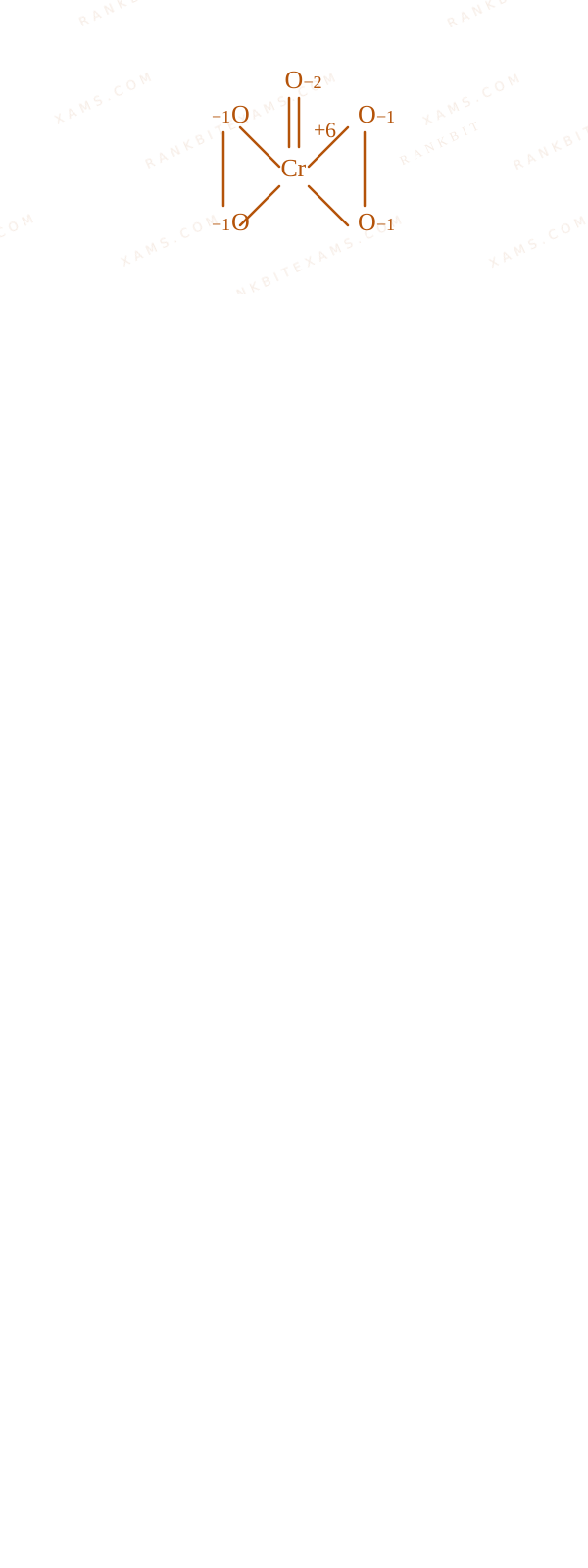
Potassium Dichromate and Chromyl Chloride Test diagram for Q63 - JEE Main 2024 Morning

The structure of chromium pentoxide (CrO₅) features a distinctive "butterfly" arrangement. It contains one double-bonded oxide oxygen (O²⁻) and four peroxide oxygens (O₂²⁻). Therefore, there are 2 peroxo linkages.

Let the oxidation state of Chromium be x.

x + 1(-2) + 4(-1) = 0

x - 2 - 4 = 0 x = +6

Thus, the oxidation state of Cr in CrO₅ is +6.

Pattern Recognition

A classic oxidation state trap. Calculating simply via formula CrO₅ yields x - 10 = 0 x = +10, which is impossible for Chromium (max +6). Whenever calculation exceeds the maximum group valency, peroxide bonds are present.

Chapter Mix

Class 12 Chemistry: d and f Block Elements Class 11 Chemistry: Redox Reactions
Q80 jee_main_2024_29_jan_morning Potassium Permanganate Reactions
In alkaline medium. MnO₄^- oxidises I^- to
  • A. IO₄^-
  • B. IO^-
  • C. I₂
  • D. IO₃^-

Solution

Core Logic

The behavior of the permanganate ion (MnO₄^-) varies with the pH of the medium. In a faintly alkaline or neutral medium, MnO₄^- oxidizes iodide (I^-) completely to iodate (IO₃^-) while getting reduced to manganese dioxide (MnO₂).

The balanced ionic equation is:

2MnO₄^- + H₂O + I^- arrow 2MnO₂ + 2OH^- + IO₃^-
Pattern Recognition

Rule of thumb for I^- oxidation by KMnO₄: In acidic medium: I^- arrow I₂ In alkaline/neutral medium: I^- arrow IO₃^-

Chapter Mix

Class 12 Chemistry: d and f Block Elements

Q jee_main_2024_30_january_evening Compounds of Transition Elements
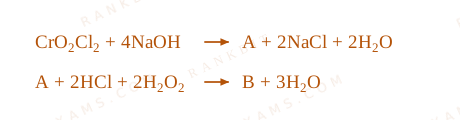
A and B formed in the following reactions are:
Compounds of Transition Elements
  • A. A = Na₂CrO₄, B = CrO₅
  • B. A = Na₂Cr₂O₄, B = CrO₄
  • C. A = Na₂Cr₂O₇, B = CrO₃
  • D. A = Na₂Cr₂O₇, B = CrO₅

Solution

Core Logic

Step 1: Chromyl chloride (CrO₂Cl₂) reacts with an alkali like NaOH to give a yellow solution of sodium chromate (Na₂CrO₄).

CrO₂Cl₂ + 4NaOH arrow Na₂CrO₄ (A) + 2NaCl + 2H₂O

Step 2: Sodium chromate (Na₂CrO₄) reacts with hydrogen peroxide (H₂O₂) in an acidic medium (HCl) to yield the deep blue colored chromium pentoxide (CrO₅, also known as chromium(VI) oxide peroxide).

Na₂CrO₄ + 2H₂O₂ + 2HCl arrow CrO₅ (B) + 2NaCl + 3H₂O

Note: NaCl formation implies the overall balanced reaction uses the acid for neutralization/salt formation.

Pattern Recognition

Chromyl chloride test intermediate: Yellow solution = Na₂CrO₄. Reaction of chromate with H₂O₂ in acid = Blue peroxide CrO₅ (butterfly structure).

Chapter Mix

Class 12 Chemistry: The d and f Block Elements Class 11 Chemistry: Redox Reactions

Q70 jee_main_2024_30_january_evening Properties of Transition Metal Compounds
The orange colour of K₂Cr₂O₇ and purple colour of KMnO₄ is due to
  • A. Charge transfer transition in both.
  • B. d arrow d transition in KMnO₄ and charge transfer transitions in K₂Cr₂O₇
  • C. d arrow d transition in K₂Cr₂O₇ and charge transfer transitions in KMnO₄.
  • D. d arrow d transition in both.

Solution

Core Logic

In K₂Cr₂O₇, Chromium is in the +6 oxidation state, which means its electronic configuration is d⁰. Since there are no d-electrons, d-d transitions cannot occur. The orange color is due to ligand-to-metal charge transfer (LMCT) from oxygen to chromium.

Similarly, in KMnO₄, Manganese is in the +7 oxidation state, which also corresponds to a d⁰ configuration. Again, no d-d transitions are possible. The intense purple color is due to ligand-to-metal charge transfer (LMCT) from oxygen to manganese.

Step 1: Final Conclusion

Both compounds owe their colors to charge transfer transitions.

Pattern Recognition

Compounds of transition metals in their highest oxidation states (where they have d⁰ configurations, like Cr⁺⁶, Mn⁺⁷, V⁺⁵) are deeply colored primarily due to Charge Transfer spectra, NOT d-d transitions.

Chapter Mix

Class 12 Chemistry: The d and f Block Elements

Q71 jee_main_2024_30_january_evening Preparation and Properties of KMnO4
Alkaline oxidative fusion of MnO₂ gives "A" which on electrolytic oxidation in alkaline solution produces B. A and B respectively are:
  • A. Mn₂O₇ and MnO₄^-
  • B. MnO₄²⁻ and MnO₄^-
  • C. Mn₂O₃ and MnO₄²⁻
  • D. MnO₄²⁻ and Mn₂O₇

Solution

Core Logic

Step 1: Alkaline oxidative fusion of MnO₂ (pyrolusite ore) with KOH in the presence of O₂ (or an oxidizing agent like KNO₃) yields the green-colored manganate ion (MnO₄²⁻).

2MnO₂ + 4OH^- + O₂ arrow 2MnO₄²⁻ + 2H₂O

So, A is MnO₄²⁻.

Step 2: Electrolytic oxidation of the manganate ion (MnO₄²⁻) in an alkaline medium converts it to the purple-colored permanganate ion (MnO₄^-).

MnO₄²⁻ arrow MnO₄^- + e^-

So, B is MnO₄^-.

Pattern Recognition

Industrial preparation sequence of KMnO₄: MnO₂ fusion, KOH, O₂ MnO₄²⁻ (green) electrolytic oxidation MnO₄^- (purple).

Chapter Mix

Class 12 Chemistry: The d and f Block Elements

More d- and f-Block Elements Questions — jee_main_2025_03_april_morning

Practice all d- and f-Block Elements previous-year questions →

Rankbit System
JEE Physics: Waves (+15.5%) | Electrostatics: Concentric Shells (-29.7%) | Modern Physics: Photoelectric Clones (+34.2%) | Mathematics: Definite Integrals (+18.1%) | Chemistry: Coordination Splitting (-11.4%) | JEE Physics: Waves (+15.5%) | Electrostatics: Concentric Shells (-29.7%) | Modern Physics: Photoelectric Clones (+34.2%) | Mathematics: Definite Integrals (+18.1%) | Chemistry: Coordination Splitting (-11.4%)