JEE Main · Chemistry ↓ Falling

d-and f-Block Elements appeared 44 times across 3 years — 5.1% of Chemistry. This question is from Potassium Dichromate - Preparation and Structure.

Year 2026 2025 2024 Total
Questions 10 17 17 44

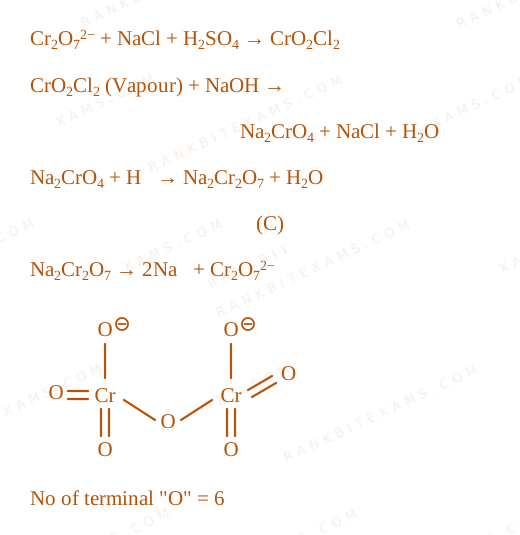
Consider the following reactions: A + NaCl + H₂SO₄ arrow CrO₂Cl₂ + Side Products CrO₂Cl₂(vapour) + NaOH arrow B + NaCl + H₂O B + H^+ arrow C + H₂O The number of terminal 'O' present in the compound 'C' is ______

Numerical Answer Type:
Enter a numerical value Answer: 6 to 6 +4 marks

Solution & Explanation

Core Logic

Let us identify the sequential chemical components via the chromyl chloride test pathway:

  • Reactant A represents a dichromate salt such as K₂Cr₂O₇. Heating it with a metal chloride and concentrated sulfuric acid generates deep red chromyl chloride vapors (CrO₂Cl₂).
  • Passing these vapors into sodium hydroxide dissolves them, producing yellow sodium chromate compound B (Na₂CrO₄).
  • Acidifying the chromate solution dimerizes it into orange sodium dichromate compound C (Na₂Cr₂O₇).
Step 1: Structural Analysis of Dichromate

The dichromate ion (Cr₂O₇²⁻) consists of two tetrahedral chromium units sharing a single bridging oxygen atom (Cr-O-Cr). Each chromium atom retains 3 localized terminal oxygen atoms:

Total terminal 'O' atoms = 7 - 1 = 6

Thus, the total count of terminal oxygen atoms present in compound C is 6.

Dichromate structural topology breakdown diagram for Q50

Pattern Recognition

Shortcut: The chromyl chloride sequence moves from dichromate arrow chromate arrow dichromate. In the dichromate ion (Cr₂O₇²⁻), out of the 7 oxygen atoms, exactly 1 is bridging, leaving 7 - 1 = 6 terminal oxygen atoms.

Evaluation Rubric / Model Answer

6

Chapter Mix

Class 12 Chemistry: d- and f-Block Elements

Dichromate structural topology breakdown diagram for Q50

More d- and f-Block Elements Previous-Year Questions — Page 5

Q35 jee_main_2025_24_jan_evening Magnetic Properties of Transition Metals
Match List-I with List-II.
List-I (Transition metal ion)List-II (Spin only magnetic moment (B.M.))
(A) Ti³⁺(I) 3.87
(B) V²⁺(II) 0.00
(C) Ni²⁺(III) 1.73
(D) Sc³⁺(IV) 2.84
Choose the correct answer from the options given below :
  • A. \text{(A)-(III), (B)-(I), (C)-(II), (D)-(IV)}
  • B. \text{(A)-(III), (B)-(I), (C)-(IV), (D)-(II)}
  • C. \text{(A)-(IV), (B)-(II), (C)-(III), (D)-(I)}
  • D. \text{(A)-(II), (B)-(IV), (C)-(I), (D)-(III)}

Solution

Related Formula
μ = √(n(n+2)) B.M.

where n represents the number of unpaired electrons.

Core Logic

Let's calculate the number of unpaired d-electrons (n) and the resulting spin-only magnetic moment for each transition metal ion:

  • (A) Ti³⁺:
  • Electronic configuration = [Ar] 3d¹ arrow n = 1

μ = √(1(1+2)) = √(3) ≈ 1.73 B.M. arrow (III)
  • (B) V²⁺:
  • Electronic configuration = [Ar] 3d³ arrow n = 3

μ = √(3(3+2)) = √(15) ≈ 3.87 B.M. arrow (I)
  • (C) Ni²⁺:
  • Electronic configuration = [Ar] 3d⁸. The 3d subshell has 3 paired orbitals and 2 unpaired orbitals arrow n = 2

μ = √(2(2+2)) = √(8) ≈ 2.84 B.M. arrow (IV)
  • (D) Sc³⁺:
  • Electronic configuration = [Ar] 3d⁰ arrow n = 0

μ = 0.00 B.M. arrow (II)

Matching these values yields the sequence: (A)-(III), (B)-(I), (C)-(IV), (D)-(II).

Pattern Recognition

Shortcut: The digit before the decimal point in a spin-only magnetic moment matches the number of unpaired electrons (n). For example, a value of 3.87 B.M. means there are exactly 3 unpaired electrons.

Chapter Mix

Class 12 Chemistry: The d- and f-Block Elements

Q31 jee_main_2025_24_jan_morning Lanthanoids Oxidation States
Which of the following ions is the strongest oxidizing agent? [Atomic Number of Ce=58, Eu=63, Tb=65, Lu=71]
  • A. Lu³⁺
  • B. Eu²⁺
  • C. Tb⁴⁺
  • D. Ce³⁺

Solution

Core Logic

The most common and chemically robust oxidation state for lanthanoid elements is +3. Consequently, ions existing in unstable +4 oxidation states exhibit a pronounced thermodynamic driving force to capture electrons and revert to the +3 form.

Among the options, Tb⁴⁺ acts as a potent oxidizing agent due to this stability drive.

Pattern Recognition

Ln⁴⁺ forms naturally act as electron grabbers to sink back into the thermodynamic sweet spot of +3 states.

Chapter Mix

Class 12 Chemistry: The d-and f-Block Elements

Q37 jee_main_2025_24_jan_morning Preparation and Properties of Potassium Permanganate
Preparation of potassium permanganate from MnO₂ involves two step process in which the 1st step is a reaction with KOH and KNO₃ to produce
  • A. K₄[Mn(OH)₆]
  • B. K₃MnO₄
  • C. KMnO₄
  • D. K₂MnO₄

Solution

Related Formula
2MnO₂ + 4KOH + O₂ KNO₃ 2K₂MnO₄ + 2H₂O
Core Logic

The standard preparation of potassium permanganate begins with the oxidative fusion of pyrolusite ore (MnO₂). Fusing the solid reactant directly along an alkaline base payload (KOH) combined explicitly with an oxidizing carrier (KNO₃) yields the intermediate green product, potassium manganate (K₂MnO₄).

Pattern Recognition

Step 1 yields the +6 green compound (K₂MnO₄); the subsequent Step 2 steps oxidize this intermediate to synthesize the target deep purple +7 agent (KMnO₄).

Chapter Mix

Class 12 Chemistry: The d-and f-Block Elements

Q27 jee_main_2025_28_jan_evening Oxides and Oxoanions of Transition Metals
The amphoteric oxide among V₂O₃, V₂O₄ and V₂O₅ upon reaction with alkali leads to formation of an oxide anion. The oxidation state of V in the oxide anion is :
  • A. +3
  • B. +7
  • C. +5
  • D. +4

Solution

Related Formula

Oxidation state equation for an oxoanion VO₄³⁻:

x + 4(-2) = -3

Core Logic

Among the given oxides of Vanadium:

  • V₂O₃ is basic.
  • V₂O₄ is less basic / amphoteric.
  • V₂O₅ is predominantly amphoteric (reacts with both acids and alkalies).
  • When V₂O₅ reacts with an alkali, it forms the orthovanadate ion (VO₄³⁻).

Step 1: Finding the Oxidation State

In VO₄³⁻ ion:

x - 8 = -3 x = +5

Thus, the oxidation state of Vanadium in the resulting oxide anion is +5.

Pattern Recognition

As the oxidation state of a transition metal increases, its oxide shifts from basic to amphoteric to acidic. V₂O₅ has the highest oxidation state (+5) here and dissolves in alkali to retain its +5 oxidation state in VO₄³⁻.

Chapter Mix

Class 12 Chemistry: d- and f-Block Elements

Q46 jee_main_2025_28_jan_evening Magnetic Properties and Oxidation States
The spin only magnetic moment (μ) value (B.M.) of the compound with strongest oxidising power among Mn₂O₃, TiO and VO is ______ B.M. (Nearest integer).
Numerical Answer. Answer: 5 to 5

Solution

Related Formula

Spin-only magnetic moment expression:

μ = √(n(n+2)) B.M.
Core Logic

Evaluating the oxidation states and stability profiles:

  • In TiO: Ti²⁺
  • In VO: V²⁺
  • In Mn₂O₃: Mn³⁺
  • Mn³⁺ possesses a very high reduction potential (E^°Mn³⁺/Mn²⁺ = +1.57 V), making it an exceptionally strong oxidizing agent because it easily gains an electron to form stable Mn²⁺ (d⁵ configuration).

Step 1: Calculate the Magnetic Moment of Mn(III)

Electronic configuration of Mn³⁺:

Mn³⁺ = [Ar]3d⁴ n = 4 unpaired electrons

Calculating the spin-only magnetic moment:

μ = √(4(4+2)) = √(24) ≈ 4.89 B.M.
Step 2: Rounding to Nearest Integer

Rounding 4.89 B.M. to the nearest integer gives 5.

Pattern Recognition

High reduction potentials are strongly tied to manganese in its +3 oxidation state. To quickly estimate magnetic moments, remember that a system with n unpaired electrons always results in a value of 'n.something' B.M. Thus, 4 unpaired electrons arrow 4.89 B.M., which rounds up to 5.

Chapter Mix

Class 12 Chemistry: d- and f-Block Elements

Rankbit System
JEE Physics: Waves (+15.5%) | Electrostatics: Concentric Shells (-29.7%) | Modern Physics: Photoelectric Clones (+34.2%) | Mathematics: Definite Integrals (+18.1%) | Chemistry: Coordination Splitting (-11.4%) | JEE Physics: Waves (+15.5%) | Electrostatics: Concentric Shells (-29.7%) | Modern Physics: Photoelectric Clones (+34.2%) | Mathematics: Definite Integrals (+18.1%) | Chemistry: Coordination Splitting (-11.4%)