JEE Main · Chemistry ↓ Falling

d-and f-Block Elements appeared 44 times across 3 years — 5.1% of Chemistry. This question is from Potassium Dichromate - Preparation and Structure.

Year 2026 2025 2024 Total
Questions 10 17 17 44

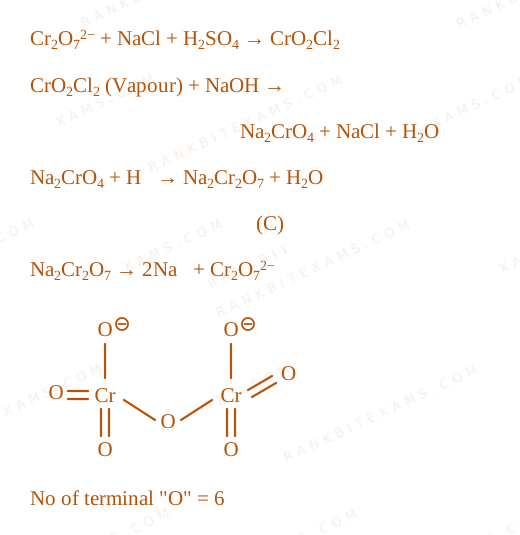
Consider the following reactions: A + NaCl + H₂SO₄ arrow CrO₂Cl₂ + Side Products CrO₂Cl₂(vapour) + NaOH arrow B + NaCl + H₂O B + H^+ arrow C + H₂O The number of terminal 'O' present in the compound 'C' is ______

Numerical Answer Type:
Enter a numerical value Answer: 6 to 6 +4 marks

Solution & Explanation

Core Logic

Let us identify the sequential chemical components via the chromyl chloride test pathway:

  • Reactant A represents a dichromate salt such as K₂Cr₂O₇. Heating it with a metal chloride and concentrated sulfuric acid generates deep red chromyl chloride vapors (CrO₂Cl₂).
  • Passing these vapors into sodium hydroxide dissolves them, producing yellow sodium chromate compound B (Na₂CrO₄).
  • Acidifying the chromate solution dimerizes it into orange sodium dichromate compound C (Na₂Cr₂O₇).
Step 1: Structural Analysis of Dichromate

The dichromate ion (Cr₂O₇²⁻) consists of two tetrahedral chromium units sharing a single bridging oxygen atom (Cr-O-Cr). Each chromium atom retains 3 localized terminal oxygen atoms:

Total terminal 'O' atoms = 7 - 1 = 6

Thus, the total count of terminal oxygen atoms present in compound C is 6.

Dichromate structural topology breakdown diagram for Q50

Pattern Recognition

Shortcut: The chromyl chloride sequence moves from dichromate arrow chromate arrow dichromate. In the dichromate ion (Cr₂O₇²⁻), out of the 7 oxygen atoms, exactly 1 is bridging, leaving 7 - 1 = 6 terminal oxygen atoms.

Evaluation Rubric / Model Answer

6

Chapter Mix

Class 12 Chemistry: d- and f-Block Elements

Dichromate structural topology breakdown diagram for Q50

More d- and f-Block Elements Previous-Year Questions — Page 3

Q39 jee_main_2025_03_april_evening Oxidation States and Stability of Transition Metals
Given below are two statements: Statement I: CrO₃ is a stronger oxidizing agent than MoO₃. Statement II: Cr(VI) is more stable than Mo(VI). In the light of the above statements, choose the correct answer from the options given below :
  • A. Statement I is false but Statement II is true
  • B. Statement I is true but Statement II is false
  • C. Both Statement I and Statement II are true
  • D. Both Statement I and Statement II are false

Solution

Related Formula

In transition metal groups:

  • Stability of higher oxidation states increases down the group:
Stability: Cr(VI) < Mo(VI) < W(VI)
  • Oxidizing power is inversely proportional to the stability of the high oxidation state.
Core Logic

Statement I Analysis:

  • Since Cr(VI) is less stable than Mo(VI), chromium is easily reduced from +6 to +3, making CrO₃ a much stronger oxidizing agent than MoO₃. Statement I is True.
Step 1: Analyze Statement II
  • Statement II asserts that Cr(VI) is more stable than Mo(VI). As we go down a transition metal group, the higher oxidation states become increasingly stable due to better shielding of the core electrons and relativistic effects. Hence, Mo(VI) is more stable than Cr(VI). Statement II is False.
Step 2: Conclusion

Therefore, Statement I is True but Statement II is False, matching Option (2).

Pattern Recognition

For d-block elements, higher oxidation states are more stable down the group (e.g., Mo(VI) and W(VI) are very stable and non-oxidizing, whereas Cr(VI) is unstable and strongly oxidizing). This is the exact opposite of p-block elements where the inert pair effect makes lower oxidation states more stable down the group.

Chapter Mix

Class 12 Chemistry: The d-and f-Block Elements

Q49 jee_main_2025_03_april_evening Enthalpy of Atomisation and Magnetic Properties
Among, Sc, Mn, Co and Cu, identify the element with highest enthalpy of atomisation. The spin only magnetic moment value of that element in its +2 oxidation state is ________ BM (in nearest integer).
Numerical Answer. Answer: 4 to 4

Solution

Related Formula

Spin-only magnetic moment (μ) is given by:

μ = √(n(n+2))~BM

where n is the number of unpaired d-electrons.

Core Logic

Enthalpies of atomization of the given 3d transition elements (in kJ/mol):

  • Scandium (Sc): 326
  • Manganese (Mn): 281
  • Cobalt (Co): 425
  • Copper (Cu): 339
  • Thus, Cobalt (Co) has the highest enthalpy of atomization.

Step 1: Determine unpaired electrons in Co²⁺

Electronic configuration of Cobalt (Z=27):

Co: [Ar] 3d⁷ 4s²

For divalent Cobalt ion (Co²⁺):

Co²⁺: [Ar] 3d⁷

In the d-subshell (five orbitals):

  • Three orbitals are paired, and three are unpaired (n=3).
Step 2: Calculate spin-only magnetic moment
μ = √(3(3+2)) = √(15) ≈ 3.87~BM

Rounding to the nearest integer gives 4.

Pattern Recognition

Enthalpy of atomization generally peaks near the middle of transition series due to maximum metallic bonding. However, Mn (3d⁵ 4s²) is an anomaly with an exceptionally low value (281~kJ/mol) due to its highly stable half-filled d⁵ subshell configuration which reduces electron delocalization in metallic bonding.

Chapter Mix

Class 12 Chemistry: The d-and f-Block Elements

Q36 jee_main_2025_07_april_morning Enthalpy of Atomisation
The number of valence electrons present in the metal among Cr, Co, Fe and Ni which has the lowest enthalpy of atomisation is:
  • A. 8
  • B. 9
  • C. 6
  • D. 10

Solution

Core Logic

Let's look at the enthalpy of atomisation values for the given 3d transition metals:

  • Chromium (Cr): 397 kJ mol⁻¹
  • Iron (Fe): 416 kJ mol⁻¹
  • Cobalt (Co): 425 kJ mol⁻¹
  • Nickel (Ni): 430 kJ mol⁻¹
  • Among the choices, Chromium (Cr) has the lowest enthalpy of atomisation (397 kJ mol⁻¹), due to a highly stable half-filled d-subshell configuration which leads to weaker metallic bonding relative to the other metals listed.

    The valence electronic configuration of Cr is:

Cr = [Ar] 3d⁵ 4s¹

Total valence electrons = 5 + 1 = 6.

Pattern Recognition

In transition metals, manganese (Mn) has the absolute lowest enthalpy of atomisation in the 3d series because of its completely half-filled d⁵ and completely filled s² stability. Since Mn is not in the list, Chromium ("Cr") is next, having 6 valence electrons.

Chapter Mix

Class 12 Chemistry: d- and f-Block Elements

Q39 jee_main_2025_07_april_morning Properties of Oxides
The first transition series metal 'M' has the highest enthalpy of atomisation in its series. One of its aquated ions (Mⁿ⁺) exists in green colour. The nature of the oxide formed by the above M ion is:
  • A. neutral
  • B. acidic
  • C. basic
  • D. amphoteric

Solution

Core Logic
  • In the 3d transition series, Vanadium (V) has the highest enthalpy of atomisation (515 kJ mol⁻¹).
  • One of its aquated ions, V³⁺(aq) [specifically [V(H₂O)₆]³⁺], has a characteristic green colour.
  • The corresponding oxide for this state is V₂O₃ (Vanadium(III) oxide).
  • Metal oxides in lower oxidation states (+2, +3) are typically basic in nature, while intermediate states like V₂O₄ are amphoteric, and high states like V₂O₅ are acidic. Therefore, V₂O₃ is purely a basic oxide.
Pattern Recognition

Vanadium (V) stands out with high atomisation enthalpy and characteristic oxidation states. Lower oxides of transition metals are always basic, higher oxidation state oxides are acidic.

Chapter Mix

Class 12 Chemistry: d- and f-Block Elements

Q jee_main_2025_08_april_evening Magnetic Properties
The correct decreasing order of spin-only magnetic moment values (BM) of Cu^+, Cu²⁺, Cr²⁺, and Cr³⁺ ions is:
  • A. Cu^+ > Cu²⁺ > Cr³⁺ > Cr²⁺
  • B. Cu²⁺ > Cu^+ > Cr²⁺ > Cr³⁺
  • C. Cr²⁺ > Cr³⁺ > Cu²⁺ > Cu^+
  • D. Cr³⁺ > Cr²⁺ > Cu^+ > Cu²⁺

Solution

Related Formula

Spin-only magnetic moment equation:

μ = √(n(n+2)) BM

where n is the exact count of unpaired d-shell electrons.

Execution

Let us compute the unpaired electron distribution for each transition metal ion:

  • Cu^+: Electronic configuration is [Ar]3d¹⁰. All electrons are paired up.
n = 0 μ = 0 BM
  • Cu²⁺: Electronic configuration is [Ar]3d⁹. Has one unpaired hole.
n = 1 μ = √(1(1+2)) = √(3) ≈ 1.73 BM
  • Cr³⁺: Electronic configuration is [Ar]3d³. Has three unpaired parallel spins.
n = 3 μ = √(3(3+2)) = √(15) ≈ 3.87 BM
  • Cr²⁺: Electronic configuration is [Ar]3d⁴. Has four unpaired spins.
n = 4 μ = √(4(4+2)) = √(24) ≈ 4.90 BM

Arranging these values in decreasing structural order:

μ(Cr²⁺) > μ(Cr³⁺) > μ(Cu²⁺) > μ(Cu^+)
Pattern Recognition

The value of the spin-only magnetic moment scales monotonically with the number of unpaired electrons (n). More unpaired electrons directly translate to a higher magnetic moment, bypassing any tedious square-root calculations during testing.

Chapter Mix

Class 12 Chemistry: d- and f-Block Elements

Rankbit System
JEE Physics: Waves (+15.5%) | Electrostatics: Concentric Shells (-29.7%) | Modern Physics: Photoelectric Clones (+34.2%) | Mathematics: Definite Integrals (+18.1%) | Chemistry: Coordination Splitting (-11.4%) | JEE Physics: Waves (+15.5%) | Electrostatics: Concentric Shells (-29.7%) | Modern Physics: Photoelectric Clones (+34.2%) | Mathematics: Definite Integrals (+18.1%) | Chemistry: Coordination Splitting (-11.4%)