JEE Main · Chemistry ↓ Falling

Classification of Elements and Periodicity in Properties appeared 36 times across 3 years — 4.2% of Chemistry. This question is from Periodic Trends in Properties.

Year 2026 2025 2024 Total
Questions 9 16 11 36

Which of the following statements are correct? A. The process of the addition an electron to a neutral gaseous atom is always exothermic B. The process of removing an electron from an isolated gaseous atom is always endothermic C. The 1st ionization energy of the boron is less than that of the beryllium D. The electronegativity of C is 2.5 in CH₄ and CCl₄ E. Li is the most electropositive among elements of group I Choose the correct answer from the options gives below

Periodic Trends in Properties

Solution & Explanation

Core Logic

Let us check each criteria statement:

  • A is incorrect: Electron gain can be endothermic for stable configurations like noble gases or alkaline earth metals.
  • B is correct: Removing an electron from a stable atomic nucleus always requires input energy, hence Δ H > 0 (endothermic).
  • C is correct: Be (1s² 2s²) has a stable, fully-filled subshell configuration, making its first ionization energy higher than B (1s² 2s² 2p¹) where the electron is removed from a higher energy p-orbital.
  • D is incorrect: Due to inductive withdrawal and shifting effective charge distribution, electronegativity alters slightly contextually across different molecular systems (CCl₄ > CH₄).
  • E is incorrect: Cesium (Cs) is the most electropositive Group 1 element.
Step 1: Match with Choices

Statements B and C are definitively evaluated to be correct, corresponding to option (1).

Pattern Recognition

Shortcut: Ionization energy is strictly endothermic (+ Δ H). Beryllium versus Boron is a classic fully-filled subshell anomaly (IE₁ Be > B). Knowing these isolates option (1) immediately.

Chapter Mix

Class 11 Chemistry: Classification of Elements and Periodicity in Properties

More Classification of Elements and Periodicity in Properties Previous-Year Questions — Page 7

Q70 jee_main_2024_27_jan_morning S-block and F-block General Features
Given below are two statements: Statement (I): The 4f and 5f series of elements are placed separately in the Periodic table to preserve the principle of classification. Statement (II) : S-block elements can be found in pure form in nature. In the light of the above statements, choose the most appropriate answer from the options given below :
  • A. Statement I is false but Statement II is true
  • B. Both Statement I and Statement II are true
  • C. Statement I is true but Statement II is false
  • D. Both Statement I and Statement II are false

Solution

Core Logic

Statement I is true: The lanthanides (4f) and actinides (5f) are separated at the bottom of the periodic table to avoid distortion of the periodic trends layout and preserve clean structural classification groups.

Statement II is false: s-block elements (alkali and alkaline earth metals) possess exceptionally low ionization energies, making them highly reactive; thus, they are always encountered as compounds rather than in native pure forms in nature.

Chapter Mix

Class 11 Chemistry: Classification of Elements and Periodicity in Properties
Q61 jee_main_2024_29_jan_morning Ionization Enthalpy
Given below are two statements : one is labelled as Assertion A and the other is labelled as Reason R: Assertion A: The first ionisation enthalpy decreases across a period. Reason R: The increasing nuclear charge outweighs the shielding across the period. In the light of the above statements, choose the most appropriate from the options given below:
  • A. Both A and R are true and R is the correct explanation of A
  • B. A is true but R is false
  • C. A is false but R is true
  • D. Both A and R are true but R is NOT the correct explanation of A

Solution

Core Logic

Assertion A states that the first ionisation enthalpy decreases across a period. This is false, because first ionisation energy generally increases along a period from left to right.

Reason R states that the increasing nuclear charge outweighs the shielding across the period. This is true, and it is the exact reason why the atomic radius decreases and ionisation enthalpy increases across a period.

Step 1: Final Conclusion

Since the assertion is incorrect and the reason is a factually correct statement, A is false but R is true.

Pattern Recognition

Recall the horizontal periodic trends: across a period, effective nuclear charge (Zeff) dominates, pulling valence electrons tighter, increasing ionisation energy.

Chapter Mix

Class 11 Chemistry: Classification of Elements and Periodicity in Properties

Q73 jee_main_2024_30_january_evening Periodic Trends in Chemical Properties
Given below are two statements: Statement I: Along the period, the chemical reactivity of the element gradually increases from group 1 to group 18. Statement II: The nature of oxides formed by group 1 element is basic while that of group 17 elements is acidic. In the light above statements, choose the most appropriate from the questions given below:
  • A. Both statement I and Statement II are true.
  • B. Statement I is true but Statement II is False.
  • C. Statement I is false but Statement II is true.
  • D. Both Statement I and Statement II is false.

Solution

Core Logic

Statement I: Along a period, the chemical reactivity of elements first decreases and then increases. Group 1 elements (alkali metals) are highly reactive, Group 17 elements (halogens) are also highly reactive, but the elements in the middle (like carbon) are less reactive. Moreover, Group 18 elements (noble gases) are mostly inert. Therefore, statement I is false.

Statement II: Group 1 elements are metals and form basic oxides (e.g., Na₂O). Group 17 elements are non-metals and form acidic oxides (e.g., Cl₂O₇). Therefore, statement II is true.

Pattern Recognition

Reactivity is highest at the extreme left (Group 1) and extreme right (Group 17) of the periodic table, excluding noble gases. Metallic character = basic oxides; Non-metallic character = acidic oxides.

Chapter Mix

Class 11 Chemistry: Classification of Elements and Periodicity in Properties

Q84 jee_main_2024_30_jan_morning IUPAC Nomenclature for Elements > 100
If IUPAC name of an element is "Unununnium" then the element belongs to nth group of periodic table. The value of n is
Numerical Answer. Answer: 11 to 11

Solution

Core Logic

Decode the IUPAC name "Unununnium" into its atomic number. Un = 1 Un = 1 Un = 1 Suffix = ium So, the atomic number is 111.

Step 1: Finding group number

For d-block elements with Z > 100, the group number is the last two digits of the atomic number. Since Z = 111, the element belongs to group 11 (the Copper group).

Chapter Mix

Class 11 Chemistry: Classification of Elements and Periodicity in Properties

Q jee_main_2024_31_jan_evening Periodic Trends in Properties
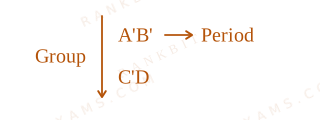
Consider the following elements.
Periodic Trends in Properties
Which of the following is/are true about A^, B^, C^ and D^? A. Order of atomic radii: B^ < A^ < D^ < C^ B. Order of metallic character: B^ < A^ < D^ < C^ C. Size of the element: D^ < C^ < B^ < A^ D. Order of ionic radii: B⁺ < A⁺ < D⁺ < C⁺ Choose the correct answer from the options given below:
  • A. A only
  • B. A, B and D only
  • C. A and B only
  • D. B, C and D only

Solution

Core Logic

From the grid layout, A^ and B^ are in the same period (left to right), while C^ and D^ are below them in the next period. In general, moving along a period from left to right, size decreases and metallic character decreases. Moving down a group, size increases and metallic character increases.

Atomic Radii / Size: B^ < A^ (across period) D^ < C^ (across period) A^ < C^ and B^ < D^ (down the group) Combining them: B^ < A^ < D^ < C^. (Statement A is correct, C is incorrect).

Metallic Character: B^ < A^ and D^ < C^ Overall trend follows size closely for these blocks: B^ < A^ < D^ < C^. (Statement B is correct).

Ionic Radii (+ ions): Follows the same basic trend as atomic radii: B⁺ < A⁺ < D⁺ < C⁺. (Statement D is correct).

Step 1: Final Selection

Statements A, B, and D are correct. Statement C contradicts A, so it is incorrect. Option 2 is the right choice.

Chapter Mix

Class 11 Chemistry: Classification of Elements and Periodicity in Properties

Rankbit System
JEE Physics: Waves (+15.5%) | Electrostatics: Concentric Shells (-29.7%) | Modern Physics: Photoelectric Clones (+34.2%) | Mathematics: Definite Integrals (+18.1%) | Chemistry: Coordination Splitting (-11.4%) | JEE Physics: Waves (+15.5%) | Electrostatics: Concentric Shells (-29.7%) | Modern Physics: Photoelectric Clones (+34.2%) | Mathematics: Definite Integrals (+18.1%) | Chemistry: Coordination Splitting (-11.4%)