Which of the following properties will change when system containing solution 1 will become solution 2?
The flowchart maps Solution 1 containing 10 mol solute in 10 L water transitioning to Solution 2 containing 1 mol solute in 1 L water.
A.Molar heat capacity
B.Density
C.Concentration
D.Gibbs free energy
Solution & Explanation
Core Logic
Let us compute the concentration of both solutions:
Concentration of Solution 1 = 10 mol10 L = 1 mol/L$$\text{Concentration of Solution 1} = \frac{10\text{ mol}}{10\text{ L}} = 1\text{ mol/L}$$Concentration of Solution 2 = 1 mol1 L = 1 mol/L$$\text{Concentration of Solution 2} = \frac{1\text{ mol}}{1\text{ L}} = 1\text{ mol/L}$$
Since concentration is identical, both systems share matching compositions. Consequently, all intensive properties (independent of mass/size) like concentration, density, and molar heat capacity remain exactly equal.
Step 1: Identifying the Variable
Gibbs free energy (G$G$) is an extensive property that scales directly with the amount of matter in the system. Because Solution 1 contains a larger total mass and volume than Solution 2, its overall Gibbs free energy value will change.
Pattern Recognition
Shortcut: Look for the only extensive property in the options. Density, concentration, and molar parameters are always intensive. Gibbs free energy (G$G$) scales with total matter quantity.
Chapter Mix
Class 11 Chemistry: Chemical Thermodynamics
Keywords:#Solute moles#Intensive property#Extensive state function#Gibbs free energy
More Chemical Thermodynamics Previous-Year Questions — Page 4
Q47jee_main_2025_03_april_eveningWork Done in Reversible Cyclic Processes
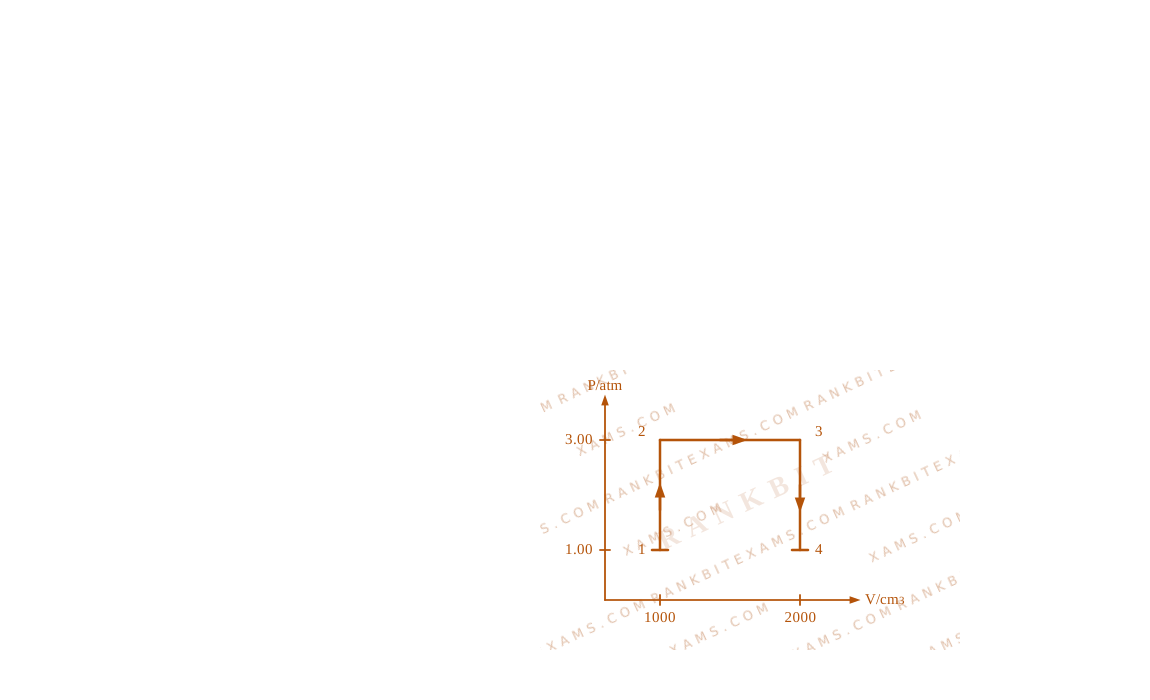
A perfect gas (0.1~mol$0.1\mathrm{~mol}$) having Cv=1.50~R$\bar{C}_{v}=1.50\mathrm{~R}$ (independent of temperature) undergoes the transformation from point 1 to point 4 as shown in the pressure-volume diagram below. If each step is reversible, the total work done (w) while going from point 1 to point 4 is (-$-$) ________ J. (nearest integer) P-V graph showing a thermodynamic process from point 1 to point 4 containing an isobaric step and isochoric steps.
[Given: R=0.082 ~L~atm~K⁻¹~mol⁻¹ = 8.314 ~J~K⁻¹~mol⁻¹$R=0.082\mathrm{~L~atm~K^{-1}~mol^{-1}} = 8.314\mathrm{~J~K^{-1}~mol^{-1}}$]
Numerical Answer.Answer: 304 to 304
Solution
Related Formula
Thermodynamic work done (w$w$) for each step:
Isochoric step (V = constant$V = \text{constant}$):
-) ________ J, meaning work done by the system (expansion) is negative and work done on the system (compression) is positive. Since this is compression, work done on the gas is$) ________ J, meaning work done by the system (expansion) is negative and work done on the system (compression) is positive. Since this is compression, work done on the gas is $+304\mathrm{~J}, which is represented as$, which is represented as $-(-304)\mathrm{~J}in typical IUPAC convention where work of expansion is examined. The absolute magnitude of the work is$ in typical IUPAC convention where work of expansion is examined. The absolute magnitude of the work is $304\mathrm{~J}.
Pattern Recognition
During any cyclic or multi-step path on a P-V graph, work is done only when there is a change in volume (
$.
Pattern Recognition
During any cyclic or multi-step path on a P-V graph, work is done only when there is a change in volume ($
W = -\int P dV$). Any vertical line (constant volume) represents an isochoric step where work is exactly zero. The horizontal segment directly represents rectangular area under the path.
Chapter Mix
Class 11 Chemistry: Thermodynamics
Class 11 Physics: Thermodynamics
Q48jee_main_2025_03_april_eveningBomb Calorimetry and Heat of Combustion
A sample of n-octane (1.14~g$1.14\mathrm{~g}$) was completely burnt in excess of oxygen in a bomb calorimeter, whose heat capacity is 5 ~kJ~K⁻¹$5\mathrm{~kJ~K^{-1}}$. As a result of combustion reaction, the temperature of the calorimeter is increased by 5 K. The magnitude of the heat of combustion of octane at constant volume is ________ kJ~mol⁻¹$\mathrm{kJ~mol^{-1}}$. (nearest integer)
Numerical Answer.Answer: 2500 to 2500
Solution
Related Formula
Heat released at constant volume (qv$q_v$) in a bomb calorimeter is:
A bomb calorimeter operates at rigid constant volume, meaning boundary work
$.
Pattern Recognition
A bomb calorimeter operates at rigid constant volume, meaning boundary work $
w = 0. Thus, by the first law of thermodynamics, the measured heat flow represents the internal energy change ($. Thus, by the first law of thermodynamics, the measured heat flow represents the internal energy change ($\Delta U), not the enthalpy change ($), not the enthalpy change ($\Delta H$, which occurs at constant pressure).
Chapter Mix
Class 11 Chemistry: Thermodynamics
Q29jee_main_2025_07_april_morningEnthalpy Changes
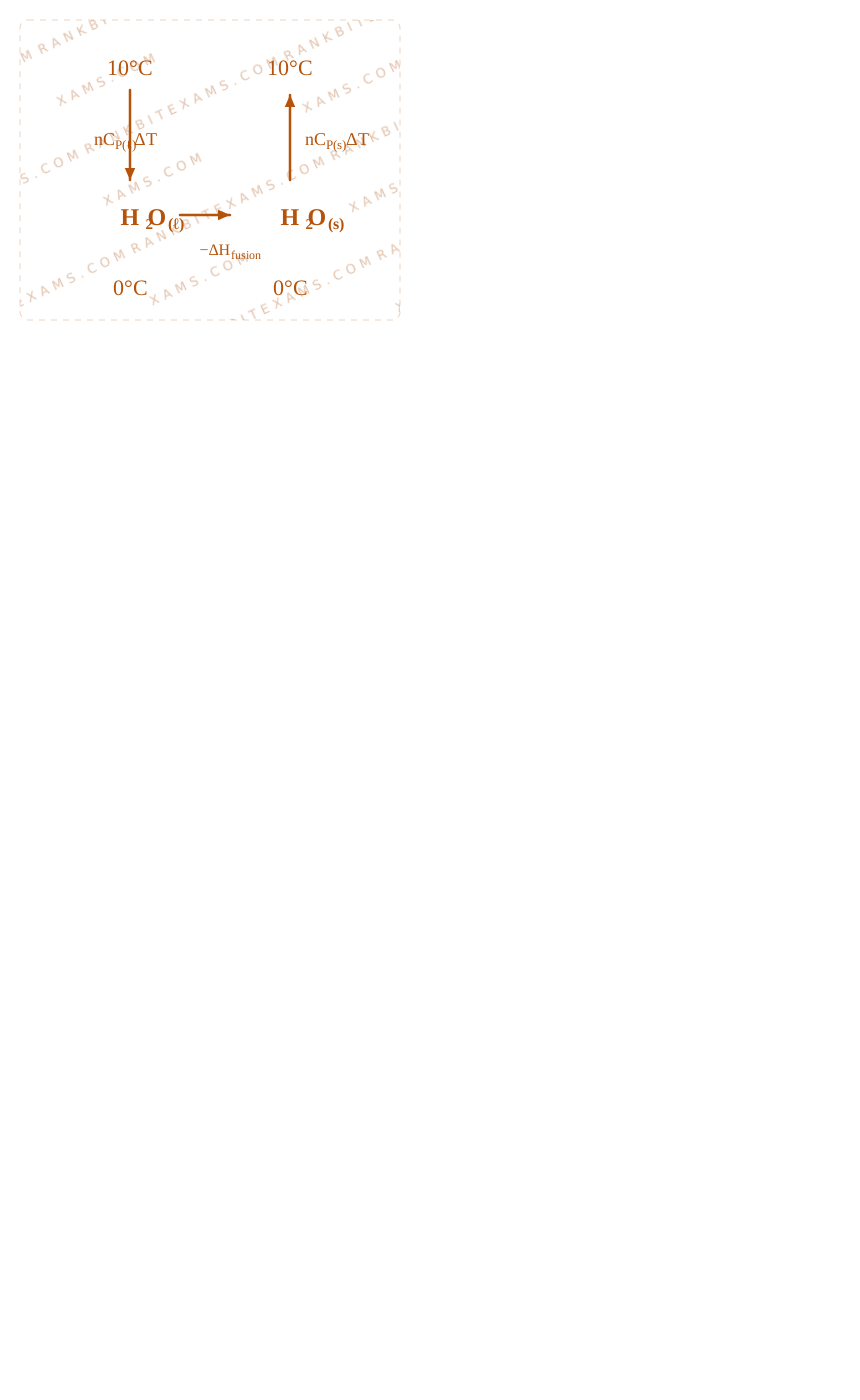
Total enthalpy change for freezing of 1 ~mol$1 \mathrm{~mol}$ of water at 10° C$10^{\circ} \mathrm{C}$ to ice at -10° C$-10^{\circ} \mathrm{C}$ is
(Given: ΔfusH = x$\Delta_{\mathrm{fus}}\mathrm{H} = \mathrm{x}$ kJ/mol, Cₚ[H₂O( )] = y J mol⁻¹ K⁻¹$\mathrm{C}_{\mathrm{p}}[\mathrm{H}_2\mathrm{O}(\ell)] = \mathrm{y}\text{ J mol}^{-1}\text{ K}^{-1}$, Cₚ[H₂O(s)] = z J mol⁻¹ K⁻¹$\mathrm{C}_{\mathrm{p}}[\mathrm{H}_2\mathrm{O}(\text{s})] = \mathrm{z}\text{ J mol}^{-1}\text{ K}^{-1}$)
Freezing is an exothermic process, so all three steps (cooling water, freezing, and cooling ice) must carry a negative sign. Factoring out -10$-10$ cleanly yields the expression -10(100x+y+z)$-10(100x+y+z)$.
Chapter Mix
Class 11 Chemistry: Chemical Thermodynamics
Qjee_main_2025_08_april_eveningResonance Energy
Resonance in an X₂Y$\text{X}_2\text{Y}$ molecule is represented as follows:
X = X = Y X ≡ X^+ - Y^-$$\text{X} = \text{X} = \text{Y} \longleftrightarrow \text{X} \equiv \text{X}^+ - \text{Y}^-$$
The experimental enthalpy of formation for gaseous X₂Y$\text{X}_2\text{Y}$ is given by the reaction:
X ≡ X(g) + (1)/(2)Y = Y(g) X₂Y(g) Δ Hf(exp) = 80 kJ mol⁻¹$$\text{X} \equiv \text{X}(g) + \frac{1}{2}\text{Y} = \text{Y}(g) \longrightarrow \text{X}_2\text{Y}(g) \quad \Delta H_{f(\text{exp})} = 80 \text{ kJ mol}^{-1}$$
Calculate the magnitude of the resonance energy of X₂Y$\text{X}_2\text{Y}$ in kJ mol⁻¹$\text{kJ mol}^{-1}$ (as the nearest integer value).
**Given bond energies:**
* X ≡ X = 940 kJ mol⁻¹$\text{X} \equiv \text{X} = 940 \text{ kJ mol}^{-1}$
* X = X = 410 kJ mol⁻¹$\text{X} = \text{X} = 410 \text{ kJ mol}^{-1}$
* Y = Y = 500 kJ mol⁻¹$\text{Y} = \text{Y} = 500 \text{ kJ mol}^{-1}$
* X = Y = 602 kJ mol⁻¹$\text{X} = \text{Y} = 602 \text{ kJ mol}^{-1}$
Valence settings: X : 3, Y : 2$\text{X} : 3, \text{Y} : 2$
Numerical Answer.Answer: 98 to 98
Solution
Related Formula
Resonance energy equation related to experimental and theoretical formation enthalpies:
Taking the magnitude as requested: |Δ HR.E.| = 98$|\Delta H_{\text{R.E.}}| = 98$.
Pattern Recognition
Resonance energy is always a stabilizing factor, meaning Δ Hf(exp)$\Delta H_{f(\text{exp})}$ is more exothermic (or less endothermic) than the theoretical localized state. The magnitude is simply the absolute value of this difference (|80 - 178| = 98$|80 - 178| = 98$).
Chapter Mix
Class 11 Chemistry: Chemical Thermodynamics
Class 11 Chemistry: Chemical Bonding and Molecular Structure
Q39jee_main_2025_29_jan_eveningHess's Law of Constant Heat Summation
If C(diamond) arrow C(graphite) + X kJ mol⁻¹$C(\text{diamond}) \rightarrow C(\text{graphite}) + X\text{ kJ mol}^{-1}$C(diamond) + O₂(g) arrow CO₂(g) + Y kJ mol⁻¹$$C(\text{diamond}) + O_{2}(g) \rightarrow CO_{2}(g) + Y\text{ kJ mol}^{-1}$$C(graphite) + O₂(g) arrow CO₂(g) + Z kJ mol⁻¹$$C(\text{graphite}) + O_{2}(g) \rightarrow CO_{2}(g) + Z\text{ kJ mol}^{-1}$$
At constant temperature, then the correct relationship is:
A. X = Y + Z
B. -X = Y + Z
C. X = -Y + Z
D. X = Y - Z
Solution
Core Logic
Let's treat the given parameters as terms for exothermic heats evolved on the product side:
1) C(diamond) arrow C(graphite)$C(\text{diamond}) \rightarrow C(\text{graphite})$, Delta H = -X$Delta H = -X$
2) C(diamond) + O₂(g) arrow CO₂(g)$C(\text{diamond}) + O_{2}(g) \rightarrow CO_{2}(g)$, Delta H = -Y$Delta H = -Y$
3) C(graphite) + O₂(g) arrow CO₂(g)$C(\text{graphite}) + O_{2}(g) \rightarrow CO_{2}(g)$, Delta H = -Z$Delta H = -Z$
By subtracting Equation (3) from Equation (2):
C(diamond) - C(graphite) arrow 0 implies C(diamond) arrow C(graphite)$$C(\text{diamond}) - C(\text{graphite}) \rightarrow 0 implies C(\text{diamond}) \rightarrow C(\text{graphite})$$Delta H = (-Y) - (-Z) = Z - Y$$Delta H = (-Y) - (-Z) = Z - Y$$
Matching this to Equation (1):
-X = Z - Y implies X = Y - Z$$-X = Z - Y implies X = Y - Z$$
Pattern Recognition
Hess's Law states that the enthalpy change of an overall reaction is equal to the sum of the enthalpy changes of its individual steps.
Practice past-year questions one chapter at a time. Pick an exam → subject → chapter and get every PYQ for that topic — pulled together from all past papers — with the chapter's key formulas alongside.
 "Solute moles, Intensive property, Extensive state function, Gibbs free energy")