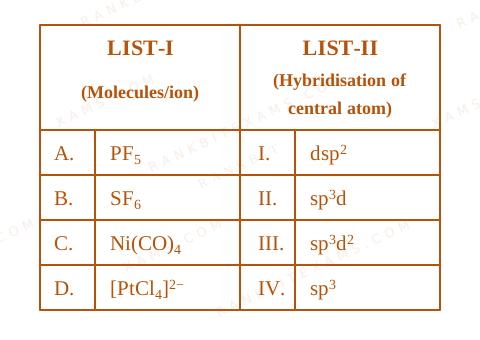
Match the LIST-I with LIST-II.
Choose the correct answer from the options given below:
Hybridisation
A.A-II, B-III, C-IV, D-I
B.A-IV, B-I, C-II, D-III
C.A-I, B-II, C-III, D-IV
D.A-III, B-I, C-IV, D-II
Solution & Explanation
Core Logic
Let us evaluate each central atom configuration systematically:
A. PF₅$\text{PF}_5$: Phosphorus has 5 valence electrons, forming 5σ$5\sigma$ bonds with zero lone pairs. Steric number = 5 sp³d$= 5 \implies sp^3d$ hybridisation.
B. SF₆$\text{SF}_6$: Sulfur has 6 valence electrons, forming 6σ$6\sigma$ bonds with zero lone pairs. Steric number = 6 sp³d²$= 6 \implies sp^3d^2$ hybridisation.
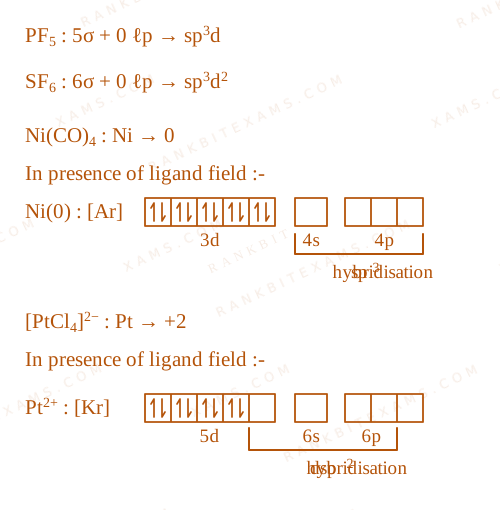
C. Ni(CO)₄$\text{Ni}(\text{CO})_4$: Nickel is in a 0 oxidation state (3d⁸ 4s²$3d^8 4s^2$). Carbon monoxide is a strong field ligand, forcing rearrangement into a filled 3d¹⁰$3d^{10}$ state. The vacant 4s$4s$ and three 4p$4p$ orbitals hybridise to give an sp³$sp^3$ configuration. Orbital configuration matrix for Q43 - JEE Main 2025 Morning
D. [PtCl₄]²⁻$[\text{PtCl}_4]^{2-}$: Platinum is in the +2$+2$ oxidation state (5d⁸$5d^8$). Since it belongs to the 5d$5d$ transition series, all ligands behave as strong field elements, leading to interior spin-pairing and an inner orbital square-planar dsp²$dsp^2$ hybridisation state. Orbital configuration matrix for Q43 - JEE Main 2025 Morning
Pattern Recognition
Shortcut: Match main-group species first: PF₅ arrow sp³d (II)$\text{PF}_5 \rightarrow sp^3d\text{ (II)}$, SF₆ arrow sp³d² (III)$\text{SF}_6 \rightarrow sp^3d^2\text{ (III)}$. This immediately isolates Option (A) without needing to evaluate coordination fields.
Evaluation Rubric / Model Answer
Option (A)
Chapter Mix
Class 11 Chemistry: Chemical Bonding and Molecular Structure
Class 12 Chemistry: Coordination Compounds
Orbital configuration matrix for Q43 - JEE Main 2025 Morning
More Chemical Bonding and Molecular Structure Previous-Year Questions — Page 9
Q77jee_main_2024_31_jan_morningMolecular Orbital Theory
The linear combination of atomic orbitals to form molecular orbitals takes place only when the combining atomic orbitals
A. have the same energy
B. have the minimum overlap
C. have same symmetry about the molecular axis
D. have different symmetry about the molecular axis
Choose the most appropriate from the options given below:
The combining atomic orbitals must have the same or nearly the same energy.
The combining atomic orbitals must have the same symmetry about the molecular axis.
The combining atomic orbitals must overlap to the maximum extent (not minimum).
Chapter Mix
Class 11 Chemistry: Chemical Bonding and Molecular Structure

Q85jee_main_2024_31_jan_morningHybridization
The number of species from the following in which the central atom uses sp³$sp^3$ hybrid orbitals in its bonding is
NH₃, SO₂, SiO₂, BeCl₂, CO₂, H₂O, CH₄, BF₃$NH_3, SO_2, SiO_2, BeCl_2, CO_2, H_2O, CH_4, BF_3$
Numerical Answer.Answer: 4 to 4
Solution
Core Logic
Analyzing the hybridization of the central atom in each species:
NH₃$NH_3$: 3 bp + 1 lp = 4 electron domains arrow sp³$\rightarrow sp^3$
SO₂$SO_2$: 2 bp + 1 lp = 3 electron domains arrow sp²$\rightarrow sp^2$
SiO₂$SiO_2$: A giant covalent network where each Si is bonded to 4 oxygens tetrahedrally arrow sp³$\rightarrow sp^3$
BeCl₂$BeCl_2$: 2 bp + 0 lp = 2 electron domains arrow sp$\rightarrow sp$
CO₂$CO_2$: 2 bp + 0 lp = 2 electron domains arrow sp$\rightarrow sp$
H₂O$H_2O$: 2 bp + 2 lp = 4 electron domains arrow sp³$\rightarrow sp^3$
CH₄$CH_4$: 4 bp + 0 lp = 4 electron domains arrow sp³$\rightarrow sp^3$
BF₃$BF_3$: 3 bp + 0 lp = 3 electron domains arrow sp²$\rightarrow sp^2$
Total species with sp³$sp^3$ hybridization: NH₃, SiO₂, H₂O, CH₄$NH_3, SiO_2, H_2O, CH_4$. Total count = 4.
Chapter Mix
Class 11 Chemistry: Chemical Bonding and Molecular Structure
Practice past-year questions one chapter at a time. Pick an exam → subject → chapter and get every PYQ for that topic — pulled together from all past papers — with the chapter's key formulas alongside.