Identify [A], [B], and [C], respectively in the following reaction sequence:
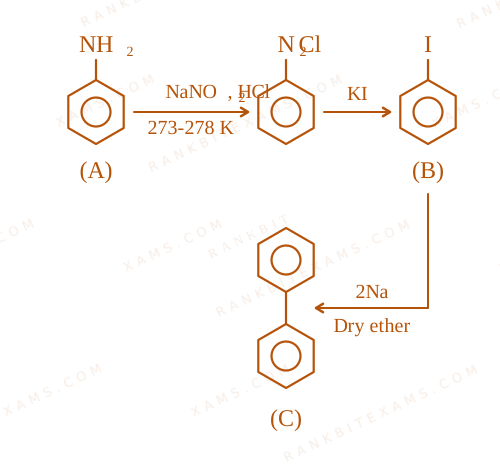
The reaction shows Aniline reacting with sodium nitrite and hydrochloric acid to produce intermediate A, followed by treatment with potassium iodide to yield B, which then dimerizes via sodium in dry ether to form C.
The reaction shows Aniline reacting with sodium nitrite and hydrochloric acid to produce intermediate A, followed by treatment with potassium iodide to yield B, which then dimerizes via sodium in dry ether to form C.
A.
The reaction shows Aniline reacting with sodium nitrite and hydrochloric acid to produce intermediate A, followed by treatment with potassium iodide to yield B, which then dimerizes via sodium in dry ether to form C.
B.
The reaction shows Aniline reacting with sodium nitrite and hydrochloric acid to produce intermediate A, followed by treatment with potassium iodide to yield B, which then dimerizes via sodium in dry ether to form C.
C.
The reaction shows Aniline reacting with sodium nitrite and hydrochloric acid to produce intermediate A, followed by treatment with potassium iodide to yield B, which then dimerizes via sodium in dry ether to form C.
D.
The reaction shows Aniline reacting with sodium nitrite and hydrochloric acid to produce intermediate A, followed by treatment with potassium iodide to yield B, which then dimerizes via sodium in dry ether to form C.
Solution & Explanation
Core Logic
Let us resolve each structural step sequentially:
Step 1: Aniline undergoes diazotization when treated with NaNO₂ + HCl$\text{NaNO}_2 + \text{HCl}$ at 273-278 K$273-278\text{ K}$, forming benzene diazonium chloride [A]$[A]$ (C₆H₅N₂^+Cl^-$\text{C}_6\text{H}_5\text{N}_2^+\text{Cl}^-$).
Step 2: Warming benzene diazonium chloride with potassium iodide (KI$\text{KI}$) substitutes the diazonium group with iodine, producing iodobenzene [B]$[B]$ (C₆H₅I$\text{C}_6\text{H}_5\text{I}$).
Step 3: Treating iodobenzene with sodium metal in dry ether causes a Fittig coupling reaction, dimerizing two phenyl radicals into biphenyl [C]$[C]$ (C₆H₅-C₆H₅$\text{C}_6\text{H}_5-\text{C}_6\text{H}_5$). The reaction shows Aniline reacting with sodium nitrite and hydrochloric acid to produce intermediate A, followed by treatment with potassium iodide to yield B, which then dimerizes via sodium in dry ether to form C.The reaction shows Aniline reacting with sodium nitrite and hydrochloric acid to produce intermediate A, followed by treatment with potassium iodide to yield B, which then dimerizes via sodium in dry ether to form C.
Pattern Recognition
Shortcut: Aniline arrow NaNO₂/HCl arrow$\rightarrow \text{NaNO}_2/\text{HCl} \rightarrow$ Diazonium salt arrow KI arrow$\rightarrow \text{KI} \rightarrow$ Iodobenzene. The final sodium metal treatment triggers a symmetrical radical dimer homocoupling (Fittig reaction) to yield a biphenyl product.
Evaluation Rubric / Model Answer
Option (C)
Chapter Mix
Class 12 Chemistry: Amines
Class 12 Chemistry: Haloalkanes and Haloarenes
The reaction shows Aniline reacting with sodium nitrite and hydrochloric acid to produce intermediate A, followed by treatment with potassium iodide to yield B, which then dimerizes via sodium in dry ether to form C.
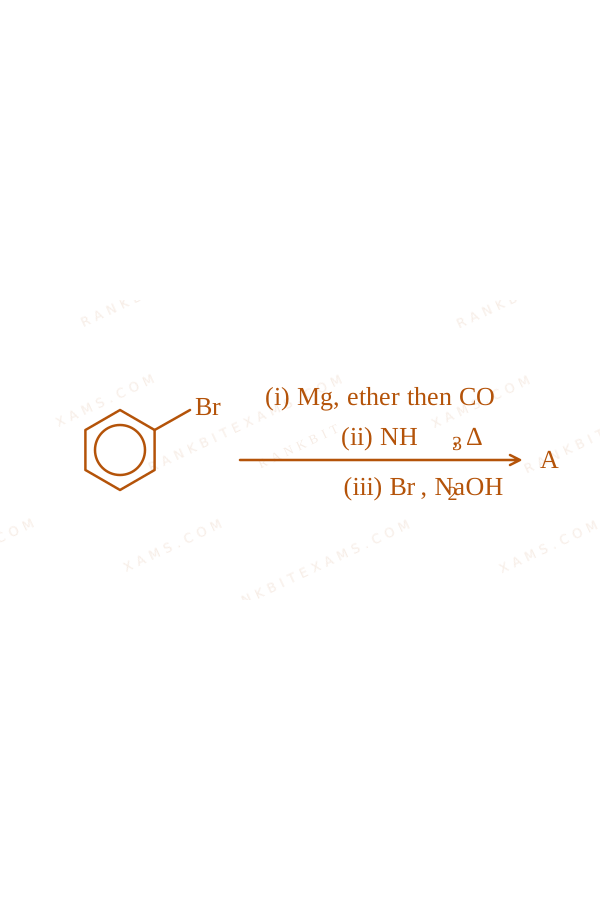
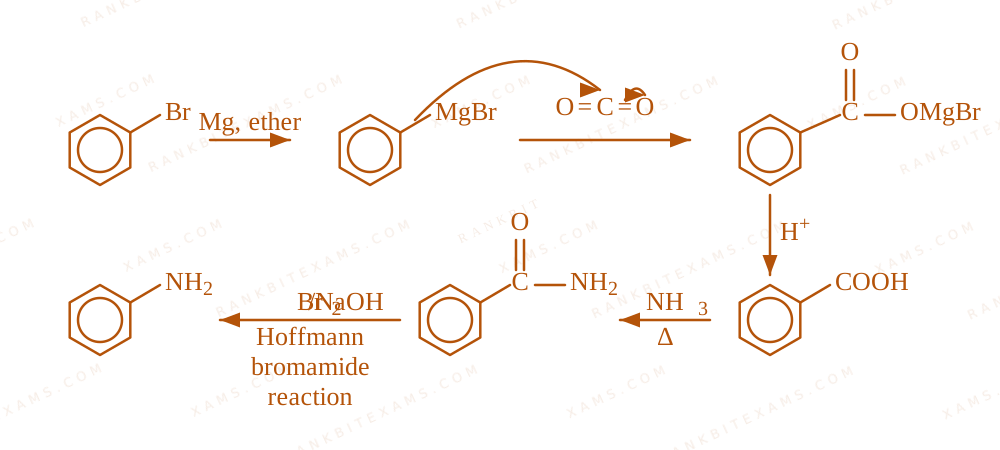
The image outlines a synthesis pathway converting bromobenzene through several steps finally using Hoffmann bromamide reaction.
Step 1: Tracing the product
The final product 'A' is Aniline.
Chapter Mix
Class 12 Chemistry: Amines
Class 12 Chemistry: Aldehydes, Ketones and Carboxylic Acids
Class 12 Chemistry: Haloalkanes and Haloarenes
Q78jee_main_2024_30_jan_morningChemical Reactions of Amines
Following is a confirmatory test for aromatic primary amines. Identify reagent (A) and (B)
Ph-NH₂ A Ph-N₂^+Cl^- B Scarlet red dye$Ph-NH_2 \xrightarrow{A} Ph-N_2^+Cl^- \xrightarrow{B} \text{Scarlet red dye}$
The reaction sequence represents the classic dye test for aromatic primary amines.
Step 1 (Diazotization): Aniline (Ph-NH₂$Ph-NH_2$) reacts with nitrous acid (generated in situ from NaNO₂ + HCl$NaNO_2 + HCl$) at low temperature (0-5^° C$0-5^\circ C$) to form benzene diazonium chloride (Ph-N₂^+Cl^-$Ph-N_2^+Cl^-$).
Thus, Reagent A is NaNO₂ + HCl$NaNO_2 + HCl$ at 0-5^° C$0-5^\circ C$.
Step 2: Coupling Reaction
Step 2: The diazonium salt undergoes an electrophilic substitution (coupling reaction) with an electron-rich aromatic ring to form an azo dye.
The formation of a 'scarlet red dye' is specifically the result of coupling benzene diazonium chloride with β$\beta$-naphthol in a weakly basic medium (NaOH).
Chemical Reactions of Amines solution diagram for Q78 - JEE Main 2024 Morning
Chapter Mix
Class 12 Chemistry: Amines
Qjee_main_2024_31_jan_eveningReactions of Diazonium Salts
The azo-dye (Y) formed in the following reactions is
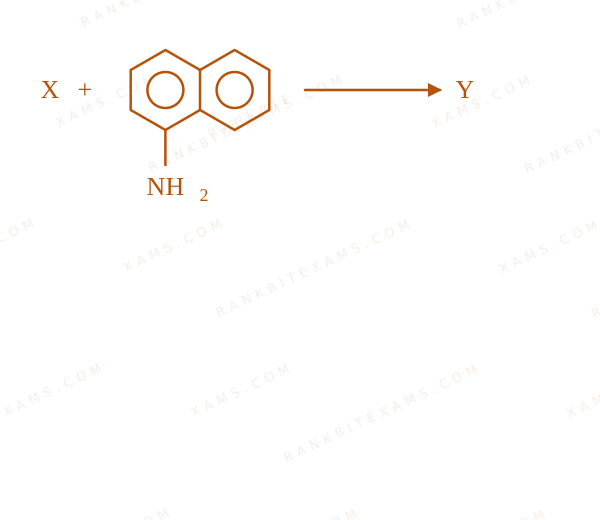
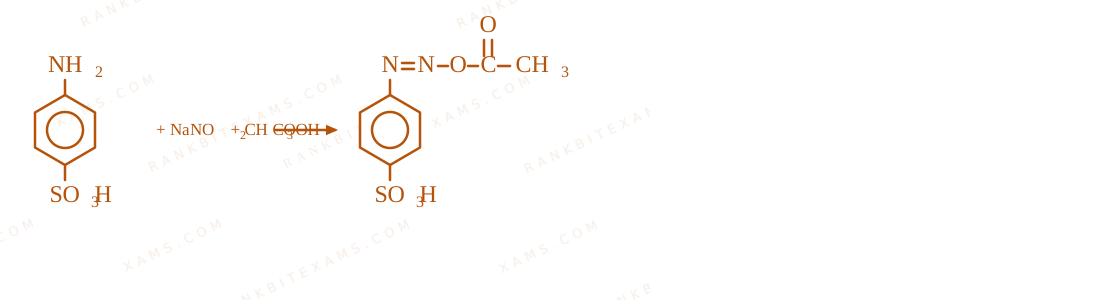
Sulphanilic acid + NaNO₂ + CH₃COOH arrow X$\text{Sulphanilic acid } + NaNO_2 + CH_3COOH \rightarrow X$The image shows the reaction of intermediate X with N,N-dimethylaniline to form an azo dye (Y).
A.
B.
C.
D.
Solution
Core Logic
Sulphanilic acid reacts with NaNO₂$NaNO_2$ and CH₃COOH$CH_3COOH$ to form a diazonium salt (X).
The diazonium salt (X) then reacts with N,N-dimethylaniline (given in the coupling step image). The coupling takes place at the para position of the highly activated N,N-dimethylaniline ring.
This coupling yields Methyl Orange, an azo dye. Its structure is p$p$-dimethylaminoazobenzenesulphonic acid.
The image shows the reaction of intermediate X with N,N-dimethylaniline to form an azo dye (Y).
Step 1: Final Identification
The final product (Y) matches option (4) structurally, containing the sulphonic acid group on one ring, the azo linkage, and the N,N-dimethylamine group on the para position of the other ring.
Chapter Mix
Class 12 Chemistry: Amines
Q70jee_main_2024_31_jan_eveningChemical Reactions of Amines
Given below are two statements:
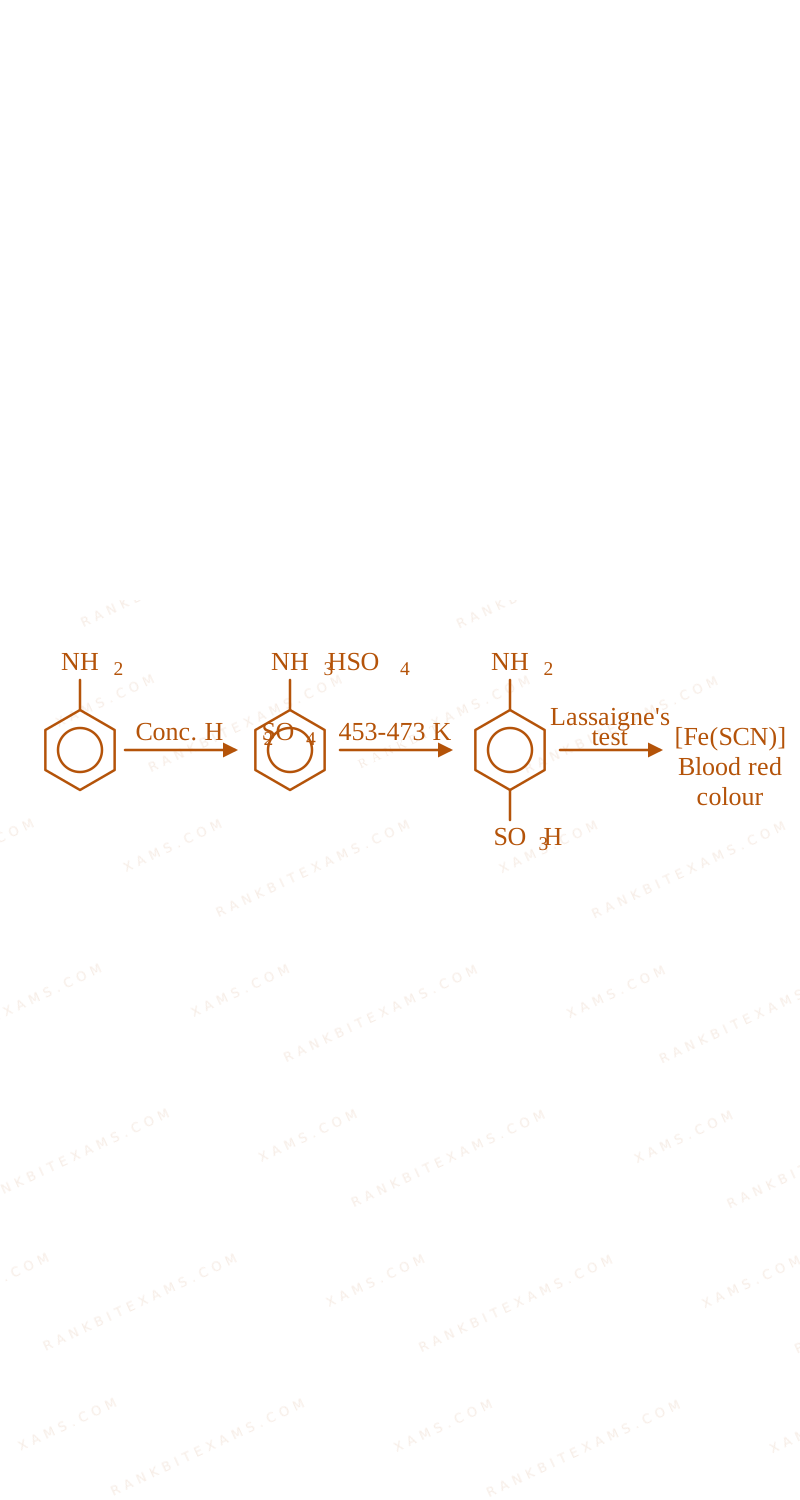
Statement I: Aniline reacts with con. H₂SO₄$H_2SO_4$ followed by heating at 453-473 K gives p-aminobenzene sulphonic acid, which gives blood red colour in the 'Lassaigne's test'.
Statement II: In Friedel-Crafts alkylation and acylation reactions, aniline forms salt with the AlCl₃$AlCl_3$ catalyst. Due to this, nitrogen of aniline acquires a positive charge and acts as deactivating group.
In the light of the above statements, choose the correct answer from the options given below:
A.(1) Statement I is false but statement II is true$\text{(1) Statement I is false but statement II is true}$
B.(2) Both statement I and statement II are false$\text{(2) Both statement I and statement II are false}$
C.(3) Statement I is true but statement II is false$\text{(3) Statement I is true but statement II is false}$
D.(4) Both statement I and statement II are true$\text{(4) Both statement I and statement II are true}$
Solution
Core Logic
Statement I: Aniline reacting with concentrated H₂SO₄$H_2SO_4$ gives anilinium hydrogensulphate, which on heating at 453-473 K produces sulphanilic acid (p-aminobenzene sulphonic acid). Because sulphanilic acid contains both Nitrogen and Sulphur, it gives a blood-red colouration in Lassaigne's test due to the formation of thiocyanate ion SCN^-$SCN^-$ which reacts with Fe³⁺$Fe^{3+}$ to form [Fe(SCN)]²⁺$[Fe(SCN)]^{2+}$. Thus, Statement I is true.
Statement II: In Friedel-Crafts reactions, the Lewis acid catalyst AlCl₃$AlCl_3$ reacts with the lone pair on the nitrogen atom of aniline to form a salt. This generates a positive charge on the nitrogen, transforming the -NH₂$-NH_2$ group from a strong activating group into a strong deactivating group, thus preventing the Friedel-Crafts reaction from occurring. Thus, Statement II is true.
Chemical Reactions of Amines diagram for Q70 - JEE Main 2024 Evening
Step 1: Final Conclusion
Both Statement I and Statement II are true. Option (4) is correct.
Chapter Mix
Class 12 Chemistry: Amines
Class 11 Chemistry: Organic Chemistry - Some Basic Principles and Techniques
Q83jee_main_2024_31_jan_eveningAcylation of Amines
A compound (x) with molar mass 108 ~g mol⁻¹$108\mathrm{~g\,mol^{-1}}$ undergoes acetylation to give product with molar mass 192 ~g mol⁻¹$192\mathrm{~g\,mol^{-1}}$. The number of amino groups in the compound (x) is ________.
During the acetylation of an amino group, one hydrogen atom (mass = 1 g/mol$1\text{ g/mol}$) is replaced by an acetyl group (-COCH₃$-COCH_3$, mass = 43 g/mol$43\text{ g/mol}$).
Gain in molecular weight for every one -NH₂$-NH_2$ group acetylated = 43 - 1 = 42 g/mol$43 - 1 = 42\text{ g/mol}$.
Step 1: Calculating Number of Groups
Total increase in molecular weight = Final mass - Initial mass = 192 - 108 = 84 g/mol$192 - 108 = 84\text{ g/mol}$.
Number of amino groups = Total mass increaseMass increase per group = (84)/(42) = 2$$\text{Number of amino groups} = \frac{\text{Total mass increase}}{\text{Mass increase per group}} = \frac{84}{42} = 2$$
Practice past-year questions one chapter at a time. Pick an exam → subject → chapter and get every PYQ for that topic — pulled together from all past papers — with the chapter's key formulas alongside.
 "Diazotization, Benzene diazonium chloride, Iodobenzene, Wurtz-Fittig biphenyl")
.svg "Diazotization, Benzene diazonium chloride, Iodobenzene, Wurtz-Fittig biphenyl")
.svg "Diazotization, Benzene diazonium chloride, Iodobenzene, Wurtz-Fittig biphenyl")
.svg "Diazotization, Benzene diazonium chloride, Iodobenzene, Wurtz-Fittig biphenyl")
.svg "Diazotization, Benzene diazonium chloride, Iodobenzene, Wurtz-Fittig biphenyl")
.svg "Diazotization, Benzene diazonium chloride, Iodobenzene, Wurtz-Fittig biphenyl")
 "Diazotization, Benzene diazonium chloride, Iodobenzene, Wurtz-Fittig biphenyl")
 "Diazotization, Benzene diazonium chloride, Iodobenzene, Wurtz-Fittig biphenyl")