Number of molecules from below which cannot give iodoform reaction is :
Ethanol, Isopropyl alcohol, Bromoacetone, 2-Butanol, 2-Butanone, Butanal, 2-Pentanone, 3-Pentanone, Pentanal and 3-Pentanol
Ethanol (CH₃CH₂OH$\mathrm{CH_3CH_2OH}$) arrow$\rightarrow$ Gives test (Gives CHI₃$\mathrm{CHI_3}$)
Isopropyl alcohol (CH₃CH(OH)CH₃$\mathrm{CH_3CH(OH)CH_3}$) arrow$\rightarrow$ Gives test
Bromoacetone (BrCH₂COCH₃$\mathrm{BrCH_2COCH_3}$) arrow$\rightarrow$ Gives test
2-Butanol (CH₃CH(OH)CH₂CH₃$\mathrm{CH_3CH(OH)CH_2CH_3}$) arrow$\rightarrow$ Gives test
2-Butanone (CH₃COCH₂CH₃$\mathrm{CH_3COCH_2CH_3}$) arrow$\rightarrow$ Gives test
Butanal (CH₃CH₂CH₂CHO$\mathrm{CH_3CH_2CH_2CHO}$) arrow$\rightarrow$Does NOT give test
2-Pentanone (CH₃COCH₂CH₂CH₃$\mathrm{CH_3COCH_2CH_2CH_3}$) arrow$\rightarrow$ Gives test
3-Pentanone (CH₃CH₂COCH₂CH₃$\mathrm{CH_3CH_2COCH_2CH_3}$) arrow$\rightarrow$Does NOT give test
Pentanal (CH₃CH₂CH₂CH₂CHO$\mathrm{CH_3CH_2CH_2CH_2CHO}$) arrow$\rightarrow$Does NOT give test
3-Pentanol (CH₃CH₂CH(OH)CH₂CH₃$\mathrm{CH_3CH_2CH(OH)CH_2CH_3}$) arrow$\rightarrow$Does NOT give test
Step 1: Final Count
The 4 compounds that cannot give the iodoform reaction are: Butanal, 3-Pentanone, Pentanal, and 3-Pentanol.
Pattern Recognition
Requires CH₃-CO-$\mathrm{CH_3-CO-}$ or CH₃-CH(OH)-$\mathrm{CH_3-CH(OH)-}$ group.
Aldehydes other than acetaldehyde do not give iodoform test.
Symmetrical 3-ketones and 3-alcohols fail the test.
Chapter Mix
Class 12 Chemistry: Aldehydes, Ketones and Carboxylic Acids
Keywords:#Iodoform test conditions#JEE Main 2025 Morning Q36#Aldehydes and Ketones JEE Main 2025#Methyl ketone identification test
More Aldehydes, Ketones and Carboxylic Acids Previous-Year Questions — Page 5
Qjee_main_2025_28_jan_morningRearrangement and Ozonolysis
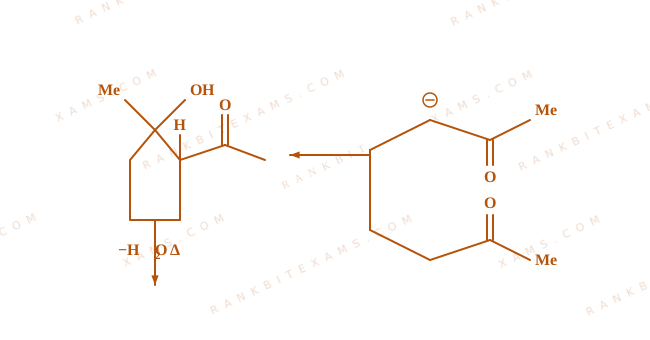
A molecule ("P") on treatment with acid undergoes rearrangement and gives ("Q") ("Q") on ozonolysis followed by reflux under alkaline condition gives ("R"). The structure of ("R") is given below:
The image displays the chemical structure of product R obtained from rearrangement and subsequent reaction steps.
The structure of (P)$(\mathrm{P})$ is
A.
B.
C.
D.
Solution
Core Logic
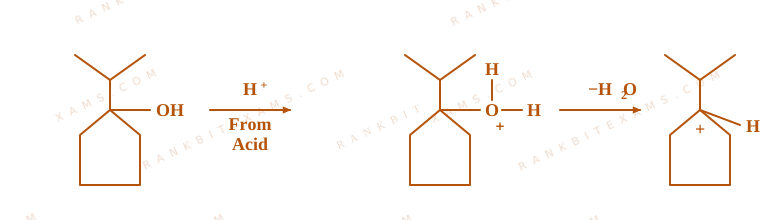
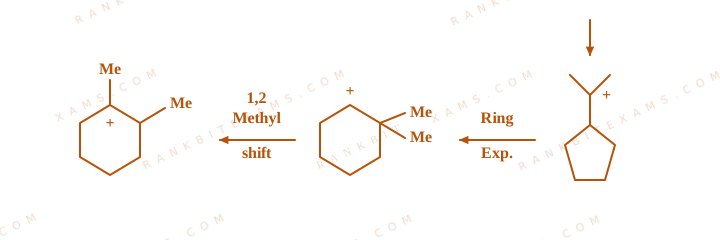
The reaction sequence indicates that molecule "P" undergoes an acid-catalyzed rearrangement to produce alkene/alcohol intermediate "Q". Subsequent ozonolysis breaks down the double bond system, and alkaline reflux sets up an intramolecular aldol condensation sequence to form the cyclic ketone system "R". Following the detailed ring contraction/expansion step templates outlined below:
The image displays the chemical structure of product R obtained from rearrangement and subsequent reaction steps.
The image displays the chemical structure of product R obtained from rearrangement and subsequent reaction steps.
The image displays the chemical structure of product R obtained from rearrangement and subsequent reaction steps.
The image displays the chemical structure of product R obtained from rearrangement and subsequent reaction steps.
The image displays the chemical structure of product R obtained from rearrangement and subsequent reaction steps.
The image displays the chemical structure of product R obtained from rearrangement and subsequent reaction steps.
The image displays the chemical structure of product R obtained from rearrangement and subsequent reaction steps.
The image displays the chemical structure of product R obtained from rearrangement and subsequent reaction steps.
Pattern Recognition
Sees: Acidic rearrangement arrow$\rightarrow$ ozonolysis arrow$\rightarrow$ intramolecular aldol condensation.
Shortcut: Work backwards from the dicarbonyl fragments formed after opening the final product ring system.
Chapter Mix
Class 12 Chemistry: Aldehydes, Ketones and Carboxylic Acids
Q37jee_main_2025_28_jan_morningReactions of Carbonyl Compounds
Both acetaldehyde and acetone (individually) undergo which of the following reactions?
A. Iodoform Reaction
B. Cannizaro Reaction
C. Aldol condensation
D. Pollen's Test
E. Clemmensen Reduction
Choose the correct answer from the options given below:
A.A, B and D only$\text{A, B and D only}$
B.A, C and E only$\text{A, C and E only}$
C.C and E only$\text{C and E only}$
D.B, C and D only$\text{B, C and D only}$
Solution
Core Logic
Let us check each option pathway:
A. Iodoform Reaction: Positive for both because both contain the CH₃-C=O$\mathrm{CH}_3-\mathrm{C}=\mathrm{O}$ methyl ketone fragment.
B. Cannizaro Reaction: Negative for both because both contain α$\alpha$-hydrogens.
C. Aldol Condensation: Positive for both because they have α$\alpha$-hydrogens available for enolization.
D. Pollen's Test (Tollen's Test): Positive only for acetaldehyde (aldehyde); negative for acetone (ketone).
E. Clemmensen Reduction: Positive for both as they contain reducible carbonyl groups.
Thus, both react via A, C, and E.
Pattern Recognition
Sees: Functional comparison of Acetaldehyde and Acetone.
Shortcut: Ketones do not respond to Tollen's test, which instantly eliminates choices featuring statement D.
Chapter Mix
Class 12 Chemistry: Aldehydes, Ketones and Carboxylic Acids
Qjee_main_2025_04_april_eveningIodoform Test
Which among the following compounds give yellow solid when reacted with NaOI/NaOH?
(A) CH₃ - CH(OH) - C₂H₅$CH_3 - CH(OH) - C_2H_5$
(B) CH₃ - CH₂ - CH₂ - OH$CH_3 - CH_2 - CH_2 - OH$
(C) CH₃ - CO - C₂H₅$CH_3 - CO - C_2H_5$
(D) CH₃-CO- OH$CH_3-CO- OH$
(E) CH₃ - CH₂ - CHO$CH_3 - CH_2 - CHO$
Choose the correct answer from the options given below:
A. (B), (C) and (E) Only
B. (A) and (C) Only
C. (C) and (D) Only
D. (A), (C) and (D) Only
Solution
Related Formula
Compounds with CH₃-CH(OH)- or CH₃-CO- groups undergo the iodoform reaction to form CHI₃ (Yellow Solid)$$\text{Compounds with } CH_3-CH(OH)- \text{ or } CH_3-CO- \text{ groups undergo the iodoform reaction to form } CHI_3 \downarrow \text{ (Yellow Solid)}$$
Core Logic
Let's check the structural groups of each given option:
(A)CH₃ - CH(OH) - C₂H₅$CH_3 - CH(OH) - C_2H_5$: Contains the methylcarbinol group (CH₃-CH(OH)-$CH_3-CH(OH)-$). Gives a positive iodoform test.
(B)CH₃ - CH₂ - CH₂ - OH$CH_3 - CH_2 - CH_2 - OH$: Linear primary alcohol, does not contain the required group.
(C)CH₃ - CO - C₂H₅$CH_3 - CO - C_2H_5$: Contains the methyl ketone group (CH₃-CO-$CH_3-CO-$). Gives a positive iodoform test.
(D)CH₃ - OH$CH_3 - OH$: Methanol does not give the test.
(E)CH₃ - CH₂ - H$CH_3 - CH_2 - H$: Ethane does not give the test.
Thus, only (A) and (C) yield the yellow precipitate of iodoform (CHI₃$CHI_3$).
The iodoform test specifically isolates methyl ketones or secondary methyl alcohols. Scan dynamically for a terminal -CH₃$-CH_3$ affixed directly to a carbonyl oxygen index (C=O$C=O$) or a hydroxyl carbon (CH-OH$CH-OH$).
Chapter Mix
Class 12 Chemistry: Aldehydes, Ketones and Carboxylic Acids
Class 12 Chemistry: Alcohols, Phenols and Ethers
Qjee_main_2025_04_april_morningAldol Condensation
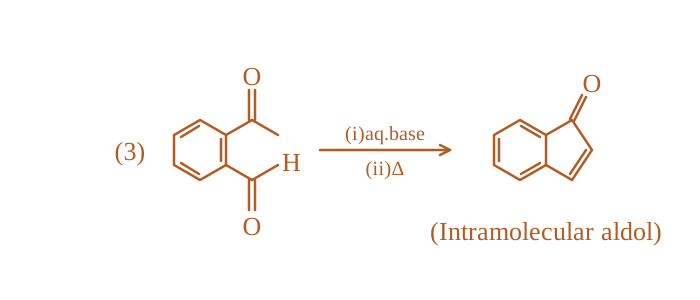
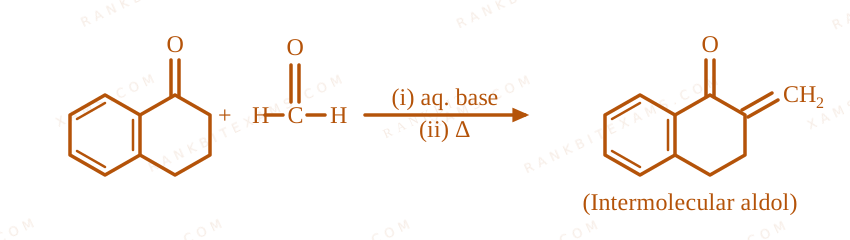
Aldol condensation is a popular and classical method to prepare α, β$\alpha, \beta$-unsaturated carbonyl compounds. This reaction can be both intermolecular and intramolecular. Predict which one of the following is not a product of intramolecular aldol condensation?
A.
B.
C.
D.
Solution
Related Reaction
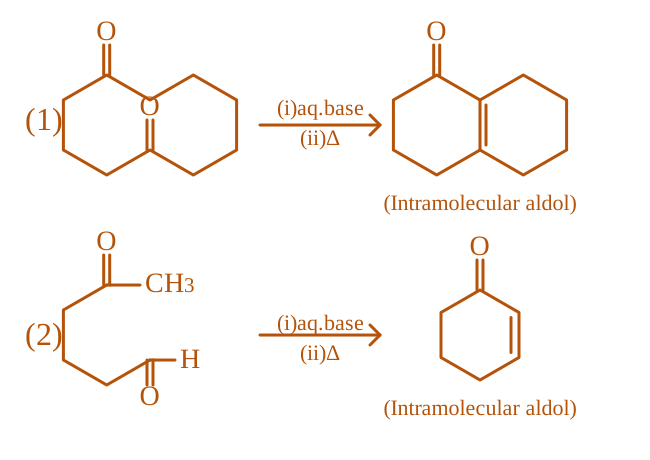
Intramolecular aldol condensation of dicarbonyl compounds:
Intramolecular cyclization strongly favors the formation of stable 5- or 6-membered rings due to minimal ring strain.
Core Logic
Options A, B, and C: Each represents a clean intramolecular cyclization product derived from a single open-chain dicarbonyl precursor (dialdehyde or diketone) forming stable 5- or 6-membered conjugated enones.
Intramolecular vs intermolecular mechanism mapping diagram
Intramolecular vs intermolecular mechanism mapping diagram
Option D: Features an exocyclic α,β$\alpha,\beta$-unsaturated linkage formed strictly via an intermolecular crossed-aldol condensation between two separate carbonyl molecules rather than an internal cyclization of a single dicarbonyl unit.
Intramolecular vs intermolecular mechanism mapping diagram
Pattern Recognition
Trace the carbon backbone back to its precursor. Products of intramolecular aldol condensation originate from a single continuous dicarbonyl molecule closing into a stable 5- or 6-membered ring. An exocyclic enone linking a ring to an external carbonyl unit typically indicates an intermolecular reaction between two distinct molecules.
Evaluation Rubric / Model Answer
Option D
Chapter Mix
Class 12 Chemistry: Aldehydes, Ketones and Carboxylic Acids
More Aldehydes, Ketones and Carboxylic Acids Questions — jee_main_2025_03_april_morning
Practice past-year questions one chapter at a time. Pick an exam → subject → chapter and get every PYQ for that topic — pulled together from all past papers — with the chapter's key formulas alongside.