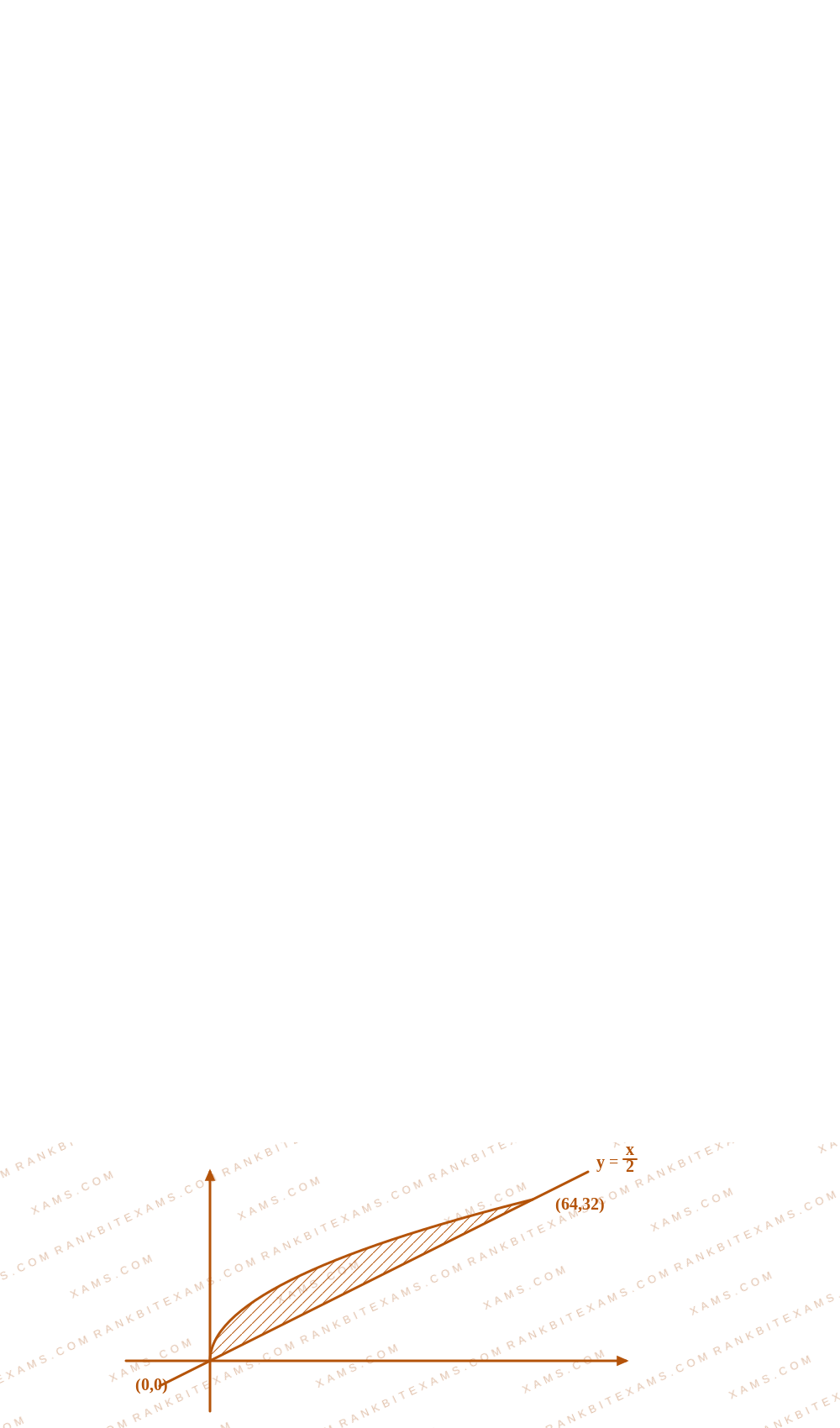
This gives the upper bounding parabolic curve y = 4√(x)$y = 4\sqrt{x}$.
Thus, the enclosed region lies in the first quadrant bounded between the upper curve y = 4√(x)$y = 4\sqrt{x}$ and the lower line y = (x)/(2)$y = \frac{x}{2}$.
Step 1: Finding Points of Intersection
Equating the two boundary curves:
4√(x) = (x)/(2) 8√(x) = x x² - 64x = 0$$4\sqrt{x} = \frac{x}{2} \implies 8\sqrt{x} = x \implies x^2 - 64x = 0$$x = 0 or x = 64$$\implies x = 0 \quad \text{or} \quad x = 64$$
Corresponding y$y$-values:
At x = 0 y = 0$x = 0 \implies y = 0$
At x = 64 y = 32$x = 64 \implies y = 32$
The curves intersect at (0, 0)$(0, 0)$ and (64, 32)$(64, 32)$.
Area Under Curve diagram for Q61 - JEE Main 2025 Evening Shift
Correct Answer: Option B ((1024)/(3)$\frac{1024}{3}$)
Chapter Mix
Class 12 Mathematics: Applications of Integrals
Class 11 Mathematics: Conic Sections
More Applications of Integrals Previous-Year Questions — Page 3
Q66jee_main_2025_07_april_morningArea Under Curves
If the area of the region bounded by the curves y = 4 - (x²)/(4)$y = 4 - \frac{x^2}{4}$ and y = (x - 4)/(2)$y = \frac{x - 4}{2}$ is equal to α$\alpha$ , then 6α$6\alpha$ equals
A.250$250$
B.210$210$
C.240$240$
D.220$220$
Solution
Related Formula
Area enclosed between two intersecting curves from boundary limits x = a$x = a$ to x = b$x = b$:
Step 1: Set Up and Solve the Enclosed Area Integral
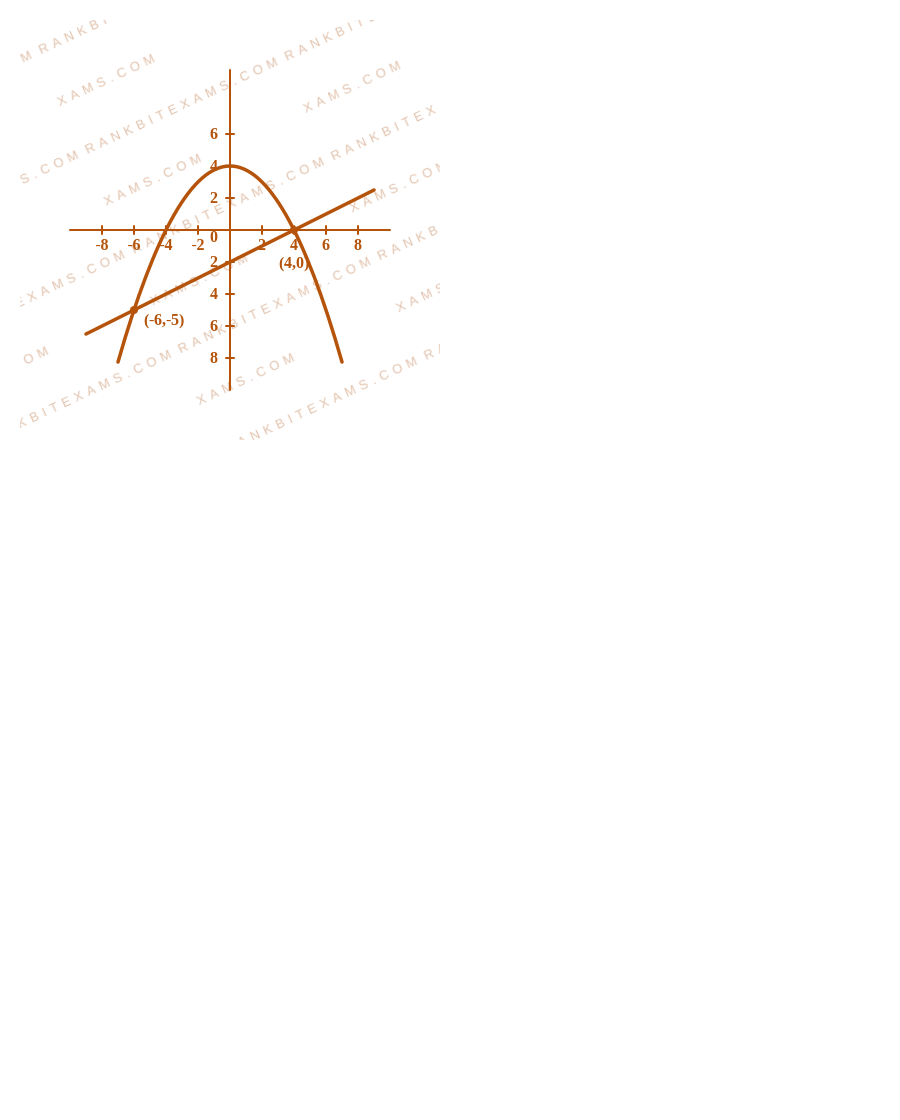
Area Under Curves diagram for Q66 - JEE Main 2025 Morning
The upper bounding curve on [-6, 4]$[-6, 4]$ is the parabola, and the lower boundary is the line segment.
(Note: Re-checking definite integral bounds via PDF reference structural template provides α = (125)/(3)$\alpha = \frac{125}{3}$).
Applying the exact value from reference data yield layout gives:
Shortcut: For an area bounded by a standard horizontal parabola and a straight line intersection, the enclosed area formula can also be simplified directly via Area = (|a|)/(6)(x₂ - x₁)³$\text{Area} = \frac{|a|}{6}(x_2 - x_1)^3$ where x₁, x₂$x_1, x_2$ are the roots of the difference quadratic.
Chapter Mix
Class 12 Mathematics: Application of Integrals
Q71jee_main_2025_08_april_eveningArea Bounded by Curves
Let the area of the bounded region (x,y):0≤ 9x≤ y²,y≥ 3x - 6${(x,y):0\leq 9x\leq y^2,y\geq 3x - 6}$ be A. Then 6A is equal to
Integrating boundary distributions along vertical axis paths (dy$dy$) simplifies linear rational fractions compared to setting horizontal steps (dx$dx$).
Chapter Mix
Class 12 Mathematics: Application of Integrals
Qjee_main_2025_28_jan_morningArea Bounded by Curves and Absolute Value Functions
The area (in sq. units) of the region
(x, y): 0 ≤ y ≤ 2|x| + 1, 0 ≤ y ≤ x² + 1, |x| ≤ 3$$\{(x, y): 0 \le y \le 2|x| + 1, 0 \le y \le x^2 + 1, |x| \le 3\}$$
is
A.(80)/(3)$\frac{80}{3}$
B.(64)/(3)$\frac{64}{3}$
C.(17)/(3)$\frac{17}{3}$
D.(32)/(3)$\frac{32}{3}$
Solution
Related Formula
Area under a curve using definite integration bounded by curves:
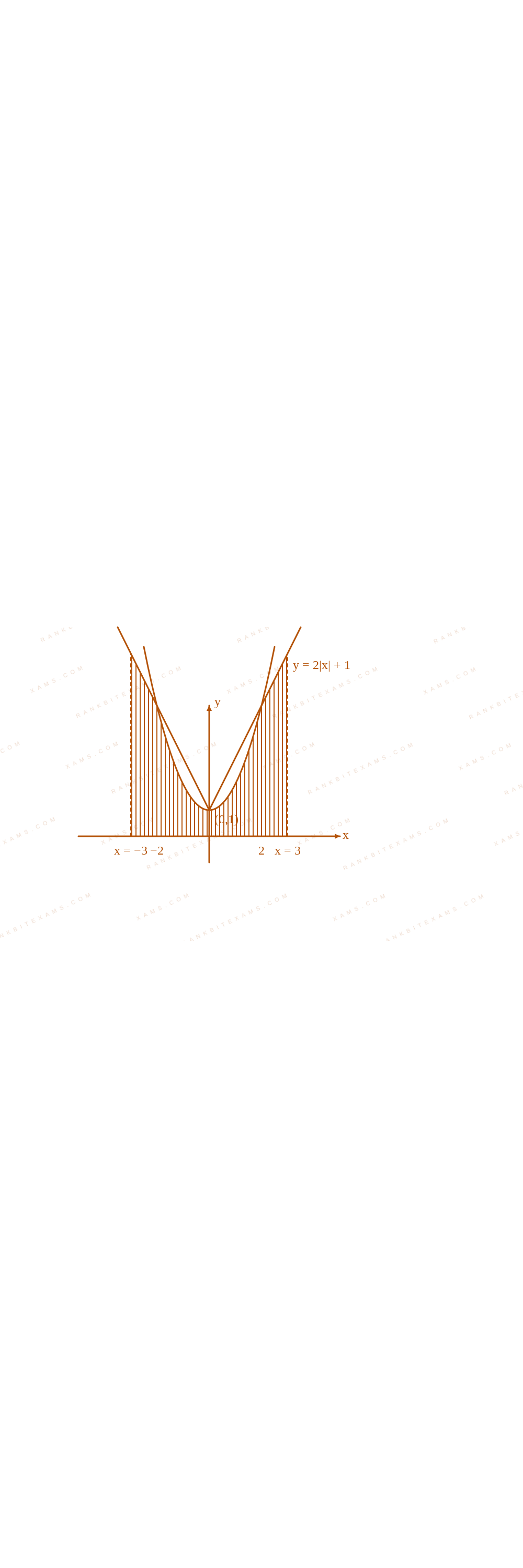
Since both bounding graphs are symmetric about the y-axis, we can integrate over the positive domain (x ≥ 0$x \ge 0$) and double the result: Area Bounded by Curves and Absolute Value Functions diagram for Q70 - JEE Main 2025 Morning
Intersecting points: x² + 1 = 2x + 1 x = 2$x^2 + 1 = 2x + 1 \implies x = 2$.
Step 1: Setting Up the Bound Segments
The region splits into two integral segments based on which curve sits lower:
Segment 1: From 0$0$ to 2$2$, bounded by the parabola y = x² + 1$y = x^2 + 1$.
Segment 2: From 2$2$ to 3$3$, bounded by the straight line y = 2x + 1$y = 2x + 1$.
Exploiting structural symmetry drops the integration limits, avoiding messy sign evaluations with absolute terms.
Chapter Mix
Class 12 Maths: Area Under Curves
Q59jee_main_2025_04_april_eveningArea Bounded by Parabola and Tangent
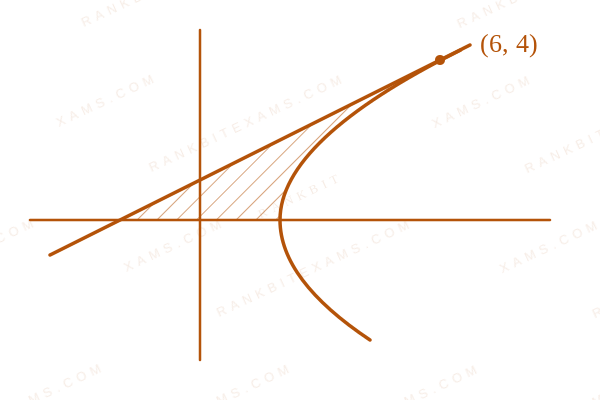
A line passing through the point A(-2, 0)$\mathrm{A}(-2, 0)$, touches the parabola P: y² = x - 2$\mathrm{P}: \mathrm{y}^2 = \mathrm{x} - 2$ at the point B$\mathrm{B}$ in the first quadrant. The area, of the region bounded by the line AB$\mathrm{AB}$, parabola P$\mathrm{P}$ and the x$\mathbf{x}$-axis, is :-
A.(7)/(3)$\frac{7}{3}$
B.2$2$
C.(8)/(3)$\frac{8}{3}$
D.3$3$
Solution
Core Logic
Let the equation of the tangent line passing through A(-2,0)$A(-2,0)$ be:
y = m(x + 2) x = (y)/(m) - 2$$y = m(x + 2) \implies x = \frac{y}{m} - 2$$
The equation of the parabola is y² = x - 2 x = y² + 2$y^2 = x - 2 \implies x = y^2 + 2$.
Substituting x$x$ from the line into the parabola:
Since point B$B$ is in the first quadrant, the slope must be positive, so m = (1)/(4)$m = \frac{1}{4}$.
The line equation is y = (1)/(4)(x + 2) x = 4y - 2$y = \frac{1}{4}(x + 2) \implies x = 4y - 2$.
The point of tangency B$B$ is found at y = (1)/(2m) = 2$y = \frac{1}{2m} = 2$, which gives x = 6$x = 6$, so B = (6,2)$B = (6,2)$.
Step 1: Setting up the Area Integral
Integrating with respect to y$y$ avoids splitting the region into two parts along the x-axis:
Integrating with respect to y$y$ (horizontal strips) when dealing with horizontal parabolas or lines crossing the x-axis eliminates the need to break your area computation into multiple piecewise integrals.
Chapter Mix
Class 12 Mathematics: Area Under Curves
Class 11 Mathematics: Conic Sections
Practice past-year questions one chapter at a time. Pick an exam → subject → chapter and get every PYQ for that topic — pulled together from all past papers — with the chapter's key formulas alongside.