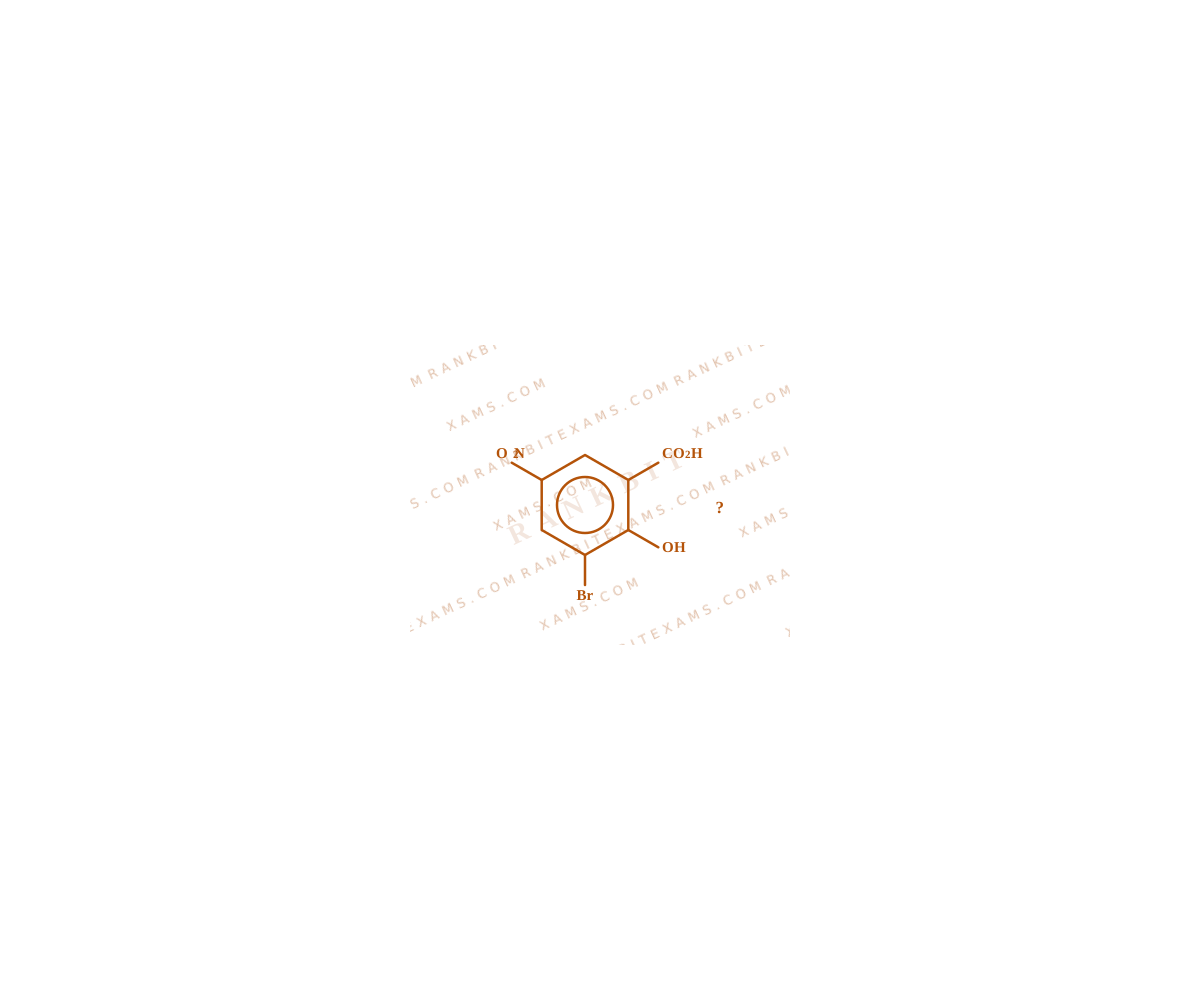
What is the correct IUPAC name of the compound given below?
Chemical structure for Q44 - JEE Main 2025 Evening
Substituted benzene derivative with carboxyl, hydroxyl, bromo, and nitro substituents.

Solution & Explanation

### Related Formula According to IUPAC rules for nomenclature of aromatic compounds: - Principal functional group has highest priority: -mathrmCOOH > -mathrmOH - The principal functional group carbon is designated as Carbon-1, and numbering is directed to give substituents the lowest possible locants. ### Core Logic Assign priority and number the ring: - Carbon-1: -mathrmCOOH (Carboxyl carbon, parent name 'benzoic acid') - Carbon-2: -mathrmOH (Hydroxyl substituent) - Carbon-3: -mathrmBr (Bromo substituent) - Carbon-5: -mathrmNO_2 (Nitro substituent) This numbering yields substituent locants at positions 2, 3, and 5. ### Step 1: Arrange alphabetically List the substituents alphabetically with locants: - 3-Bromo - 2-Hydroxy - 5-Nitro Combining these names: text3-Bromo-2-hydroxy-5-nitrobenzoic acid This matches Option (1). ### Pattern Recognition Carboxylic acid always dictates position 1 in ring numbering over alcohol. Numbering clockwise gives 2-hydroxy, 3-bromo, and 5-nitro, whereas counterclockwise numbering would yield much higher locants (2-nitro, 4-bromo, 5-hydroxy) which violates the lowest-locant rule. ### Evaluation Rubric / Model Answer null ### Chapter Mix Class 11 Chemistry: Organic Chemistry - Some Basic Principles and Techniques Class 12 Chemistry: Aldehydes, Ketones and Carboxylic Acids
IUPAC Nomenclature of Multi-substituted Benzenes
Substituted benzene derivative with carboxyl, hydroxyl, bromo, and nitro substituents.

More Organic Chemistry - Some Basic Principles and Techniques Previous-Year Questions

Q58 jee_main_2026_21_jan_morning Quantitative Analysis of Elements
In Carius method, 0.75 g of an organic compound gave 1.2 g of barium sulphate, find percentage of sulphur (molar mass 32text g mol^-1). Molar mass of barium sulphate is 233text g mol^-1.
  • A. 4.55\%
  • B. 10.30\%
  • C. 21.97\%
  • D. 16.48\%

Solution

### Related Formula textPercentage of Sulphur = fractextMass of S text in BaSO_4textMolar mass of BaSO_4 times fractextMass of BaSO_4 text formedtextMass of organic compound times 100 ### Core Logic Molar mass of BaSO_4 = 233 g/mol. Mass of Sulfur (S) in 1 mole of BaSO_4 = 32 g. Mass of BaSO_4 formed = 1.2 g. Mass of organic compound = 0.75 g. \% mathrmS = frac32233 times frac1.20.75 times 100 \% mathrmS = frac32 times 1.2 times 100233 times 0.75 = frac3840174.75 approx 21.97\% ### Evaluation Rubric / Model Answer null ### Chapter Mix Class 11 Chemistry: Organic Chemistry - Some Basic Principles and Techniques

Q62 jee_main_2026_21_jan_morning Resonance Effects
From the following, the least stable structure is :
  • A. textOption 1
  • B. textOption 2
  • C. textOption 3
  • D. textOption 4

Solution

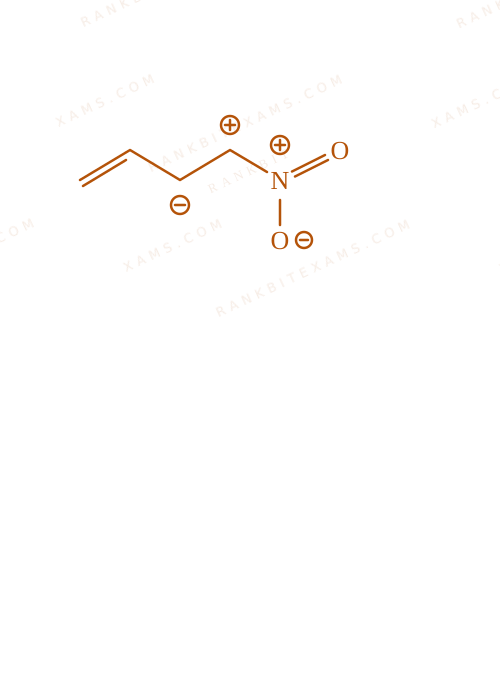
### Core Logic In structure 3, there are positive formal charges on two adjacent atoms (Oxygen and the Carbon adjacent to it). Like charges on adjacent atoms cause extreme electrostatic repulsion, making the structure highly unstable.
Resonance Effects diagram for Q62 - JEE Main 2026 Morning
### Pattern Recognition Rules of resonance stability: 1. Complete octets are more stable. 2. More covalent bonds = more stable. 3. Least charge separation is more stable. 4. Like charges on adjacent atoms create massive destabilization (Least stable scenario). ### Evaluation Rubric / Model Answer null ### Chapter Mix Class 11 Chemistry: Organic Chemistry - Some Basic Principles and Techniques
Q66 jee_main_2026_21_jan_morning Isomerism
Identify correct statement from the following: A. Propanal and propanone are functional isomers. B. Ethoxyethane and methoxypropane are metamers. C. But-2-ene shows optical isomerism. D. But-1-ene and but-2-ene are functional isomers. E. Pentane and 2, 2-dimethyl propane are chain isomers. Choose the correct answer from the options given below:
  • A. textB, C and D only
  • B. textA, B and C only
  • C. textA, B and E only
  • D. textC, D and E only

Solution

### Core Logic A. Propanal (CH_3CH_2CHO) and propanone (CH_3COCH_3) have different functional groups (aldehyde vs ketone) but the same molecular formula. They are functional isomers. (Correct) B. Ethoxyethane (C_2H_5-O-C_2H_5) and methoxypropane (CH_3-O-C_3H_7) differ in the alkyl chains attached to the polyvalent oxygen atom. They are metamers. (Correct) C. But-2-ene shows geometrical isomerism (cis-trans), but no optical isomerism as it lacks a chiral center. (Incorrect) D. But-1-ene and but-2-ene differ in the position of the double bond. They are position isomers, not functional isomers. (Incorrect) E. Pentane (straight chain) and 2,2-dimethyl propane (branched chain) have the same formula C_5H_12 but different carbon skeletons. They are chain isomers. (Correct) Correct statements: A, B, and E. ### Pattern Recognition Metamerism arises when there is a difference in the alkyl groups attached to a polyvalent functional group (e.g., -O-, -S-, -NH-, -CO-). ### Evaluation Rubric / Model Answer null ### Chapter Mix Class 11 Chemistry: Organic Chemistry - Some Basic Principles and Techniques
Q jee_main_2025_02_april_evening Hybridization in Organic Compounds
In 3, 3-dimethylhex-1-ene-4-yne, there are mathbfsp^3, mathbfsp^2 and mathbfsp hybridised carbon atoms respectively:
  • A. 4, 2, 2
  • B. 3, 3, 2
  • C. 2, 4, 2
  • D. 2, 2, 4

Solution

### Related Formula textHybridization of Carbon = begincases mathrmsp^3 & 4~sigmatext-bonds \\ mathrmsp^2 & 3~sigmatext-bonds, 1~pitext-bond \\ mathrmsp & 2~sigmatext-bonds, 2~pitext-bonds endcases ### Core Logic Let's first draw the structural formula of **3,3-dimethylhex-1-ene-4-yne**:
Hybridization in Organic Compounds
overset6mathrmCmathrmH_3 - overset5mathrmC equiv overset4mathrmC - overset3mathrmC(mathrmCH_3)_2 - overset2mathrmCmathrmH = overset1mathrmCmathrmH_2 ### Step 1: Identify Hybridization of Each Carbon We count the sigma (sigma) bonds or pi (pi) bonds on each carbon: - **mathrmC_1**: Involved in a double bond (mathrmCH_2 =) implies mathrmsp^2 - **mathrmC_2**: Involved in a double bond (=mathrmCH-) implies mathrmsp^2 - **mathrmC_3**: Single bonds only (bonded to mathrmC_2, mathrmC_4, and two methyl carbons) implies mathrmsp^3 - **Two methyl carbons** attached to mathrmC_3: Single bonds only implies 2 times mathrmsp^3 - **mathrmC_4**: Involved in a triple bond (-mathrmC equiv) implies mathrmsp - **mathrmC_5**: Involved in a triple bond (equiv mathrmC-) implies mathrmsp - **mathrmC_6**: Single bonds only (-mathrmCH_3) implies mathrmsp^3 ### Step 2: Calculate the Count Summing the hybridization counts: - mathrmsp^3 carbons: mathrmC_3, mathrmC_6, and 2 times mathrmCH_3 on mathrmC_3 = 4 carbon atoms - mathrmsp^2 carbons: mathrmC_1 and mathrmC_2 = 2 carbon atoms - mathrmsp carbons: mathrmC_4 and mathrmC_5 = 2 carbon atoms Thus, the number of mathrmsp^3, mathrmsp^2 and mathrmsp hybridized carbons is 4, 2, 2 respectively. ### Pattern Recognition Quick Tip: Always draw side substituents (like methyl groups) explicitly. A common mistake is to skip counting the methyl substituent carbons as mathrmsp^3. ### Evaluation Rubric / Model Answer null ### Chapter Mix Class 11 Chemistry: Organic Chemistry - Some Basic Principles and Techniques
Q jee_main_2025_02_april_evening Methods of Purification of Organic Compounds
Match List-I with List-II: beginarray|l|l| hline beginarrayc textbfList-I \\ textbf(Purification technique) endarray & beginarrayc textbfList-II \\ textbf(Mixture of organic compounds) endarray \\ hline text(A) quad textDistillation (simple) & text(I) quad textDiesel + Petrol \\ hline text(B) quad textFractional distillation & text(II) quad textAniline + Water \\ hline text(C) quad textDistillation under reduced pressure & text(III) quad textChloroform + Aniline \\ hline text(D) quad textSteam distillation & text(IV) quad textGlycerol + Spent-lye \\ hline endarray Choose the correct answer from the options given below:
  • A. text(A)-(II), (B)-(III), (C)-(IV), (D)-(I)
  • B. text(A)-(II), (B)-(IV), (C)-(I), (D)-(III)
  • C. text(A)-(III), (B)-(IV), (C)-(II), (D)-(I)
  • D. text(A)-(III), (B)-(I), (C)-(IV), (D)-(II)

Solution

### Related Formula textMethod Selection = fleft( Delta T_mathrmb, textdecomposition threshold, textvolatility with steam right) ### Core Logic Let's align each purification technique to its designated mixtures based on NCERT guidelines: - **(A) Simple distillation**: Used for liquids having a significant difference in their boiling points (>30~mathrmK or 30^circmathrmC). Chloroform (b.p. 334~mathrmK) and aniline (b.p. 457~mathrmK) are separated easily using simple distillation rightarrow **(III)**. - **(B) Fractional distillation**: Used if boiling point differences of the components are very close (less than 25~mathrmK). Separation of petrochemical fractions such as diesel and petrol uses this technique rightarrow **(I)**. - **(C) Distillation under reduced pressure**: Used for liquids that tend to decompose at or below their normal boiling points. Glycerol is separated from spent-lye in soap manufacturing industry using this vacuum method to prevent glycerol decomposition rightarrow **(IV)**. - **(D) Steam distillation**: Applied to substances which are steam-volatile and completely immiscible in water. Aniline and water are separated using this technique rightarrow **(II)**. ### Step 1: Conclusion Thus, the correct match is: **(A)-(III), (B)-(I), (C)-(IV), (D)-(II)** This corresponds perfectly to option (4). ### Pattern Recognition Glycerol from spent-lye is a highly tested practical chemistry concept. Remember that vacuum distillation lowers the boiling point, permitting evaporation without decomposition. ### Evaluation Rubric / Model Answer null ### Chapter Mix Class 11 Chemistry: Organic Chemistry - Some Basic Principles and Techniques
Rankbit System
JEE Physics: Waves (+15.5%) | Electrostatics: Concentric Shells (-29.7%) | Modern Physics: Photoelectric Clones (+34.2%) | Mathematics: Definite Integrals (+18.1%) | Chemistry: Coordination Splitting (-11.4%) | JEE Physics: Waves (+15.5%) | Electrostatics: Concentric Shells (-29.7%) | Modern Physics: Photoelectric Clones (+34.2%) | Mathematics: Definite Integrals (+18.1%) | Chemistry: Coordination Splitting (-11.4%)