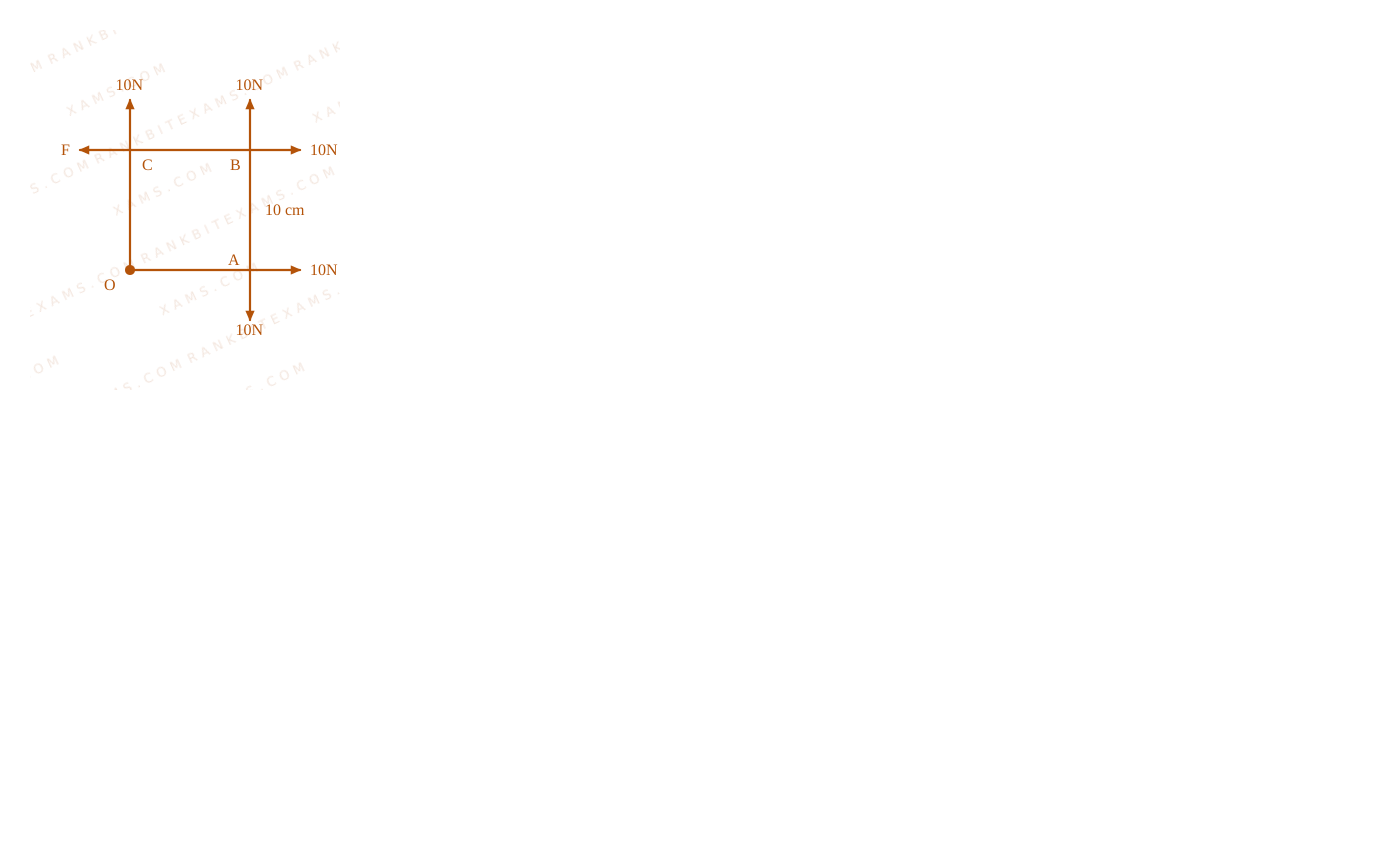
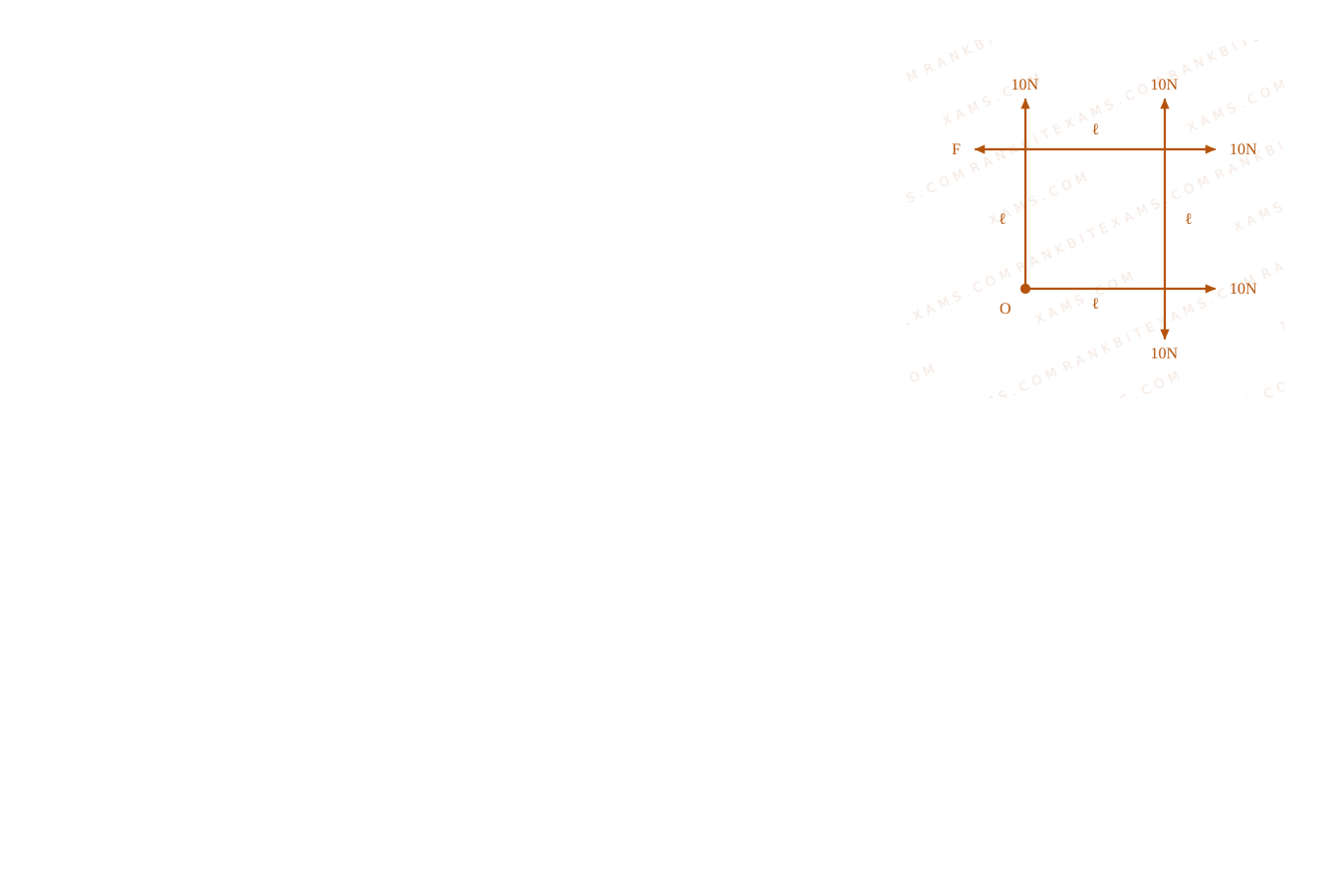
A square Lamina OABC of length 10mathrm~cm is pivoted at 'O'. Forces act on the Lamina as shown in the figure. If the Lamina remains stationary, then the magnitude of F is:
Square lamina pivoted at O diagram for Q13
A square lamina OABC with multiple force vectors acting on its vertices, pivoted at O.

Solution & Explanation

### Related Formula tau_O = F cdot r_perp sum tau_O = 0 quad text(for rotational equilibrium) ### Core Logic Let the side length of the square lamina be l = 10mathrm~cm. The lamina is pivoted at point O(0,0) and remains stationary under rotational equilibrium. Therefore, the net torque about O must be zero. Evaluating torque contributions about point O: - Forces acting directly at pivot O produce zero torque. - Forces whose lines of action pass through O produce zero torque. - The 10mathrm~N force perpendicular to side OA produces torque: tau_1 = 10 times l quad text(Counter-Clockwise) - The unknown force F acting perpendicular to side OC produces torque: tau_2 = F times l quad text(Clockwise) Setting sum tau_O = 0: 10 cdot l - F cdot l = 0 implies F = 10mathrm~N ### Step 1: Final Conclusion The magnitude of the force F is 10\mathrm{~N}$. ### Pattern Recognition In pivoted laminas, focus on the pivot and disregard any force vector whose line of action passes through the pivot. For symmetric placements, equate Clockwise torque = Counter-Clockwise torque directly. ### Evaluation Rubric / Model Answer null ### Chapter Mix Class 11 Physics: Rotational Motion
Torque analysis on pivoted square lamina
A square lamina OABC with multiple force vectors acting on its vertices, pivoted at O.

Reference Study Guides

More Rotational Motion Previous-Year Questions — Page 7

Q60 jee_main_2024_29_january_evening Angular Momentum of a Particle
A body of mass 5text kg moving with a uniform speed 3sqrt2text ms^-1 in X–Y plane along the line y = x + 4. The angular momentum of the particle about the origin will be ______ textkg m^2texts^-1.
Numerical Answer. Answer: 60 to 60

Solution

### Related Formula The magnitude of the angular momentum L of a particle of mass m moving with velocity v is: L = m v d where: * d is the perpendicular distance from the axis of rotation (origin) to the line of motion of the particle. ### Core Logic Given parameters: * Mass, m = 5text kg * Velocity, v = 3sqrt2text ms^-1 * Line of motion: y = x + 4 implies x - y + 4 = 0 ### Step 1: Calculate Perpendicular Distance The perpendicular distance d from the origin (0,0) to the line Ax + By + C = 0 is: d = frac|A(0) + B(0) + C|sqrtA^2 + B^2 For the line x - y + 4 = 0: d = frac|4|sqrt1^2 + (-1)^2 = frac4sqrt2 = 2sqrt2text m ### Step 2: Calculate Angular Momentum Substitute the values into the angular momentum formula: L = m v d L = 5text kg times (3sqrt2text ms^-1) times (2sqrt2text m) L = 5 times 3 times 4 = 60text kg m^2texts^-1 Thus, the angular momentum of the particle about the origin is 60text kg m^2texts^-1. ### Pattern Recognition Instead of complicated vector cross products, find the perpendicular distance of the straight line from the origin using standard coordinate geometry. L = mvd is extremely fast and reliable. ### Evaluation Rubric / Model Answer null ### Chapter Mix Class 11 Physics: System of Particles and Rotational Motion
Q56 jee_main_2024_27_jan_morning Moment of Inertia
Four particles each of mass 1text kg are placed at four corners of a square of side 2text m. The moment of inertia of the system about an axis perpendicular to its plane and passing through one of its vertices is ______ textkgcdottextm^2.
Numerical Answer. Answer: 16 to 16

Solution

### Related Formula I = sum m_i r_i^2 ### Core Logic Let the axis pass through vertex 1. Evaluate distances (r) for each corner particle: - Particle at vertex 1: r_1 = 0 - Particle at adjacent vertex 2: r_2 = a - Particle at adjacent vertex 4: r_4 = a - Particle at diagonally opposite vertex 3: r_3 = sqrt2a ### Step 1: Set up substitution formula I = m(0)^2 + m(a)^2 + m(a)^2 + m(sqrt2a)^2 I = ma^2 + ma^2 + 2ma^2 = 4ma^2 ### Step 2: Numeric Evaluation Substitute m = 1text kg and side length a = 2text m: I = 4 times 1 times (2)^2 = 4 times 4 = 16text kgcdottextm^2 ### Pattern Recognition For a standard planar configuration system, total orthogonal moment components map predictably via basic summation configurations matching 4ma^2 exactly. ### Evaluation Rubric / Model Answer null ### Chapter Mix Class 11 Physics: System of Particles and Rotational Motion

Q54 jee_main_2024_29_jan_morning Rolling Motion
A cylinder is rolling down on an inclined plane of inclination 60^circ. It's acceleration during rolling down will be fracxsqrt3 mathrm~m / s^2, where x = ________ (use g = 10 mathrm~m/s^2).
Numerical Answer. Answer: 10 to 10

Solution

### Related Formula The linear acceleration (a) of a symmetric body performing pure rolling down an inclined plane of angle theta is given by: a = fracg sin theta1 + fracI_textcmM R^2 ### Core Logic For a solid cylinder, the moment of inertia about its central longitudinal axis is: I_textcm = frac12 M R^2 implies fracI_textcmM R^2 = frac12 Given inclination angle, theta = 60^circ, and g = 10 mathrm~m/s^2.
Free body diagram of a rolling cylinder on an incline for Q54
### Step 1: Calculate Linear Acceleration Substituting the values into the acceleration template: a = frac10 times sin 60^circ1 + frac12 = frac10 times fracsqrt32frac32 a = frac10 sqrt33 = frac10sqrt3 mathrm~m/s^2 ### Step 2: Solve for x Comparing this evaluated value with the expression \frac{x}{\sqrt{3}}: frac10sqrt3 = fracxsqrt3 implies x = 10 Therefore, the value of x is 10. ### Pattern Recognition Pure rolling problems reduce down to tracking the shape factor fraction \beta = 1 + \frac{I}{MR^2}. For solid cylinders it is 1.5, for solid spheres it is 1.4, and for hoops it is 2.0$. This value acts as an effective inertial scaling factor for gravity. ### Evaluation Rubric / Model Answer null ### Chapter Mix Class 11 Physics: System of Particles and Rotational Motion
Q53 jee_main_2024_30_january_evening Loss in Kinetic Energy on Coupling
Two discs of moment of inertia mathrmI_1 = 4 mathrm~kg mathrm~m^2 and mathrmI_2 = 2 mathrm~kg mathrm~m^2 about their central axes & normal to their planes, rotating with angular speeds 10 mathrm~rad/s & 4 mathrm~rad/s respectively are brought into contact face to face with their axe of rotation coincident. The loss in kinetic energy of the system in the process is ________ mathrmJ.
Numerical Answer. Answer: 24 to 24

Solution

### Related Formula textC.O.A.M: I_1 omega_1 + I_2 omega_2 = (I_1 + I_2) omega_textfinal Delta K.E. = frac12 fracI_1 I_2I_1 + I_2 (omega_1 - omega_2)^2 ### Core Logic When two rotating discs are brought into contact, they exert friction on each other until they reach a common angular velocity. Angular momentum is conserved about the central axis. We can use the conservation of angular momentum to find the final angular velocity, or use the direct formula for loss in kinetic energy. ### Step 1: Calculate Final Angular Velocity (Alternative Method) I_1 omega_1 + I_2 omega_2 = (I_1 + I_2)omega_0 4(10) + 2(4) = (4 + 2)omega_0 40 + 8 = 6omega_0 implies omega_0 = 8 mathrm~rad/s ### Step 2: Calculate Kinetic Energy Loss Initial Energy mathrmE_1 = frac12 I_1 omega_1^2 + frac12 I_2 omega_2^2 mathrmE_1 = frac12(4)(100) + frac12(2)(16) = 200 + 16 = 216 mathrm~J Final Energy mathrmE_2 = frac12 (I_1 + I_2) omega_0^2 mathrmE_2 = frac12 (6) (8^2) = 3 times 64 = 192 mathrm~J Loss Delta E = mathrmE_1 - mathrmE_2 = 216 - 192 = 24 mathrm~J ### Pattern Recognition The loss formula \Delta K = \frac{1}{2} \frac{I_1 I_2}{I_1 + I_2} (\omega_1 - \omega_2)^2 is incredibly fast: \frac{1}{2} \times \frac{4 \times 2}{6} \times (10 - 4)^2 = \frac{1}{2} \times \frac{8}{6} \times 36 = \frac{4}{6} \times 36 = 24 \mathrm{~J}$. ### Evaluation Rubric / Model Answer null ### Chapter Mix Class 11 Physics: System of Particles and Rotational Motion
Q47 jee_main_2024_30_jan_morning Impulse and Momentum
A spherical body of mass 100 mathrm~g is dropped from a height of 10 mathrm~m from the ground. After hitting the ground, the body rebounds to a height of 5 mathrm~m. The impulse of force imparted by the ground to the body is given by: (given g = 9.8 mathrm~m / s^2)
  • A. 4.32 mathrm~kg\,ms^-1
  • B. 43.2 mathrm~kg\,ms^-1
  • C. 23.9 mathrm~kg\,ms^-1
  • D. 2.39 mathrm~kg\,ms^-1

Solution

### Related Formula v = sqrt2gh vecI = Delta vecP = m(vecv_f - vecv_i) ### Core Logic Impulse delivered by the ground equals the total change in momentum of the body during the collision. We must compute the velocity immediately before impact and immediately after rebound, respecting their opposite vector directions. ### Step 1: Calculate Velocities Velocity just before hitting the ground (v_i): v_i = sqrt2 times 9.8 times 10 = sqrt196 = -14 mathrm~m/s quad (textdownwards) Velocity just after rebounding (v_f): v_f = sqrt2 times 9.8 times 5 = sqrt98 = +7sqrt2 mathrm~m/s quad (textupwards) ### Step 2: Calculate Impulse Mass M = 100 mathrm~g = 0.1 mathrm~kg vecI = Delta P = m(v_f - v_i) vecI = 0.1 times [7sqrt2 - (-14)] vecI = 0.1(14 + 7sqrt2) Since sqrt2 approx 1.414: vecI = 0.1(14 + 7(1.414)) = 0.1(14 + 9.898) = 0.1(23.898) vecI approx 2.39 mathrm~kg\,ms^-1 ### Pattern Recognition When dealing with rebounds, Delta v is the sum of magnitudes |v_1| + |v_2| because the direction reverses. A common trap is to subtract the magnitudes instead of adding. ### Evaluation Rubric / Model Answer null ### Chapter Mix Class 11 Physics: System of Particles and Rotational Motion Class 11 Physics: Kinematics

More Rotational Motion Questions — jee_main_2025_02_april_morning

Practice all Rotational Motion previous-year questions →

Rankbit System
JEE Physics: Waves (+15.5%) | Electrostatics: Concentric Shells (-29.7%) | Modern Physics: Photoelectric Clones (+34.2%) | Mathematics: Definite Integrals (+18.1%) | Chemistry: Coordination Splitting (-11.4%) | JEE Physics: Waves (+15.5%) | Electrostatics: Concentric Shells (-29.7%) | Modern Physics: Photoelectric Clones (+34.2%) | Mathematics: Definite Integrals (+18.1%) | Chemistry: Coordination Splitting (-11.4%)