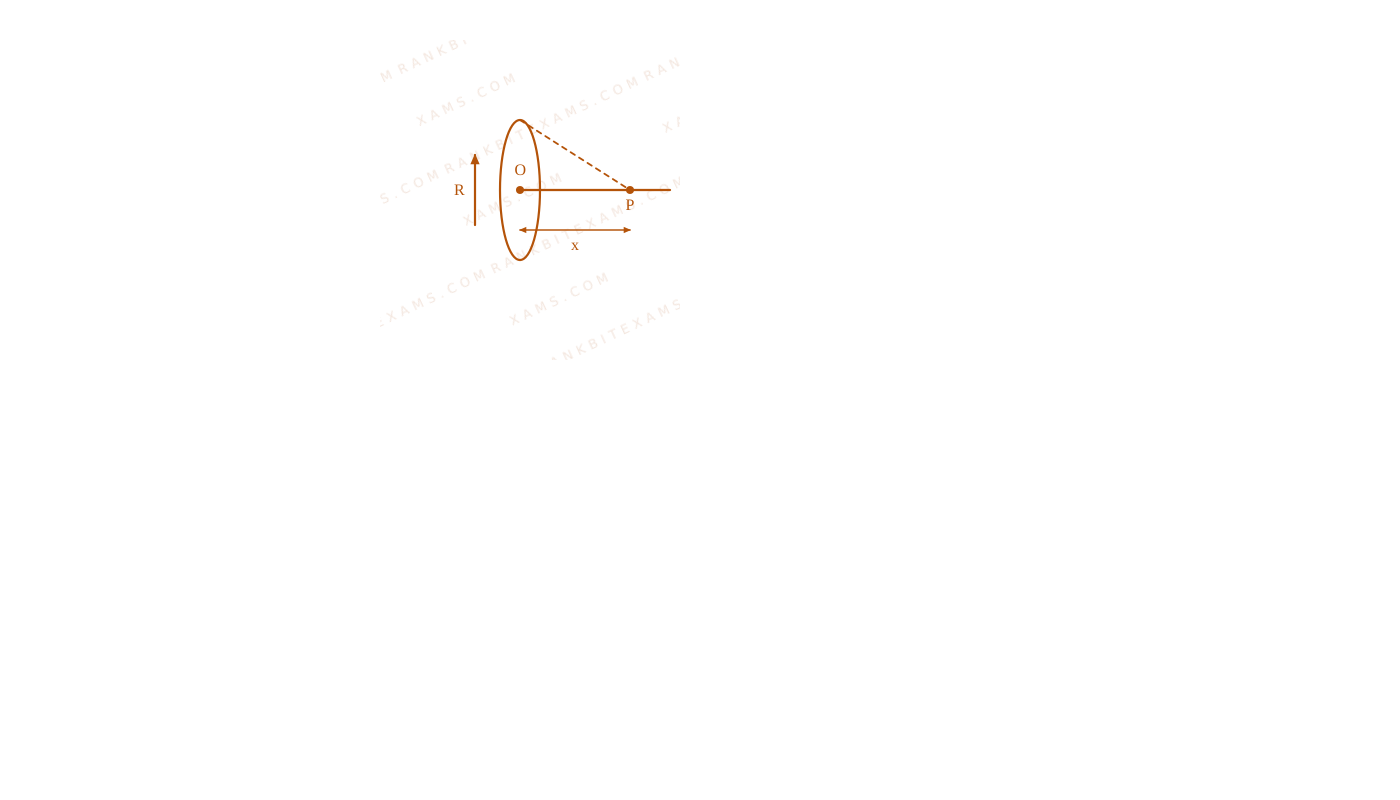
Let B_1$B_1$ be the magnitude of magnetic field at center of a circular coil of radius R$R$ carrying current I$I$. Let B_2$B_2$ be the magnitude of magnetic field at an axial distance 'x$x$' from the center. For x:R = 3:4$x:R = 3:4$, fracB_2B_1$\frac{B_2}{B_1}$ is:
A.4:5
B.16:25
C.64:125
D.25:16
Solution & Explanation
### Related Formula
B_1 = fracmu_0 I2R$$B_1 = \frac{\mu_0 I}{2R}$$B_2 = fracmu_0 I R^22(R^2 + x^2)^3/2$$B_2 = \frac{\mu_0 I R^2}{2(R^2 + x^2)^{3/2}}$$B_2 = B_1 sin^3theta quad textwhere sintheta = fracRsqrtR^2 + x^2$$B_2 = B_1 \sin^3\theta \quad \text{where } \sin\theta = \frac{R}{\sqrt{R^2 + x^2}}$$
### Core Logic
Given the ratio x : R = 3 : 4$x : R = 3 : 4$. Let x = 3k$x = 3k$ and R = 4k$R = 4k$.
The distance to the element is:
sqrtR^2 + x^2 = sqrt(4k)^2 + (3k)^2 = 5k$$\sqrt{R^2 + x^2} = \sqrt{(4k)^2 + (3k)^2} = 5k$$
The sine of the semi-vertical angle subtended at the axial point is:
sintheta = fracRsqrtR^2 + x^2 = frac4k5k = frac45$$\sin\theta = \frac{R}{\sqrt{R^2 + x^2}} = \frac{4k}{5k} = \frac{4}{5}$$
We know that the axial magnetic field relates to the central magnetic field as follows:
fracB_2B_1 = sin^3theta = left(frac45right)^3 = frac64125$$\frac{B_2}{B_1} = \sin^3\theta = \left(\frac{4}{5}\right)^3 = \frac{64}{125}$$
### Step 1: Final Conclusion
The ratio fracB_2B_1$\frac{B_2}{B_1}$ is 64:125$64:125$.
### Pattern Recognition
For axial magnetic field problems, bypass manual calculation of (R^2+x^2)^3/2$(R^2+x^2)^{3/2}$ by writing the relation directly in terms of the subtended angle: B_textaxial = B_textcenter sin^3theta$B_{\text{axial}} = B_{\text{center}} \sin^3\theta$.
### Evaluation Rubric / Model Answer
null
### Chapter Mix
Class 12 Physics: Magnetic Effects of Current
Axial magnetic field geometry
More Magnetic Effects of Current Previous-Year Questions
Q14jee_main_2025_08_april_eveningBiot-Savart Law
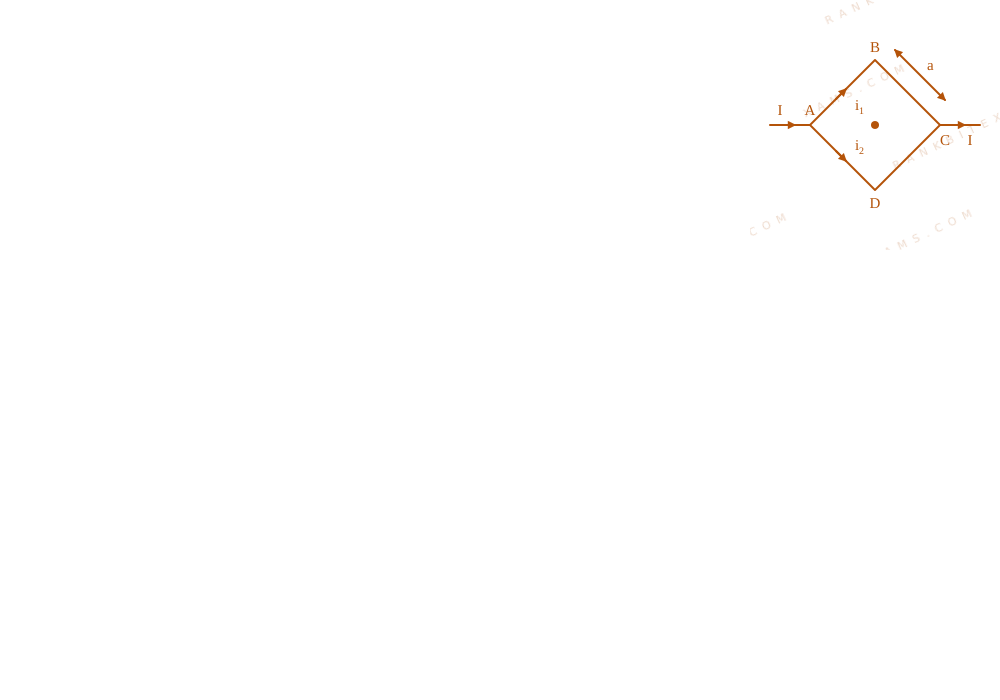
Figure shows a current carrying square loop ABCD of edge length is 'a' lying in a plane. If the resistance of the ABC part is r$r$ and that of ADC part is 2r$2r$, then the magnitude of the resultant magnetic field at centre of the square loop is:
A schematic of a square current loop labeled ABCD with path ABC having resistance r and path ADC having resistance 2r, causing incoming current to divide.
### Related Formula
B_textwire = fracmu_0 I4pi d left(sintheta_1 + sintheta_2right)$$B_{\text{wire}} = \frac{\mu_0 I}{4\pi d} \left(\sin\theta_1 + \sin\theta_2\right)$$
where,
B_textwire$B_{\text{wire}}$ = magnetic field due to a straight wire segment
d$d$ = perpendicular distance from center to wire segment (d = a/2$d = a/2$)
theta_1, theta_2$\theta_1, \theta_2$ = subtended angles at the center
### Core Logic
The loop parts ABC and ADC are in parallel. Let total current entering corner A and leaving corner C be I$I$.
- Resistance of path ABC = r$r$
- Resistance of path ADC = 2r$2r$
Using current divider rule:
- Current in path ABC, I_1 = frac2rr + 2r I = frac23 I$I_1 = \frac{2r}{r + 2r} I = \frac{2}{3} I$
- Current in path ADC, I_2 = fracrr + 2r I = frac13 I$I_2 = \frac{r}{r + 2r} I = \frac{1}{3} I$
Now, calculate the magnetic field contribution at center O$O$:
- Distance of center from each of the 4 wire segments is d = fraca2$d = \frac{a}{2}$.
- For each segment, the angles are theta_1 = theta_2 = 45^circ$\theta_1 = \theta_2 = 45^\circ$:
B_textsegment = fracmu_0 i4pi (a/2) left(sin 45^circ + sin 45^circright) = fracmu_0 i2pi a sqrt2$$B_{\text{segment}} = \frac{\mu_0 i}{4\pi (a/2)} \left(\sin 45^\circ + \sin 45^\circ\right) = \frac{\mu_0 i}{2\pi a} \sqrt{2}$$
### Step 1: Summing the Fields at the Center
Using right-hand rule to find the direction of magnetic fields:
- Paths AB and BC (carrying I_1$I_1$ clockwise) create fields pointing into the page (-hatk$-\hat{k}$).
- Paths AD and DC (carrying I_2$I_2$ counter-clockwise) create fields pointing out of the page (+hatk$+\hat{k}$).
B_textnet = 2 B_textsegment(I_2) - 2 B_textsegment(I_1)$$B_{\text{net}} = 2 B_{\text{segment}}(I_2) - 2 B_{\text{segment}}(I_1)$$B_textnet = 2 left[ fracmu_0 (I/3)2pi a sqrt2 right] - 2 left[ fracmu_0 (2I/3)2pi a sqrt2 right]$$B_{\text{net}} = 2 \left[ \frac{\mu_0 (I/3)}{2\pi a} \sqrt{2} \right] - 2 \left[ \frac{\mu_0 (2I/3)}{2\pi a} \sqrt{2} \right]$$B_textnet = fracsqrt2mu_0 Ipi a left( frac13 - frac23 right) = -fracsqrt2mu_0 I3pi ahatk$$B_{\text{net}} = \frac{\sqrt{2}\mu_0 I}{\pi a} \left( \frac{1}{3} - \frac{2}{3} \right) = -\frac{\sqrt{2}\mu_0 I}{3\pi a}\hat{k}$$
Taking the magnitude of the field:
|B_textnet| = fracsqrt2mu_mathrmo I3pi a$$|B_{\text{net}}| = \frac{\sqrt{2}\mu_{\mathrm{o}} I}{3\pi a}$$
### Pattern Recognition
Sees: Current divides into parallel paths of a symmetric loop.
Trap: In a completely symmetric square loop (equal resistances), the net magnetic field at the center is exactly 0$0$. However, here the paths have unequal resistances (r$r$ and 2r$2r$), which prevents total cancellation.
Shortcut: Find the net effective current imbalance Delta I = I_1 - I_2 = frac23I - frac13I = frac13I$\Delta I = I_1 - I_2 = \frac{2}{3}I - \frac{1}{3}I = \frac{1}{3}I$. The magnitude is simply the magnetic field contribution of two sides carrying this net imbalance. ✓
### Evaluation Rubric / Model Answer
null
### Chapter Mix
Class 12 Physics: Magnetic Effects of Current
Q22jee_main_2025_03_april_morningMagnetic Force on a Straight Wire
A 4.0mathrm~cm$4.0\mathrm{~cm}$ long straight wire carrying a current of 8mathrm~A$8\mathrm{~A}$ is placed perpendicular to an uniform magnetic field of strength 0.15mathrm~T$0.15\mathrm{~T}$. The magnetic force on the wire is ________ mathrmmN$\mathrm{mN}$.
Numerical Answer.Answer: 48 to 48
Solution
### Related Formula
Magnetic force on a current-carrying straight wire:
F = I (vecL times vecB) = I L B sin theta$$F = I (\vec{L} \times \vec{B}) = I L B \sin \theta$$
where,
I$I$ = current,
L$L$ = length of the wire,
B$B$ = magnetic field strength,
theta$\theta$ = angle between current direction and magnetic field.
### Core Logic
Given values:
- Length, L = 4.0mathrm~cm = 0.04mathrm~m$L = 4.0\mathrm{~cm} = 0.04\mathrm{~m}$
- Current, I = 8mathrm~A$I = 8\mathrm{~A}$
- Magnetic field strength, B = 0.15mathrm~T$B = 0.15\mathrm{~T}$
- Since the wire is placed perpendicular to the field: theta = 90^circ implies sin 90^circ = 1$\theta = 90^{\circ} \implies \sin 90^{\circ} = 1$
### Step 1: Substitution and Calculation
Substitute values into the force formula:
F = 8 times 0.04 times 0.15 times 1$$F = 8 \times 0.04 \times 0.15 \times 1$$F = 0.32 times 0.15 = 0.048mathrm~N$$F = 0.32 \times 0.15 = 0.048\mathrm{~N}$$
Convert this force into millinewtons (mathrmmN$\mathrm{mN}$):
F = 0.048 times 1000 = 48mathrm~mN$$F = 0.048 \times 1000 = 48\mathrm{~mN}$$
### Pattern Recognition
Simple, direct application of Bil-sin-theta! Ensure units are converted to standard SI (meters, amperes, tesla) first, and then converted back into millinewtons at the very end to prevent decimal errors.
### Evaluation Rubric / Model Answer
null
### Chapter Mix
Class 12 Physics: Moving Charges and Magnetism
Q24jee_main_2025_03_april_morningMagnetic Field at the Center of Circular Segments
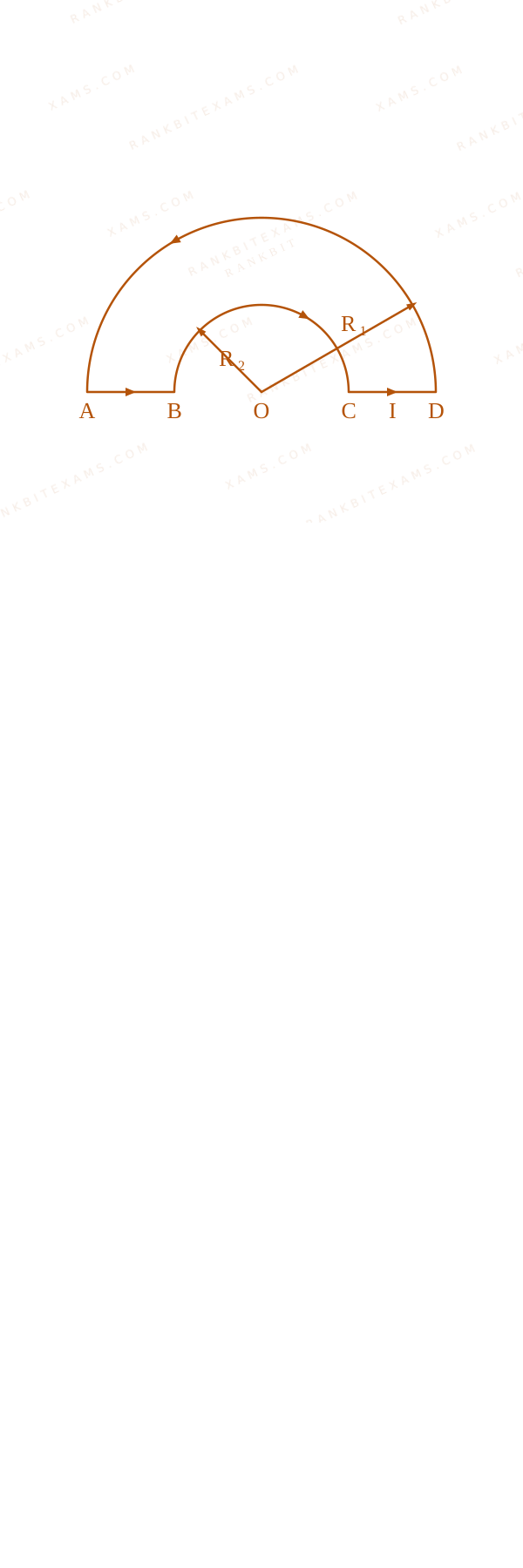
A loop ABCDA, carrying current I = 12mathrm~A$I = 12\mathrm{~A}$, is placed in a plane, consists of two semi-circular segments of radius R_1 = 6pimathrm~m$R_1 = 6\pi\mathrm{~m}$ and R_2 = 4pimathrm~m$R_2 = 4\pi\mathrm{~m}$. The magnitude of the resultant magnetic field at center O is ktimes 10^-7mathrm~T$k\times 10^{-7}\mathrm{~T}$ The value of k is ________. (Given mu_0=4pitimes10^-7mathrm~Tcdot mcdot A^-1$\mu_{0}=4\pi\times10^{-7}\mathrm{~T\cdot m\cdot A}^{-1}$)
A current loop containing two concentric semicircular segments of radii R1 and R2 connected by radial straight segments, with common center O.
Numerical Answer.Answer: 1 to 1
Solution
### Related Formula
Magnetic field at the center of a circular segment of angle theta$\theta$:
B = fracmu_0 I4pi R theta$$B = \frac{\mu_0 I}{4\pi R} \theta$$
For a semicircle (theta = pi$\theta = \pi$):
B_textsemi = fracmu_0 I4 R$$B_{\text{semi}} = \frac{\mu_0 I}{4 R}$$
### Core Logic
Let's analyze the contributions from each part of the loop to the magnetic field at the center O$O$:
- The straight wire segments AB$AB$ and CD$CD$ lie along radial lines passing directly through O$O$. Since dvecl parallel vecr$d\vec{l} \parallel \vec{r}$, their magnetic field contribution is zero:
B_textAB = B_textCD = 0$$B_{\text{AB}} = B_{\text{CD}} = 0$$
- Semicircular segment of radius R_2 = 4pimathrm~m$R_2 = 4\pi\mathrm{~m}$ carries current creating a field pointing out of the page (by right-hand rule):
B_R2 = fracmu_0 I4 R_2 quad (textOut of page)$$B_{R2} = \frac{\mu_0 I}{4 R_2} \quad (\text{Out of page})$$
- Semicircular segment of radius R_1 = 6pimathrm~m$R_1 = 6\pi\mathrm{~m}$ carries current creating a field pointing into the page:
B_R1 = fracmu_0 I4 R_1 quad (textInto page)$$B_{R1} = \frac{\mu_0 I}{4 R_1} \quad (\text{Into page})$$
### Step 1: Calculating Resultant Field
Since R_2 < R_1$R_2 < R_1$, the field B_R2$B_{R2}$ is stronger. The net magnetic field is:
B_textnet = B_R2 - B_R1 = fracmu_0 I4left(frac1R_2 - frac1R_1right)$$B_{\text{net}} = B_{R2} - B_{R1} = \frac{\mu_0 I}{4}\left(\frac{1}{R_2} - \frac{1}{R_1}\right)$$
Substitute the given values (I = 12mathrm~A$I = 12\mathrm{~A}$, R_2 = 4pi$R_2 = 4\pi$, R_1 = 6pi$R_1 = 6\pi$, mu_0 = 4pi times 10^-7$\mu_0 = 4\pi \times 10^{-7}$):
B_textnet = frac(4pi times 10^-7) times 124 left(frac14pi - frac16piright)$$B_{\text{net}} = \frac{(4\pi \times 10^{-7}) \times 12}{4} \left(\frac{1}{4\pi} - \frac{1}{6\pi}\right)$$B_textnet = 12pi times 10^-7 times left(frac6pi - 4pi24pi^2right)$$B_{\text{net}} = 12\pi \times 10^{-7} \times \left(\frac{6\pi - 4\pi}{24\pi^2}\right)$$B_textnet = 12pi times 10^-7 times frac2pi24pi^2$$B_{\text{net}} = 12\pi \times 10^{-7} \times \frac{2\pi}{24\pi^2}$$B_textnet = 12pi times 10^-7 times frac112pi = 1 times 10^-7mathrm~T$$B_{\text{net}} = 12\pi \times 10^{-7} \times \frac{1}{12\pi} = 1 \times 10^{-7}\mathrm{~T}$$
Comparing this to k times 10^-7mathrm~T$k \times 10^{-7}\mathrm{~T}$:
k = 1$k = 1$
### Pattern Recognition
Notice how the radial straight wires never contribute to the magnetic field at the center. Semicircles with opposite currents simply subtract. Symmetrizing the math early by factoring out fracmu_0 I4pi$\frac{\mu_0 I}{4\pi}$ makes the calculations incredibly neat and quick.
### Evaluation Rubric / Model Answer
null
### Chapter Mix
Class 12 Physics: Magnetic Effects of Current: Biot-Savart Law
Qjee_main_2025_28_jan_eveningBiot Savart Law
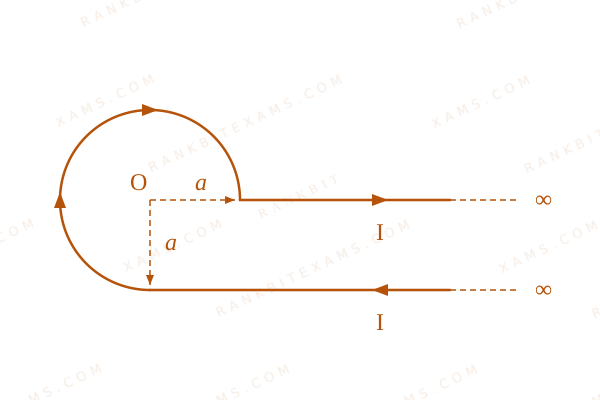
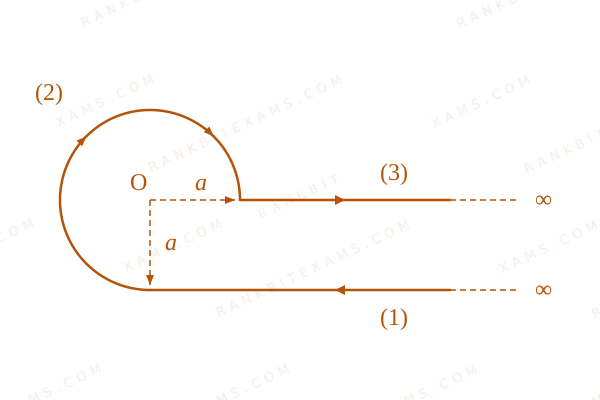
An infinite wire has a circular bend of radius a$a$ , and carrying a current I as shown in figure. The magnitude of magnetic field at the origin O of the arc is given by:
An infinite current carrying wire presenting a three-quarter circular bend around center origin O.
### Related Formula
The magnetic field contributions from unique structural line elements are given by:
* **Semi-infinite straight wire segment** at a distance perpendicular to its end tip:
B_textstraight = fracmu_0 I4pi a$$B_{\text{straight}} = \frac{\mu_0 I}{4\pi a}$$
* **Circular arc path segment** subtending an angle theta$\theta$ at the center:
B_textarc = fracmu_0 I4pi a theta$$B_{\text{arc}} = \frac{\mu_0 I}{4\pi a} \theta$$
### Core Logic
Let us decompose the structure into three functional parts as mapped out below:
An infinite current carrying wire presenting a three-quarter circular bend around center origin O.
1. **Segment 1 (Incoming semi-infinite line)**: The straight line extends to infinity, with its terminating tip at a perpendicular distance a$a$ from origin O$O$. Using the right-hand grip rule, the direction points into the page:
B_1 = fracmu_0 I4pi a quad (otimes)$$B_1 = \frac{\mu_0 I}{4\pi a} \quad (\otimes)$$
2. **Segment 2 (Three-quarter circular loop)**: The loop forms an angle of theta = frac3pi2$\theta = \frac{3\pi}{2}$ radians around O$O$. The field points into the page:
B_2 = fracmu_0 I4pi a left(frac3pi2right) quad (otimes)$$B_2 = \frac{\mu_0 I}{4\pi a} \left(\frac{3\pi}{2}\right) \quad (\otimes)$$
3. **Segment 3 (Outgoing semi-infinite line)**: This line aligns perfectly with the origin O$O$ along its vector axis, making sintheta = 0$\sin\theta = 0$:
B_3 = 0$B_3 = 0$
Summing the total fields via superposition:
B = B_1 + B_2 + B_3 = fracmu_0 I4pi a + fracmu_0 I4pi aleft(frac3pi2right)$$B = B_1 + B_2 + B_3 = \frac{\mu_0 I}{4\pi a} + \frac{\mu_0 I}{4\pi a}\left(\frac{3\pi}{2}\right)$$B = fracmu_0 I4pi a left[frac3pi2 + 1right]$$B = \frac{\mu_0 I}{4\pi a} \left[\frac{3\pi}{2} + 1\right]$$
### Pattern Recognition
Always check the axis alignment first. Any straight wire segment whose extended line passes directly through the field point contributes exactly zero to the total magnetic field value.
More Magnetic Effects of Current Questions — jee_main_2025_02_april_morning
We Map Every Repeating Question in Competitive Exams.
Say goodbye to generic mock test fatigue. RankBit uses smart analysis to group past exam questions into their foundational Repeating Question Types. Find chapter weightage, track repeating questions, and score higher with targeted practice.
Select Your Target Exam
Choose an exam track below to find formulas per chapter and patterns.
Syncing Exam Intelligence
Mapping formulas and patterns across all tracks…
PATH A — FULL LENGTH PRACTICE
Full Mock Test Hub
Simulate real NTA exam conditions with fully tracked mocks. Time yourself against past papers.
Practice past-year questions one chapter at a time. Pick an exam → subject → chapter and get every PYQ for that topic — pulled together from all past papers — with the chapter's key formulas alongside.