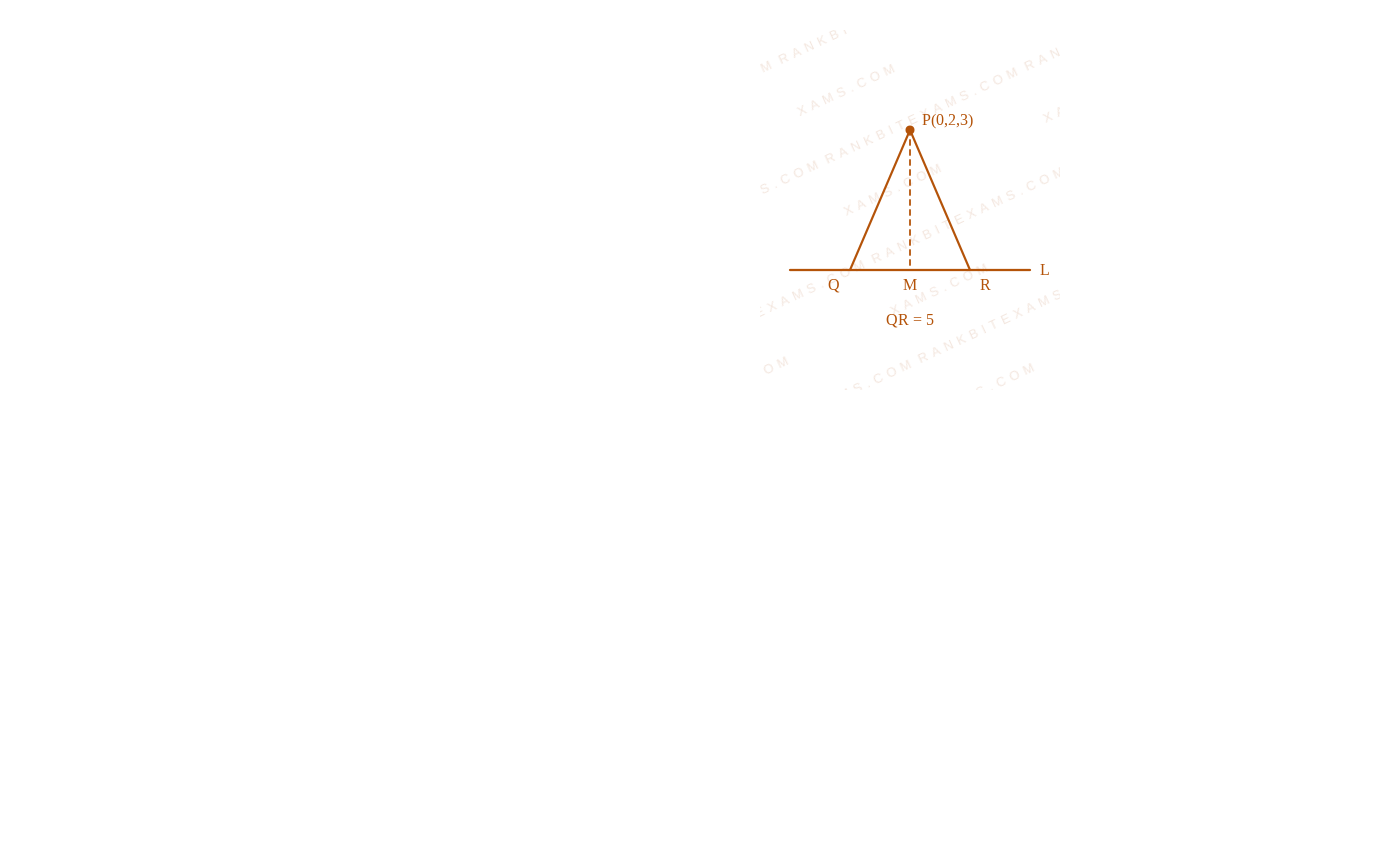
Let the vertices Q$Q$ and R$R$ of the triangle PQR$PQR$ lie on the line (x+3)/(5)=(y-1)/(2)=(z+4)/(3)$\frac{x+3}{5}=\frac{y-1}{2}=\frac{z+4}{3}$, QR=5$QR=5$ and the coordinates of the point P$P$ be (0, 2, 3)$(0, 2, 3)$. If the area of the triangle PQR$PQR$ is (m)/(n)$\frac{m}{n}$ then:
A.m-5√(21)n=0$m-5\sqrt{21}n=0$
B.2m-5√(21)n=0$2m-5\sqrt{21}n=0$
C.5m-2√(21)n=0$5m-2\sqrt{21}n=0$
D.5m-21√(2)n=0$5m-21\sqrt{2}n=0$
Solution & Explanation
Related Formula
Area of a triangle given base length b$b$ and perpendicular height h$h$:
Area = (1)/(2) · b · h$$\text{Area} = \frac{1}{2} \cdot b \cdot h$$
Core Logic
Since Q$Q$ and R$R$ lie on the line, the length QR=5$QR=5$ forms the base of the triangle. The perpendicular distance from point P$P$ to the line represents the height h$h$. Area of Triangle in 3D Space diagram for Q67 - JEE Main 2025 Morning
Step 1: Define Perpendicular Foot coordinates
Let M$M$ be the foot of the perpendicular from P(0,2,3)$P(0,2,3)$ to the line. Parametric form of any point on the line:
Finding the foot of a perpendicular via parametric variables is a guaranteed shortcut for 3D area problems instead of cross-product calculations, keeping computation times minimal.
Chapter Mix
Class 12 Mathematics: Three Dimensional Geometry
More Three Dimensional Geometry Previous-Year Questions — Page 5
Qjee_main_2025_03_april_eveningDirection Cosines and Direction Ratios
Each of the angles β$\beta$ and γ$\gamma$ that a given line makes with the positive y$y$- and z$z$-axes, respectively, is half of the angle that this line makes with the positive x$x$-axis. Then the sum of all possible values of the angle β$\beta$ is
A.(3π)/(4)$\frac{3\pi}{4}$
B.π$\pi$
C.(π)/(2)$\frac{\pi}{2}$
D.(3π)/(2)$\frac{3\pi}{2}$
Solution
Related Formula
For any line making angles α, β, γ$\alpha, \beta, \gamma$ with the coordinate axes, the direction cosines satisfy:
Direction cosines are bounded between [-1, 1]$[-1, 1]$. Always utilize the identities relating double angles or half angles (2 ²θ = 1 + 2θ$2\cos^2\theta = 1 + \cos 2\theta$) to simplify quadratic forms involving different multiples of the coordinate angles.
Chapter Mix
Class 12 Mathematics: Three Dimensional Geometry
Class 11 Mathematics: Trigonometric Functions
Q69jee_main_2025_03_april_eveningLines in 3D Space
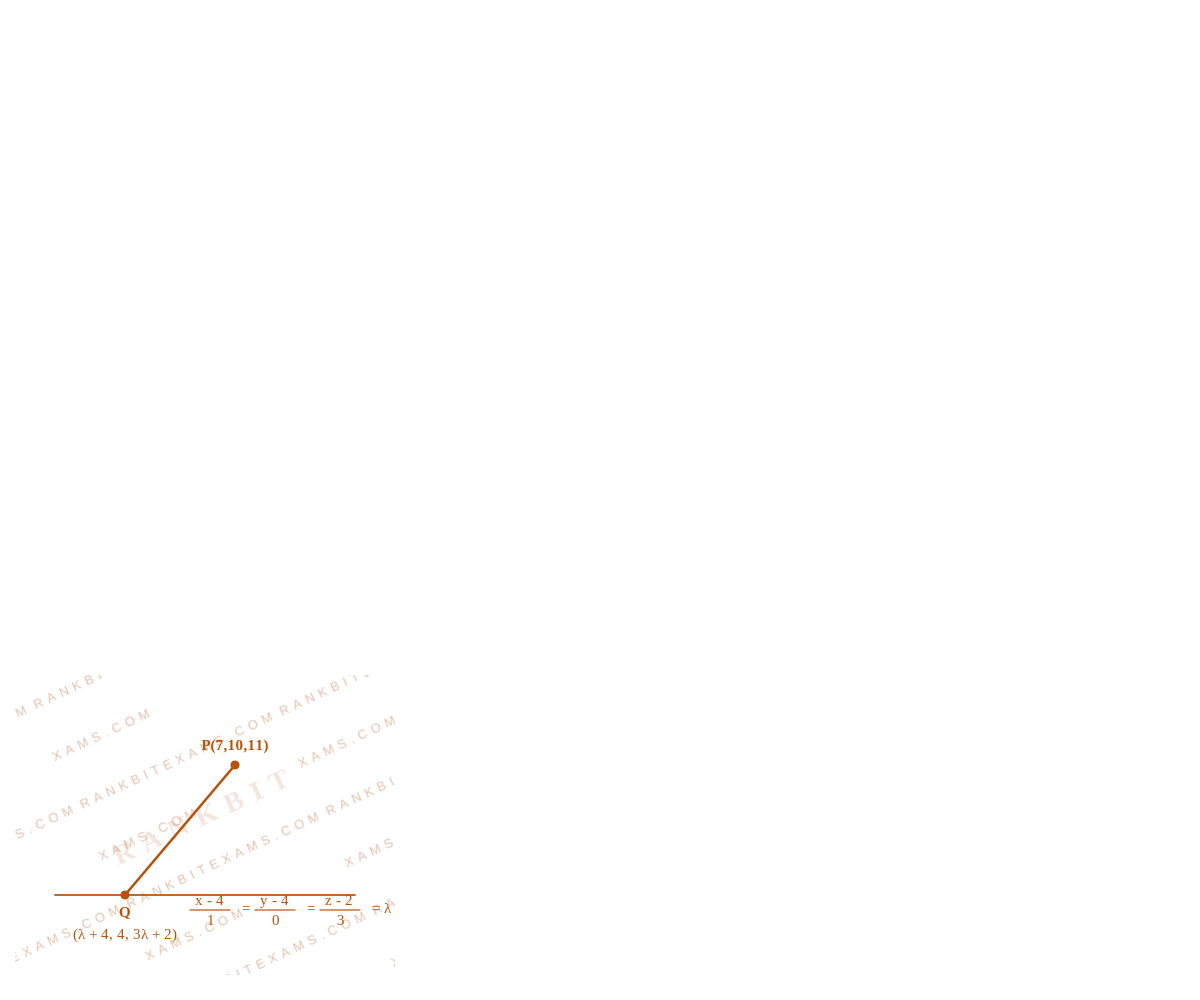
The distance of the point (7, 10, 11)$(7, 10, 11)$ from the line (x-4)/(1) = (y-4)/(0) = (z-2)/(3)$\frac{x-4}{1} = \frac{y-4}{0} = \frac{z-2}{3}$ along the line (x-9)/(2) = (y-13)/(3) = (z-17)/(6)$\frac{x-9}{2} = \frac{y-13}{3} = \frac{z-17}{6}$ is
A.18$18$
B.14$14$
C.12$12$
D.16$16$
Solution
Related Formula
Distance 'along a line' means the direction vector of the line segment joining target point P$P$ to intersecting point Q$Q$ must be parallel to the given direction ratios:
PQ = k · d$$\vec{PQ} = k \cdot \vec{d}$$
Core Logic
Let point P = (7, 10, 11)$P = (7, 10, 11)$.
Any general point Q$Q$ on the first line (x-4)/(1) = (y-4)/(0) = (z-2)/(3) = λ$\frac{x-4}{1} = \frac{y-4}{0} = \frac{z-2}{3} = \lambda$ is:
When solving distance parallel to a line in 3D, always write down the parametric coordinates of the general point first. Match the ratio of direction cosines directly to avoid setting up complicated systems of coordinate planes.
Chapter Mix
Class 12 Mathematics: Three Dimensional Geometry
Class 12 Mathematics: Vector Algebra
Q52jee_main_2025_07_april_morningShortest Distance Between Two Lines
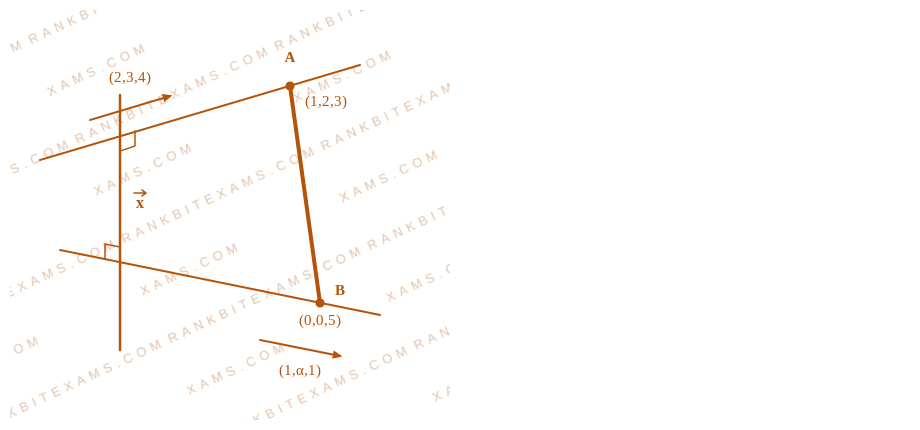
If the shortest distance between the lines (x - 1)/(2) = (y - 2)/(3) = (z - 3)/(4)$\frac{x - 1}{2} = \frac{y - 2}{3} = \frac{z - 3}{4}$ and (x)/(1) = (y)/(α) = (z - 5)/(1)$\frac{x}{1} = \frac{y}{\alpha} = \frac{z - 5}{1}$ is 5√(6)$\frac{5}{\sqrt{6}}$ , then the sum of all possible values of α$\alpha$ is
A.(3)/(2)$\frac{3}{2}$
B.-(3)/(2)$-\frac{3}{2}$
C.3$3$
D.-3$-3$
Solution
Related Formula
Shortest distance between two skewed lines with vector equations r = a₁ + λ b₁$\vec{r} = \vec{a}_1 + \lambda \vec{b}_1$ and \vec{r} = \vec{a}_2 + \mu \vec{b}_2 is:
From the given lines:
Line 1 passes through A(1, 2, 3)$A(1, 2, 3)$ with direction vector b₁ = 2 i + 3 j + 4 k$\vec{b}_1 = 2\hat{i} + 3\hat{j} + 4\hat{k}$.
Line 2 passes through B(0, 0, 5)$B(0, 0, 5)$ with direction vector b₂ = i + α j + k$\vec{b}_2 = \hat{i} + \alpha\hat{j} + \hat{k}$.
The vector connecting the two fixed points is:
BA = (1-0) i + (2-0) j + (3-5) k = i + 2 j - 2 k$$\vec{BA} = (1-0)\hat{i} + (2-0)\hat{j} + (3-5)\hat{k} = \hat{i} + 2\hat{j} - 2\hat{k}$$
Step 1: Compute Cross Product of Direction Vectors
Whenever asked for the sum of all possible parameter values resulting from a vector condition, look to directly read the linear term coefficient via Vieta's relations rather than explicitly factoring or computing the roots individually.
Chapter Mix
Class 12 Mathematics: Three Dimensional Geometry
Class 12 Mathematics: Vector Algebra
Q68jee_main_2025_07_april_morningLine Intersecting Two Lines
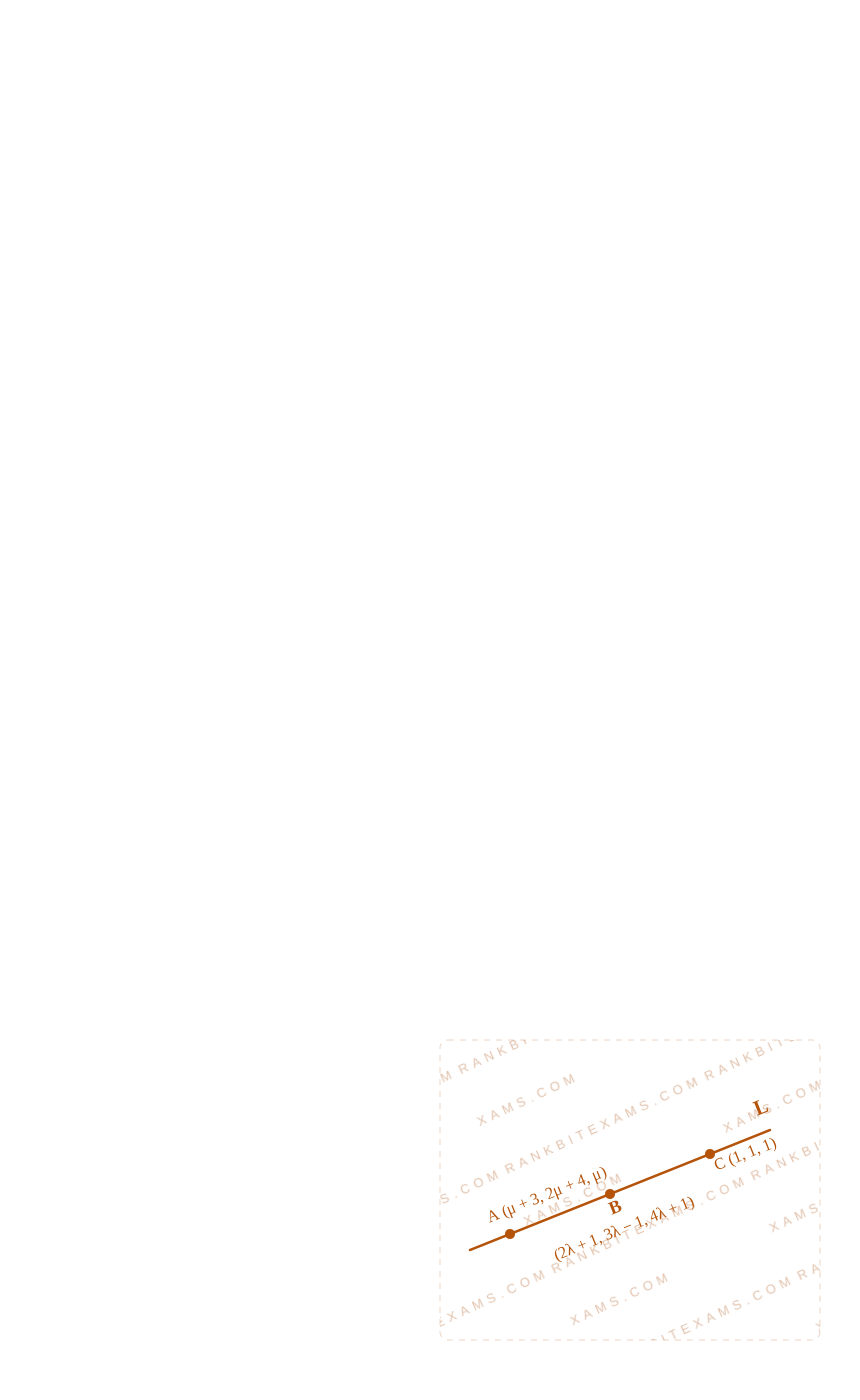
Let the line L pass through (1, 1, 1) and intersect the lines (x - 1)/(2) = (y + 1)/(3) = (z - 1)/(4)$\frac{x - 1}{2} = \frac{y + 1}{3} = \frac{z - 1}{4}$ and (x - 3)/(1) = (y - 4)/(2) = (z)/(1)$\frac{x - 3}{1} = \frac{y - 4}{2} = \frac{z}{1}$ . Then, which of the following points lies on the line L?
A.(4,22,7)$(4,22,7)$
B.(5, 4, 3)$(5, 4, 3)$
C.(10, -29, -50)$(10, -29, -50)$
D.(7, 15, 13)$(7, 15, 13)$
Solution
Related Formula
General coordinates of any variable point on a 3D line given symmetric form equations:
Let line L intersect Line 1 at point A(2λ + 1, 3λ - 1, 4λ + 1)$A(2\lambda + 1, 3\lambda - 1, 4\lambda + 1)$ and Line 2 at point B(μ + 3, 2μ + 4, μ)$B(\mu + 3, 2\mu + 4, \mu)$.
Since line L passes through C(1, 1, 1)$C(1, 1, 1)$, the direction ratios computed from vector segment AC$AC$ must be proportional to the direction ratios computed from vector segment BC$BC$.
Step 1: Determine Direction Ratio Parameters
Line Intersecting Two Lines diagram for Q68 - JEE Main 2025 Morning
Direction ratios of AC$AC$ segment:
Substitute μ = -5$\mu = -5$ back into the second parameter group linkage to evaluate the target structural direction indicators, which gives the simplified direction ratio vector for BC$BC$ as:
Since all values match perfectly, (7, 15, 13)$(7, 15, 13)$ lies on the line L.
Pattern Recognition
By comparing the first and third fractional terms containing λ$\lambda$ in the denominator, you can solve for μ$\mu$ independently without tracking complex cross-multiplied quadratic λμ$\lambda\mu$ variations.
Chapter Mix
Class 12 Mathematics: Three Dimensional Geometry
Q51jee_main_2025_08_april_eveningShortest Distance Between Lines
Let the values of λ$\lambda$ for which the shortest distance between the lines
(x - 1)/(2) = (y - 2)/(3) = (z - 3)/(4) (x - λ)/(3) = (y - 4)/(4) = (z - 5)/(5)$$\frac{x - 1}{2} = \frac{y - 2}{3} = \frac{z - 3}{4}\quad\text{and}\quad\frac{x - \lambda}{3} = \frac{y - 4}{4} = \frac{z - 5}{5}$$
is 1√(6)$\frac{1}{\sqrt{6}}$ be λ₁$\lambda_{1}$ and λ₂$\lambda_{2}$. Then the radius of the circle passing through the points (0, 0)$(0, 0)$, (λ₁, λ₂)$(\lambda_{1}, \lambda_{2})$ and (λ₂, λ₁)$(\lambda_{2}, \lambda_{1})$ is
A.5 √(2)3$\frac{5 \sqrt{2}}{3}$
B.4$4$
C.√(2)3$\frac{\sqrt{2}}{3}$
D.3$3$
Solution
Related Formula
Shortest Distance = | AB · ( p × q)| p × q| |$$\text{Shortest Distance} = \left| \frac{\vec{AB} \cdot (\vec{p} \times \vec{q})}{|\vec{p} \times \vec{q}|} \right|$$
Core Logic
Identify points A(1, 2, 3)$A(1, 2, 3)$ and B(λ, 4, 5)$B(\lambda, 4, 5)$ on the lines with directions p = 2 i + 3 j + 4 k$\vec{p} = 2\hat{i} + 3\hat{j} + 4\hat{k}$ and q = 3 i + 4 j + 5 k$\vec{q} = 3\hat{i} + 4\hat{j} + 5\hat{k}$ respectively. Use the shortest distance formula to determine λ₁$\lambda_1$ and λ₂$\lambda_2$.
Step 1: Calculate Cross Product and Direction Vector
Shortest distance values create symmetric configurations. When finding a circle passing through (0,0)$(0,0)$, (x,y)$(x,y)$, and (y,x)$(y,x)$, the symmetry about y=x$y=x$ simplifies radius calculations immediately.
Chapter Mix
Class 12 Mathematics: Three Dimensional Geometry
Class 11 Mathematics: Circles
More Three Dimensional Geometry Questions — jee_main_2025_02_april_morning
Practice past-year questions one chapter at a time. Pick an exam → subject → chapter and get every PYQ for that topic — pulled together from all past papers — with the chapter's key formulas alongside.