For alpha, beta, gamma in mathbbR, if lim_x to 0 fracx^2 sin alpha x + (gamma - 1) e^x^2sin 2x - beta x = 3, then beta + gamma - alpha is equal to:

Solution & Explanation

### Related Formula Standard Taylor series expansions centered at x=0: sin x = x - fracx^36 + dots e^x = 1 + x + fracx^22 + dots ### Core Logic Since the limit evaluates to a finite value (3) while the denominator goes to zero when x to 0 (if 2-beta=0), the numerator coefficients of lower-degree terms must vanish to resolve the indetermination. ### Step 1: Substitute Expansions Substitute series expansions into numerator and denominator: textNumerator = x^2(alpha x) + (gamma - 1)left(1 + x^2 + fracx^42 + dotsright) textDenominator = left(2x - frac8x^36 + dotsright) - beta x = (2 - beta)x - frac43x^3 + dots ### Step 2: Equate Coefficients to Avoid Infinity Combine terms by degree: lim_x to 0 frac(gamma - 1) + (gamma - 1)x^2 + alpha x^3(2 - beta)x - frac43x^3 = 3 For a valid finite limit, the lowest power in the numerator cannot be smaller than the lowest power in the denominator. * Constraining constant term to zero: gamma - 1 = 0 implies gamma = 1 * This also forces the x^2 coefficient to vanish: (gamma - 1) = 0. * To balance the remaining leading x^3 terms, the x term in the denominator must vanish: 2 - beta = 0 implies beta = 2. ### Step 3: Evaluate Remaining Limit Value Now compute the remaining simplified limit of x^3 variables: lim_x to 0 fracalpha x^3-frac43x^3 = frac-3alpha4 = 3 implies alpha = -4 ### Step 4: Final Expression Calculation Substitute the found parameters into beta + gamma - alpha: beta + gamma - alpha = 2 + 1 - (-4) = 7 ### Pattern Recognition Taylor expansions are far safer than consecutive L'Hopital iterations here because multiple variables are spread across distinct polynomial powers, isolating components explicitly by structural degree. ### Evaluation Rubric / Model Answer null ### Chapter Mix Class 12 Mathematics: Limits, Continuity and Differentiability

More Limits, Continuity and Differentiability Previous-Year Questions — Page 8

Q29 jee_main_2024_30_jan_morning Differentiability
If the function f(x) = begincases frac1|x| & ,|x| geq 2 \\ ax^2 + 2b & ,|x| < 2 endcases is differentiable on mathbbR, then 48 (a + b) is equal to
Numerical Answer. Answer: 15 to 15

Solution

### Related Formula textContinuity at x=c: lim_x to c^- f(x) = lim_x to c^+ f(x) textDifferentiability at x=c: lim_x to c^- f'(x) = lim_x to c^+ f'(x) ### Core Logic Rewrite the piecewise function without absolute values: f(x) = begincases frac1x & , x geq 2 \\ ax^2 + 2b & , -2 < x < 2 \\ -frac1x & , x leq -2 endcases ### Step 1: Applying Continuity For f(x) to be continuous at x = 2: lim_x to 2^- (ax^2 + 2b) = lim_x to 2^+ frac1x a(2)^2 + 2b = frac12 Rightarrow 4a + 2b = frac12 quad dots (1) Because the function is even, continuity at x = -2 yields the exact same equation: 4a + 2b = 1/2. ### Step 2: Applying Differentiability Find the derivative f'(x) for piecewise sections: f'(x) = begincases -frac1x^2 & , x > 2 \\ 2ax & , -2 < x < 2 \\ frac1x^2 & , x < -2 endcases For f(x) to be differentiable at x = 2: lim_x to 2^- (2ax) = lim_x to 2^+ left(-frac1x^2right) 4a = -frac14 Rightarrow a = -frac116 ### Step 3: Finding variables and final target Substitute a back into equation (1): 4left(-frac116right) + 2b = frac12 -frac14 + 2b = frac12 Rightarrow 2b = frac34 Rightarrow b = frac38 We need to evaluate 48(a + b): 48left(-frac116 + frac38right) = 48left(frac-1 + 616right) = 48left(frac516right) = 3 times 5 = 15 ### Pattern Recognition Piecewise differentiability forces simultaneous linear equations matching function values and their first derivatives at boundary limits. ### Evaluation Rubric / Model Answer null ### Chapter Mix Class 12 Maths: Continuity and Differentiability
Q10 jee_main_2024_31_jan_evening Limits of Functions
Let f: mathbbR to (0, infty) be strictly increasing function such that lim_x to infty fracf(7x)f(x) = 1. Then, the value of lim_x rightarrow infty left[ fracf(5x)f(x) - 1 right] is equal to
  • A. 4
  • B. 0
  • C. 7/5
  • D. 1

Solution

### Related Formula textSandwich / Squeeze Theorem: If g(x) le h(x) le k(x) text and lim g(x) = lim k(x) = L, text then lim h(x) = L ### Core Logic Since f is a strictly increasing function mapping to (0,infty): For x > 0, we have x < 5x < 7x. Thus, f(x) < f(5x) < f(7x). Divide everything by f(x) (which is strictly positive): 1 < fracf(5x)f(x) < fracf(7x)f(x) Take the limit as x to infty: lim_xtoinfty 1 le lim_xtoinfty fracf(5x)f(x) le lim_xtoinfty fracf(7x)f(x) 1 le lim_xtoinfty fracf(5x)f(x) le 1 Therefore, lim_xtoinfty fracf(5x)f(x) = 1. The required value is: lim_x rightarrow infty left[ fracf(5x)f(x) - 1 right] = 1 - 1 = 0 ### Evaluation Rubric / Model Answer null ### Chapter Mix Class 11 Maths: Limits and Derivatives Class 12 Maths: Continuity and Differentiability
Q14 jee_main_2024_31_jan_evening Differentiability
Consider the function f:(0,infty)to mathbbR defined by f(x) = e^-|log_ex|. If m and n be respectively the number of points at which f is not continuous and f is not differentiable, then m + n is
  • A. 0
  • B. 3
  • C. 1
  • D. 2

Solution

### Core Logic
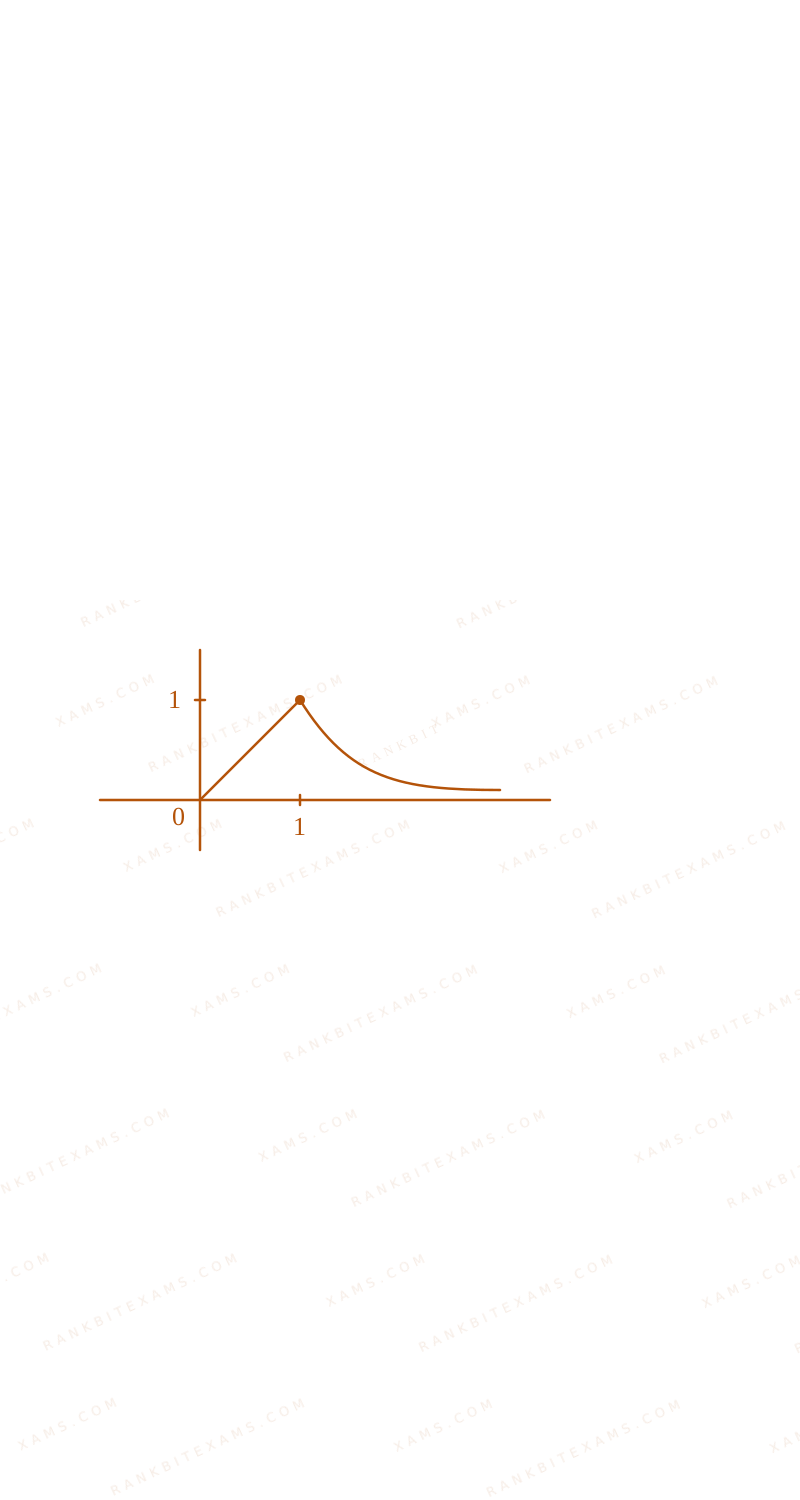
Differentiability diagram for Q14 - JEE Main 2024 Evening
The function is f(x) = e^-|ln x|. Rewrite piecewise for (0, infty): f(x) = begincases e^-(-ln x) & textif 0 < x < 1 \\ e^-ln x & textif x ge 1 endcases f(x) = begincases e^ln x = x & textif 0 < x < 1 \\ frac1e^ln x = frac1x & textif x ge 1 endcases Check continuity at x = 1: lim_x to 1^- f(x) = lim_x to 1^- x = 1 lim_x to 1^+ f(x) = lim_x to 1^+ frac1x = 1 f(1) = 1. The function is continuous everywhere on (0, infty). Thus, m = 0. Check differentiability at x = 1: LHD = lim_x to 1^- f'(x) = 1 RHD = lim_x to 1^+ f'(x) = -frac1x^2Big|_x=1 = -1 Since LHD neq RHD, the function is not differentiable at x = 1. Thus, n = 1. Finally, m + n = 0 + 1 = 1. ### Evaluation Rubric / Model Answer null ### Chapter Mix Class 12 Maths: Continuity and Differentiability

Q27 jee_main_2024_31_jan_evening Maclaurin Series / L'Hopital
If lim_x to 0 fracax^2e^x - b log_e(1 + x) + cxe^-xx^2sin x = 1, then 16(a^2 + b^2 + c^2) is equal to
Numerical Answer. Answer: 81 to 81

Solution

### Related Formula e^x = 1 + x + fracx^22! + dots ln(1+x) = x - fracx^22 + fracx^33 - dots sin x approx x implies x^2sin x approx x^3 ### Core Logic Expand the numerator terms using Maclaurin series around x=0: ax^2 left(1 + x + fracx^22 + dotsright) - b left(x - fracx^22 + fracx^33 - dotsright) + cx left(1 - x + fracx^22 - fracx^36 + dotsright) Denominator behavior is x^3. Group by powers of x: Coefficient of x: -b + c = 0 implies c = b Coefficient of x^2: a + fracb2 - c = 0 implies a = c - fracb2 = fracb2 Coefficient of x^3: a - fracb3 + fracc2 = 1 Substitute a = b/2 and c = b into the x^3 equation: fracb2 - fracb3 + fracb2 = 1 b - fracb3 = 1 implies frac2b3 = 1 implies b = frac32 This gives c = frac32 and a = frac34. Calculate the required value: 16(a^2 + b^2 + c^2) = 16left(frac916 + frac94 + frac94right) = 9 + 36 + 36 = 81 ### Evaluation Rubric / Model Answer null ### Chapter Mix Class 11 Maths: Limits and Derivatives
Q7 jee_main_2024_31_jan_morning Exponential Limits
lim_xto 0frace^2|sin x| - 2|sin x| - 1x^2
  • A. textis equal to -1
  • B. textdoes not exist
  • C. textis equal to 1
  • D. textis equal to 2

Solution

### Core Logic Evaluate lim_x to 0 frace^2|sin x| - 2|sin x| - 1x^2. Multiply and divide by |sin x|^2: = lim_x to 0 frace^2|sin x| - 2|sin x| - 1|sin x|^2 times fracsin^2 xx^2 ### Step 1: Substitution and L'Hôpital Let |sin x| = t. As x to 0, t to 0. lim_t to 0 frace^2t - 2t - 1t^2 times lim_x to 0 fracsin^2 xx^2 The second limit evaluates to 1. Using L'Hôpital's Rule on the first limit: = lim_t to 0 frac2e^2t - 22t = lim_t to 0 frac4e^2t2 = 2 ### Step 2: Final Result 2 times 1 = 2 ### Evaluation Rubric / Model Answer null ### Chapter Mix Class 11 Maths: Limits and Derivatives
Rankbit System
JEE Physics: Waves (+15.5%) | Electrostatics: Concentric Shells (-29.7%) | Modern Physics: Photoelectric Clones (+34.2%) | Mathematics: Definite Integrals (+18.1%) | Chemistry: Coordination Splitting (-11.4%) | JEE Physics: Waves (+15.5%) | Electrostatics: Concentric Shells (-29.7%) | Modern Physics: Photoelectric Clones (+34.2%) | Mathematics: Definite Integrals (+18.1%) | Chemistry: Coordination Splitting (-11.4%)