For alpha, beta, gamma in mathbbR, if lim_x to 0 fracx^2 sin alpha x + (gamma - 1) e^x^2sin 2x - beta x = 3, then beta + gamma - alpha is equal to:

Solution & Explanation

### Related Formula Standard Taylor series expansions centered at x=0: sin x = x - fracx^36 + dots e^x = 1 + x + fracx^22 + dots ### Core Logic Since the limit evaluates to a finite value (3) while the denominator goes to zero when x to 0 (if 2-beta=0), the numerator coefficients of lower-degree terms must vanish to resolve the indetermination. ### Step 1: Substitute Expansions Substitute series expansions into numerator and denominator: textNumerator = x^2(alpha x) + (gamma - 1)left(1 + x^2 + fracx^42 + dotsright) textDenominator = left(2x - frac8x^36 + dotsright) - beta x = (2 - beta)x - frac43x^3 + dots ### Step 2: Equate Coefficients to Avoid Infinity Combine terms by degree: lim_x to 0 frac(gamma - 1) + (gamma - 1)x^2 + alpha x^3(2 - beta)x - frac43x^3 = 3 For a valid finite limit, the lowest power in the numerator cannot be smaller than the lowest power in the denominator. * Constraining constant term to zero: gamma - 1 = 0 implies gamma = 1 * This also forces the x^2 coefficient to vanish: (gamma - 1) = 0. * To balance the remaining leading x^3 terms, the x term in the denominator must vanish: 2 - beta = 0 implies beta = 2. ### Step 3: Evaluate Remaining Limit Value Now compute the remaining simplified limit of x^3 variables: lim_x to 0 fracalpha x^3-frac43x^3 = frac-3alpha4 = 3 implies alpha = -4 ### Step 4: Final Expression Calculation Substitute the found parameters into beta + gamma - alpha: beta + gamma - alpha = 2 + 1 - (-4) = 7 ### Pattern Recognition Taylor expansions are far safer than consecutive L'Hopital iterations here because multiple variables are spread across distinct polynomial powers, isolating components explicitly by structural degree. ### Evaluation Rubric / Model Answer null ### Chapter Mix Class 12 Mathematics: Limits, Continuity and Differentiability

More Limits, Continuity and Differentiability Previous-Year Questions — Page 3

Q72 jee_main_2025_29_jan_evening Limits of Definite Integrals
If lim_tto 0left(int_0^1 (3x + 5)^t dxright)^frac1t = fracalpha5eleft(frac85right)^frac23, then alpha is equal to
Numerical Answer. Answer: 64 to 64

Solution

### Related Formula Standard indeterminacy layout resolution rules for limits matching form 1^infty: lim_t to 0 [g(t)]^frac1t = e^lim_t to 0 fracg(t) - 1t ### Core Logic Evaluate structural integration base at boundary limit initialization state t to 0: int_0^1 1 \, dx = 1 This confirms it matches an indeterminate form of type 1^infty. ### Step 1: Apply Taylor Series or L'Hopital's Theorem Compute limits of logarithmic integration properties inside exponential power indices: textExponent Expression = lim_t to 0 fracint_0^1 (3x+5)^t \, dx - 1t Applying L'Hopital's theorem to differentiate the numerator with respect to t yields: int_0^1 (3x+5)^t ln(3x+5) \, dx Evaluating this at t = 0 gives: int_0^1 ln(3x+5) \, dx ### Step 2: Complete the Final Form Match Integrating via parts results in logarithmic value updates: left[ frac(3x+5)ln(3x+5) - (3x+5)3 right]_0^1 = frac8ln 8 - 5ln 5 - 33 Passing components back through exponential foundations transforms terms to: e^frac8ln 8 - 5ln 5 - 33 = left(frac85right)^frac23 cdot left(frac645eright) Comparing with the target expression fracalpha5eleft(frac85 ight)^frac23 isolates the numerical solution directly: alpha = 64 ### Pattern Recognition Treating 1^infty structural transformations using logarithmic derivatives allows managing complex functions containing multiple integral boundaries effectively. ### Evaluation Rubric / Model Answer null ### Chapter Mix Class 11 Mathematics: Limits Class 12 Mathematics: Definite Integration
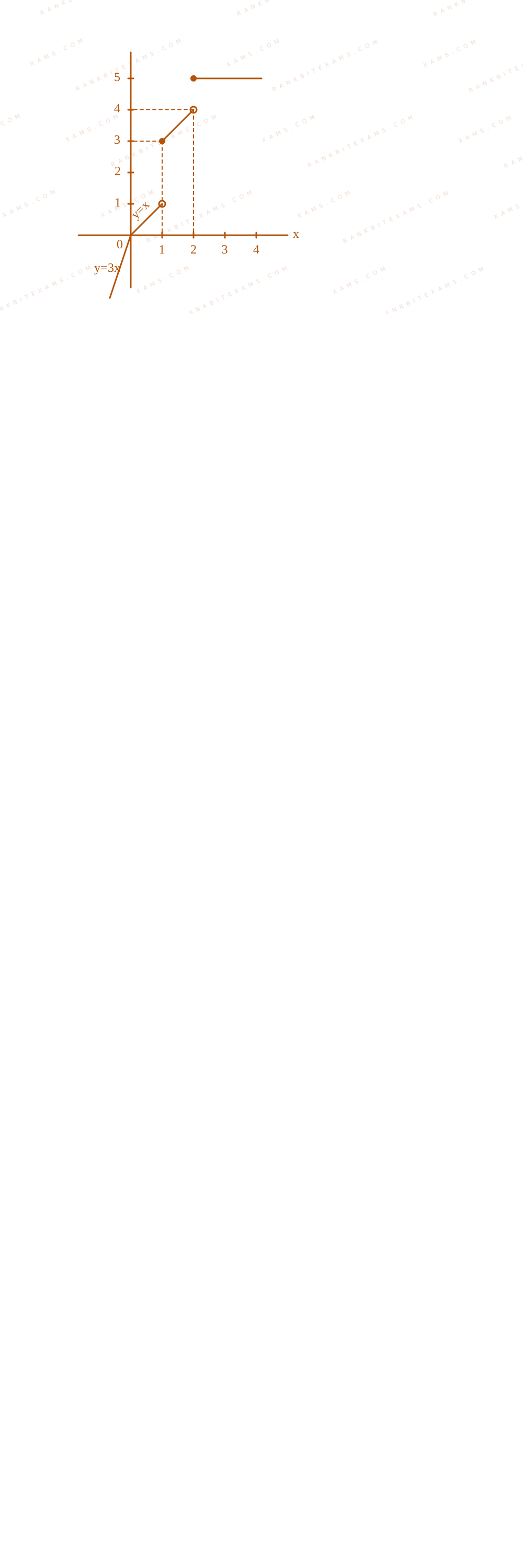
Q74 jee_main_2025_28_jan_morning Continuity and Differentiability of Piecewise Functions
Let f(x) = begincases 3x, & x < 0 \\ min left\1 + x + [ x ], x + 2 [ x ] right\, & 0 le x le 2 \\ 5, & x > 2 endcases where [.] denotes greatest integer function. If alpha and beta are the number of points, where f is not continuous and is not differentiable, respectively, then alpha + beta equals....
Numerical Answer. Answer: 5 to 5

Solution

### Related Formula A function is discontinuous if left-hand and right-hand limits mismatch at boundary transitions. Non-differentiability occurs at discontinuities or sharp turns. ### Core Logic Simplify the greatest integer component [x] by expanding over integer intervals:
Continuity and Differentiability of Piecewise Functions diagram for Q74 - JEE Main 2025 Morning
f(x) = begincases 3x, & x < 0 \\ x, & 0 le x < 1 \\ x + 2, & 1 le x < 2 \\ 5, & x > 2 endcases ### Step 1: Testing Continuity Limits Check continuity at structural boundaries: At x = 0: textLHM = 0, textRHM = 0 implies Continuous. At x = 1: textLHM = 1, textRHM = 3 implies Discontinuous. At x = 2: textLHM = 4, textRHM = 5 implies Discontinuous. Thus, alpha = 2 points of discontinuity (x in \1, 2\). ### Step 2: Testing Differentiability Parameters Discontinuities automatically introduce non-differentiability. Now check smooth corners at the remaining continuous transition x = 0: f^prime(0^-) = 3, quad f^prime(0^+) = 1 implies textNot differentiable at x=0. Thus, beta = 3 points of non-differentiability (x in \0, 1, 2\). alpha + beta = 2 + 3 = 5 ### Pattern Recognition Discontinuities automatically break differentiability. Always count them first before checking derivatives at smooth corner points. ### Evaluation Rubric / Model Answer null ### Chapter Mix Class 12 Maths: Limits, Continuity and Differentiability
Q69 jee_main_2025_03_april_morning Continuity of Piecewise Functions
Let f(x) = begincases (1 + ax)^1/x & , x < 0 \\ 1 + b & , x = 0 \\ frac(x + 4)^1/2 - 2(x + c)^1/3 - 2 & , x > 0 endcases [cite: 680] be continuous at x = 0[cite: 681]. Then mathrme^mathrmacdot b cdot c is equal to[cite: 681]:
  • A. 64
  • B. 72
  • C. 48
  • D. 36

Solution

### Related Formula Continuity definition condition frame: lim_x rightarrow 0^- f(x) = f(0) = lim_x rightarrow 0^+ f(x) ### Core Logic Evaluate Left-Hand Limit (LHL) using standard forms [cite: 1410]: textLHL = lim_x rightarrow 0^- (1+ax)^1/x = e^a [cite: 1410] Given baseline definition states f(0) = 1+b [cite: 1410]. For Right-Hand Limit (RHL) to be finite and valid, the numerator tracking towards 0 means the denominator must also balance towards 0 to avoid divergence [cite: 1411]: lim_x rightarrow 0^+ left[(x+c)^1/3 - 2right] = 0 implies c^1/3 = 2 implies c = 8 [cite: 1414] ### Step 1: Applying L'Hopital's rule to the RHL With c=8, evaluate RHL limit expressions using derivatives [cite: 1411]: textRHL = lim_x rightarrow 0^+ fracfrac12sqrtx+4frac13(x+8)^-2/3 = fracfrac12(2)frac13(8)^-2/3 = fracfrac14frac13 cdot 4 = frac14 cdot 12 = 3 [cite: 1411, 1415] ### Step 2: Equating limits for parameter solutions Equate continuous criteria milestones together [cite: 1416]: e^a = 1 + b = 3 [cite: 1416] e^a = 3 implies b = 2 [cite: 1416] Compute the ultimate target combination product configuration [cite: 1416]: e^a cdot b cdot c = 3 cdot 2 cdot 8 = 48 [cite: 1416] ### Pattern Recognition Determining missing root constants inside indeterminate fraction structures handles calculations swiftly before running formal limits. ### Evaluation Rubric / Model Answer null ### Chapter Mix Class 12 Mathematics: Limits, Continuity and Differentiability
Q52 jee_main_2025_04_april_evening Evaluation of Limits
Let f be a differentiable function on mathbfR such that f(2) = 1, f'(2) = 4. Let lim_x to 0 (f(2 + x))^3/x = e^alpha. Then the number of times the curve y = 4x^3 - 4x^2 - 4(alpha -7)x - alpha meets x-axis is:-
  • A. 2
  • B. 1
  • C. 0
  • D. 3

Solution

### Related Formula For a limit of the form lim_x to 0 [g(x)]^h(x) where g(x) to 1 and h(x) to infty, the limit evaluates to: e^lim_x to 0 h(x)[g(x) - 1] ### Core Logic Given the limit expression: lim_x to 0 (f(2 + x))^3/x = e^alpha Using the standard form as f(2)=1, this transforms to: e^lim_x to 0 frac3x (f(2 + x) - 1) = e^alpha Recognizing the definition of the derivative f'(2) = lim_x to 0 fracf(2+x)-1x: e^3 f'(2) = e^alpha Given f'(2) = 4: e^3(4) = e^12 = e^alpha implies alpha = 12 ### Step 1: Finding Intersection points with x-axis Substitute alpha = 12 into the equation of the curve: y = 4x^3 - 4x^2 - 4(12 - 7)x - 12 y = 4x^3 - 4x^2 - 20x - 12 To find where it meets the x-axis, set y = 0: 4x^3 - 4x^2 - 20x - 12 = 0 implies x^3 - x^2 - 5x - 3 = 0 Testing for rational roots, x = -1 is a root because (-1)^3 - (-1)^2 - 5(-1) - 3 = -1 - 1 + 5 - 3 = 0. ### Step 2: Factoring the cubic polynomial Dividing x^3 - x^2 - 5x - 3 by (x+1) gives: (x + 1)(x^2 - 2x - 3) = 0 (x + 1)(x + 1)(x - 3) = 0 implies (x + 1)^2(x - 3) = 0 The roots are x = -1 (repeated root) and x = 3. Therefore, the distinct real values of x where the curve intersects the x-axis are -1 and 3, meaning it meets the x-axis exactly 2 times. ### Pattern Recognition A repeated root like (x+1)^2 means the curve is tangent to the x-axis at that point, but it still counts as a meeting point. Always count distinct real roots when determining the number of meeting points with the coordinate axes. ### Evaluation Rubric / Model Answer null ### Chapter Mix Class 12 Mathematics: Limits, Continuity and Differentiability Class 11 Mathematics: Theory of Equations
Q57 jee_main_2025_04_april_morning Evaluation of Limits using Expansion
If lim_x to 1^+frac(x - 1)(6 + lambdacos(x - 1)) + musin(1 - x)(x - 1)^3 = -1, where lambda, mu in mathbbR, then \lambda + \mu is equal to
  • A. 18
  • B. 20
  • C. 19
  • D. 17

Solution

### Related Formula Standard Taylor expansions near zero: cos h = 1 - frach^22! + frach^44! - dots sin h = h - frach^33! + frach^55! - dots ### Core Logic Let x - 1 = h, where h to 0^+. The expression transforms into: lim_h to 0frach(6 + lambdacos h) - musin hh^3 = -1 Substitute the expansions into the numerator: lim_h to 0frachleft[6 + lambdaleft(1 - frach^22right)right] - muleft(h - frach^36right)h^3 = -1 lim_h to 0frac(6 + lambda - mu)h + left(-fraclambda2 + fracmu6right)h^3h^3 = -1 ### Step 1: Match Coefficients for Existence For the limit to be finite, the coefficient of h must vanish: 6 + lambda - mu = 0 implies mu - lambda = 6 quad dots (1) Equating the h^3 term to the given limit value: -fraclambda2 + fracmu6 = -1 implies -3lambda + mu = -6 quad dots (2) ### Step 2: Solve System of Equations Subtract equation (1) from (2): (-3lambda + mu) - (mu - lambda) = -6 - 6 implies -2lambda = -12 implies lambda = 6 From (1), mu = 6 + 6 = 12. lambda + mu = 6 + 12 = 18 ### Pattern Recognition When dealing with indeterminate form limits involving mixed trigonometric expressions with a non-zero denominator power, polynomial substitution using Taylor series is much cleaner and less prone to differentiation tracking mistakes compared to multiple L'Hôpital cycles. ### Evaluation Rubric / Model Answer null ### Chapter Mix Class 12 Mathematics: Limits, Continuity and Differentiability
Rankbit System
JEE Physics: Waves (+15.5%) | Electrostatics: Concentric Shells (-29.7%) | Modern Physics: Photoelectric Clones (+34.2%) | Mathematics: Definite Integrals (+18.1%) | Chemistry: Coordination Splitting (-11.4%) | JEE Physics: Waves (+15.5%) | Electrostatics: Concentric Shells (-29.7%) | Modern Physics: Photoelectric Clones (+34.2%) | Mathematics: Definite Integrals (+18.1%) | Chemistry: Coordination Splitting (-11.4%)
