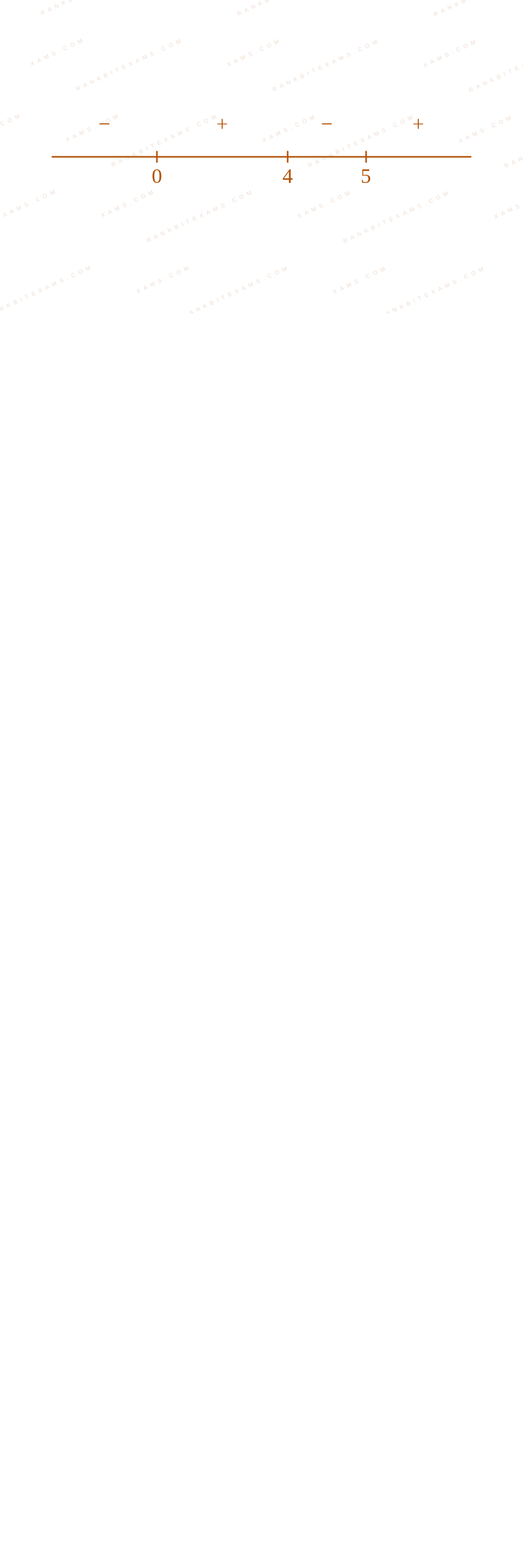
Solution
Related Formula
Critical points occur where f'(x) = 0. For absolute maximum and minimum on an interval [c, d], evaluate function values at the boundaries and at any local critical points falling inside the domain.
Core Logic
Given f(x) = x³ + ax² + bln|x| + 1 Differentiating with respect to x:
f'(x) = 3x² + 2ax + (b)/(x)Since x = -1 and x = 2 are critical points:
f'(-1) = 3(-1)² + 2a(-1) + (b)/(-1) = 3 - 2a - b = 0 2a + b = 3 f'(2) = 3(2)² + 2a(2) + (b)/(2) = 12 + 4a + (b)/(2) = 0 8a + b = -24Step 1: Solve for Coefficients
Subtracting the first simplified derivative equation from the second:
(8a + b) - (2a + b) = -24 - 3 6a = -27 a = -(9)/(2)Substituting a back to get b:
2(-(9)/(2)) + b = 3 -9 + b = 3 b = 12Thus, the function is:
f(x) = x³ - (9)/(2)x² + 12ln|x| + 1Step 2: Check Critical Points in Target Interval
The given interval is [-2, -1/2]. Inside this interval, the relevant critical point is x = -1 (since x = 2 lies outside).
Evaluate the function values at x = -2, -1, -1/2:
- At x = -1:
- At x = -2:
- At x = -1/2:
Step 3: Calculate Absolute Sum
Comparing the calculated values:
M = Absolute Maximum = -4.5 (at x = -1) m = Absolute Minimum = -16.6 (at x = -2)Therefore:
|M + m| = |-4.5 + (-16.6)| = |-21.1| = 21.1Pattern Recognition
Always verify whether the critical points lie inside the requested boundary interval before blindly testing all values. Here, x=2 was an irrelevant trap for the interval valuation phase.
Chapter Mix
Class 12 Mathematics: Application of Derivatives