Consider the following compound (X) beginarrayc mathrm I \\ mathrm H - mathrm C equiv mathrm C - mathrm C H _ 2 - mathrm C H - mathrm C H _ 3 \\ mathrm I \\ mathrm C H _ 3 endarray The most stable and least stable carbon radicals, respectively, produced by homolytic cleavage of corresponding mathrmC - H bond are :

Solution & Explanation

### Related Formula Free radical stability structural hierarchy sequence: textResonance Stabilized (Propargyl/Allyl) > 3^circ > 2^circ > 1^circ > textVinylic/Alkyne Center ### Core Logic Let's analyze individual cleavage points across the carbon backbone skeleton: * **Position II** yields a propargyl intermediate radical directly adjacent to the alkyne bond. This allows strong resonance stabilization across the pi system, making it the most stable radical position. * **Position I** places the radical directly on an mathrmsp-hybridized carbon center. The high electronegativity of mathrmsp orbitals tightly holds the unpaired electron, making homolytic cleavage extremely difficult and rendering this intermediate the least stable radical position.
Free Radical Stability
### Step 1: Verdict Therefore, the most stable and least stable positions are II and I, respectively. ### Pattern Recognition Radicals located on mathrmsp carbons (vinylic/alkynic) are highly unstable due to poor orbital overlap, while positions next to triple bonds (propargylic) are exceptionally stable due to active resonance delocalization. ### Evaluation Rubric / Model Answer null ### Chapter Mix Class 11 Chemistry: Organic Chemistry - Some Basic Principles and Techniques

More Organic Chemistry - Some Basic Principles and Techniques Previous-Year Questions — Page 5

Q42 jee_main_2025_08_april_evening Qualitative Analysis of Functional Groups
Match the reagents in LIST-I with the corresponding chemical functional groups they detect in LIST-II:
LIST-I (Reagent)LIST-II (Functional Group detected)
A. Sodium bicarbonate solutionI. double bond / unsaturation
B. Neutral ferric chlorideII. carboxylic acid
C. Ceric ammonium nitrateIII. phenolic - OH
D. Alkaline textKMnO_4IV. alcoholic - OH
Choose the correct answer from the options given below:
  • A. textA-II, B-III, C-IV, D-I
  • B. textA-II, B-III, C-I, D-IV
  • C. textA-III, B-II, C-IV, D-I
  • D. textA-II, B-IV, C-III, D-I

Solution

### Core Logic Let us review the chemical basis for each qualitative test: * **A. Sodium bicarbonate (textNaHCO_3) solution**: Carboxylic acids are sufficiently acidic to decompose textNaHCO_3, liberating carbon dioxide gas observed as vigorous effervescence. Therefore, textA rightarrow textII. * **B. Neutral ferric chloride (textFeCl_3)**: Phenols react with neutral textFeCl_3 solution to form characteristic deeply colored violet coordination complexes. Therefore, textB rightarrow textIII. * **C. Ceric ammonium nitrate (CAN)**: Alcohols react with CAN reagent to cause a distinct color shift to deep dark red due to complexation. Therefore, textC rightarrow textIV. * **D. Alkaline textKMnO_4 (Baeyer's Reagent)**: Reacts readily via syn-hydroxylation across carbon-carbon double/triple bonds, resulting in decolored solutions alongside brown textMnO_2 precipitates. This detects unsaturation. Therefore, textD rightarrow textI. ### Step 1: Assembly Combining the validated relationships gives: textA-II, B-III, C-IV, D-I This maps perfectly to Option (1). ### Pattern Recognition Baeyer's test (alkaline textKMnO_4) always tests for alkenes/alkynes. textNaHCO_3 is unique for acidic groups like carboxylic acids. Matching these two reliable pairs isolates the correct option without needing to review the entire table. ### Evaluation Rubric / Model Answer null ### Chapter Mix Class 11 Chemistry: Organic Chemistry - Some Basic Principles and Techniques Class 12 Chemistry: Alcohols, Phenols and Ethers

Q28 jee_main_2025_29_jan_evening Chromatographic Techniques
Given below are two statements: Statement (I): In partition chromatography, stationary phase is thin film of liquid present in the inert support. Statement (II): In paper chromatography, the material of paper acts as a stationary phase. In the light of the above statements, choose the correct answer from the options given below:
  • A. Both Statement I and Statement II are false
  • B. Statement I is true but Statement II is false
  • C. Both Statement I and Statement II are true
  • D. Statement I is false but Statement II is true

Solution

### Core Logic Statement I is true: In partition chromatography, the stationary phase is indeed a thin film of liquid held on the surface of an inert solid support. Statement II is false: In paper chromatography, the water molecules trapped inside the cellulose network of the paper act as the stationary phase, not the paper material itself. ### Pattern Recognition Remember that paper chromatography is a type of partition chromatography where moisture content (water) adsorbed on the paper serves as the stationary liquid phase. ### Evaluation Rubric / Model Answer null ### Chapter Mix Class 11 Chemistry: Organic Chemistry - Some Basic Principles and Techniques
Q38 jee_main_2025_29_jan_evening Sigma and Pi Bond Counting
Total number of sigma (sigma) and pi(pi) bonds respectively present in hex-1-en-4-yne are:
  • A. 13 and 3
  • B. 11 and 3
  • C. 3 and 13
  • D. 14 and 3

Solution

### Core Logic The structural formula of hex-1-en-4-yne is given by: CH_2 = CH - CH_2 - C equiv C - CH_3 Let's count the chemical bonds chronologically: * Number of C-H sigma bonds = 2 + 1 + 2 + 3 = 8 * Number of C-C sigma bonds = 5 Total sigma bonds = 8 + 5 = 13.
Sigma and Pi Bond Counting diagram for Q38 - JEE Main 2025 Evening
* Number of pi bonds: 1 from double bond + 2 from triple bond = 3 pi bonds. ### Pattern Recognition Every single bond is 1sigma, every double bond contains 1sigma + 1pi, and every triple bond contains 1sigma + 2pi. ### Evaluation Rubric / Model Answer null ### Chapter Mix Class 11 Chemistry: Organic Chemistry - Some Basic Principles and Techniques
Q49 jee_main_2025_29_jan_evening Quantitative Estimation of Sulphur
In the sulphur estimation, 0.20text g of a pure organic compound gave 0.40text g of barium sulphate. The percentage of sulphur in the compound is x times 10^-1\%, where x = ________. (Molar mass: O=16, S=32, Ba=137text in g mol^-1)
Numerical Answer. Answer: 275 to 275

Solution

### Related Formula %S = frac32233 times fractextMass of BaSO_4textMass of organic compound times 100 ### Core Logic Let's substitute the given values into the formula: textMass of BaSO_4 = 0.40text g textMass of organic compound = 0.20text g textMolar mass of BaSO_4 = 137 + 32 + (4 times 16) = 233text g/mol %S = frac32233 times frac0.400.20 times 100 = frac32 times 2 times 100233 approx 27.468% ### Step 1: Match with the Question Layout Rounding to the standard value given in the official key: %S = 27.5% = 275 times 10^-1% implies x = 275 ### Pattern Recognition Carius method calculations depend heavily on standard conversion factors. The constant factor for sulphur gravimetry is frac32233. ### Evaluation Rubric / Model Answer null ### Chapter Mix Class 11 Chemistry: Organic Chemistry - Some Basic Principles and Techniques
Q42 jee_main_2025_28_jan_morning Carbocation Stability
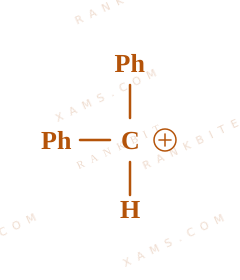
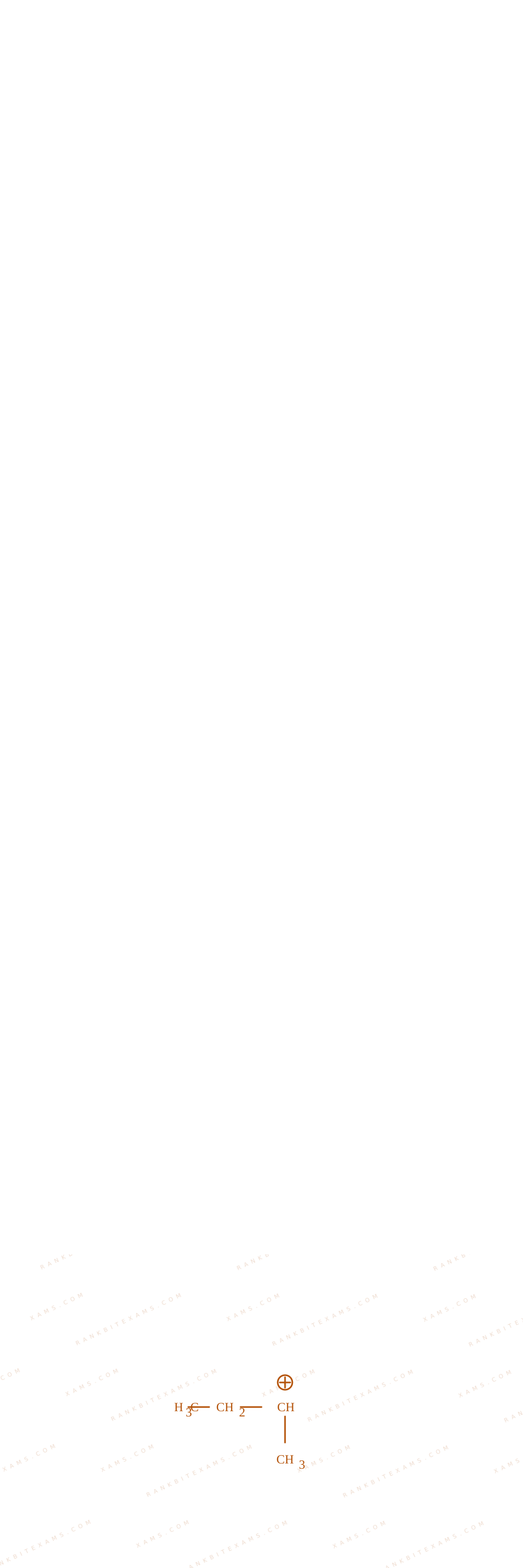
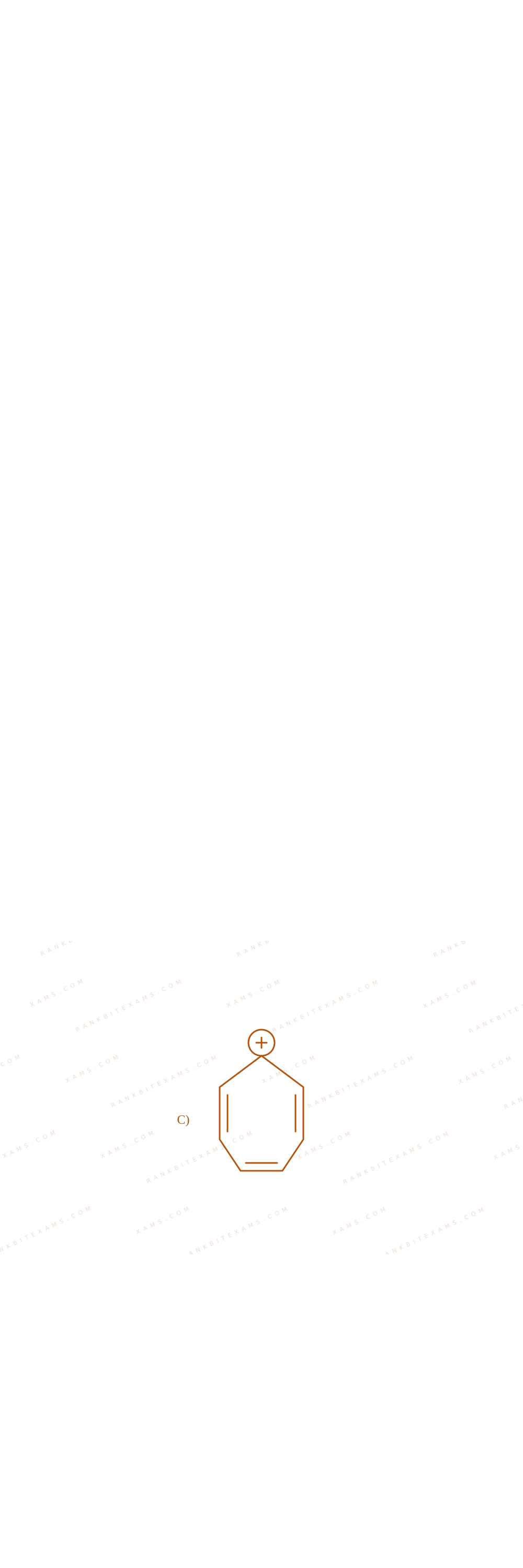
The correct order of stability of following carbocations is :
Carbocation structures for Q42 - JEE Main 2025 Morning
The images show different structural models labeled A, B, C, and D for evaluating stability variations.
A
Carbocation structures for Q42 - JEE Main 2025 Morning
The images show different structural models labeled A, B, C, and D for evaluating stability variations.
B
Carbocation structures for Q42 - JEE Main 2025 Morning
The images show different structural models labeled A, B, C, and D for evaluating stability variations.
C
Carbocation structures for Q42 - JEE Main 2025 Morning
The images show different structural models labeled A, B, C, and D for evaluating stability variations.
D
  • A. mathrmA > mathrmB > mathrmC > mathrmD
  • B. mathrmB > mathrmC > mathrmA > mathrmD
  • C. mathrmC > mathrmB > mathrmA > mathrmD
  • D. mathrmC > mathrmA > mathrmB > mathrmD

Solution

### Core Logic To evaluate carbocation stability, apply the priority rules: Aromaticity > Resonance > Hyperconjugation. - **C:** Represents a cyclopropenyl cation derivative which achieves full aromatic stabilization due to its planar cyclic conjugated system satisfying Huckel's rule (2pi electrons). This makes it the most stable. - **A:** Stabilized by extended resonance from multiple phenyl groups. - **B:** Contains fewer phenyl rings participating in active cross-conjugation relative to A. - **D:** Stabilized solely by simple aliphatic hyperconjugation, making it the least stable. Visual alignment chart:
Stability ranking structural chart for Q42 - JEE Main 2025 Morning
The images show different structural models labeled A, B, C, and D for evaluating stability variations.
Hence, the correct stability hierarchy is: mathrmC > mathrmA > mathrmB > mathrmD ### Pattern Recognition Sees: Mixed aromatic, benzylic, and aliphatic carbocations. Shortcut: Isolate the cyclopropenyl system as an aromatic champion to confidently lead the sequence. ### Evaluation Rubric / Model Answer null ### Chapter Mix Class 11 Chemistry: Organic Chemistry - Some Basic Principles and Techniques
Rankbit System
JEE Physics: Waves (+15.5%) | Electrostatics: Concentric Shells (-29.7%) | Modern Physics: Photoelectric Clones (+34.2%) | Mathematics: Definite Integrals (+18.1%) | Chemistry: Coordination Splitting (-11.4%) | JEE Physics: Waves (+15.5%) | Electrostatics: Concentric Shells (-29.7%) | Modern Physics: Photoelectric Clones (+34.2%) | Mathematics: Definite Integrals (+18.1%) | Chemistry: Coordination Splitting (-11.4%)