Q
jee_main_2025_02_april_morning
Free Radical Stability
Consider the following compound (X)
arrayc I H - C ≡ C - C H _ 2 - C H - C H _ 3 I C H _ 3 array
The most stable and least stable carbon radicals, respectively, produced by homolytic cleavage of corresponding C - H bond are :
Solution
Related Formula
Free radical stability structural hierarchy sequence:
Resonance Stabilized (Propargyl/Allyl) > 3^° > 2^° > 1^° > Vinylic/Alkyne CenterCore Logic
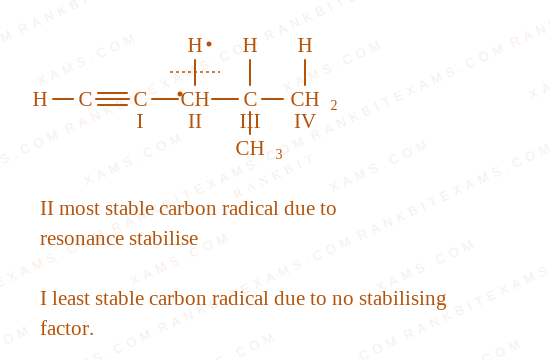
Let's analyze individual cleavage points across the carbon backbone skeleton:
- Position II yields a propargyl intermediate radical directly adjacent to the alkyne bond. This allows strong resonance stabilization across the π system, making it the most stable radical position.
- Position I places the radical directly on an sp-hybridized carbon center. The high electronegativity of sp orbitals tightly holds the unpaired electron, making homolytic cleavage extremely difficult and rendering this intermediate the least stable radical position.
Step 1: Verdict
Therefore, the most stable and least stable positions are II and I, respectively.
Pattern Recognition
Radicals located on sp carbons (vinylic/alkynic) are highly unstable due to poor orbital overlap, while positions next to triple bonds (propargylic) are exceptionally stable due to active resonance delocalization.
Chapter Mix
Class 11 Chemistry: Organic Chemistry - Some Basic Principles and Techniques