Organic Chemistry - Some Basic Principles and Techniques appeared 101 times across 3 years — 11.7% of Chemistry.
This question is from Aromaticity and Huckel's Rule.
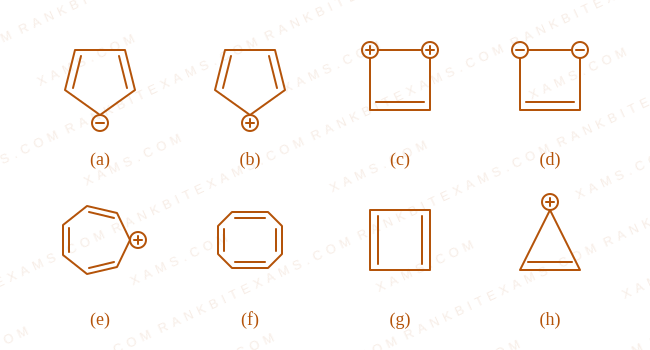
Designate whether each of the following compounds is aromatic or not aromatic:
The diagram displays eight different cyclic conjugated hydrocarbon compounds labeled (a) through (h) to evaluate for aromatic character.
Choose the correct answer from the options given below:
A.(1) e, g aromatic and a, b, c, d, f, h not aromatic$\text{(1) e, g aromatic and a, b, c, d, f, h not aromatic}$
B.(2) b, e, f, g aromatic and a, c, d, h not aromatic$\text{(2) b, e, f, g aromatic and a, c, d, h not aromatic}$
C.(3) a, b, c, d aromatic and e, f, g, h not aromatic$\text{(3) a, b, c, d aromatic and e, f, g, h not aromatic}$
D.(4) a, c, d, e, h aromatic and b, f, g not aromatic$\text{(4) a, c, d, e, h aromatic and b, f, g not aromatic}$
Solution & Explanation
Related Formula
According to Huckel's Rule, a planar, monocyclic, completely conjugated system is aromatic if it contains:
The diagram displays eight different cyclic conjugated hydrocarbon compounds labeled (a) through (h) to evaluate for aromatic character.The diagram displays eight different cyclic conjugated hydrocarbon compounds labeled (a) through (h) to evaluate for aromatic character.
Step 1: Classification
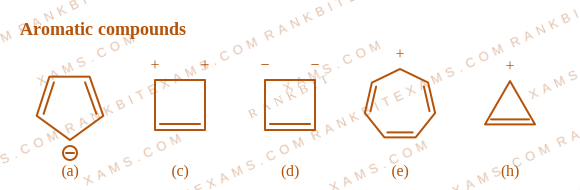
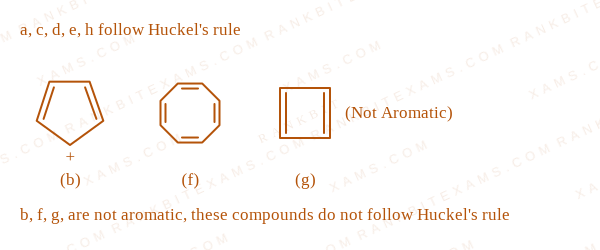
Hence, compounds a, c, d, e, and h follow Huckel's rule and are aromatic, whereas b, f, and g are not aromatic.
Pattern Recognition
Quick check for aromaticity: Count the pairs of localized/delocalized π$\pi$ electrons moving through the continuous loop. Odd number of pairs (1, 3, 5...) means aromatic (2π, 6π, 10π$2\pi, 6\pi, 10\pi$). Even pairs mean anti-aromatic/non-aromatic.
Chapter Mix
Class 11 Chemistry: Organic Chemistry - Some Basic Principles and Techniques

Class 11 Chemistry: Hydrocarbons
Keywords:#molecular structures#conjugated ring systems#Huckel rule analysis
More Organic Chemistry - Some Basic Principles and Techniques Previous-Year Questions
Q58jee_main_2026_21_jan_morningQuantitative Analysis of Elements
In Carius method, 0.75 g of an organic compound gave 1.2 g of barium sulphate, find percentage of sulphur (molar mass 32 g mol⁻¹$32\text{ g mol}^{-1}$). Molar mass of barium sulphate is 233 g mol⁻¹$233\text{ g mol}^{-1}$.
A.4.55%$4.55\%$
B.10.30%$10.30\%$
C.21.97%$21.97\%$
D.16.48%$16.48\%$
Solution
Related Formula
Percentage of Sulphur = Mass of S in BaSO₄Molar mass of BaSO₄ × Mass of BaSO₄ formedMass of organic compound × 100$$\text{Percentage of Sulphur} = \frac{\text{Mass of } S \text{ in } BaSO_4}{\text{Molar mass of } BaSO_4} \times \frac{\text{Mass of } BaSO_4 \text{ formed}}{\text{Mass of organic compound}} \times 100$$
Core Logic
Molar mass of BaSO₄$BaSO_4$ = 233 g/mol.
Mass of Sulfur (S) in 1 mole of BaSO₄$BaSO_4$ = 32 g.
Mass of BaSO₄$BaSO_4$ formed = 1.2 g.
Mass of organic compound = 0.75 g.
Class 11 Chemistry: Organic Chemistry - Some Basic Principles and Techniques
Q62jee_main_2026_21_jan_morningResonance Effects
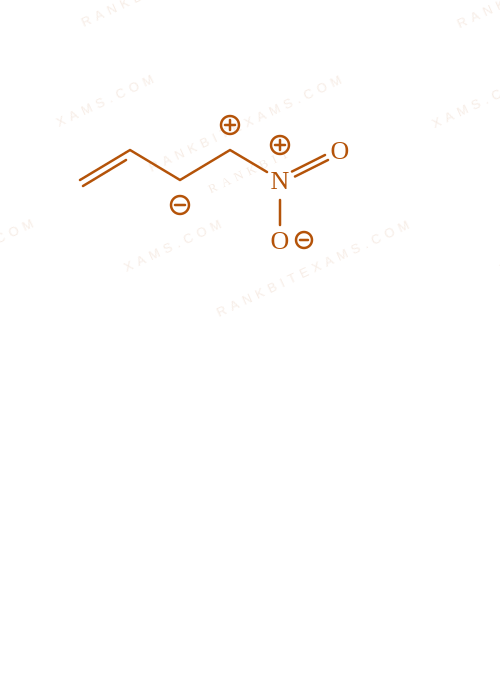
From the following, the least stable structure is :
A.Option 1$\text{Option 1}$
B.Option 2$\text{Option 2}$
C.Option 3$\text{Option 3}$
D.Option 4$\text{Option 4}$
Solution
Core Logic
In structure 3, there are positive formal charges on two adjacent atoms (Oxygen and the Carbon adjacent to it). Like charges on adjacent atoms cause extreme electrostatic repulsion, making the structure highly unstable.
Resonance Effects diagram for Q62 - JEE Main 2026 Morning
Pattern Recognition
Rules of resonance stability:
Complete octets are more stable.
More covalent bonds = more stable.
Least charge separation is more stable.
Like charges on adjacent atoms create massive destabilization (Least stable scenario).
Chapter Mix
Class 11 Chemistry: Organic Chemistry - Some Basic Principles and Techniques
Q66jee_main_2026_21_jan_morningIsomerism
Identify correct statement from the following:
A. Propanal and propanone are functional isomers.
B. Ethoxyethane and methoxypropane are metamers.
C. But-2-ene shows optical isomerism.
D. But-1-ene and but-2-ene are functional isomers.
E. Pentane and 2, 2-dimethyl propane are chain isomers.
Choose the correct answer from the options given below:
A.B, C and D only$\text{B, C and D only}$
B.A, B and C only$\text{A, B and C only}$
C.A, B and E only$\text{A, B and E only}$
D.C, D and E only$\text{C, D and E only}$
Solution
Core Logic
A. Propanal (CH₃CH₂CHO$CH_3CH_2CHO$) and propanone (CH₃COCH₃$CH_3COCH_3$) have different functional groups (aldehyde vs ketone) but the same molecular formula. They are functional isomers. (Correct)
B. Ethoxyethane (C₂H₅-O-C₂H₅$C_2H_5-O-C_2H_5$) and methoxypropane (CH₃-O-C₃H₇$CH_3-O-C_3H_7$) differ in the alkyl chains attached to the polyvalent oxygen atom. They are metamers. (Correct)
C. But-2-ene shows geometrical isomerism (cis-trans), but no optical isomerism as it lacks a chiral center. (Incorrect)
D. But-1-ene and but-2-ene differ in the position of the double bond. They are position isomers, not functional isomers. (Incorrect)
E. Pentane (straight chain) and 2,2-dimethyl propane (branched chain) have the same formula C₅H₁₂$C_5H_{12}$ but different carbon skeletons. They are chain isomers. (Correct)
Correct statements: A, B, and E.
Pattern Recognition
Metamerism arises when there is a difference in the alkyl groups attached to a polyvalent functional group (e.g., -O-, -S-, -NH-, -CO-).
Chapter Mix
Class 11 Chemistry: Organic Chemistry - Some Basic Principles and Techniques
A. 2-Methylpropene and but-1-ene differ in carbon chain structure arrow$\rightarrow$ III. Chain isomers
B. Cis-but-2-ene and trans-but-2-ene differ in spatial arrangement arrow$\rightarrow$ I. Stereoisomers
C. 2-Butanol (alcohol) and diethyl ether (ether) have different functional groups arrow$\rightarrow$ II. Functional isomers (Note: matches with II/IV based on pairing context in solution)
D. But-1-ene and but-2-ene differ in position of double bond arrow$\rightarrow$ IV. Position isomers
Nucleophilicity generally parallels basicity among related species (when comparing oxygen-centered nucleophiles in similar environments). Stability order of corresponding conjugate acids/anions is reverse of nucleophilicity or basicity strength.
Basicity/Nucleophilicity order: ^-OH > PhO^- > CH₃COO^- > ClO₄^-$^-\text{OH} > \text{PhO}^- > \text{CH}_3\text{COO}^- > \text{ClO}_4^-$.
Step 1: Final Conclusion
Thus, option (4) represents the correct nucleophilicity order.
Pattern Recognition
Sees: Nucleophilic substitution rate and nucleophilicity order.
Trap: Confusing leaving group ability with nucleophile strength.
Chapter Mix
Class 11 Chemistry: Organic Chemistry - Some Basic Principles and Techniques
Practice past-year questions one chapter at a time. Pick an exam → subject → chapter and get every PYQ for that topic — pulled together from all past papers — with the chapter's key formulas alongside.