Haloalkanes and Haloarenes appeared 40 times across 3 years — 4.6% of Chemistry.
This question is from Reactions of Alkyl Halides and Alkyne Hydration.
An optically active alkyl halide C₄H₉Br$\mathrm{C_4H_9Br}$ [A] reacts with hot KOH dissolved in ethanol and forms alkene [B] as major product which reacts with bromine to give dibromide [C]. The compound [C] is converted into a gas [D] upon reacting with alcoholic NaNH₂$\mathrm{NaNH_2}$. During hydration 18 gram of water is added to 1 mole of gas [D] on warming with mercuric sulphate and dilute acid at 333K$333\mathrm{K}$ to form compound [E]. The IUPAC name of compound [E] is :
A.(1) But-2-yne$(1)\ \text{But-2-yne}$
B.(2) Butan-2-ol$(2)\ \text{Butan-2-ol}$
C.(3) Butan-2-one$(3)\ \text{Butan-2-one}$
D.(4) Butan-1-al$(4)\ \text{Butan-1-al}$
Solution & Explanation
Related Formula
Dehydrohalogenation via alcoholic KOH follows E2 elimination mechanism:
Hydration of alkynes using HgSO₄/H₂SO₄$\mathrm{HgSO_4/H_2SO_4}$ yields ketones via keto-enol tautomerism.
Core Logic
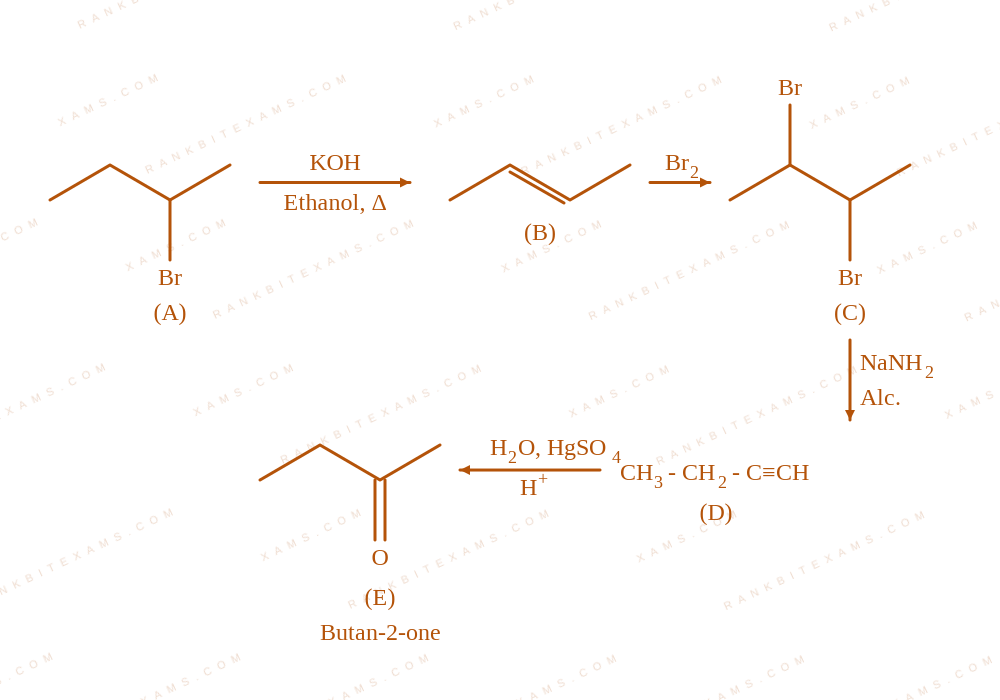
Let's trace the full sequence line-by-row:
[A] is an optically active halide with formula C₄H₉Br arrow CH₃-CH(Br)-CH₂-CH₃$\mathrm{C_4H_9Br} \rightarrow \mathrm{CH_3-CH(Br)-CH_2-CH_3}$ (2-Bromobutane).
Reaction of [A] with hot ethanolic KOH produces [B] as the major product: CH₃-CH=CH-CH₃$\mathrm{CH_3-CH=CH-CH_3}$ (But-2-ene).
Treatment of [B] with Br₂$\mathrm{Br_2}$ yields a vicinal dibromide [C]: CH₃-CH(Br)-CH(Br)-CH₃$\mathrm{CH_3-CH(Br)-CH(Br)-CH_3}$ (2,3-Dibromobutane).
Reaction of [C] with alcoholic NaNH₂$\mathrm{NaNH_2}$ converts it via double dehydrohalogenation into gas [D]: CH₃-C≡ C-CH₃$\mathrm{CH_3-C\equiv C-CH_3}$ (But-2-yne).
Hydration of 1 mole of [D] with H₂O$\mathrm{H_2O}$ in the presence of Hg²⁺/H^+$\mathrm{Hg^{2+}/H^+}$ forms an enol intermediate that rapidly tautomerizes to compound [E]: CH₃-CO-CH₂-CH₃$\mathrm{CH_3-CO-CH_2-CH_3}$ (Butan-2-one).
Step 1: Visualization
Reaction roadmap step verification for Q27
Pattern Recognition
Whenever you see a 4-carbon chain undergoing terminal/internal dehydrohalogenation followed by hydration of the resulting alkyne, look closely at the configuration: symmetric or unsymmetric alkyne hydration both systematically lead to Butan-2-one because a stable ketone cannot form on position 1 via standard Kucherov hydration of an internal chain.
Chapter Mix
Class 12 Physics: Haloalkanes and Haloarenes
Class 11 Chemistry: Hydrocarbons
Class 12 Chemistry: Aldehydes, Ketones and Carboxylic Acids
More Haloalkanes and Haloarenes Previous-Year Questions — Page 8
Q74jee_main_2024_30_jan_morningClassification
Given below are two statement one is labeled as Assertion (A) and the other is labeled as Reason (R).
Assertion (A): CH₂=CH-CH₂-Cl$CH_2=CH-CH_2-Cl$ is an example of allyl halide
Reason (R): Allyl halides are the compounds in which the halogen atom is attached to sp²$sp^2$ hybridised carbon atom.
In the light of the two above statements, choose the most appropriate answer from the options given below:
A.(A) is true but (R) is false$\text{(A) is true but (R) is false}$
B.Both (A) and (R) are true but (R) is not the correct explanation of (A)$\text{Both (A) and (R) are true but (R) is not the correct explanation of (A)}$
C.(A) is false but (R) is true$\text{(A) is false but (R) is true}$
D.Both (A) and (R) are true and (R) is the correct explanation of (A)$\text{Both (A) and (R) are true and (R) is the correct explanation of (A)}$
Solution
Core Logic
Assertion (A): CH₂=CH-CH₂-Cl$CH_2=CH-CH_2-Cl$ is an allyl halide. This statement is True. The halogen is attached to the carbon adjacent to the double bond (allylic position).
Reason (R): Allyl halides are compounds in which the halogen atom is attached to an sp²$sp^2$ hybridized carbon atom. This statement is False. In allyl halides, the halogen is attached to an sp³$sp^3$ hybridized carbon atom which is next to an sp²$sp^2$ hybridized carbon (C=C double bond).
Step 1: Conclusion
Therefore, (A) is true but (R) is false.
Pattern Recognition
Allylic = sp³$sp^3$ C adjacent to C=C.
Vinylic = sp²$sp^2$ C of the C=C itself.
Identify A and B in the following reaction sequence.
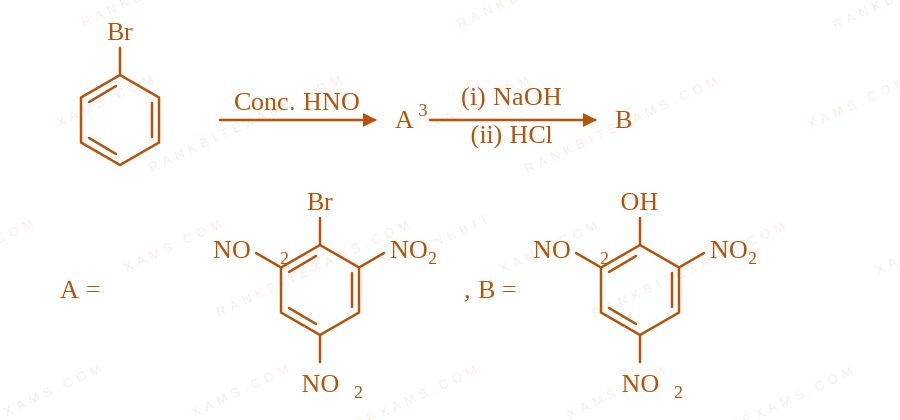
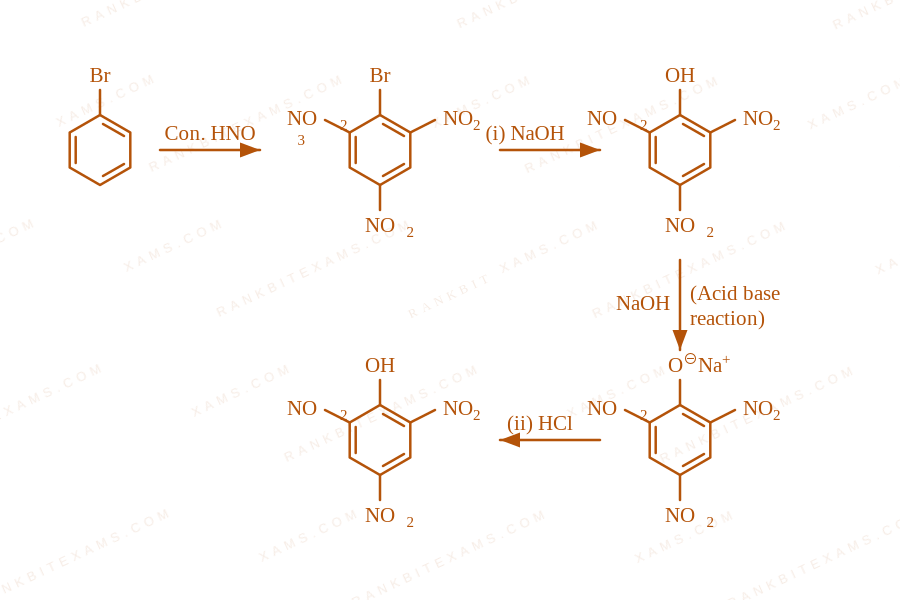
The image shows a reaction scheme starting from bromobenzene undergoing nitration followed by substitution.
A.
B.
C.
D.
Solution
Core Logic
When bromobenzene reacts with concentrated HNO₃$HNO_3$ (nitration), the bromine atom is ortho/para directing. However, under drastic conditions with excess concentrated nitrating mixture, 1-bromo-2,4,6-trinitrobenzene is formed (Compound A).
When 1-bromo-2,4,6-trinitrobenzene (Compound A) is treated with NaOH$NaOH$, the presence of three strong electron-withdrawing -NO₂$-NO_2$ groups activates the aromatic ring toward Nucleophilic Aromatic Substitution (SNAr$S_NAr$). The -Br$-Br$ is easily replaced by -OH$-OH$ to form 2,4,6-trinitrophenol (picric acid).
Subsequent acidification with HCl$HCl$ yields the neutral picric acid (Compound B).
The image shows a reaction scheme starting from bromobenzene undergoing nitration followed by substitution.
Pattern Recognition
Multiple NO₂$NO_2$ groups drastically increase the susceptibility of halobenzenes to SNAr$S_NAr$. Bromine is replaced completely by OH^-$OH^-$ under alkaline conditions.
Chapter Mix
Class 12 Chemistry: Haloalkanes and Haloarenes
Class 12 Chemistry: Alcohols, Phenols and Ethers
Qjee_main_2024_31_jan_eveningIUPAC Nomenclature of Haloalkanes
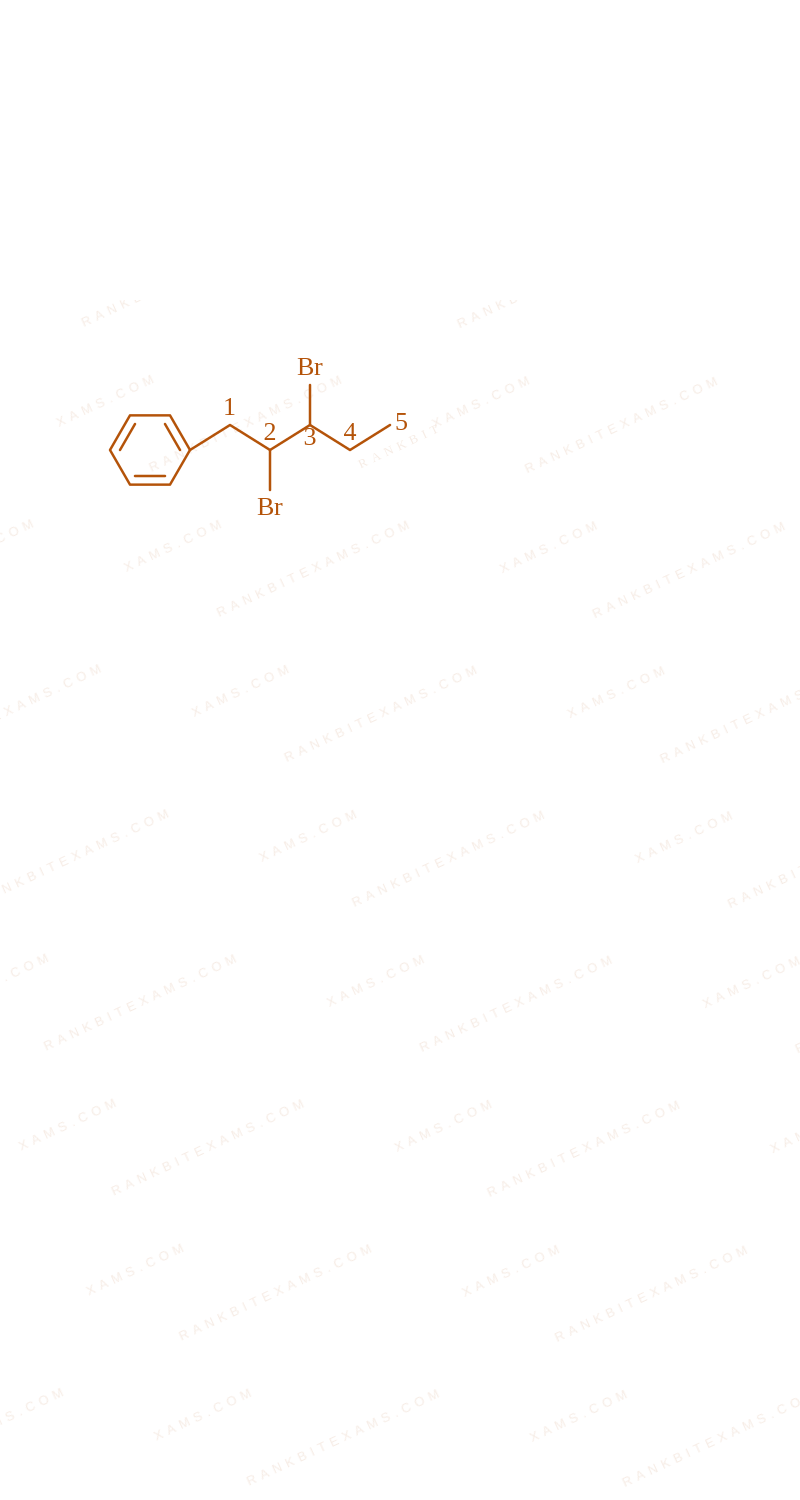
Identify structure of 2,3-dibromo-1-phenylpentane.
A.
B.
C.
D.
Solution
Core Logic
Decode the IUPAC name: 2,3-dibromo-1-phenylpentane.
Parent chain is pentane (5 carbon chain: C1-C2-C3-C4-C5).
Substituents:
Phenyl group at position 1.
Bromo groups at positions 2 and 3.
Option (3) correctly displays a 5-carbon straight chain. The first carbon attaches to the benzene ring (phenyl group), and the second and third carbons each hold a bromine atom.
IUPAC Nomenclature of Haloalkanes diagram for Q67 - JEE Main 2024 Evening
Chapter Mix
Class 12 Chemistry: Haloalkanes and Haloarenes
Qjee_main_2024_31_jan_morningElimination and Addition Reactions
The product (C) in the below mentioned reaction is:
CH₃-CH₂-CH₂-Br [Δ]KOH(alc) A [Δ]HBr B [Δ]KOH(aq) C$$CH_3-CH_2-CH_2-Br \xrightarrow[\Delta]{KOH_{(alc)}} A \xrightarrow[\Delta]{HBr} B \xrightarrow[\Delta]{KOH_{(aq)}} C$$
Q86jee_main_2024_31_jan_morningElimination and Substitution
CH₃CH₂Br + NaOH arrow Product A$$CH_3CH_2Br + NaOH \rightarrow \text{Product A}$$CH₃CH₂Br + NaOH / H₂O arrow Product B$$CH_3CH_2Br + NaOH / H_2O \rightarrow \text{Product B}$$
The total number of hydrogen atoms in product A and product B is
Numerical Answer.Answer: 10 to 10
Solution
Core Logic
Reaction 1:
If the reagent is alcoholic NaOH (implied due to formation of a distinct product A to contrast B), elimination occurs:
Practice past-year questions one chapter at a time. Pick an exam → subject → chapter and get every PYQ for that topic — pulled together from all past papers — with the chapter's key formulas alongside.