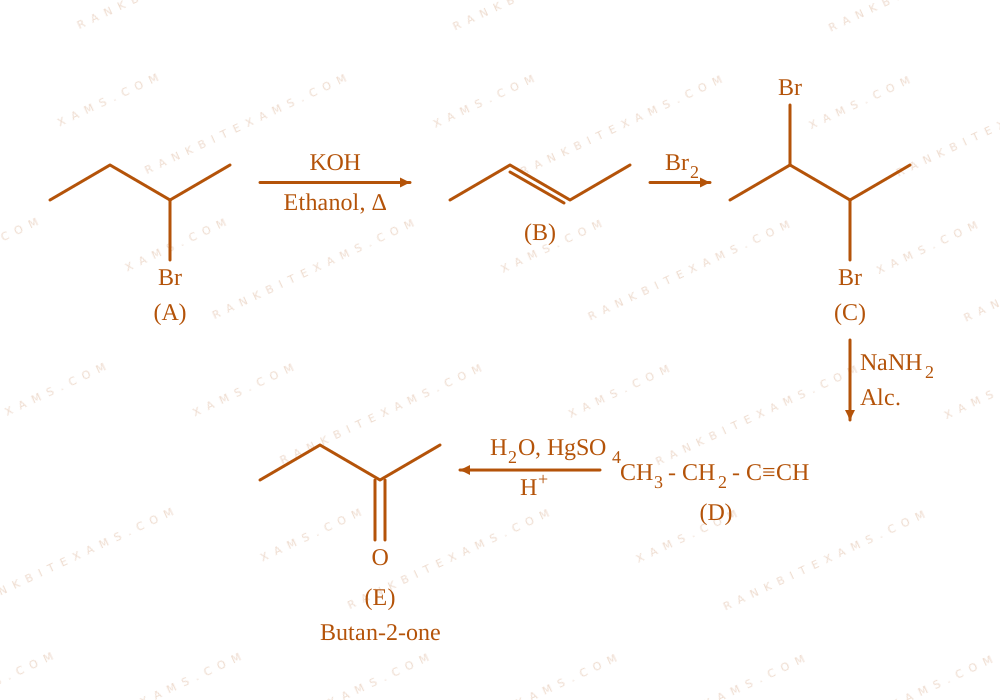
An optically active alkyl halide mathrmC_4H_9Br$\mathrm{C_4H_9Br}$ [A] reacts with hot KOH dissolved in ethanol and forms alkene [B] as major product which reacts with bromine to give dibromide [C]. The compound [C] is converted into a gas [D] upon reacting with alcoholic mathrmNaNH_2$\mathrm{NaNH_2}$. During hydration 18 gram of water is added to 1 mole of gas [D] on warming with mercuric sulphate and dilute acid at 333mathrmK$333\mathrm{K}$ to form compound [E]. The IUPAC name of compound [E] is :
A.(1)\ textBut-2-yne$(1)\ \text{But-2-yne}$
B.(2)\ textButan-2-ol$(2)\ \text{Butan-2-ol}$
C.(3)\ textButan-2-one$(3)\ \text{Butan-2-one}$
D.(4)\ textButan-1-al$(4)\ \text{Butan-1-al}$
Solution & Explanation
### Related Formula
Dehydrohalogenation via alcoholic KOH follows E2 elimination mechanism:
mathrmR-CH_2-CH(Br)-R' xrightarrowtextalc. KOH R-CH=CH-R'$$\mathrm{R-CH_2-CH(Br)-R' \xrightarrow{\text{alc. KOH}} R-CH=CH-R'}$$
Hydration of alkynes using mathrmHgSO_4/H_2SO_4$\mathrm{HgSO_4/H_2SO_4}$ yields ketones via keto-enol tautomerism.
### Core Logic
Let's trace the full sequence line-by-row:
1. **[A]** is an optically active halide with formula mathrmC_4H_9Br rightarrow mathrmCH_3-CH(Br)-CH_2-CH_3$\mathrm{C_4H_9Br} \rightarrow \mathrm{CH_3-CH(Br)-CH_2-CH_3}$ (2-Bromobutane).
2. Reaction of [A] with hot ethanolic KOH produces **[B]** as the major product: mathrmCH_3-CH=CH-CH_3$\mathrm{CH_3-CH=CH-CH_3}$ (But-2-ene).
3. Treatment of [B] with mathrmBr_2$\mathrm{Br_2}$ yields a vicinal dibromide **[C]**: mathrmCH_3-CH(Br)-CH(Br)-CH_3$\mathrm{CH_3-CH(Br)-CH(Br)-CH_3}$ (2,3-Dibromobutane).
4. Reaction of [C] with alcoholic mathrmNaNH_2$\mathrm{NaNH_2}$ converts it via double dehydrohalogenation into gas **[D]**: mathrmCH_3-Cequiv C-CH_3$\mathrm{CH_3-C\equiv C-CH_3}$ (But-2-yne).
5. Hydration of 1 mole of [D] with mathrmH_2O$\mathrm{H_2O}$ in the presence of mathrmHg^2+/H^+$\mathrm{Hg^{2+}/H^+}$ forms an enol intermediate that rapidly tautomerizes to compound **[E]**: mathrmCH_3-CO-CH_2-CH_3$\mathrm{CH_3-CO-CH_2-CH_3}$ (Butan-2-one).
### Step 1: Visualization
Reaction roadmap step verification for Q27
### Pattern Recognition
Whenever you see a 4-carbon chain undergoing terminal/internal dehydrohalogenation followed by hydration of the resulting alkyne, look closely at the configuration: symmetric or unsymmetric alkyne hydration both systematically lead to Butan-2-one because a stable ketone cannot form on position 1 via standard Kucherov hydration of an internal chain.
### Evaluation Rubric / Model Answer
null
### Chapter Mix
Class 12 Physics: Haloalkanes and Haloarenes
Class 11 Chemistry: Hydrocarbons
Class 12 Chemistry: Aldehydes, Ketones and Carboxylic Acids
More Haloalkanes and Haloarenes Previous-Year Questions — Page 6
Q67jee_main_2024_31_jan_eveningIUPAC Nomenclature of Haloalkanes
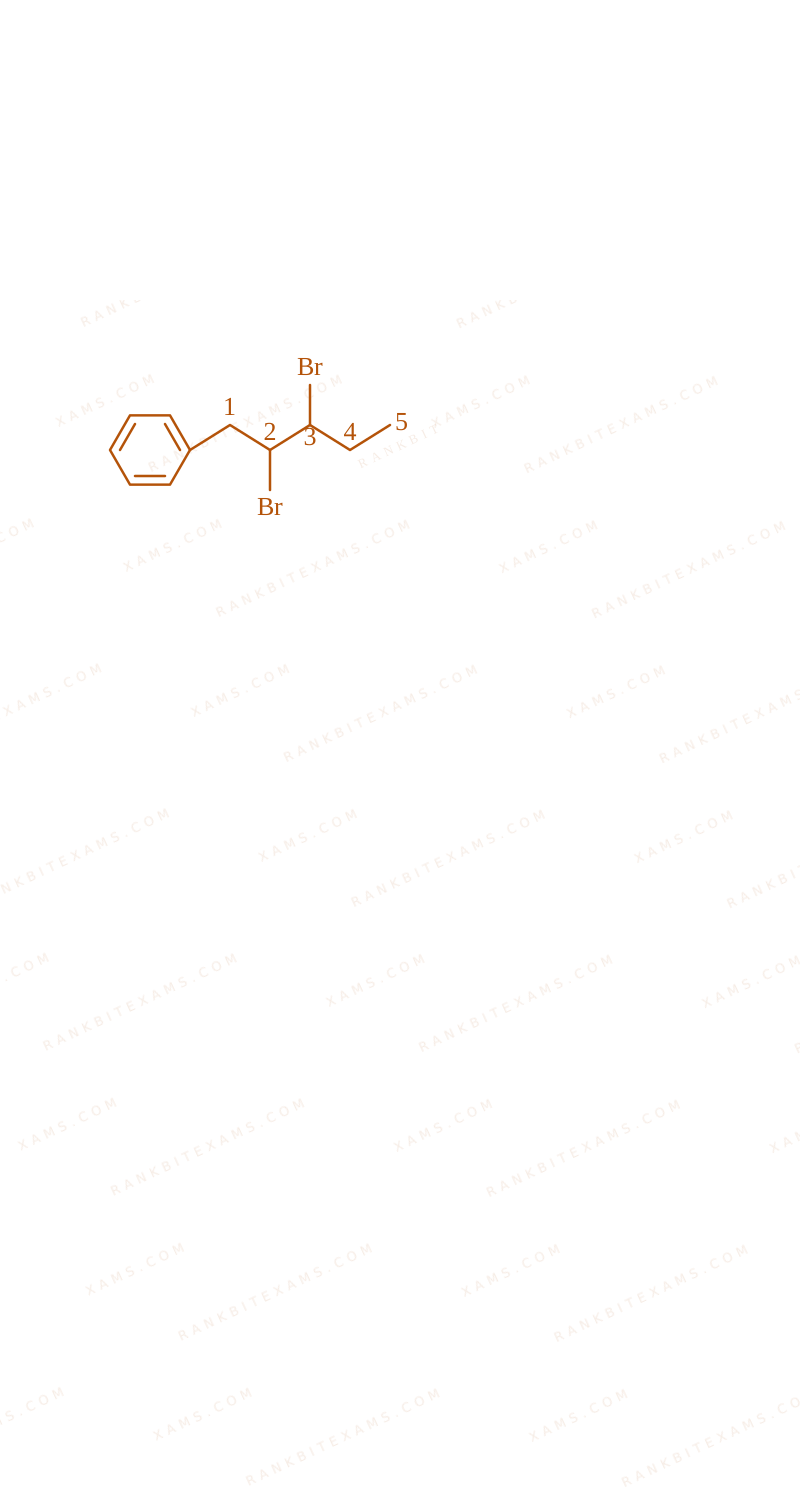
Identify structure of 2,3-dibromo-1-phenylpentane.
A.text(1) Structure A$\text{(1) Structure A}$
B.text(2) Structure B$\text{(2) Structure B}$
C.text(3) Structure C$\text{(3) Structure C}$
D.text(4) Structure D$\text{(4) Structure D}$
Solution
### Core Logic
Decode the IUPAC name: 2,3-dibromo-1-phenylpentane.
1) Parent chain is pentane (5 carbon chain: C1-C2-C3-C4-C5).
2) Substituents:
- Phenyl group at position 1.
- Bromo groups at positions 2 and 3.
Option (3) correctly displays a 5-carbon straight chain. The first carbon attaches to the benzene ring (phenyl group), and the second and third carbons each hold a bromine atom.
IUPAC Nomenclature of Haloalkanes diagram for Q67 - JEE Main 2024 Evening
### Evaluation Rubric / Model Answer
null
### Chapter Mix
Class 12 Chemistry: Haloalkanes and Haloarenes
Q68jee_main_2024_31_jan_morningElimination and Addition Reactions
The product (C) in the below mentioned reaction is:
CH_3-CH_2-CH_2-Br xrightarrow[Delta]KOH_(alc) A xrightarrow[Delta]HBr B xrightarrow[Delta]KOH_(aq) C$$CH_3-CH_2-CH_2-Br \xrightarrow[\Delta]{KOH_{(alc)}} A \xrightarrow[\Delta]{HBr} B \xrightarrow[\Delta]{KOH_{(aq)}} C$$
Q86jee_main_2024_31_jan_morningElimination and Substitution
CH_3CH_2Br + NaOH rightarrow textProduct A$$CH_3CH_2Br + NaOH \rightarrow \text{Product A}$$CH_3CH_2Br + NaOH / H_2O rightarrow textProduct B$$CH_3CH_2Br + NaOH / H_2O \rightarrow \text{Product B}$$
The total number of hydrogen atoms in product A and product B is
Numerical Answer.Answer: 10 to 10
Solution
### Core Logic
Reaction 1:
If the reagent is alcoholic NaOH (implied due to formation of a distinct product A to contrast B), elimination occurs:
CH_3CH_2Br + NaOH (textalc) rightarrow CH_2=CH_2 text (Ethene)$$CH_3CH_2Br + NaOH (\text{alc}) \rightarrow CH_2=CH_2 \text{ (Ethene)}$$
Hydrogen atoms in ethene (C_2H_4$C_2H_4$) = 4.
Reaction 2:
If the reagent is aqueous NaOH (NaOH / H_2O$NaOH / H_2O$), nucleophilic substitution (S_N2$S_N2$) occurs:
CH_3CH_2Br + NaOH (textaq) rightarrow CH_3CH_2OH text (Ethanol)$$CH_3CH_2Br + NaOH (\text{aq}) \rightarrow CH_3CH_2OH \text{ (Ethanol)}$$
Hydrogen atoms in ethanol (C_2H_6O$C_2H_6O$) = 6.
Total hydrogen atoms = 4 + 6 = 10.
### Evaluation Rubric / Model Answer
null
### Chapter Mix
Class 12 Chemistry: Haloalkanes and Haloarenes
We Map Every Repeating Question in Competitive Exams.
Say goodbye to generic mock test fatigue. RankBit uses smart analysis to group past exam questions into their foundational Repeating Question Types. Find chapter weightage, track repeating questions, and score higher with targeted practice.
Select Your Target Exam
Choose an exam track below to find formulas per chapter and patterns.
Syncing Exam Intelligence
Mapping formulas and patterns across all tracks…
PATH A — FULL LENGTH PRACTICE
Full Mock Test Hub
Simulate real NTA exam conditions with fully tracked mocks. Time yourself against past papers.
Practice past-year questions one chapter at a time. Pick an exam → subject → chapter and get every PYQ for that topic — pulled together from all past papers — with the chapter's key formulas alongside.