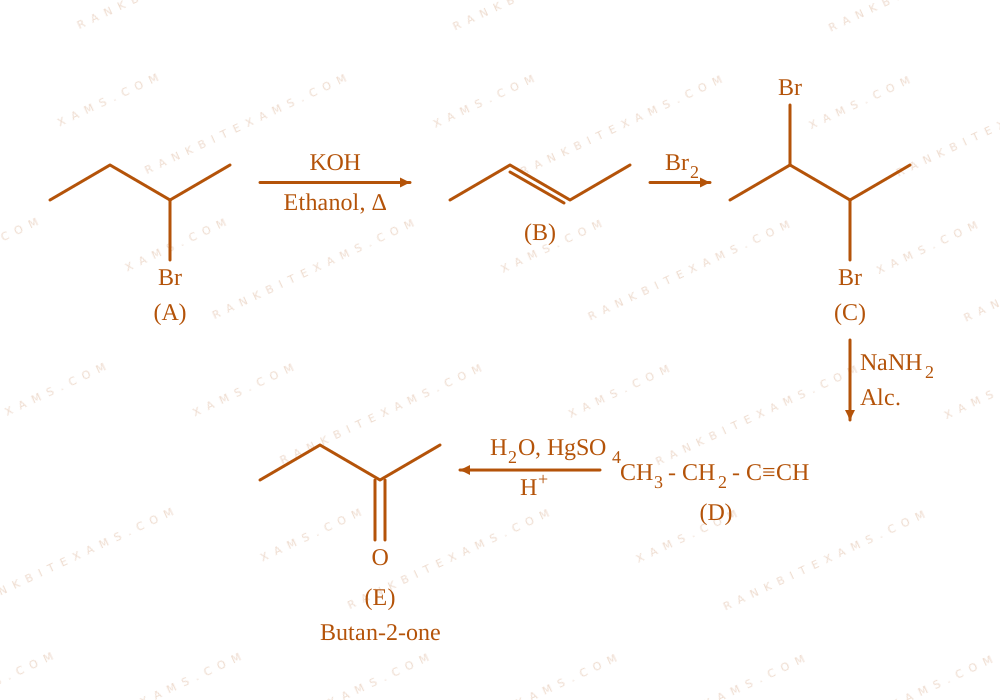
An optically active alkyl halide mathrmC_4H_9Br$\mathrm{C_4H_9Br}$ [A] reacts with hot KOH dissolved in ethanol and forms alkene [B] as major product which reacts with bromine to give dibromide [C]. The compound [C] is converted into a gas [D] upon reacting with alcoholic mathrmNaNH_2$\mathrm{NaNH_2}$. During hydration 18 gram of water is added to 1 mole of gas [D] on warming with mercuric sulphate and dilute acid at 333mathrmK$333\mathrm{K}$ to form compound [E]. The IUPAC name of compound [E] is :
A.(1)\ textBut-2-yne$(1)\ \text{But-2-yne}$
B.(2)\ textButan-2-ol$(2)\ \text{Butan-2-ol}$
C.(3)\ textButan-2-one$(3)\ \text{Butan-2-one}$
D.(4)\ textButan-1-al$(4)\ \text{Butan-1-al}$
Solution & Explanation
### Related Formula
Dehydrohalogenation via alcoholic KOH follows E2 elimination mechanism:
mathrmR-CH_2-CH(Br)-R' xrightarrowtextalc. KOH R-CH=CH-R'$$\mathrm{R-CH_2-CH(Br)-R' \xrightarrow{\text{alc. KOH}} R-CH=CH-R'}$$
Hydration of alkynes using mathrmHgSO_4/H_2SO_4$\mathrm{HgSO_4/H_2SO_4}$ yields ketones via keto-enol tautomerism.
### Core Logic
Let's trace the full sequence line-by-row:
1. **[A]** is an optically active halide with formula mathrmC_4H_9Br rightarrow mathrmCH_3-CH(Br)-CH_2-CH_3$\mathrm{C_4H_9Br} \rightarrow \mathrm{CH_3-CH(Br)-CH_2-CH_3}$ (2-Bromobutane).
2. Reaction of [A] with hot ethanolic KOH produces **[B]** as the major product: mathrmCH_3-CH=CH-CH_3$\mathrm{CH_3-CH=CH-CH_3}$ (But-2-ene).
3. Treatment of [B] with mathrmBr_2$\mathrm{Br_2}$ yields a vicinal dibromide **[C]**: mathrmCH_3-CH(Br)-CH(Br)-CH_3$\mathrm{CH_3-CH(Br)-CH(Br)-CH_3}$ (2,3-Dibromobutane).
4. Reaction of [C] with alcoholic mathrmNaNH_2$\mathrm{NaNH_2}$ converts it via double dehydrohalogenation into gas **[D]**: mathrmCH_3-Cequiv C-CH_3$\mathrm{CH_3-C\equiv C-CH_3}$ (But-2-yne).
5. Hydration of 1 mole of [D] with mathrmH_2O$\mathrm{H_2O}$ in the presence of mathrmHg^2+/H^+$\mathrm{Hg^{2+}/H^+}$ forms an enol intermediate that rapidly tautomerizes to compound **[E]**: mathrmCH_3-CO-CH_2-CH_3$\mathrm{CH_3-CO-CH_2-CH_3}$ (Butan-2-one).
### Step 1: Visualization
Reaction roadmap step verification for Q27
### Pattern Recognition
Whenever you see a 4-carbon chain undergoing terminal/internal dehydrohalogenation followed by hydration of the resulting alkyne, look closely at the configuration: symmetric or unsymmetric alkyne hydration both systematically lead to Butan-2-one because a stable ketone cannot form on position 1 via standard Kucherov hydration of an internal chain.
### Evaluation Rubric / Model Answer
null
### Chapter Mix
Class 12 Physics: Haloalkanes and Haloarenes
Class 11 Chemistry: Hydrocarbons
Class 12 Chemistry: Aldehydes, Ketones and Carboxylic Acids
More Haloalkanes and Haloarenes Previous-Year Questions — Page 2
Which among the following halides will generate the most stable carbocation in Nucleophilic substitution reaction?
A. Allylic halide option (1)
B. Secondary halide option (2)
C. Secondary benzylic halide option (3)
D. Triphenylmethyl halide option (4)
Solution
### Core Logic
The mechanism of S_N1$S_N1$ substitution proceeds via carbocation intermediate formation. Option (4) gives a triphenylmethyl carbocation (Ph_3C^+$Ph_{3}C^{+}$), which is exceptionally stable due to extensive delocalization of positive charge across three phenyl rings (resonance stabilization via 9 canonical structures).
Nucleophilic Substitution Mechanisms diagram for Q30 - JEE Main 2025 Evening
### Step 1: Stability Comparison
Stability sequence:
Ph_3C^+ > textbenzylic > textallylic > textalkyl carbocations$$Ph_{3}C^{+} > \text{benzylic} > \text{allylic} > \text{alkyl carbocations}$$
### Pattern Recognition
Look for maximum phenyl groups attached directly to the carbon bearing the leaving group to maximize resonance contribution.
### Evaluation Rubric / Model Answer
null
### Chapter Mix
Class 12 Chemistry: Haloalkanes and Haloarenes
Q29jee_main_2025_28_jan_morningAlkaline Hydrolysis and NGP
Given below are two statements :
Statement I: mathrmEt_2mathrmN-mathrmCH_2-mathrmCH_2-mathrmCl$\mathrm{Et}_2\mathrm{N}-\mathrm{CH}_2-\mathrm{CH}_2-\mathrm{Cl}$ will undergo alkaline hydrolysis at a faster rate than mathrmEt_2mathrmCH-mathrmCH_2-mathrmCl$\mathrm{Et}_2\mathrm{CH}-\mathrm{CH}_2-\mathrm{Cl}$.
Statement II: In mathrmEt_2mathrmN-mathrmCH_2-mathrmCH_2-mathrmCl$\mathrm{Et}_2\mathrm{N}-\mathrm{CH}_2-\mathrm{CH}_2-\mathrm{Cl}$, intramolecular substitution takes place first by involving lone pair of electrons on nitrogen.
In the light of the above statements, choose the most appropriate answer from the options given below:
A.textBoth Statement I and Statement II are incorrect$\text{Both Statement I and Statement II are incorrect}$
B.textStatement I is incorrect but statement II is correct$\text{Statement I is incorrect but statement II is correct}$
C.textBoth Statement I and Statement II are correct$\text{Both Statement I and Statement II are correct}$
D.textStatement I is correct but Statement II is incorrect$\text{Statement I is correct but Statement II is incorrect}$
Solution
### Core Logic
Statement I is correct because the nitrogen atom contains a lone pair situated at the beta$\beta$-position relative to the chlorine atom, promoting Neighboring Group Participation (NGP).
Statement II is correct because the lone pair on nitrogen attacks internally to kick out the chloride ion, forming a cyclic aziridinium ion intermediate. This quick intramolecular cyclization leads to an exceptionally rapid hydrolysis rate compared to standard aliphatic substitution.
### Pattern Recognition
Sees: Nitrogen with lone pair beta$\beta$ to a leaving group.
Shortcut: NGP (Neighboring Group Participation) accelerates substitution dramatically via intramolecular assistance.
### Evaluation Rubric / Model Answer
null
### Chapter Mix
Class 12 Chemistry: Haloalkanes and Haloarenes
The products A and B in the following reactions, respectively are
mathrm A xleftarrow mathrm A g - mathrm N O _ 2 mathrm C H _ 3 - mathrm C H _ 2 - mathrm C H _ 2 - mathrm B r xrightarrow mathrm A g C N mathrm B$$\mathrm {A} \xleftarrow {\mathrm {A g} - \mathrm {N O} _ {2}} \mathrm {C H} _ {3} - \mathrm {C H} _ {2} - \mathrm {C H} _ {2} - \mathrm {B r} \xrightarrow {\mathrm {A g C N}} \mathrm {B}$$
### Core Logic
Both silver reagents exhibit significantly covalent bond characters:
- Reaction with mathrmAgNO_2$\mathrm{AgNO}_2$: The bond between silver and oxygen is covalent, making the lone pair on the nitrogen atom the primary nucleophilic site. Attack via nitrogen yields a nitroalkane product:
mathrmA = mathrmCH_3-mathrmCH_2-mathrmCH_2-mathrmNO_2$$\mathrm{A} = \mathrm{CH}_3-\mathrm{CH}_2-\mathrm{CH}_2-\mathrm{NO}_2$$
- Reaction with mathrmAgCN$\mathrm{AgCN}$: The covalent mathrmAg-mathrmC$\mathrm{Ag}-\mathrm{C}$ bond directs the nucleophilic attack to proceed through the lone pair on nitrogen, yielding an isocyanide compound:
mathrmB = mathrmCH_3-mathrmCH_2-mathrmCH_2-mathrmNC$$\mathrm{B} = \mathrm{CH}_3-\mathrm{CH}_2-\mathrm{CH}_2-\mathrm{NC}$$
Hence, option (4) represents the correct combination.
### Pattern Recognition
Sees: Alkyl halide reacting with covalent silver salts of ambident anions.
Shortcut: Silver reagents (mathrmAgCN$\mathrm{AgCN}$ or mathrmAgNO_2$\mathrm{AgNO}_2$) drive bond formatting via the nitrogen center, producing isocyanides and nitroalkanes respectively.
### Evaluation Rubric / Model Answer
null
### Chapter Mix
Class 12 Chemistry: Haloalkanes and Haloarenes
Q31jee_main_2025_04_april_eveningSubstitution versus Elimination
Given below are two statements :
Statement (I): Alcohols are formed when alkyl chlorides are treated with aqueous potassium hydroxide by elimination reaction.
Statement (II) : In alcoholic potassium hydroxide, alkyl chlorides form alkenes by abstracting the hydrogen from the beta$\beta$-carbon.
In the light of the above statements, choose the most appropriate answer from the options given below:
A. Both Statement I and Statement II are incorrect
B. Statement I is incorrect but Statement II is correct
C. Statement I is correct but Statement II is incorrect
D. Both Statement I and Statement II are correct.
Solution
### Related Formula
textR-Cl + KOH_text(aq) rightarrow textR-OH + KCl quad (S_Ntext Nucleophilic Substitution)$$\text{R-Cl} + KOH_{\text{(aq)}} \rightarrow \text{R-OH} + KCl \quad (S_N\text{ Nucleophilic Substitution})$$textR-CH_2text-CH_2text-Cl + KOH_text(alc) rightarrow textR-CH=textCH_2 + KCl + H_2O quad (E2text Elimination)$$\text{R-CH}_2\text{-CH}_2\text{-Cl} + KOH_{\text{(alc)}} \rightarrow \text{R-CH}=\text{CH}_2 + KCl + H_2O \quad (E2\text{ Elimination})$$
### Core Logic
- **Statement I is incorrect:** Treatment of alkyl chlorides with aqueous KOH$KOH$ yields alcohols via a **nucleophilic substitution (S_N$S_N$) reaction**, not an elimination reaction.
- **Statement II is correct:** Alcoholic KOH$KOH$ acts as a strong base (R-O^-$R-O^-$ ions present), which preferentially abstracts a proton from the beta$\beta$-carbon atom, leading to dehydrohalogenation to form an alkene via an elimination pathway.
### Pattern Recognition
Remember: Aqueous medium = substitution (nucleophilic attack dominates due to highly hydrated, less basic hydroxide ions). Alcoholic medium = elimination (alkoxide acts as a bulky strong base to capture beta$\beta$-hydrogens).
### Evaluation Rubric / Model Answer
null
### Chapter Mix
Class 12 Chemistry: Haloalkanes and Haloarenes
### Related Formula
textRate of S_NtextAr propto textNumber of electron-withdrawing groups (-I, -M) at ortho/para positions $$\text{Rate of } S_N\text{Ar} \propto \text{Number of electron-withdrawing groups (-I, -M) at ortho/para positions} $$
### Core Logic
Aryl halides are generally unreactive towards nucleophilic substitution due to resonance stabilization of the textC-Cl$\text{C-Cl}$ bond. However, the presence of strong electron-withdrawing groups (-textNO_2$-\text{NO}_2$) at ortho and para positions dramatically increases reactivity by stabilizing the intermediate carbanion:
- (A) Chlorobenzene: Needs extreme conditions: textNaOH at 623text K, 300text atm$\text{NaOH at } 623\text{ K, } 300\text{ atm}$ (Dow's Process)
ightarrow$
ightarrow$ (IV)
- (B) p-Nitrochlorobenzene: One para -textNO_2$-\text{NO}_2$ group softens required temperature to 443text K$443\text{ K}$
ightarrow$
ightarrow$ (III)
- (C) 2,4-Dinitrochlorobenzene: Two electron-withdrawing groups lower needed temperature further to 368text K$368\text{ K}$
ightarrow$
ightarrow$ (II)
- (D) 2,4,6-Trinitrochlorobenzene: Highly activated picryl chloride hydrolyzes smoothly with just warm water
ightarrow$
ightarrow$ (I)
### Step 1: Final Match Alignment
Matching sequences cleanly yields:
(A)-(IV), (B)-(III), (C)-(II), (D)-(I).
### Pattern Recognition
The more -textNO_2$-\text{NO}_2$ groups present on the ring, the less aggressive the reagent/temperature setup required. Count -textNO_2$-\text{NO}_2$ groups: 0
ightarrow 623textK$0
ightarrow 623\text{K}$, 1
ightarrow 443textK$1
ightarrow 443\text{K}$, 2
ightarrow 368textK$2
ightarrow 368\text{K}$, 3
ightarrow textwarm water$3
ightarrow \text{warm water}$.
### Evaluation Rubric / Model Answer
null
### Chapter Mix
Class 12 Chemistry: Haloalkanes and Haloarenes
We Map Every Repeating Question in Competitive Exams.
Say goodbye to generic mock test fatigue. RankBit uses smart analysis to group past exam questions into their foundational Repeating Question Types. Find chapter weightage, track repeating questions, and score higher with targeted practice.
Select Your Target Exam
Choose an exam track below to find formulas per chapter and patterns.
Syncing Exam Intelligence
Mapping formulas and patterns across all tracks…
PATH A — FULL LENGTH PRACTICE
Full Mock Test Hub
Simulate real NTA exam conditions with fully tracked mocks. Time yourself against past papers.
Practice past-year questions one chapter at a time. Pick an exam → subject → chapter and get every PYQ for that topic — pulled together from all past papers — with the chapter's key formulas alongside.
)
