JEE Main · Chemistry → Steady

Chemical Kinetics appeared 43 times across 3 years — 5% of Chemistry. This question is from Zero Order Reaction Dynamics.

Year 2026 2025 2024 Total
Questions 14 21 8 43

For the reaction Aarrow products.
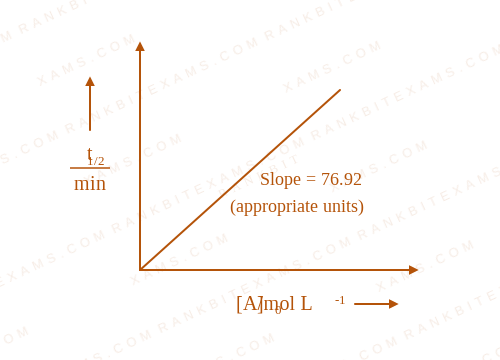
Half-life concentration dependence graph for Q50
The graph plots half-life period t_1/2 along the vertical axis against starting substance concentration [A]_0 on the horizontal axis, displaying a straight line passing through the origin with an explicit slope value of 76.92.
The concentration of A at 10 minutes is × 10⁻³ ~mol ~L⁻¹ (nearest integer). The reaction was started with 2.5mol ⁻¹ of A.

Numerical Answer Type:
Enter a numerical value Answer: 2435 to 2435 +4 marks

Solution & Explanation

Related Formula

Half-life equation for a Zero-Order reaction layout:

t1/2 = [A]₀2K

Integrated rate law configuration expression:

[A]ₜ = -Kt + [A]₀
Core Logic

Let's extract kinetic constants step-by-step:

  • The given plot displays a perfect linear variation passing through the origin: t1/2 ∝ [A]₀. This confirms the transformation process follows Zero-Order kinetics.
  • The visual slope equation evaluates as:
Slope = (1)/(2K) = 76.92 K = (1)/(2 × 76.92) = 0.0065 ~mol· L⁻¹· min⁻¹
Step 1: Compute Concentration at t = 10 min

Apply the values to the integrated rate law formula track (t = 10~min, [A]₀ = 2.5 ~mol· L⁻¹):

[A]₁₀ = -((1)/(2 × 76.92)) × 10 + 2.5 [A]₁₀ = -0.0650 + 2.5 = 2.435 ~mol· L⁻¹ = 2435 × 10⁻³ ~mol· L⁻¹

Hence, the target value for the blank field is 2435.

Pattern Recognition

Always identify the reaction order first by inspecting the axes layout: a linear plot of t1/2 versus [A]₀ uniquely identifies zero-order behavior, whereas a horizontal flat line implies a first-order path.

Chapter Mix

Class 12 Chemistry: Chemical Kinetics

More Chemical Kinetics Previous-Year Questions

Q71 jee_main_2026_21_jan_morning Arrhenius Equation
Pre-exponential factors of two different reactions of same order are identical. Let activation energy of first reaction exceeds the activation energy of second reaction by 20 kJ mol⁻¹. If k₁ and k₂ are the rate constants of first and second reaction respectively at 300 K, then ln k₂k₁ will be ..... (nearest integer) [R=8.3 J K⁻¹ mol⁻¹]
Numerical Answer. Answer: 8 to 8

Solution

Related Formula
ln k = ln A - (Eₐ)/(RT)
Core Logic

For Reaction 1: ln k₁ = ln A - (E₁)/(RT) For Reaction 2: ln k₂ = ln A - (E₂)/(RT) (Pre-exponential factor A is the same).

Subtracting the first from the second:

ln k₂ - ln k₁ = -(E₂)/(RT) - (-(E₁)/(RT)) ln ((k₂)/(k₁)) = (E₁ - E₂)/(RT)

Given that E₁ exceeds E₂ by 20 kJ mol⁻¹, E₁ - E₂ = 20000 J mol⁻¹. T = 300 K, R = 8.3 J K⁻¹ mol⁻¹.

ln ((k₂)/(k₁)) = (20000)/(8.3 × 300) = (200)/(8.3 × 3) = (200)/(24.9) ln ((k₂)/(k₁)) = 8.032

Rounding off to nearest integer gives 8.

Chapter Mix

Class 12 Chemistry: Chemical Kinetics

Q58 jee_main_2026_21_jan_evening First Order Reactions and Rate Constant
Decomposition of A is a first order reaction at T(K) and is given by A(g) arrow B(g) + C(g). In a closed 1 L vessel, 1 bar A(g) is allowed to decompose at T(K). After 100 minutes, the total pressure was 1.5 bar. What is the rate constant (in min⁻¹) of the reaction? ( 2 = 0.3)
  • A. (1) 6.9 × 10⁻¹
  • B. (2) 6.9 × 10⁻³
  • C. (3) 6.9 × 10⁻²
  • D. (4) 6.9 × 10⁻⁴

Solution

Related Formula

k = (2.303)/(t) ( P₀2P₀ - Ptotal) or equivalent first-order expression.

Core Logic

For A(g) arrow B(g) + C(g):

  • Initial pressure: P₀ = 1 bar
  • At time t = 100 min, pressure of A remaining = 1 - P, pressures of B and C = P.
  • Total pressure Ptotal = 1 - P + P + P = 1 + P = 1.5 bar P = 0.5 bar.
  • Remaining pressure of A = 1 - 0.5 = 0.5 bar.

Step 1: Calculating Rate Constant
k = (1)/(100) ln((1)/(0.5)) = (0.693)/(100) = 6.9 × 10⁻³ min⁻¹
Pattern Recognition

Sees: gaseous phase first-order kinetics with total pressure data. Trap: Confusing partial pressure of reactant with total pressure in rate expressions.

Chapter Mix

Class 12 Chemistry: Chemical Kinetics

Q62 jee_main_2026_22_january_morning First Order Reaction Rates
A arrow products (First order reaction). Three sets of experiment were performed for a reaction under similar experimental conditions. Run 1 ⇒ 100 mL of 10 M solution of reactant A Run 2 ⇒ 200 mL of 10 M solution of reactant A Run 3 ⇒ 100 mL of 10 M solution of reactant A + 100 mL of H₂O added. The correct variation of rate of reaction is
  • A. Run 1 = Run 2 = Run 3
  • B. Run 3 < Run 1 = Run 2
  • C. Run 3 < Run 1 < Run 2
  • D. Run 1 < Run 2 < Run 3

Solution

Related Formula
Rate = k[A]

Where [A] is the molar concentration of reactant A.

Core Logic

For a first order reaction, the rate is directly proportional to the concentration of the reactant, not the total volume or the total number of moles.

In Run 1: [A] = 10 M. Rate₁ = k(10). In Run 2: [A] = 10 M. Rate₂ = k(10). (Volume increased, but molarity is identical). In Run 3: 100 mL of 10 M solution is diluted with 100 mL water. New volume is 200 mL. M₁ V₁ = M₂ V₂ 10 × 100 = M₂ × 200 M₂ = 5 M. [A] = 5 M. Rate₃ = k(5).

Step 1: Final Conclusion

Therefore, Rate₃ < Rate₁ = Rate₂.

Pattern Recognition

Rate laws depend exclusively on molar concentration (M). Diluting the solution decreases rate, while just taking a larger volume of the same stock solution keeps the rate identical.

Chapter Mix

Class 12 Chemistry: Chemical Kinetics

Q73 jee_main_2026_22_january_morning Arrhenius Equation
The temperature at which the rate constants of the given below two gaseous reactions become equal is ____ K. (Nearest integer). X arrow Y k₁ = 10⁶e(-30000)/(T) P arrow Q k₂ = 10⁴e(-24000)/(T) Given: ln 10 = 2.303
Numerical Answer. Answer: 1303 to 1303

Solution

Related Formula
k = A e-Eₐ/RT
Core Logic

Equate the two rate constants: k₁ = k₂

10⁶e(-30000)/(T) = 10⁴e(-24000)/(T)

Divide both sides by 10⁴:

10²e(-30000)/(T) = e(-24000)/(T)

Divide both sides by e(-30000)/(T):

100 = e(-24000)/(T)e(-30000)/(T) 100 = e(6000)/(T)
Step 1: Solve for T

Take the natural logarithm (ln) on both sides:

ln(100) = (6000)/(T) 2 ln(10) = (6000)/(T)

Substitute ln 10 = 2.303:

2 × 2.303 = (6000)/(T) 4.606 = (6000)/(T) T = (6000)/(4.606) = 1302.64 K
Step 2: Rounding

Nearest integer is 1303.

Pattern Recognition

Simple exponential equating. Group powers of 10 on one side and exponentials on the other, then apply natural log.

Chapter Mix

Class 12 Chemistry: Chemical Kinetics

Q57 jee_main_2026_22_january_evening Arrhenius Equation and Temperature Dependence
Correct statements regarding Arrhenius equation among the following are: (A) Factor e-Eₐ/RT corresponds to fraction of molecules having kinetic energy less than Eₐ. (B) At a given temperature, lower the Eₐ, faster is the reaction. (C) Increase in temperature by about 10^ doubles the rate of reaction. (D) Plot of k vs (1)/(T) gives a straight line with slope = -(Eₐ)/(R). Choose the correct answer from the options given below:
  • A. B and D only
  • B. A and B only
  • C. A and C only
  • D. B and C only

Solution

Related Formula
k = A e-Eₐ/RT ln k = ln A - (Eₐ)/(RT) k = A - (Eₐ)/(2.303 R T)
Core Logic

Statement (A): BANNED - e-Eₐ/RT represents fraction of molecules with energy ≥ Eₐ (not less).

Statement (B): CORRECT - Lower activation energy Eₐ increases the rate constant k, speeding up the reaction.

Statement (C): CORRECT - For most reactions, a 10^ rise in temperature doubles the rate coefficient.

Statement (D): INCORRECT - Plot of k vs 1/T has slope equal to -(Eₐ)/(2.303 R) (the factor 2.303 is missing).

Pattern Recognition

Sees: Arrhenius statements. Shortcut: Watch for missing 2.303 in slope equation and 'less than' vs 'greater than' in exponential fraction definition.

Chapter Mix

Class 12 Chemistry: Chemical Kinetics

Rankbit System
JEE Physics: Waves (+15.5%) | Electrostatics: Concentric Shells (-29.7%) | Modern Physics: Photoelectric Clones (+34.2%) | Mathematics: Definite Integrals (+18.1%) | Chemistry: Coordination Splitting (-11.4%) | JEE Physics: Waves (+15.5%) | Electrostatics: Concentric Shells (-29.7%) | Modern Physics: Photoelectric Clones (+34.2%) | Mathematics: Definite Integrals (+18.1%) | Chemistry: Coordination Splitting (-11.4%)