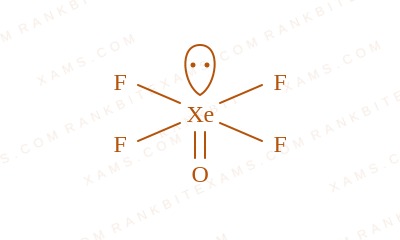
A molecule with the formula AX₄Y$\mathrm{AX}_4\mathrm{Y}$ has all its elements from p-block. Element A is rarest, monoatomic, non-radioactive from its group and has the lowest ionization enthalpy value among A, X and Y. Elements X and Y have first and second highest electronegativity values respectively among all the known elements. The shape of the molecule is :
Let's decode individual identities based on the descriptive properties:
The elements with the first and second highest electronegativity values across the entire periodic table are Fluorine (F$\mathrm{F}$) and Oxygen (O$\mathrm{O}$), matching labels X$\mathrm{X}$ and Y$\mathrm{Y}$.
Element A$\mathrm{A}$ is a rare, monoatomic, non-radioactive p-block element with low ionization energy, identifying it as Xenon (Xe$\mathrm{Xe}$).
Substituting these components into the target layout formula yields XeOF₄$\mathrm{XeOF_4}$:
Xenon brings 8 valence electrons. It forms 4 single bonds with F and 1 double bond with O, consuming 6 electrons and leaving 1 lone pair on the central atom.
Steric Number = 5 bond regions + 1 lone pair = 6$= 5 \text{ bond regions} + 1 \text{ lone pair} = 6$ (Octahedral electronic arrangement).
Step 1: Geometry Determination
Placing the double-bonded oxygen and lone pair along vertical spatial axes yields a stable square pyramidal molecular shape layout:
XeOF4 square pyramidal spatial geometry diagram for Q45
Pattern Recognition
In sp³d²$\mathrm{sp^3d^2}$ architectures containing an explicit lone pair along with an asymmetric double bond (like XeOF₄$\mathrm{XeOF_4}$), the lone pair always sits directly opposite the double bond to minimize electron repulsion, leaving a clean square pyramidal shape.
Chapter Mix
Class 11 Chemistry: Chemical Bonding and Molecular Structure
Class 12 Chemistry: The p-Block Elements
More Chemical Bonding and Molecular Structure Previous-Year Questions — Page 9
Q77jee_main_2024_31_jan_morningMolecular Orbital Theory
The linear combination of atomic orbitals to form molecular orbitals takes place only when the combining atomic orbitals
A. have the same energy
B. have the minimum overlap
C. have same symmetry about the molecular axis
D. have different symmetry about the molecular axis
Choose the most appropriate from the options given below:
The combining atomic orbitals must have the same or nearly the same energy.
The combining atomic orbitals must have the same symmetry about the molecular axis.
The combining atomic orbitals must overlap to the maximum extent (not minimum).
Chapter Mix
Class 11 Chemistry: Chemical Bonding and Molecular Structure

Q85jee_main_2024_31_jan_morningHybridization
The number of species from the following in which the central atom uses sp³$sp^3$ hybrid orbitals in its bonding is
NH₃, SO₂, SiO₂, BeCl₂, CO₂, H₂O, CH₄, BF₃$NH_3, SO_2, SiO_2, BeCl_2, CO_2, H_2O, CH_4, BF_3$
Numerical Answer.Answer: 4 to 4
Solution
Core Logic
Analyzing the hybridization of the central atom in each species:
NH₃$NH_3$: 3 bp + 1 lp = 4 electron domains arrow sp³$\rightarrow sp^3$
SO₂$SO_2$: 2 bp + 1 lp = 3 electron domains arrow sp²$\rightarrow sp^2$
SiO₂$SiO_2$: A giant covalent network where each Si is bonded to 4 oxygens tetrahedrally arrow sp³$\rightarrow sp^3$
BeCl₂$BeCl_2$: 2 bp + 0 lp = 2 electron domains arrow sp$\rightarrow sp$
CO₂$CO_2$: 2 bp + 0 lp = 2 electron domains arrow sp$\rightarrow sp$
H₂O$H_2O$: 2 bp + 2 lp = 4 electron domains arrow sp³$\rightarrow sp^3$
CH₄$CH_4$: 4 bp + 0 lp = 4 electron domains arrow sp³$\rightarrow sp^3$
BF₃$BF_3$: 3 bp + 0 lp = 3 electron domains arrow sp²$\rightarrow sp^2$
Total species with sp³$sp^3$ hybridization: NH₃, SiO₂, H₂O, CH₄$NH_3, SiO_2, H_2O, CH_4$. Total count = 4.
Chapter Mix
Class 11 Chemistry: Chemical Bonding and Molecular Structure
Practice past-year questions one chapter at a time. Pick an exam → subject → chapter and get every PYQ for that topic — pulled together from all past papers — with the chapter's key formulas alongside.