Given below are two statements : Statement (I): Vanillin
Reactions of Phenolic Benzaldehydes
will react with NaOH and also with Tollen's reagent. Statement (II) : Vanillin
Reactions of Phenolic Benzaldehydes
will undergo self aldol condensation very easily. In the light of the above statements, choose the most appropriate answer from the options given below:

Solution & Explanation

### Related Formula Phenolic protons react with standard strong bases: mathrmAr-OH + NaOH rightarrow Ar-ONa + H_2O Aldol condensation structural requirement: Requires presence of acidic alpha-hydrogen atoms connected to carbonyl centers. ### Core Logic Let's analyze functional groups within the Vanillin molecular framework: * Vanillin contains a phenolic hydroxyl group, an aromatic ether, and a formyl functional group (benzaldehyde derivative). * **Statement I**: The presence of the phenolic -mathrmOH group allows acid-base reaction with mathrmNaOH directly
Vanillin structural functional group verification for Q36
. The aldehyde center readily reduces Tollen's reagent to produce a silver mirror. (Statement I is accurate). * **Statement II**: Vanillin lacks any alpha-hydrogens adjacent to its carbonyl carbon, preventing it from undergoing self-aldol condensation. (Statement II is false). ### Pattern Recognition Benzaldehyde and its substituted derivatives (like vanillin or benzaldehyde itself) never undergo self-aldol condensation because they lack alpha-carbons with abstractable protons. Instead, they typically perform Cannizzaro transformations when exposed to highly concentrated alkaline media. ### Evaluation Rubric / Model Answer null ### Chapter Mix Class 12 Chemistry: Aldehydes, Ketones and Carboxylic Acids
More Aldehydes, Ketones and Carboxylic Acids Previous-Year Questions — Page 7

Q87 jee_main_2024_30_jan_morning Nucleophilic Addition Reactions
The compound formed by the reaction of ethanal with semicarbazide contains ________ number of nitrogen atoms.
Numerical Answer. Answer: 3 to 3

Solution

### Related Formula CH_3-CHO + H_2N-NH-CO-NH_2 rightarrow CH_3-CH=N-NH-CO-NH_2 + H_2O ### Core Logic Ethanal (CH_3CHO) reacts with semicarbazide (H_2N-NH-CO-NH_2) via nucleophilic addition followed by elimination of water to form a semicarbazone. ### Step 1: Product Analysis The product is Ethanal semicarbazone: CH_3-CH=N-NH-CO-NH_2. Counting the nitrogen atoms in this structure: 1. The imine nitrogen (=N-) 2. The amine nitrogen (-NH-) 3. The amide nitrogen (-NH_2) Total = 3 Nitrogen atoms. ### Evaluation Rubric / Model Answer null ### Chapter Mix Class 12 Chemistry: Aldehydes, Ketones and Carboxylic Acids
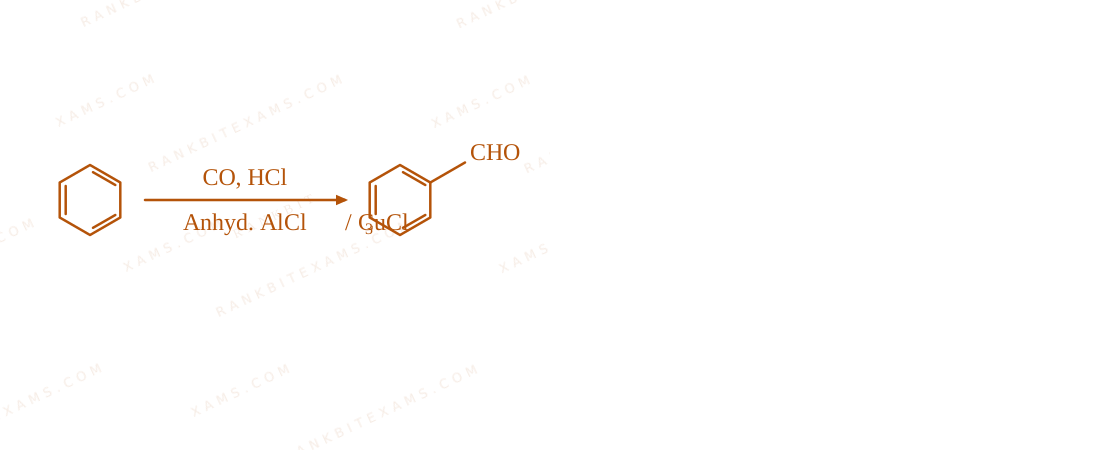
Q73 jee_main_2024_31_jan_evening Preparation of Aldehydes and Ketones
Identify the name reaction.
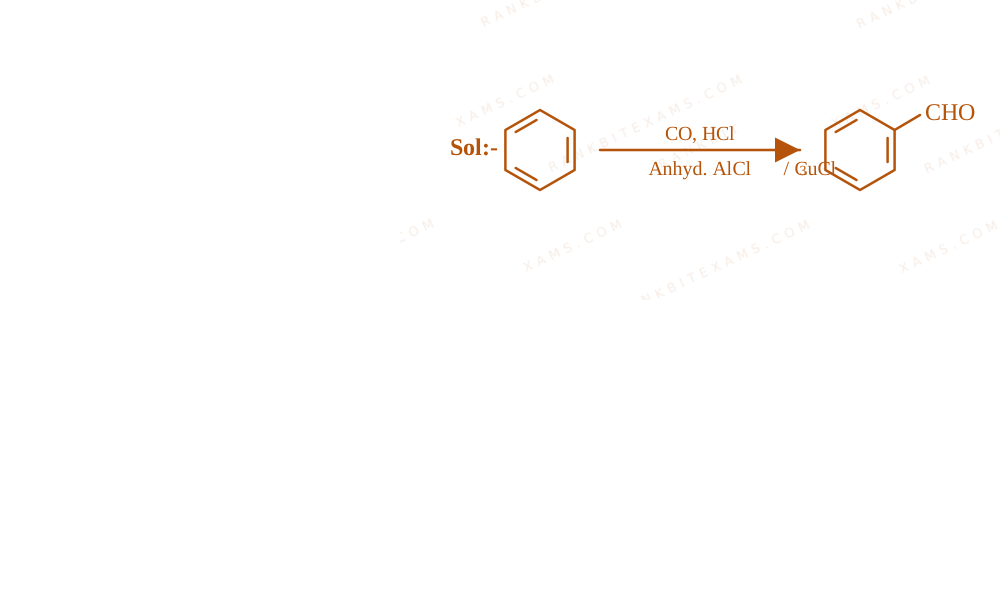
Preparation of Aldehydes and Ketones diagram for Q73 - JEE Main 2024 Evening
The image shows the conversion of benzene to benzaldehyde using CO, HCl, and Anhydrous AlCl3/CuCl.
  • A. text(1) Stephen reaction
  • B. text(2) Etard reaction
  • C. text(3) Gatterman-koch reaction
  • D. text(4) Rosenmund reduction

Solution

### Core Logic The reaction of benzene with carbon monoxide (CO) and hydrogen chloride (HCl) in the presence of anhydrous aluminium chloride (AlCl_3) and cuprous chloride (CuCl) to give benzaldehyde is known as the Gatterman-Koch reaction.
Preparation of Aldehydes and Ketones diagram for Q73 - JEE Main 2024 Evening
The image shows the conversion of benzene to benzaldehyde using CO, HCl, and Anhydrous AlCl3/CuCl.
### Pattern Recognition CO + HCl rightarrow Formyl chloride intermediate (in situ) with Lewis acid rightarrow formylation of benzene. This is definitively the Gatterman-Koch formylation. ### Evaluation Rubric / Model Answer null ### Chapter Mix Class 12 Chemistry: Aldehydes, Ketones and Carboxylic Acids
Q84 jee_main_2024_31_jan_morning Reactions with Grignard Reagent
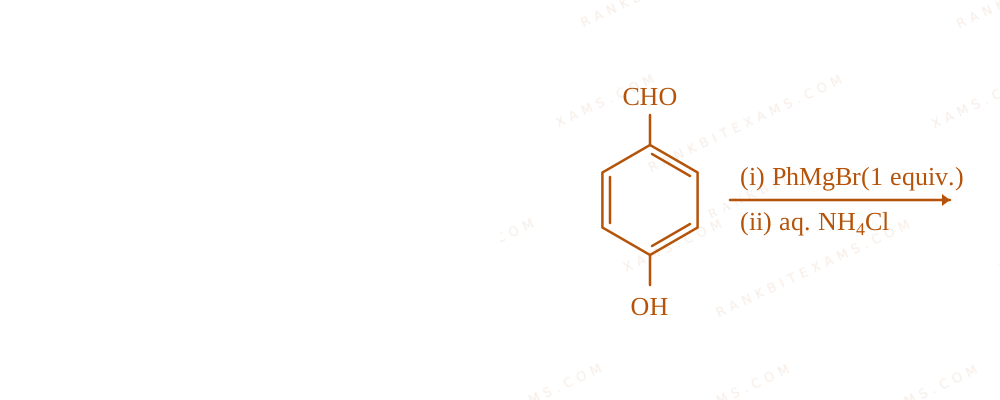
The product of the following reaction is P.
Reactions with Grignard Reagent diagram for Q84 - JEE Main 2024 Morning
The image shows p-hydroxybenzaldehyde reacting with one equivalent of PhMgBr followed by aqueous ammonium chloride.
The number of hydroxyl groups present in the product P is
Numerical Answer. Answer: 0 to 0

Solution

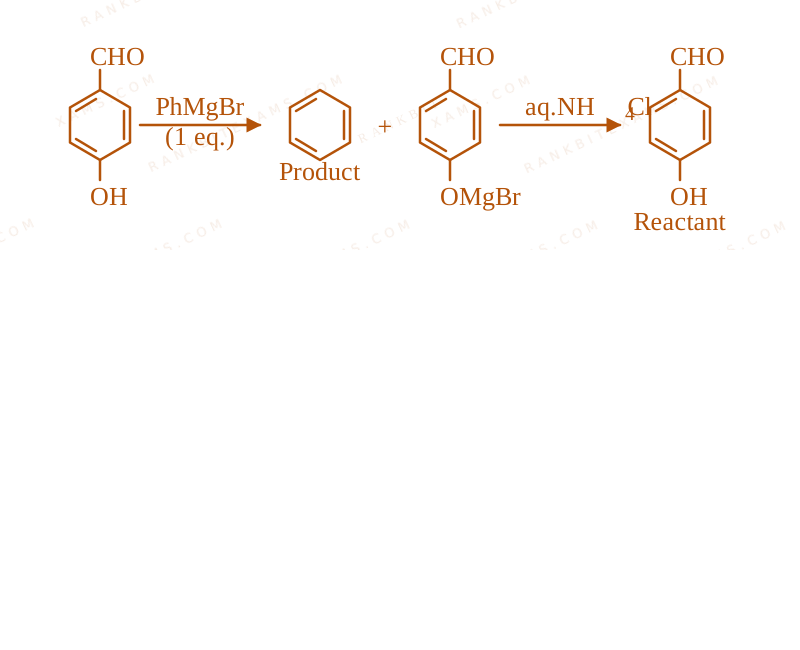
### Core Logic The given reactant is p-hydroxybenzaldehyde, which contains both a phenolic -OH group (acidic) and an aldehyde group (electrophilic). When one equivalent of Grignard reagent (PhMgBr) is added, it behaves primarily as a strong base due to the presence of an acidic proton. Acid-base reactions are extremely fast compared to nucleophilic additions. The acidic phenolic -OH reacts with PhMgBr: PhMgBr + HO-C_6H_4-CHO rightarrow Ph-H (Benzene) + BrMg-O-C_6H_4-CHO Upon workup with aq. NH_4Cl, the phenoxide ion simply regenerates the starting p-hydroxybenzaldehyde. However, the question asks for the number of hydroxyl groups present in the formed product (Benzene).
Reactions with Grignard Reagent diagram for Q84 - JEE Main 2024 Morning
The image shows p-hydroxybenzaldehyde reacting with one equivalent of PhMgBr followed by aqueous ammonium chloride.
The distinct product formed in the reaction is Benzene. Benzene has 0 hydroxyl groups. ### Pattern Recognition Whenever a Grignard reagent encounters a molecule with an acidic hydrogen (alcohol, phenol, amine, alkyne), it will invariably act as a base first. If only 1 equivalent is used, nucleophilic addition to carbonyls will NOT happen. ### Evaluation Rubric / Model Answer null ### Chapter Mix Class 12 Chemistry: Aldehydes, Ketones and Carboxylic Acids Class 12 Chemistry: Alcohols, Phenols and Ethers
Rankbit System
JEE Physics: Waves (+15.5%) | Electrostatics: Concentric Shells (-29.7%) | Modern Physics: Photoelectric Clones (+34.2%) | Mathematics: Definite Integrals (+18.1%) | Chemistry: Coordination Splitting (-11.4%) | JEE Physics: Waves (+15.5%) | Electrostatics: Concentric Shells (-29.7%) | Modern Physics: Photoelectric Clones (+34.2%) | Mathematics: Definite Integrals (+18.1%) | Chemistry: Coordination Splitting (-11.4%)
