Given below are two statements : Statement (I): Vanillin
Reactions of Phenolic Benzaldehydes
will react with NaOH and also with Tollen's reagent. Statement (II) : Vanillin
Reactions of Phenolic Benzaldehydes
will undergo self aldol condensation very easily. In the light of the above statements, choose the most appropriate answer from the options given below:

Solution & Explanation

### Related Formula Phenolic protons react with standard strong bases: mathrmAr-OH + NaOH rightarrow Ar-ONa + H_2O Aldol condensation structural requirement: Requires presence of acidic alpha-hydrogen atoms connected to carbonyl centers. ### Core Logic Let's analyze functional groups within the Vanillin molecular framework: * Vanillin contains a phenolic hydroxyl group, an aromatic ether, and a formyl functional group (benzaldehyde derivative). * **Statement I**: The presence of the phenolic -mathrmOH group allows acid-base reaction with mathrmNaOH directly
Vanillin structural functional group verification for Q36
. The aldehyde center readily reduces Tollen's reagent to produce a silver mirror. (Statement I is accurate). * **Statement II**: Vanillin lacks any alpha-hydrogens adjacent to its carbonyl carbon, preventing it from undergoing self-aldol condensation. (Statement II is false). ### Pattern Recognition Benzaldehyde and its substituted derivatives (like vanillin or benzaldehyde itself) never undergo self-aldol condensation because they lack alpha-carbons with abstractable protons. Instead, they typically perform Cannizzaro transformations when exposed to highly concentrated alkaline media. ### Evaluation Rubric / Model Answer null ### Chapter Mix Class 12 Chemistry: Aldehydes, Ketones and Carboxylic Acids

More Aldehydes, Ketones and Carboxylic Acids Previous-Year Questions — Page 3

Q28 jee_main_2025_04_april_evening Iodoform Test
Which among the following compounds give yellow solid when reacted with NaOI/NaOH? (A) CH_3 - CH(OH) - C_2H_5 (B) CH_3 - CH_2 - CH_2 - OH (C) CH_3 - CO - C_2H_5 (D) CH_3 - OH (E) CH_3 - CH_2 - H Choose the correct answer from the options given below:
  • A. (B), (C) and (E) Only
  • B. (A) and (C) Only
  • C. (C) and (D) Only
  • D. (A), (C) and (D) Only

Solution

### Related Formula textCompounds with CH_3-CH(OH)- text or CH_3-CO- text groups undergo the iodoform reaction to form CHI_3 downarrow text (Yellow Solid) ### Core Logic Let's check the structural groups of each given option: - **(A)** CH_3 - CH(OH) - C_2H_5: Contains the methylcarbinol group (CH_3-CH(OH)-). Gives a positive iodoform test. - **(B)** CH_3 - CH_2 - CH_2 - OH: Linear primary alcohol, does not contain the required group. - **(C)** CH_3 - CO - C_2H_5: Contains the methyl ketone group (CH_3-CO-). Gives a positive iodoform test. - **(D)** CH_3 - OH: Methanol does not give the test. - **(E)** CH_3 - CH_2 - H: Ethane does not give the test. Thus, only **(A)** and **(C)** yield the yellow precipitate of iodoform (CHI_3). ### Step 1: Chemical Equations The balanced haloform pathways occur as follows: CH_3-CH(OH)-CH_2-CH_3 xrightarrowtextNaOI/NaOH CHI_3downarrow + textCH_3text-CH_2text-COO^-textNa^+ CH_3-CO-CH_2-CH_3 xrightarrowtextNaOI/NaOH CHI_3downarrow + textCH_3text-CH_2text-COO^-textNa^+ ### Pattern Recognition The iodoform test specifically isolates methyl ketones or secondary methyl alcohols. Scan dynamically for a terminal -CH_3 affixed directly to a carbonyl oxygen index (C=O) or a hydroxyl carbon (CH-OH). ### Evaluation Rubric / Model Answer null ### Chapter Mix Class 12 Chemistry: Aldehydes, Ketones and Carboxylic Acids Class 12 Chemistry: Alcohols, Phenols and Ethers
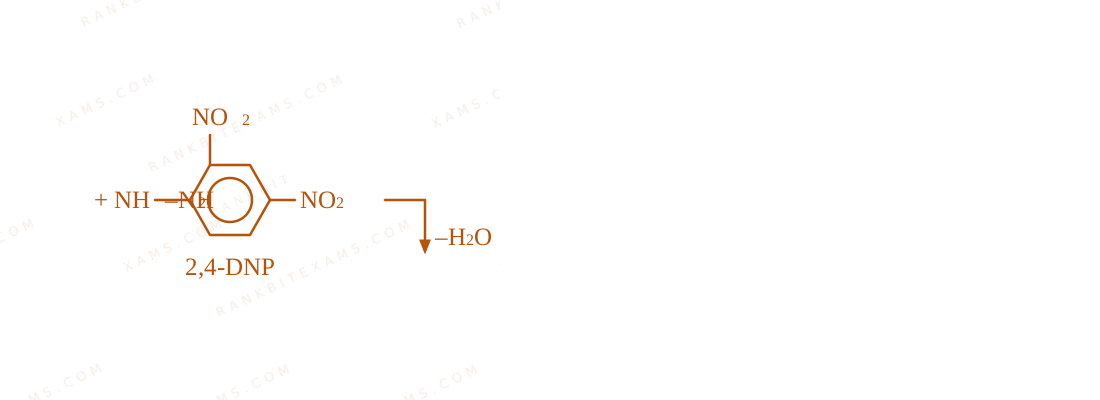
Q29 jee_main_2025_04_april_morning Aldol Condensation
Aldol condensation is a popular and classical method to prepare alpha, beta-unsaturated carbonyl compounds. This reaction can be both intermolecular and intramolecular. Predict which one of the following is not a product of intramolecular aldol condensation?
  • A. textProduct 1
  • B. textProduct 2
  • C. textProduct 3
  • D. textProduct 4

Solution

### Core Logic Intramolecular aldol condensation involves a dicarbonyl compound reacting within itself to yield stable cyclic alpha, beta-unsaturated rings (most commonly 5- or 6-membered rings due to minimal ring strain). * Products (1), (2), and (3) can all be cleanly synthesized via intramolecular cyclization path workflows from their respective dialdehyde/diketone precursors. * Product (4) features an exo-cyclic group structure arrangement formed strictly through an **intermolecular** condensation sequence step between two distinct reactant units, rather than an internal cyclization path layout. ### Pattern Recognition Look closely at the ring substitution system. Intermolecular steps are forced when intramolecular cyclization path workflows would generate highly strained small rings or structurally impossible orientations. ### Evaluation Rubric / Model Answer null ### Chapter Mix Class 12 Chemistry: Aldehydes, Ketones and Carboxylic Acids
Q41 jee_main_2025_04_april_morning Chemical Properties of Ketones
An organic compound (X) with molecular formula C_3H_6O is not readily oxidised. On reduction it gives C_3H_8O (Y) which reacts with HBr to give a bromide (Z) which is converted to Grignard reagent. This Grignard reagent on reaction with (X) followed by hydrolysis gives 2, 3-dimethylbutan-2-ol. Compounds (X), (Y) and (Z) respectively are:
  • A. mathrmCH_3mathrmCOCH_3, mathrmCH_3mathrmCH_2mathrmCH_2mathrmOH, mathrmCH_3mathrmCH(Br)CH_3
  • B. mathrmCH_3mathrmCOCH_3, mathrmCH_3mathrmCH(OH)CH_3, mathrmCH_3mathrmCH(Br)CH_3
  • C. mathrmCH_3mathrmCH_2mathrmCHO, mathrmCH_3mathrmCH_2mathrmCH_2mathrmOH, mathrmCH_3mathrmCH_2mathrmCH_2mathrmBr
  • D. mathrmCH_3mathrmCH_2mathrmCHO, mathrmCH_3mathrmCH=CH_2, mathrmCH_3mathrmCH(Br)CH_3

Solution

### Core Logic Let's deduce the identities stepwise: 1. Compound (X) has the formula C_3H_6O and is resistant to mild oxidation, which identifies it as a ketone: **Acetone** (CH_3COCH_3). 2. Reduction of Acetone yields a secondary alcohol, Propan-2-ol (CH_3CH(OH)CH_3, Compound Y). 3. Treatment of Propan-2-ol with HBr substitutes the hydroxyl group to form 2-Bromopropane (CH_3CH(Br)CH_3, Compound Z). 4. Reacting 2-Bromopropane with Magnesium in ether creates the branched Grignard reagent, Isopropylmagnesium bromide ((CH_3)_2CHMgBr). 5. Finally, nucleophilic addition of this Grignard reagent to Acetone followed by aqueous workup yields the highly branched tertiary alcohol: **2,3-dimethylbutan-2-ol**. ### Pattern Recognition Resistance to mild oxidation immediately distinguishes ketones from isomeric aldehydes. Nucleophilic addition of an isopropyl Grignard to acetone cleanly yields the 2,3-dimethylbutan-2-ol framework. ### Evaluation Rubric / Model Answer null ### Chapter Mix Class 12 Chemistry: Aldehydes, Ketones and Carboxylic Acids Class 12 Chemistry: Alcohols, Phenols and Ethers
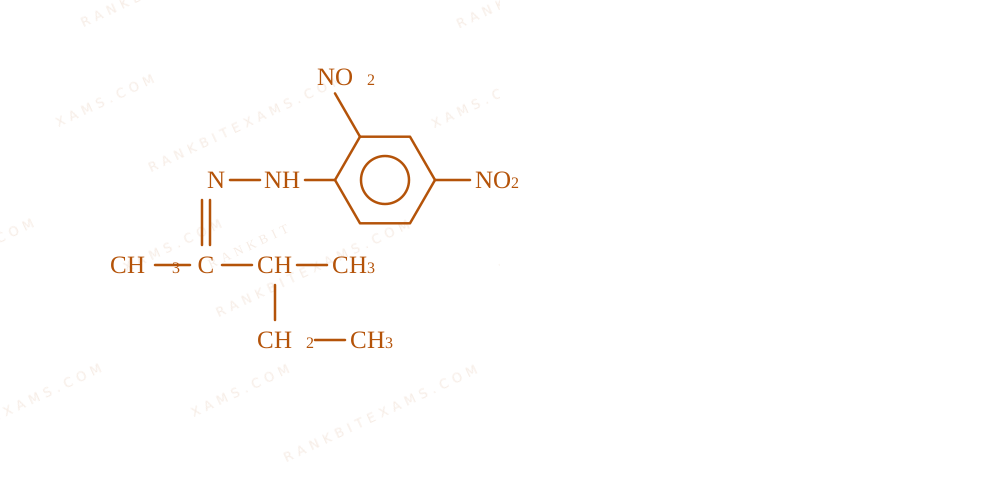
Q30 jee_main_2025_07_april_evening Identification of Carbonyl Compounds
"P" is an optically active compound with molecular formula textC_6textH_12textO. When "P" is treated with 2,4-dinitrophenylhydrazine, it gives a positive test. However, in presence of Tollens reagent, "P" gives a negative test. Predict the structure of "P".
  • A. textCH_3text-C(=textO)text-CH_2text-CH_2text-CH_2text-CH_3
  • B. textCH_3text-C(=textO)text-CH(textCH_2text-CH_3)text-CH_3
  • C. textH-C(=textO)text-CH_2text-CH(textCH_2text-CH_3)text-CH_3
  • D. textCH_3text-C(=textO)text-CH_2text-CH(textCH_3)_2

Solution

### Related Formula textCarbonyl compound + text2,4-DNP ightarrow textHydrazone derivative (Positive test) textAldehyde + textTollens' Reagent ightarrow textSilver Mirror (Positive test) textKetone + textTollens' Reagent ightarrow textNo reaction (Negative test) ### Core Logic Analyzing individual functional constraints: - Positive 2,4-DNP test shows compound contains a carbonyl group (aldehyde or ketone). - Negative Tollens' test clarifies it is not an aldehyde; hence it must be a ketone. - The compound is optically active, meaning it must possess a chiral center (carbon with 4 distinct groups). Let's evaluate the options via structural configurations:
Identification of Carbonyl Compounds diagram for Q30 - JEE Main 2025 Evening
### Step 1: Structural Verification Option (2) represents 3-methylpentan-2-one: textCH3-textC(=textO)-oversetasttextCH(textCH3)(textCH2textCH3) The third carbon (C3) is linked to: -textH, -textCH_3, -textCH_2textCH_3, and -textCOCH_3. It has 4 distinct structural fields, making it chiral and optically active. ### Pattern Recognition Tollens' negative + DNP positive = Ketone. Once categorized as a ketone, look directly for the structure holding a carbon with four unique groups to secure the optical activity constraint. ### Evaluation Rubric / Model Answer null ### Chapter Mix Class 12 Chemistry: Aldehydes, Ketones and Carboxylic Acids Class 11 Chemistry: Organic Chemistry - Some Basic Principles and Techniques
Q42 jee_main_2025_24_jan_evening Preparation of Aldehydes
Match List-I with List-II
List-IList-II (Name of Reaction)
(A) mathrmRCN xrightarrow[text(ii)mathrmH_3mathrmO^+]text(i)mathrmSnCl_2, mathrmHCl mathrmRCHO(I) Etard reaction
(B)
Preparation of Aldehydes diagram for Q42 - JEE Main 2025 Evening
The Match List displays chemical transformations side-by-side with their respective named organic chemical reactions.
(II) Gatterman-Koch reaction
(C)
Preparation of Aldehydes diagram for Q42 - JEE Main 2025 Evening
The Match List displays chemical transformations side-by-side with their respective named organic chemical reactions.
(III) Rosenmund reduction
(D)
Preparation of Aldehydes diagram for Q42 - JEE Main 2025 Evening
The Match List displays chemical transformations side-by-side with their respective named organic chemical reactions.
(IV) Stephen reaction
Choose the correct answer from the options given below:
  • A. \text{(A)-(IV), (B)-(III), (C)-(I), (D)-(II)}
  • B. \text{(A)-(III), (B)-(IV), (C)-(II), (D)-(I)}
  • C. \text{(A)-(I), (B)-(III), (C)-(II), (D)-(IV)}
  • D. \text{(A)-(III), (B)-(IV), (C)-(I), (D)-(II)}

Solution

### Core Logic Let's match each aldehyde preparation method with its official named organic reaction: * **(A) mathrmRCN ightarrow mathrmRCHO using mathrmSnCl_2/mathrmHCl followed by hydrolysis:** This is the classic **Stephen reaction** ightarrow **(IV)**. * **(B) Reducing an acyl chloride (mathrmRCOCl) to an aldehyde using mathrmH_2 over mathrmPd-BaSO_4:** This partial reduction is known as the **Rosenmund reduction** ightarrow **(III)**. * **(C) Oxidizing toluene to benzaldehyde using chromyl chloride (mathrmCrO_2mathrmCl_2) in mathrmCS_2:** This selective oxidation method is the **Etard reaction** ightarrow **(I)**. * **(D) Converting benzene to benzaldehyde using mathrmCO and mathrmHCl in the presence of anhydrous mathrmAlCl_3/mathrmCuCl:** This formylation process is the **Gatterman-Koch reaction** ightarrow **(II)**. Combining these assignments yields the final sequence: (A)-(IV), (B)-(III), (C)-(I), (D)-(II). ### Step-by-Step Layout The visual reaction components correspond directly to the official structural transformations:
Preparation of Aldehydes solution diagram for Q42 - JEE Main 2025 Evening
The Match List displays chemical transformations side-by-side with their respective named organic chemical reactions.
Preparation of Aldehydes solution diagram for Q42 - JEE Main 2025 Evening
The Match List displays chemical transformations side-by-side with their respective named organic chemical reactions.
Preparation of Aldehydes solution diagram for Q42 - JEE Main 2025 Evening
The Match List displays chemical transformations side-by-side with their respective named organic chemical reactions.
### Pattern Recognition Quick identification keys: - Nitrile ightarrow Aldehyde = Stephen - Acid Chloride ightarrow Aldehyde = Rosenmund - Toluene ightarrow Chromyl Complex = Etard - Benzene ightarrow Carbon Monoxide = Gatterman-Koch ### Evaluation Rubric / Model Answer null ### Chapter Mix Class 12 Chemistry: Aldehydes, Ketones and Carboxylic Acids
Rankbit System
JEE Physics: Waves (+15.5%) | Electrostatics: Concentric Shells (-29.7%) | Modern Physics: Photoelectric Clones (+34.2%) | Mathematics: Definite Integrals (+18.1%) | Chemistry: Coordination Splitting (-11.4%) | JEE Physics: Waves (+15.5%) | Electrostatics: Concentric Shells (-29.7%) | Modern Physics: Photoelectric Clones (+34.2%) | Mathematics: Definite Integrals (+18.1%) | Chemistry: Coordination Splitting (-11.4%)
