Formation of mathrmNa_4[mathrmFe(mathrmCN)_5mathrmNOS], a purple coloured complex formed by addition of sodium nitroprusside in sodium carbonate extract of salt indicates the presence of:

Solution & Explanation

### Related Formula textNa_2textS + textNa_2[textFe(textCN)_5textNO] rightarrow textNa_4[textFe(textCN)_5textNOS] AI responses may include mistakes. ### Core Logic Sulphide ion (S^2-) undergoes a qualitative verification test when reacted with sodium nitroprusside. Sodium extract of the salt containing sulphide forms sodium sulphide (mathrmNa_2S). When sodium nitroprusside solution is added to the sodium carbonate extract, the sulphide reacts to yield a deep violet/purple coloured complex called sodium thionitroprusside: mathrmNa_2S + Na_2[Fe(CN)_5NO] rightarrow Na_4[Fe(CN)_5NOS] ### Step 1: Verification This specific purple/violet reaction occurs exclusively for the identification of the **Sulphide ion** (S^2-). ### Pattern Recognition Mnemonic: 'Nitroprusside turns purple for Sulphide'. This is a highly specific redox/substitution reaction of coordination complexes used inside analytical laboratory practices. ### Evaluation Rubric / Model Answer null ### Chapter Mix Class 11 Chemistry: Practical Chemistry

More Practical Chemistry Previous-Year Questions — Page 2

Q74 jee_main_2024_29_january_evening Chromatographic Separations
Chromatographic technique/s based on the principle of differential adsorption is/are A. Column chromatography B. Thin layer chromatography C. Paper chromatography Choose the most appropriate answer from the options given below:
  • A. B only
  • B. A only
  • C. A & B only
  • D. C only

Solution

### Related Formula Classification of chromatography based on adsorption vs partition parameters. ### Core Logic Chromatography techniques are broadly divided into two main categories based on their operating principles: 1. **Adsorption Chromatography**: Relies on the differential adsorption of components on the surface of a stationary phase. Both Column Chromatography and Thin Layer Chromatography (TLC) operate on this principle. 2. **Partition Chromatography**: Relies on continuous differential partitioning of components between stationary and mobile liquid phases. Paper Chromatography is a prime example of this category. ### Step 1: Final Selection Thus, statements A and B are correct, matching choice (3). ### Pattern Recognition Remember: Column and Thin Layer chromatography are adsorption-based, while paper chromatography relies on partition mechanisms. ### Evaluation Rubric / Model Answer null ### Chapter Mix Class 11 Chemistry: Principles of Practical Chemistry
Q87 jee_main_2024_29_jan_morning Organic Functional Groups
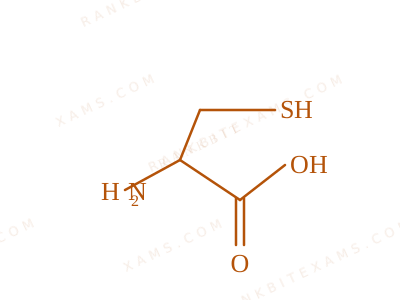
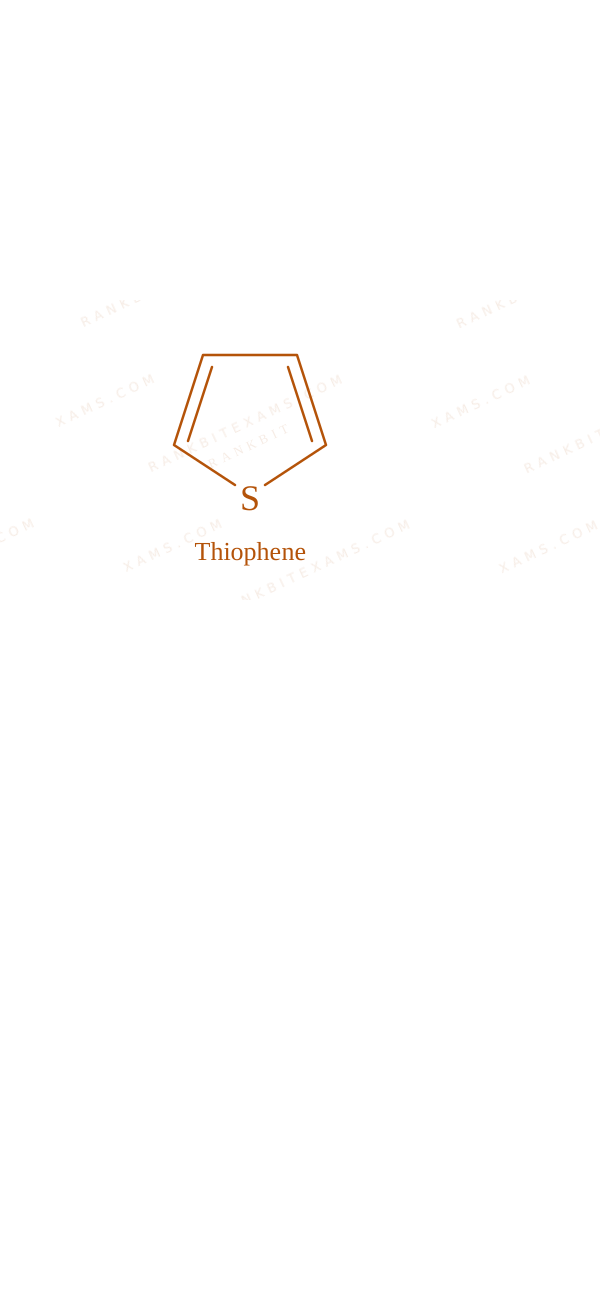
Number of compounds among the following which contain sulphur as heteroatom is Furan, Thiophene, Pyridine, Pyrrole, Cysteine, Tyrosine
Numerical Answer. Answer: 2 to 2

Solution

### Core Logic Let us check the chemical structure of each compound given in the list to determine if it contains a Sulphur (S) atom. 1. **Furan**: A 5-membered heterocyclic aromatic ring containing Oxygen (C_4H_4O). No Sulphur. 2. **Thiophene**: A 5-membered heterocyclic aromatic ring containing Sulphur (C_4H_4S). **Contains Sulphur**. 3. **Pyridine**: A 6-membered heterocyclic aromatic ring containing Nitrogen (C_5H_5N). No Sulphur. 4. **Pyrrole**: A 5-membered heterocyclic aromatic ring containing Nitrogen (C_4H_4NH). No Sulphur. 5. **Cysteine**: A naturally occurring alpha-amino acid with a thiol side chain (-CH_2-SH). **Contains Sulphur**. 6. **Tyrosine**: An alpha-amino acid with a phenol side chain. No Sulphur. ### Step 1: Final Count
Organic Functional Groups diagram for Q87 - JEE Main 2024 Morning
Only Thiophene and Cysteine contain a sulphur heteroatom. Total number = 2. ### Evaluation Rubric / Model Answer null ### Chapter Mix Class 11 Chemistry: Organic Chemistry Some Basic Principles and Techniques Class 12 Chemistry: Biomolecules
Rankbit System
JEE Physics: Waves (+15.5%) | Electrostatics: Concentric Shells (-29.7%) | Modern Physics: Photoelectric Clones (+34.2%) | Mathematics: Definite Integrals (+18.1%) | Chemistry: Coordination Splitting (-11.4%) | JEE Physics: Waves (+15.5%) | Electrostatics: Concentric Shells (-29.7%) | Modern Physics: Photoelectric Clones (+34.2%) | Mathematics: Definite Integrals (+18.1%) | Chemistry: Coordination Splitting (-11.4%)