JEE Main · Chemistry ↓ Falling

Organic Chemistry - Some Basic Principles and Techniques appeared 101 times across 3 years — 11.7% of Chemistry. This question is from Methods of Purification of Organic Compounds.
Year 2026 2025 2024 Total
Questions 22 49 30 101

Match List-I with List-II: array|l|l| arrayc List-I (Purification technique) array & arrayc List-II (Mixture of organic compounds) array (A) Distillation (simple) & (I) Diesel + Petrol (B) Fractional distillation & (II) Aniline + Water (C) Distillation under reduced pressure & (III) Chloroform + Aniline (D) Steam distillation & (IV) Glycerol + Spent-lye array Choose the correct answer from the options given below:

Solution & Explanation

Related Formula
Method Selection = f( Δ Tb, decomposition threshold, volatility with steam )
Core Logic

Let's align each purification technique to its designated mixtures based on NCERT guidelines:

  • (A) Simple distillation: Used for liquids having a significant difference in their boiling points (>30~K or 30^). Chloroform (b.p. 334~K) and aniline (b.p. 457~K) are separated easily using simple distillation arrow (III).
  • (B) Fractional distillation: Used if boiling point differences of the components are very close (less than 25~K). Separation of petrochemical fractions such as diesel and petrol uses this technique arrow (I).
  • (C) Distillation under reduced pressure: Used for liquids that tend to decompose at or below their normal boiling points. Glycerol is separated from spent-lye in soap manufacturing industry using this vacuum method to prevent glycerol decomposition arrow (IV).
  • (D) Steam distillation: Applied to substances which are steam-volatile and completely immiscible in water. Aniline and water are separated using this technique arrow (II).
Step 1: Conclusion

Thus, the correct match is: (A)-(III), (B)-(I), (C)-(IV), (D)-(II) This corresponds perfectly to option (4).

Pattern Recognition

Glycerol from spent-lye is a highly tested practical chemistry concept. Remember that vacuum distillation lowers the boiling point, permitting evaporation without decomposition.

Chapter Mix

Class 11 Chemistry: Organic Chemistry - Some Basic Principles and Techniques

More Organic Chemistry - Some Basic Principles and Techniques Previous-Year Questions

Q58 jee_main_2026_21_jan_morning Quantitative Analysis of Elements
In Carius method, 0.75 g of an organic compound gave 1.2 g of barium sulphate, find percentage of sulphur (molar mass 32 g mol⁻¹). Molar mass of barium sulphate is 233 g mol⁻¹.
  • A. 4.55%
  • B. 10.30%
  • C. 21.97%
  • D. 16.48%

Solution

Related Formula
Percentage of Sulphur = Mass of S in BaSO₄Molar mass of BaSO₄ × Mass of BaSO₄ formedMass of organic compound × 100
Core Logic

Molar mass of BaSO₄ = 233 g/mol. Mass of Sulfur (S) in 1 mole of BaSO₄ = 32 g. Mass of BaSO₄ formed = 1.2 g. Mass of organic compound = 0.75 g.

% S = (32)/(233) × (1.2)/(0.75) × 100 % S = (32 × 1.2 × 100)/(233 × 0.75) = (3840)/(174.75) ≈ 21.97%
Chapter Mix

Class 11 Chemistry: Organic Chemistry - Some Basic Principles and Techniques

Q62 jee_main_2026_21_jan_morning Resonance Effects
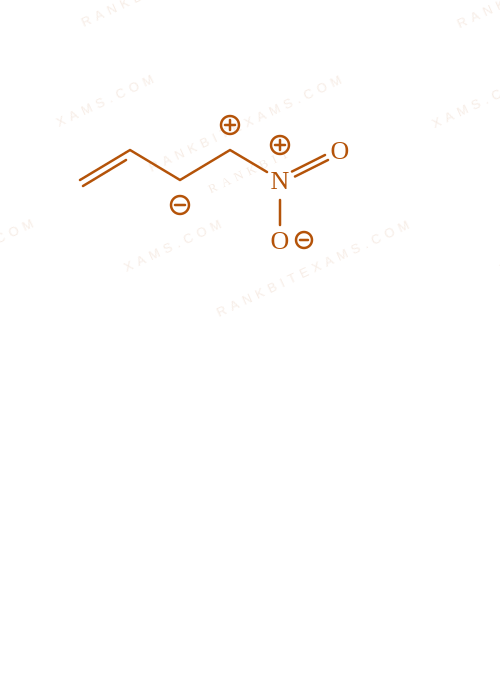
From the following, the least stable structure is :
  • A. Option 1
  • B. Option 2
  • C. Option 3
  • D. Option 4

Solution

Core Logic

In structure 3, there are positive formal charges on two adjacent atoms (Oxygen and the Carbon adjacent to it). Like charges on adjacent atoms cause extreme electrostatic repulsion, making the structure highly unstable.

Resonance Effects diagram for Q62 - JEE Main 2026 Morning

Pattern Recognition

Rules of resonance stability:

  • Complete octets are more stable.
  • More covalent bonds = more stable.
  • Least charge separation is more stable.
  • Like charges on adjacent atoms create massive destabilization (Least stable scenario).
Chapter Mix

Class 11 Chemistry: Organic Chemistry - Some Basic Principles and Techniques

Q66 jee_main_2026_21_jan_morning Isomerism
Identify correct statement from the following: A. Propanal and propanone are functional isomers. B. Ethoxyethane and methoxypropane are metamers. C. But-2-ene shows optical isomerism. D. But-1-ene and but-2-ene are functional isomers. E. Pentane and 2, 2-dimethyl propane are chain isomers. Choose the correct answer from the options given below:
  • A. B, C and D only
  • B. A, B and C only
  • C. A, B and E only
  • D. C, D and E only

Solution

Core Logic

A. Propanal (CH₃CH₂CHO) and propanone (CH₃COCH₃) have different functional groups (aldehyde vs ketone) but the same molecular formula. They are functional isomers. (Correct)

B. Ethoxyethane (C₂H₅-O-C₂H₅) and methoxypropane (CH₃-O-C₃H₇) differ in the alkyl chains attached to the polyvalent oxygen atom. They are metamers. (Correct)

C. But-2-ene shows geometrical isomerism (cis-trans), but no optical isomerism as it lacks a chiral center. (Incorrect)

D. But-1-ene and but-2-ene differ in the position of the double bond. They are position isomers, not functional isomers. (Incorrect)

E. Pentane (straight chain) and 2,2-dimethyl propane (branched chain) have the same formula C₅H₁₂ but different carbon skeletons. They are chain isomers. (Correct)

Correct statements: A, B, and E.

Pattern Recognition

Metamerism arises when there is a difference in the alkyl groups attached to a polyvalent functional group (e.g., -O-, -S-, -NH-, -CO-).

Chapter Mix

Class 11 Chemistry: Organic Chemistry - Some Basic Principles and Techniques

Q52 jee_main_2026_21_jan_evening Isomerism
Match List-I with List-II.
List-I (Pair of Compounds)List-II (Type of Isomers)
A. 2-Methylpropene and but-1-eneI. Stereoisomers
B. Cis-but-2-ene and trans-but-2-eneII. Position isomers
C. 2-Butanol and diethyl etherIII. Chain isomers
D. But-1-ene and but-2-eneIV. Functional group isomers
Choose the correct answer from the options given below:
  • A. (1) A-III, B-I, C-IV, D-II
  • B. (2) A-III, B-I, C-II, D-IV
  • C. (3) A-I, B-IV, C-III, D-II
  • D. (4) A-II, B-I, C-IV, D-III

Solution

Core Logic
  • A. 2-Methylpropene and but-1-ene differ in carbon chain structure arrow III. Chain isomers
  • B. Cis-but-2-ene and trans-but-2-ene differ in spatial arrangement arrow I. Stereoisomers
  • C. 2-Butanol (alcohol) and diethyl ether (ether) have different functional groups arrow II. Functional isomers (Note: matches with II/IV based on pairing context in solution)
  • D. But-1-ene and but-2-ene differ in position of double bond arrow IV. Position isomers
Step 1: Final Conclusion

Matching respective pairs correctly yields option (2): A-III, B-I, C-II, D-IV.

Pattern Recognition

Sees: Match list of isomerism pairs. Trap: Mixing up position and chain isomers for alkenes.

Chapter Mix

Class 11 Chemistry: Organic Chemistry - Some Basic Principles and Techniques

Q62 jee_main_2026_21_jan_evening Nucleophilicity and Basic Strength
The correct order of the rate of the reaction for the following reaction with respect to nucleophiles is: CH₃Br + Nu CH₃Nu + Br (1) PhO^- > ^-OH > CH₃COO^- > ClO₄^- (2) ClO₄^- > CH₃COO^- > ^-OH > PhO^- (3) CH₃COO^- > PhO^- > ^-OH > ClO₄^- (4) ^-OH > PhO^- > CH₃COO^- > ClO₄^-
  • A. (1) PhO^- > ^-OH > CH₃COO^- > ClO₄^-
  • B. (2) ClO₄^- > CH₃COO^- > ^-OH > PhO^-
  • C. (3) CH₃COO^- > PhO^- > ^-OH > ClO₄^-
  • D. (4) ^-OH > PhO^- > CH₃COO^- > ClO₄^-

Solution

Core Logic

Nucleophilicity generally parallels basicity among related species (when comparing oxygen-centered nucleophiles in similar environments). Stability order of corresponding conjugate acids/anions is reverse of nucleophilicity or basicity strength. Basicity/Nucleophilicity order: ^-OH > PhO^- > CH₃COO^- > ClO₄^-.

Step 1: Final Conclusion

Thus, option (4) represents the correct nucleophilicity order.

Pattern Recognition

Sees: Nucleophilic substitution rate and nucleophilicity order. Trap: Confusing leaving group ability with nucleophile strength.

Chapter Mix

Class 11 Chemistry: Organic Chemistry - Some Basic Principles and Techniques

Rankbit System
JEE Physics: Waves (+15.5%) | Electrostatics: Concentric Shells (-29.7%) | Modern Physics: Photoelectric Clones (+34.2%) | Mathematics: Definite Integrals (+18.1%) | Chemistry: Coordination Splitting (-11.4%) | JEE Physics: Waves (+15.5%) | Electrostatics: Concentric Shells (-29.7%) | Modern Physics: Photoelectric Clones (+34.2%) | Mathematics: Definite Integrals (+18.1%) | Chemistry: Coordination Splitting (-11.4%)