Given below are two statements:
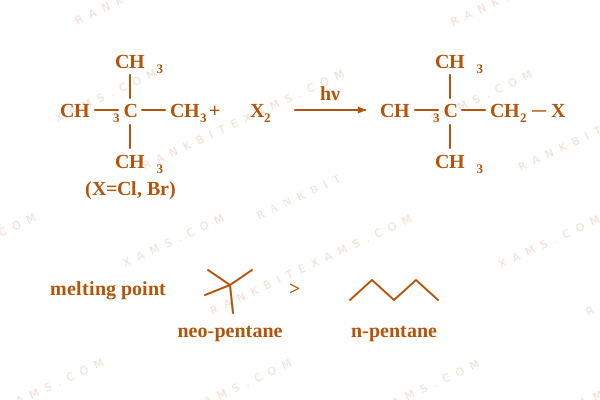
Statement (I): Neopentane forms only one monosubstituted derivative.
Statement (II): Melting point of neopentane is higher than n-pentane
In the light of the above statements, choose the most appropriate answer from the options given below:
A.textStatement I is correct but Statement II is incorrect$\text{Statement I is correct but Statement II is incorrect}$
B.textBoth Statement I and Statement II are correct$\text{Both Statement I and Statement II are correct}$
C.textBoth Statement I and Statement II are incorrect$\text{Both Statement I and Statement II are incorrect}$
D.textStatement I is incorrect but Statement II is correct$\text{Statement I is incorrect but Statement II is correct}$
Solution & Explanation
### Related Formula
textSymmetric Structure propto textMelting Point (Packing efficiency)$$\text{Symmetric Structure} \propto \text{Melting Point (Packing efficiency)}$$
### Core Logic
**Statement (I) is correct**: Neopentane (2,2-dimethylpropane) contains a quaternary carbon bonded to four methyl groups. There are 12 hydrogen atoms, all of which are primary and chemically equivalent. Halogenation yields exactly one monosubstituted derivative:
mathrm(CH_3)_4C + X_2 xrightarrowhnu (CH_3)_3C-CH_2X + HX$$\mathrm{(CH_3)_4C + X_2 \xrightarrow{h\nu} (CH_3)_3C-CH_2X + HX}$$
Statement (II) is correct: Neopentane has a compact, symmetrical, nearly spherical molecular structure. In the solid crystal lattice, these spherical molecules pack much more efficiently compared to the floppy, linear n-pentane. This robust crystalline packing dramatically increases its melting point (256.4~mathrmK$256.4~\mathrm{K}$) compared to that of n-pentane (143.4~mathrmK$143.4~\mathrm{K}$).
### Step 1: Final Verification
Since both statements are theoretically and experimentally correct, the correct option is (2).
Alkanes and Physical Properties
### Pattern Recognition
While branching *decreases* the boiling point (due to decreased surface area and weaker van der Waals forces), branching that creates a highly symmetric structure *increases* the melting point because of close-packing efficiency in the solid phase.
### Evaluation Rubric / Model Answer
null
### Chapter Mix
Class 11 Chemistry: Hydrocarbons
More Hydrocarbons Previous-Year Questions — Page 3
Q50jee_main_2025_07_april_eveningReaction Mechanisms and Hybridization
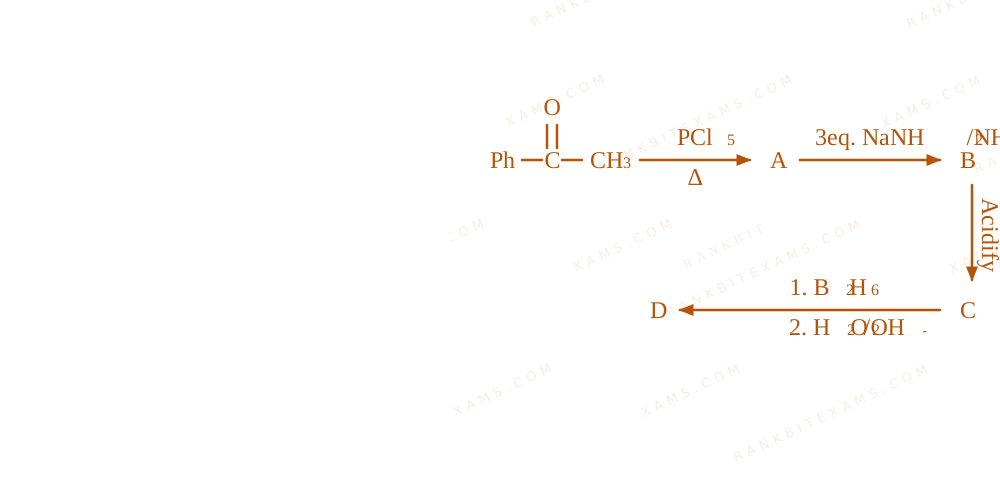
Identify the structure of the final product (D) in the following sequence of the reactions:
The image maps out a sequential multi-step chemical reaction scheme moving from acetophenone via gem-dichloride to an alkyne, hydroboration, and product D.
Total number of sp^2$sp^2$ hybridised carbon atoms in product D is dots$\dots$.
Numerical Answer.Answer: 6.5 to 7.5
Solution
### Related Formula
textTerminal Alkyne (textR-CequivtextCH) xrightarrow[2.\,textH_2textO_2 / textOH^-]1.\,textB_2textH_6 textR-CH_2text-CHO quad text(Anti-Markovnikov Hydroboration-Oxidation)$$\text{Terminal Alkyne } (\text{R-C}\equiv\text{CH}) \xrightarrow[2.\,\text{H}_2\text{O}_2 / \text{OH}^-]{1.\,\text{B}_2\text{H}_6} \text{R-CH}_2\text{-CHO} \quad \text{(Anti-Markovnikov Hydroboration-Oxidation)}$$
### Core Logic
Let's track the molecular changes at every intermediate junction:
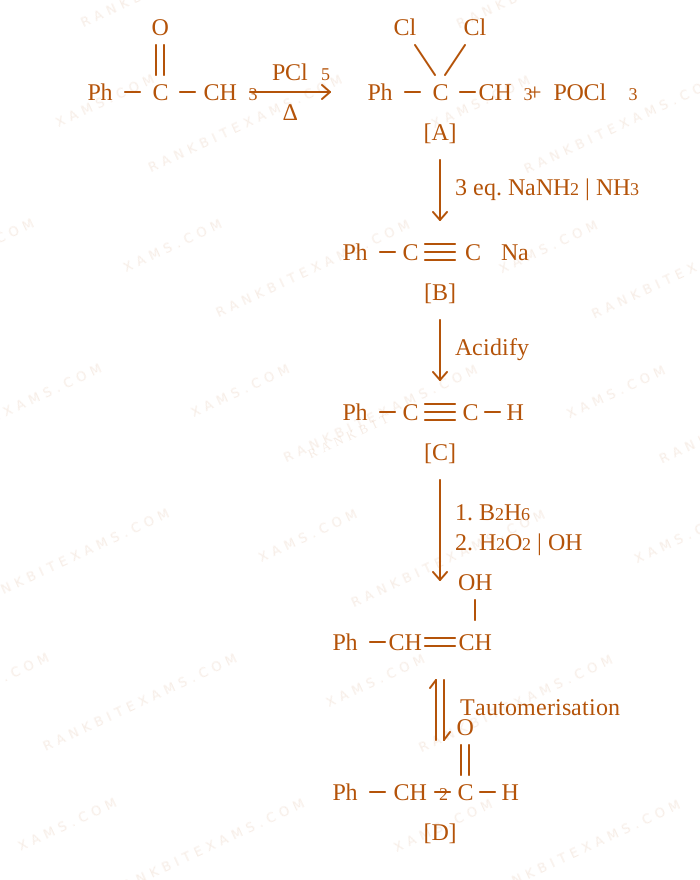
- Step 1: Acetophenone (textPh-CO-CH_3$\text{Ph-CO-CH}_3$) reacts with textPCl_5$\text{PCl}_5$ to generate a gem-dichloride intermediate [A]: textPh-CCl_2text-CH_3$\text{Ph-CCl}_2\text{-CH}_3$.
- Step 2: Reaction with 3$3$ equivalents of the incredibly strong base textNaNH_2$\text{NaNH}_2$ triggers dual elimination to form a terminal sodium acetylide salt [B]: textPh-CequivtextC^-textNa^+$\text{Ph-C}\equiv\text{C}^-\text{Na}^+$.
- Step 3: Acidification yields phenylacetylene [C]: textPh-CequivtextCH$\text{Ph-C}\equiv\text{CH}$.
- Step 4: Hydroboration-oxidation of phenylacetylene leads to anti-Markovnikov water addition forming an enol structure, which immediately tautomerizes to [D] phenylacetaldehyde: textPh-CH_2text-CHO$\text{Ph-CH}_2\text{-CHO}$.
### Step 1: Counting Hybridized Carbons
The step transformations match the sequential tracking map:
The image maps out a sequential multi-step chemical reaction scheme moving from acetophenone via gem-dichloride to an alkyne, hydroboration, and product D.
Let's locate all sp^2$sp^2$ hybridised carbon environments in product D (textPh-CH_2text-CHO$\text{Ph-CH}_2\text{-CHO}$):
1. The aromatic benzene ring contains 6 sp^2$sp^2$ carbon atoms.
2. The aldehyde carbonyl carbon (-textCHO$-\text{CHO}$) is double-bonded to oxygen, adding 1 sp^2$sp^2$ carbon atom.
3. The aliphatic link carbon (-textCH_2-$-\text{CH}_2-$) is entirely sp^3$sp^3$ hybridized.
Total sp^2$sp^2$ carbon count = 6 + 1 = 7$= 6 + 1 = 7$.
### Pattern Recognition
Alkyne oxidation mapping: Hydroboration-oxidation transforms a terminal alkyne into an aldehyde carbonyl group, while oxymercuration-demercuration yields a ketone carbonyl. Both introduce precisely one extra carbonyl sp^2$sp^2$ site on top of the original aromatic framework.
### Evaluation Rubric / Model Answer
null
### Chapter Mix
Class 12 Chemistry: Aldehydes, Ketones and Carboxylic Acids
Class 11 Chemistry: Hydrocarbons
Q27jee_main_2025_24_jan_morningElectrophilic Addition to Alkenes
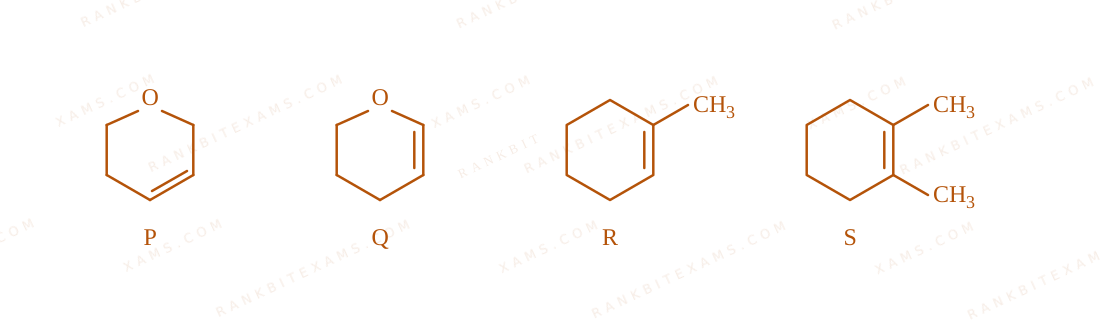
Following are the four molecules "P", "Q", "R" and "S":
The image shows four cyclic and acyclic alkene molecules labelled P, Q, R, and S.
Which one among the four molecules will react with H-Br(aq)$H-Br(aq)$ at the fastest rate?
A. S
B. Q
C. R
D. P
Solution
### Related Formula
textRate of Electrophilic Addition propto textStability of Intermediate Carbocation$$\text{Rate of Electrophilic Addition} \propto \text{Stability of Intermediate Carbocation}$$
### Core Logic
Addition of H-Br(aq)$H-Br(aq)$ follows an electrophilic addition pathway where a carbocation intermediate is formed in the rate-determining step. Among the given structures, compound Q forms a resonance-stabilized allylic/benzylic carbocation, rendering it highly stable compared to the others. The image shows four cyclic and acyclic alkene molecules labelled P, Q, R, and S.
### Pattern Recognition
Look for conjugated or allylic systems that stabilize the positive charge dynamically via resonance.
### Evaluation Rubric / Model Answer
null
### Chapter Mix
Class 11 Chemistry: Hydrocarbons
Q29jee_main_2025_28_jan_eveningAlkyne Reactions and Ozonolysis
Identify product [A], [B] and [C] in the following reaction sequence :
CH_3-Cequiv CHfracPd/CH_2rightarrow[A]frac(i)O_3(ii)Zn,H_2Orightarrow[B]+[C]$$CH_{3}-C\equiv CH\frac{Pd/C}{H_{2}}\rightarrow[A]\frac{(i)O_{3}}{(ii)Zn,H_{2}O}\rightarrow[B]+[C]$$
### Related Formula
textAlkene + textHX rightarrow textAlkyl Halide quad text(Markovnikov's Rule)$$\text{Alkene} + \text{HX} \rightarrow \text{Alkyl Halide} \quad \text{(Markovnikov's Rule)}$$
### Core Logic
The reaction involving the addition of textHI$\text{HI}$ to the double bond follows electrophilic addition mechanism governed by Markovnikov's rule. The proton adds to the less substituted carbon to generate the more stable tertiary carbocation intermediate, which is then attacked by textI^-$\text{I}^-$ to yield the corresponding major tertiary alkyl iodide.
### Step 1: Verification of Choices
Option (2) perfectly captures the sound execution of Markovnikov addition mechanics whereas the remaining choices present invalid product distributions or faulty reaction stoichiometry templates.
### Pattern Recognition
Electrophilic addition cleanly forms the most substituted, most stable carbocation before halide attack takes place.
### Evaluation Rubric / Model Answer
null
### Chapter Mix
Class 11 Chemistry: Hydrocarbons
Q71jee_main_2024_29_jan_morningAddition Reactions of Alkenes
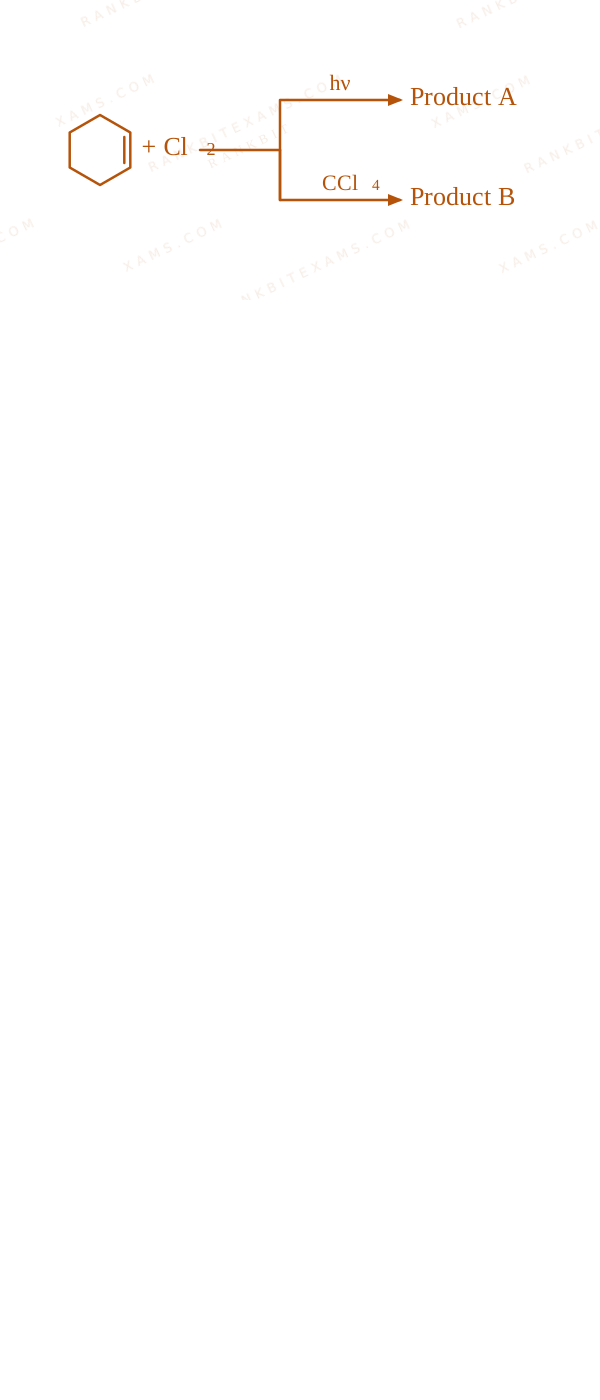
Identify product A and product B :
Cyclohexene undergoing chlorination under two different conditions: light (hv) and dark with CCl4 solvent.
A. ""
B. ""
C. ""
D. ""
Solution
### Core Logic
The substrate is cyclohexene, which can undergo two distinct types of reactions with chlorine (Cl_2$Cl_2$) depending on the reaction conditions.
**Reaction 1: Condition hv$hv$ (Product A)**
In the presence of light (hnu$h\nu$) or high temperature, halogens undergo homolytic cleavage to generate free radicals. This triggers allylic substitution (a free radical substitution mechanism). The allylic position is targeted because the resulting allylic free radical is resonance stabilized. Thus, substitution occurs at the carbon adjacent to the double bond, yielding 3-chlorocyclohexene as Product A.
**Reaction 2: Condition CCl_4$CCl_4$ (Product B)**
In the presence of a non-polar solvent like CCl_4$CCl_4$ and without light/heat, Cl_2$Cl_2$ undergoes an electrophilic addition reaction across the carbon-carbon double bond. A cyclic chloronium ion intermediate is formed, leading to anti-addition of two chlorine atoms. This yields 1,2-dichlorocyclohexane as Product B.
### Step 1: Structures of A and B
Cyclohexene undergoing chlorination under two different conditions: light (hv) and dark with CCl4 solvent.
Product A preserves the double bond and substitutes a Cl at the allylic position.
Product B loses the double bond and adds two Cl atoms adjacently.
### Pattern Recognition
X_2$X_2$ + light (hnu$h\nu$) = Free radical Allylic Substitution.
X_2$X_2$ + dark/solvent (CCl_4$CCl_4$) = Electrophilic Addition across double bond.
### Evaluation Rubric / Model Answer
null
### Chapter Mix
Class 11 Chemistry: Hydrocarbons
Class 12 Chemistry: Haloalkanes and Haloarenes
We Map Every Repeating Question in Competitive Exams.
Say goodbye to generic mock test fatigue. RankBit uses smart analysis to group past exam questions into their foundational Repeating Question Types. Find chapter weightage, track repeating questions, and score higher with targeted practice.
Select Your Target Exam
Choose an exam track below to find formulas per chapter and patterns.
Syncing Exam Intelligence
Mapping formulas and patterns across all tracks…
PATH A — FULL LENGTH PRACTICE
Full Mock Test Hub
Simulate real NTA exam conditions with fully tracked mocks. Time yourself against past papers.
Practice past-year questions one chapter at a time. Pick an exam → subject → chapter and get every PYQ for that topic — pulled together from all past papers — with the chapter's key formulas alongside.