### Related Formula
textNamed Organic Transformations$$\text{Named Organic Transformations}$$
### Core Logic
Let us systematically match each reaction in List-I to its standardized organic reaction name in List-II:
- **Reaction (A)**: Coupling of two aryl halides with sodium metal in dry ether to form biaryl is the classic **Fittig reaction** rightarrow$\rightarrow$ **(III)**.
- **Reaction (B)**: Conversion of benzene diazonium chloride to aryl halide using copper powder (mathrmCu$\mathrm{Cu}$) in halogen acids like mathrmHCl$\mathrm{HCl}$ is the **Gatterman reaction** rightarrow$\rightarrow$ **(IV)**.
- **Reaction (C)**: Substitution of halogen in an alkyl halide with sodium iodide (mathrmNaI$\mathrm{NaI}$) in dry acetone solvent is the classic halogen exchange method called the **Finkelstein reaction** rightarrow$\rightarrow$ **(II)**.
- **Reaction (D)**: Replacement of the hydroxyl group in tertiary butyl alcohol with chlorine using conc. mathrmHCl$\mathrm{HCl}$ in the presence of anhydrous mathrmZnCl_2$\mathrm{ZnCl_2}$ catalyst is the **Lucas reaction** rightarrow$\rightarrow$ **(I)**.
### Step 1: Selection
Combining the selections, the correct sequence is:
**(A)-(III), (B)-(IV), (C)-(II), (D)-(I)**
This maps directly to option (2).
### Pattern Recognition
Named reaction matching questions are very straightforward. Keep a clear distinction between the Sandmeyer reaction (which uses cuprous halide, e.g. mathrmCu_2Cl_2$\mathrm{Cu_2Cl_2}$) and the Gatterman reaction (which uses copper powder, mathrmCu$\mathrm{Cu}$).
### Evaluation Rubric / Model Answer
null
### Chapter Mix
Class 12 Chemistry: Haloalkanes and Haloarenes
More Haloalkanes and Haloarenes Previous-Year Questions — Page 6
Q67jee_main_2024_31_jan_eveningIUPAC Nomenclature of Haloalkanes
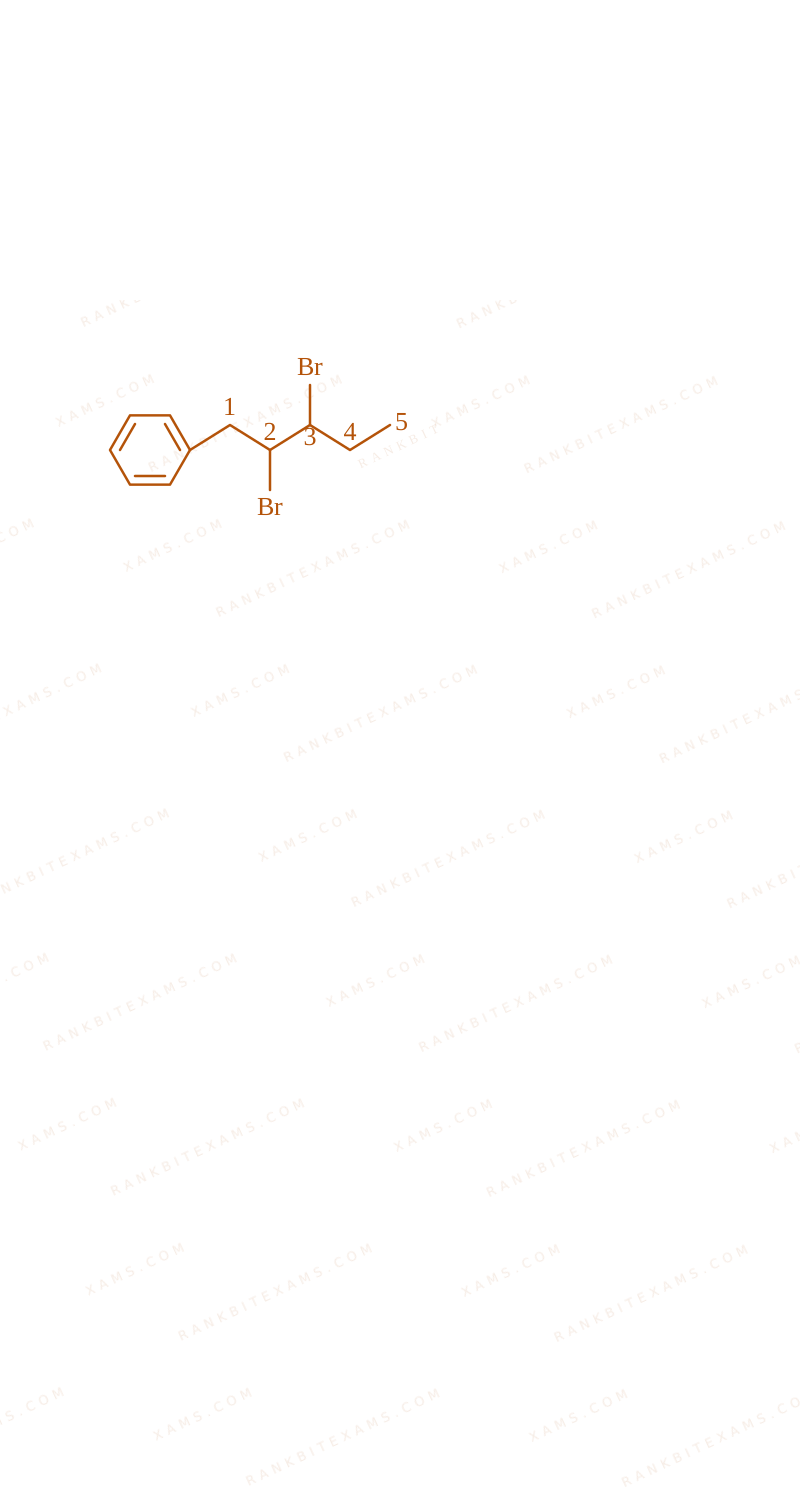
Identify structure of 2,3-dibromo-1-phenylpentane.
A.text(1) Structure A$\text{(1) Structure A}$
B.text(2) Structure B$\text{(2) Structure B}$
C.text(3) Structure C$\text{(3) Structure C}$
D.text(4) Structure D$\text{(4) Structure D}$
Solution
### Core Logic
Decode the IUPAC name: 2,3-dibromo-1-phenylpentane.
1) Parent chain is pentane (5 carbon chain: C1-C2-C3-C4-C5).
2) Substituents:
- Phenyl group at position 1.
- Bromo groups at positions 2 and 3.
Option (3) correctly displays a 5-carbon straight chain. The first carbon attaches to the benzene ring (phenyl group), and the second and third carbons each hold a bromine atom.
IUPAC Nomenclature of Haloalkanes diagram for Q67 - JEE Main 2024 Evening
### Evaluation Rubric / Model Answer
null
### Chapter Mix
Class 12 Chemistry: Haloalkanes and Haloarenes
Q68jee_main_2024_31_jan_morningElimination and Addition Reactions
The product (C) in the below mentioned reaction is:
CH_3-CH_2-CH_2-Br xrightarrow[Delta]KOH_(alc) A xrightarrow[Delta]HBr B xrightarrow[Delta]KOH_(aq) C$$CH_3-CH_2-CH_2-Br \xrightarrow[\Delta]{KOH_{(alc)}} A \xrightarrow[\Delta]{HBr} B \xrightarrow[\Delta]{KOH_{(aq)}} C$$
Q86jee_main_2024_31_jan_morningElimination and Substitution
CH_3CH_2Br + NaOH rightarrow textProduct A$$CH_3CH_2Br + NaOH \rightarrow \text{Product A}$$CH_3CH_2Br + NaOH / H_2O rightarrow textProduct B$$CH_3CH_2Br + NaOH / H_2O \rightarrow \text{Product B}$$
The total number of hydrogen atoms in product A and product B is
Numerical Answer.Answer: 10 to 10
Solution
### Core Logic
Reaction 1:
If the reagent is alcoholic NaOH (implied due to formation of a distinct product A to contrast B), elimination occurs:
CH_3CH_2Br + NaOH (textalc) rightarrow CH_2=CH_2 text (Ethene)$$CH_3CH_2Br + NaOH (\text{alc}) \rightarrow CH_2=CH_2 \text{ (Ethene)}$$
Hydrogen atoms in ethene (C_2H_4$C_2H_4$) = 4.
Reaction 2:
If the reagent is aqueous NaOH (NaOH / H_2O$NaOH / H_2O$), nucleophilic substitution (S_N2$S_N2$) occurs:
CH_3CH_2Br + NaOH (textaq) rightarrow CH_3CH_2OH text (Ethanol)$$CH_3CH_2Br + NaOH (\text{aq}) \rightarrow CH_3CH_2OH \text{ (Ethanol)}$$
Hydrogen atoms in ethanol (C_2H_6O$C_2H_6O$) = 6.
Total hydrogen atoms = 4 + 6 = 10.
### Evaluation Rubric / Model Answer
null
### Chapter Mix
Class 12 Chemistry: Haloalkanes and Haloarenes
We Map Every Repeating Question in Competitive Exams.
Say goodbye to generic mock test fatigue. RankBit uses smart analysis to group past exam questions into their foundational Repeating Question Types. Find chapter weightage, track repeating questions, and score higher with targeted practice.
Select Your Target Exam
Choose an exam track below to find formulas per chapter and patterns.
Syncing Exam Intelligence
Mapping formulas and patterns across all tracks…
PATH A — FULL LENGTH PRACTICE
Full Mock Test Hub
Simulate real NTA exam conditions with fully tracked mocks. Time yourself against past papers.
Practice past-year questions one chapter at a time. Pick an exam → subject → chapter and get every PYQ for that topic — pulled together from all past papers — with the chapter's key formulas alongside.