Related Formula
Δ G° = Δ H° - TΔ S°$$\Delta G^{\circ} = \Delta H^{\circ} - T\Delta S^{\circ}$$
ln Keq = - Δ G°RT = - Δ H°RT + Δ S°R$$\ln K_{\text{eq}} = -\frac{\Delta G^{\circ}}{RT} = -\frac{\Delta H^{\circ}}{RT} + \frac{\Delta S^{\circ}}{R}$$
Core Logic
Let us state Haber's process reaction:
N₂(g) + 3H₂(g) arrow 2NH₃(g)$$\mathrm{N_2(g) + 3H_2(g) \rightarrow 2NH_3(g)}$$
This synthesis reaction is thermodynamically characterized by:
- Δ H° < 0$\Delta H^{\circ} < 0$ (Exothermic reaction)
- Δ S° < 0$\Delta S^{\circ} < 0$ (Decrease in the number of gaseous molecules, from 4 moles to 2 moles)
Both Δ H°$\Delta H^{\circ}$ and Δ S°$\Delta S^{\circ}$ remain relatively constant across the temperature range of interest.
N₂(g) + 3H₂(g) arrow 2NH₃$\mathrm{N}_2(\mathrm{g}) + 3\mathrm{H}_2(\mathrm{g}) \rightarrow 2\mathrm{NH}_3$
^° = -ve$\Delta\mathrm{H}^\circ = -\text{ve}$
^° = -ve$\Delta\mathrm{S}^\circ = -\text{ve}$
(As gaseous moles decreases).
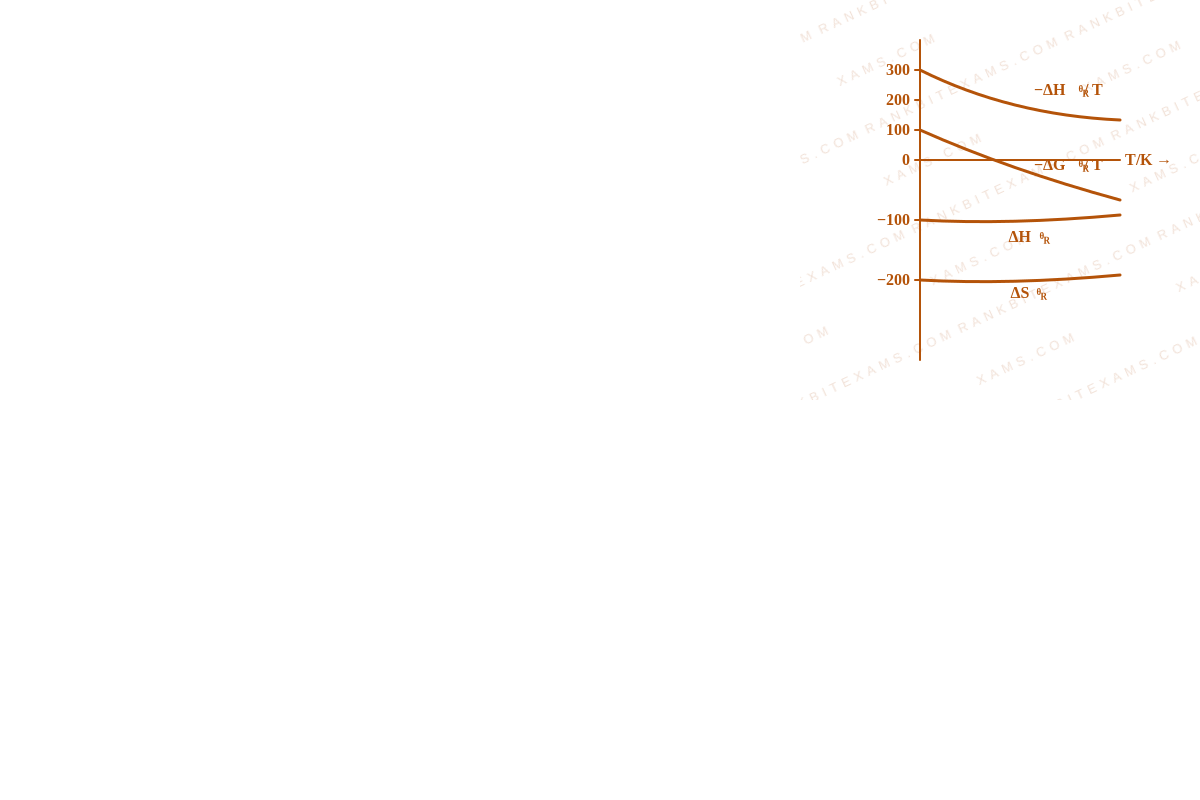
(1) As temperature increases - ^°RT$\frac{-\Delta\mathrm{H}^\circ_{\mathrm{R}}}{\mathrm{T}}$ , decreases
(2) ^° = -RT ln Keq$\Delta\mathrm{G}^\circ = -\mathrm{RT} \ln \mathrm{K}_{\mathrm{eq}}$
R ln Keq = - ^°T$\mathrm{R} \ln \mathrm{K}_{\mathrm{eq}} = -\frac{\Delta\mathrm{G}^\circ}{\mathrm{T}}$
(on increasing temperature in exothermic reaction Keq$\mathrm{K}_{\mathrm{eq}}$ decreases)
^°$\Delta\mathrm{H}^\circ$ and ^°$\Delta\mathrm{S}^\circ$ are almost constant with temperature.
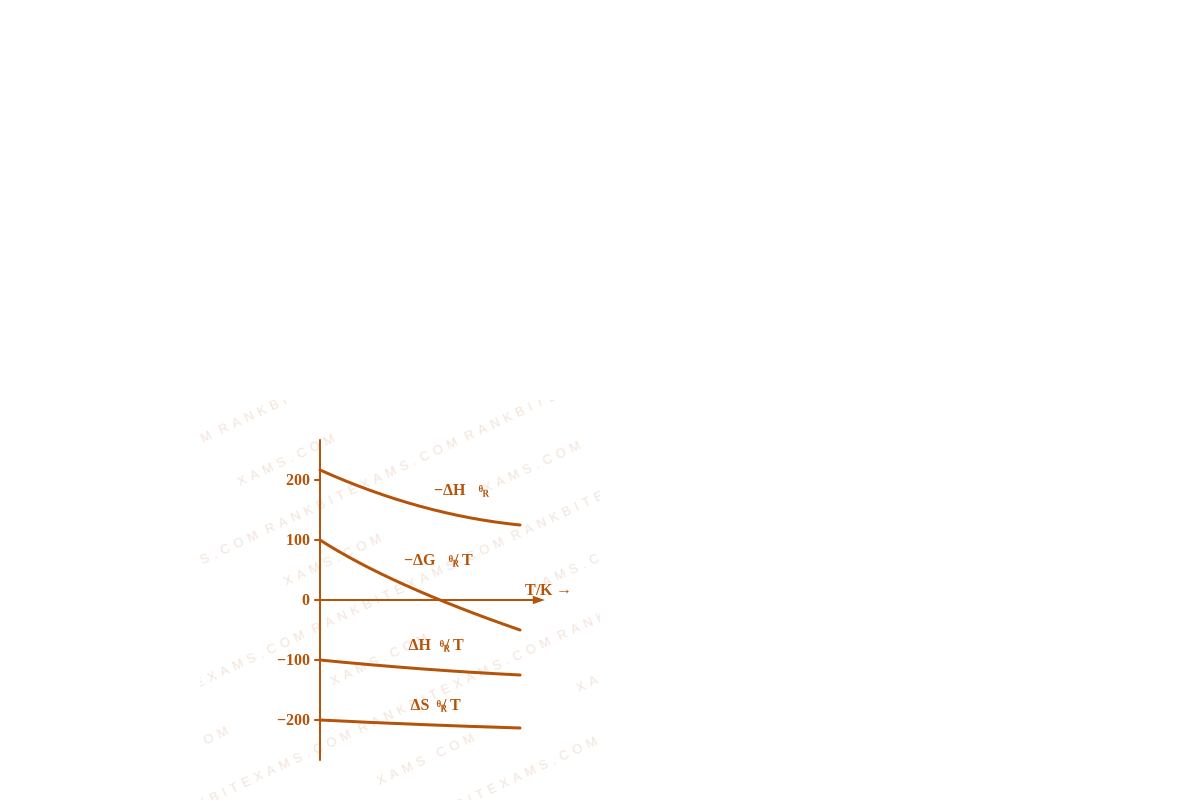
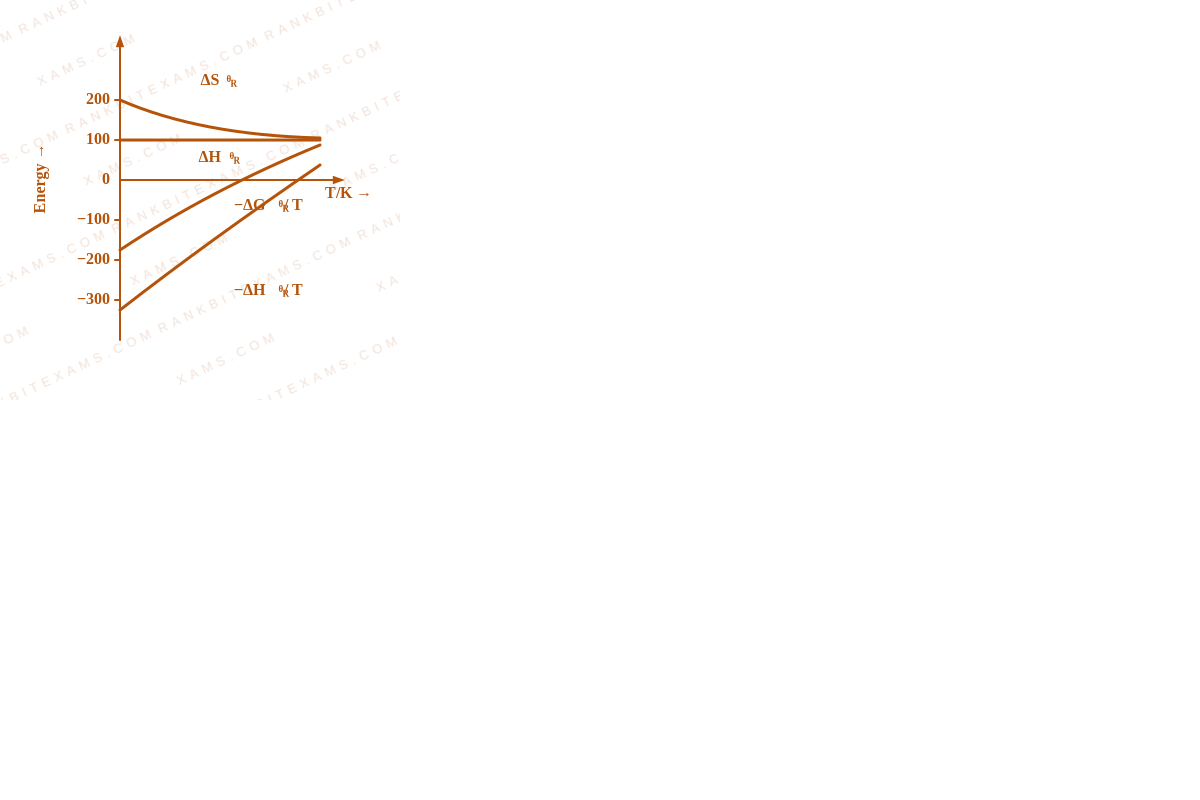
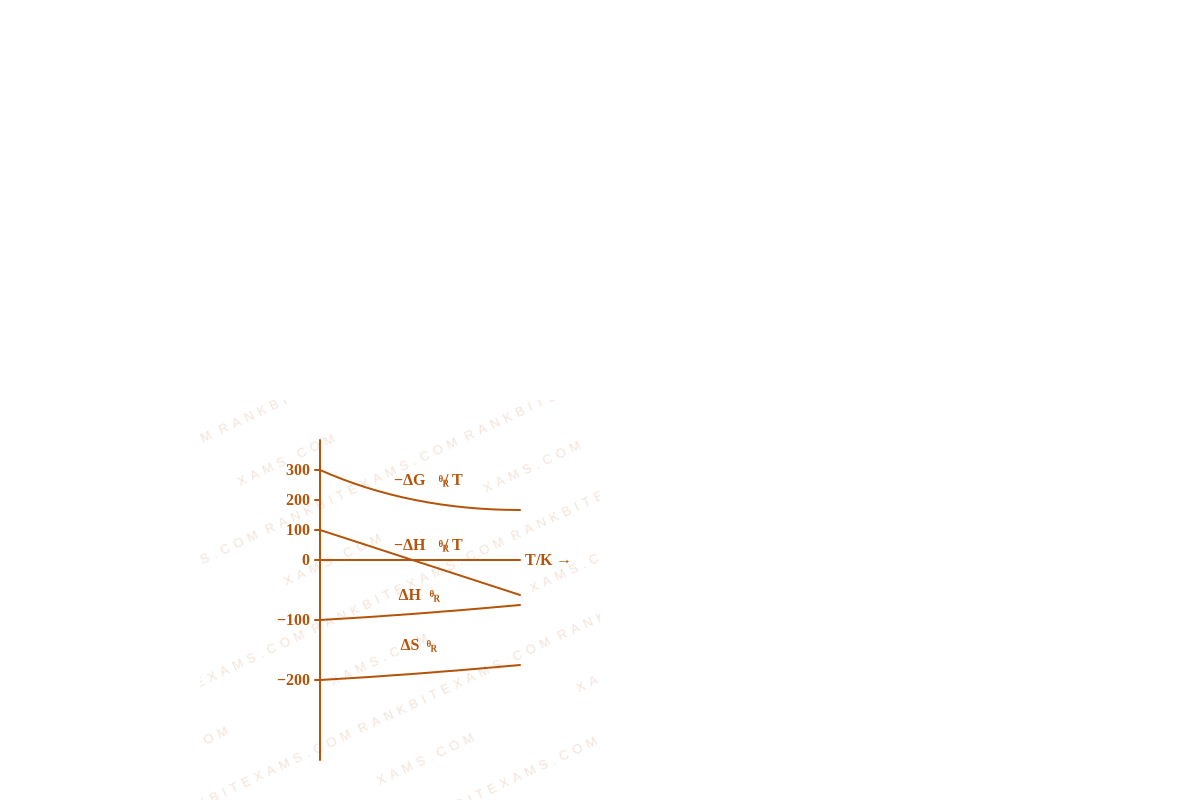
This perfectly matches Graph (1).
Pattern Recognition
Since Haber's process is exothermic, Keq$K_{\text{eq}}$ must decrease as temperature increases (according to Le Chatelier's Principle). Because R ln Keq = -Δ G°/T$R \ln K_{\text{eq}} = -\Delta G^{\circ}/T$, the quantity -Δ G°/T$-\Delta G^{\circ}/T$ must also decrease with temperature.
Chapter Mix
Class 11 Chemistry: Equilibrium
Class 11 Chemistry: Chemical Thermodynamics