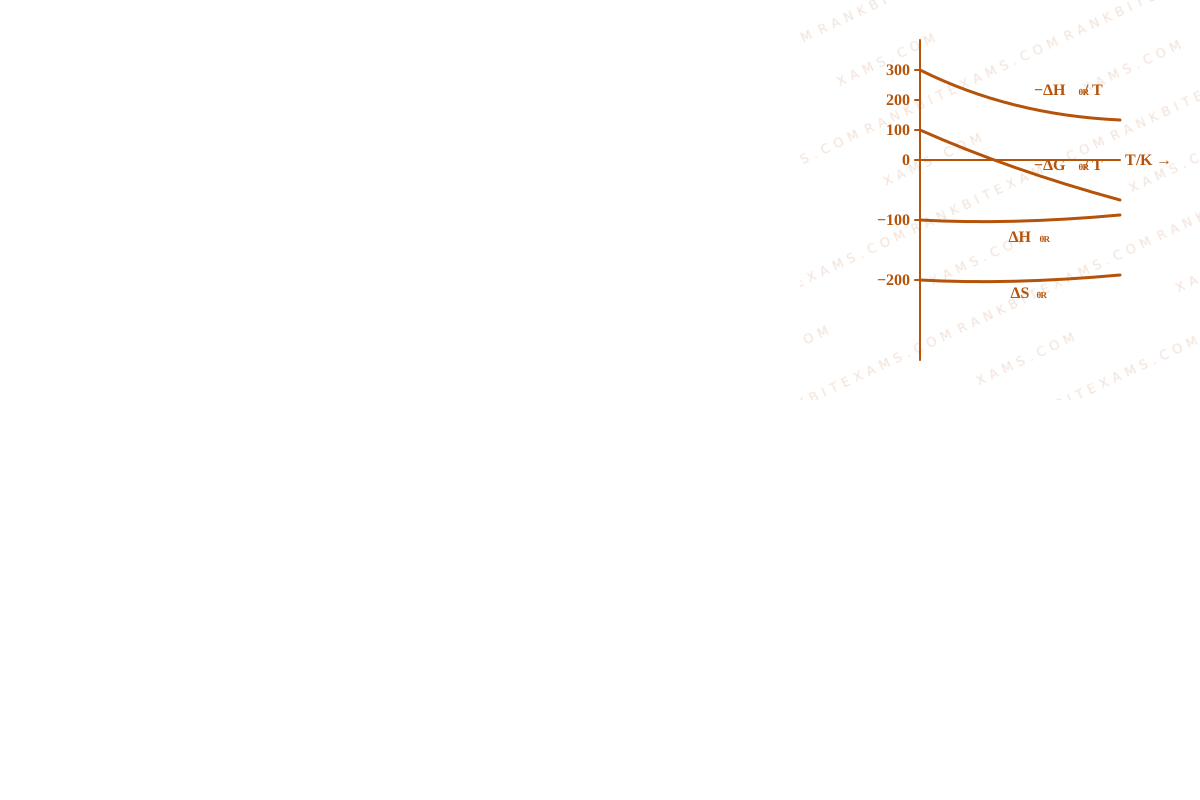
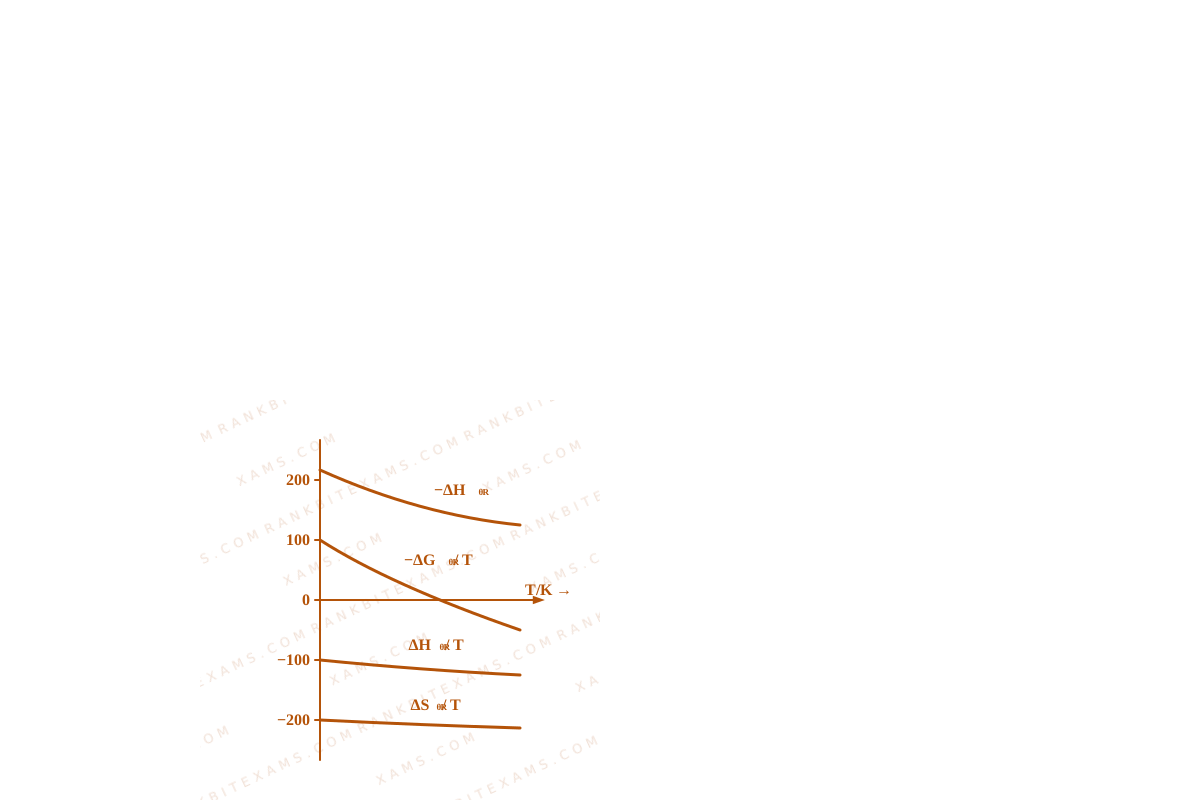
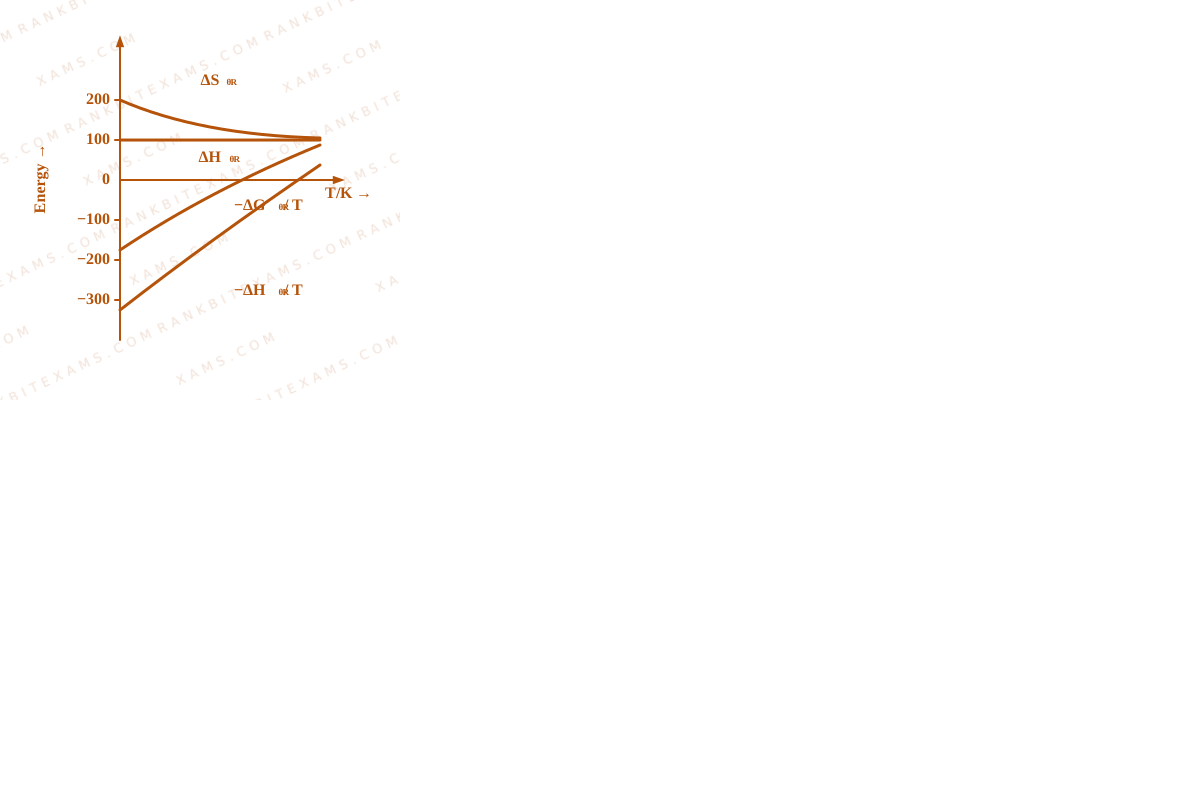
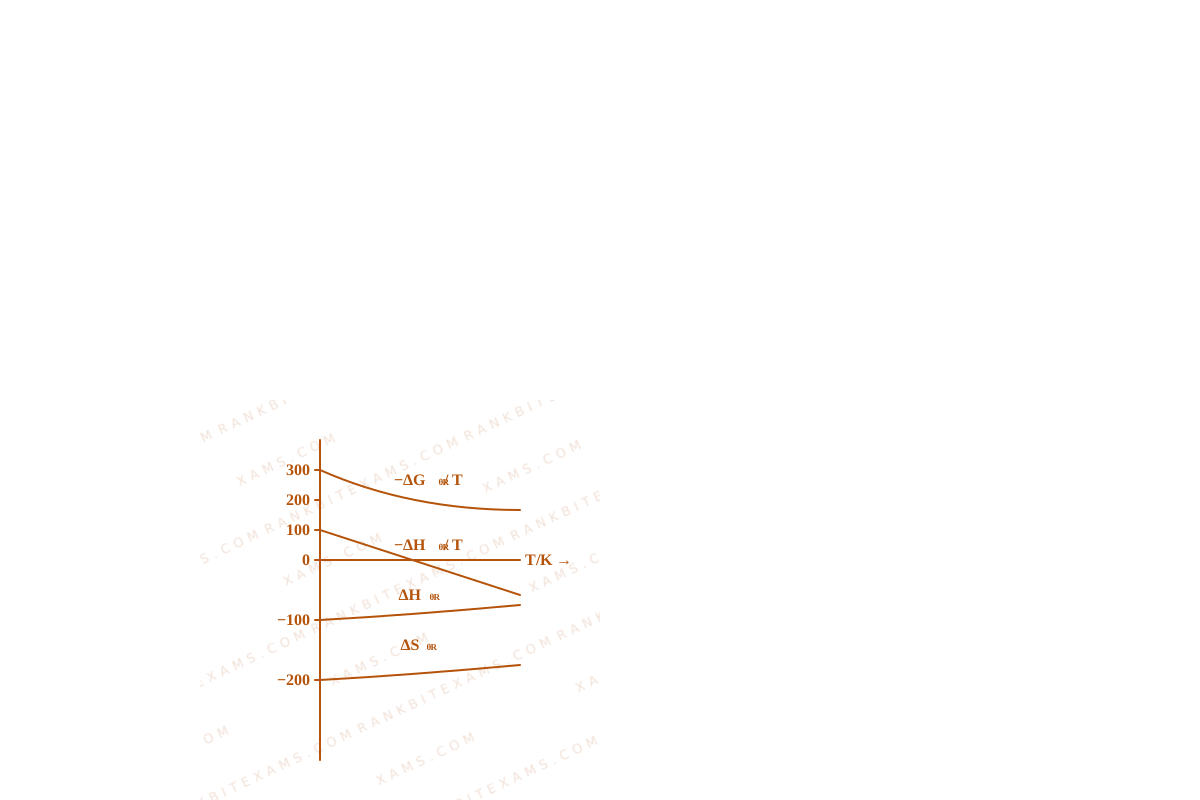
Which of the following graphs correctly represents the variation of thermodynamic properties of Haber's process?

Solution & Explanation

### Related Formula Delta G^circ = Delta H^circ - TDelta S^circ ln K_texteq = -fracDelta G^circRT = -fracDelta H^circRT + fracDelta S^circR ### Core Logic Let us state Haber's process reaction: mathrmN_2(g) + 3H_2(g) rightarrow 2NH_3(g) This synthesis reaction is thermodynamically characterized by: 1. **Delta H^circ < 0** (Exothermic reaction) 2. **Delta S^circ < 0** (Decrease in the number of gaseous molecules, from 4 moles to 2 moles) Both Delta H^circ and Delta S^circ remain relatively constant across the temperature range of interest. mathrmN_2(mathrmg) + 3mathrmH_2(mathrmg) rightarrow 2mathrmNH_3 DeltamathrmH^circ = -textve DeltamathrmS^circ = -textve (As gaseous moles decreases). (1) As temperature increases frac-DeltamathrmH^circ_mathrmRmathrmT , decreases (2) DeltamathrmG^circ = -mathrmRT ln mathrmK_mathrmeq mathrmR ln mathrmK_mathrmeq = -fracDeltamathrmG^circmathrmT (on increasing temperature in exothermic reaction mathrmK_mathrmeq decreases) DeltamathrmH^circ and DeltamathrmS^circ are almost constant with temperature. This perfectly matches Graph (1). ### Pattern Recognition Since Haber's process is exothermic, K_texteq must decrease as temperature increases (according to Le Chatelier's Principle). Because R ln K_texteq = -Delta G^circ/T, the quantity -Delta G^circ/T must also decrease with temperature. ### Evaluation Rubric / Model Answer null ### Chapter Mix Class 11 Chemistry: Equilibrium Class 11 Chemistry: Chemical Thermodynamics

More Equilibrium Previous-Year Questions — Page 5

Q76 jee_main_2024_27_jan_morning Salt Hydrolysis
Given below are two statements: Statement (I): Aqueous solution of ammonium carbonate is basic. Statement (II): Acidic/basic nature of salt solution of a salt of weak acid and weak base depends on K_a and K_b value of acid and the base forming it. In the light of the above statements, choose the most appropriate answer from the options given below :
  • A. Both Statement I and Statement II are correct
  • B. Statement I is correct but Statement II is incorrect
  • C. Both Statement I and Statement II are incorrect
  • D. Statement I is incorrect but Statement II is correct

Solution

### Related Formula pH of a weak acid-weak base salt system: textpH = 7 + frac12(textpK_a - textpK_b) ### Core Logic Ammonium carbonate, (textNH_4)_2textCO_3, is formed from a weak acid (textH_2textCO_3, K_a approx 4.3 times 10^-7) and weak base (textNH_4textOH, K_b approx 1.8 times 10^-5). Since K_b > K_a, the aqueous medium accumulates an excess of hydroxyl particles over hydronium, forming a basic system (textpH > 7). Both statements are structurally accurate descriptions. ### Chapter Mix Class 11 Chemistry: Equilibrium

Q84 jee_main_2024_29_jan_morning Kp and Kc Relationship
For the reaction mathrmN_2mathrmO_4(mathrmg) rightleftharpoons 2mathrmNO_2(mathrmg) mathrmK_p = 0.492 atm at 300mathrmK . mathrmK_c for the reaction at same temperature is \_\_\_\_\_\_ times 10^-2 . (textGiven: R = 0.082 text L atm mathrmmol^-1 textK^-1)
Numerical Answer. Answer: 2 to 2

Solution

### Related Formula K_p = K_c cdot (RT)^Delta n_g ### Core Logic For the given gaseous equilibrium reaction: N_2O_4(g) rightleftharpoons 2NO_2(g) First, find the change in the number of moles of gas (Delta n_g): Delta n_g = n_p - n_r = 2 - 1 = 1 ### Step 1: Calculation Substitute the given values into the K_p - K_c relationship: K_p = 0.492 R = 0.082 T = 300text K 0.492 = K_c cdot (0.082 times 300)^1 K_c = frac0.4920.082 times 300 K_c = frac0.49224.6 K_c = 0.02 Converting to the requested format (x times 10^-2): K_c = 2 times 10^-2 So, the value is 2. ### Evaluation Rubric / Model Answer null ### Chapter Mix Class 11 Chemistry: Equilibrium
Q85 jee_main_2024_30_january_evening Buffer Solutions
The pH of an aqueous solution containing 1M benzoic acid (pK_a = 4.20) and 1M sodium benzoate is 4.5. The volume of benzoic acid solution in 300 mL of this buffer solution is ______ mL.
Numerical Answer. Answer: 100 to 100

Solution

### Related Formula Henderson-Hasselbalch Equation for Acidic Buffers: mathrmpH = pK_a + log left( frac[textSalt][textAcid] right) ### Core Logic Let the volume of 1M Benzoic acid be V_a mL and the volume of 1M Sodium benzoate be V_s mL. Total volume = V_s + V_a = 300\,textmL. Millimoles of acid = 1 times V_a = V_a Millimoles of salt = 1 times V_s = V_s Applying Henderson's Equation: 4.5 = 4.2 + log left(fracV_sV_aright) ### Step 1: Calculate Volume Ratio log left(fracV_sV_aright) = 4.5 - 4.2 = 0.3 Since log 2 approx 0.3, we have: fracV_sV_a = 2 V_s = 2 V_a ### Step 2: Substitute and Solve We know V_s + V_a = 300 Substituting V_s = 2 V_a: 2 V_a + V_a = 300 3 V_a = 300 V_a = 100 \, textmL ### Evaluation Rubric / Model Answer null ### Chapter Mix Class 11 Chemistry: Equilibrium
Q82 jee_main_2024_30_jan_morning Solubility Product
The pH at which Mg(OH)_2 [K_sp=1times 10^-11] begins to precipitate from a solution containing 0.10text M Mg^2+ ions is
Numerical Answer. Answer: 9 to 9

Solution

### Related Formula K_sp = [Mg^2+][OH^-]^2 pOH = -log[OH^-] pH + pOH = 14 ### Core Logic Precipitation begins just when the ionic product equals the solubility product (Q_sp = K_sp). ### Step 1: Calculating required [OH-] [Mg^2+][OH^-]^2 = 10^-11 Given [Mg^2+] = 0.10 text M 0.10 times [OH^-]^2 = 10^-11 [OH^-]^2 = 10^-10 [OH^-] = 10^-5 text M ### Step 2: Finding pH pOH = -log(10^-5) = 5 pH = 14 - pOH pH = 14 - 5 = 9 ### Evaluation Rubric / Model Answer null ### Chapter Mix Class 11 Chemistry: Equilibrium
Q71 jee_main_2024_31_jan_evening Equilibrium Constants (Kp and Kc)
A_(g) rightleftharpoons B_(g) + fracC2_(g) The correct relationship between K_P, alpha and equilibrium pressure P is
  • A. K_P = fracalpha^frac12P^frac12(2 + alpha)^frac12
  • B. K_P = fracalpha^frac32P^frac12(2 + alpha)^frac12(1 - alpha)
  • C. K_P = fracalpha^frac12P^frac32(2 + alpha)^frac32
  • D. K_P = fracalpha^frac12P^frac12(2 + alpha)^frac32

Solution

### Related Formula K_P = fracP_B cdot (P_C)^frac12P_A where P_i is the partial pressure of component i. ### Step 1: Setting up the ICE Table For the reaction A_(g) rightleftharpoons B_(g) + frac12 C_(g) Let initial moles of A = 1. At equilibrium: Moles of A = 1 - alpha Moles of B = alpha Moles of C = fracalpha2 Total moles at equilibrium = (1 - alpha) + alpha + fracalpha2 = 1 + fracalpha2 = frac2 + alpha2 ### Step 2: Calculating Partial Pressures Using mole fraction times Total Pressure (P): P_A = frac1 - alpha1 + fracalpha2 cdot P P_B = fracalpha1 + fracalpha2 cdot P P_C = fracfracalpha21 + fracalpha2 cdot P ### Step 3: Calculating Kp K_P = fracP_B cdot (P_C)^frac12P_A K_P = fracleft( fracalpha1 + alpha/2 P right) cdot left( fracalpha/21 + alpha/2 P right)^1/2frac1 - alpha1 + alpha/2 P K_P = fracalpha cdot (alpha/2)^1/2 cdot P^3/2(1 + alpha/2)^3/2 cdot frac1 + alpha/2(1 - alpha) P K_P = fracalpha^3/2 cdot P^1/2sqrt2 cdot (1 + alpha/2)^1/2 cdot (1 - alpha) Since 1 + alpha/2 = frac2+alpha2, the sqrt2 in denominator cancels out perfectly leaving: K_P = fracalpha^frac32 P^frac12(2 + alpha)^frac12(1 - alpha) ### Evaluation Rubric / Model Answer null ### Chapter Mix Class 11 Chemistry: Equilibrium
Rankbit System
JEE Physics: Waves (+15.5%) | Electrostatics: Concentric Shells (-29.7%) | Modern Physics: Photoelectric Clones (+34.2%) | Mathematics: Definite Integrals (+18.1%) | Chemistry: Coordination Splitting (-11.4%) | JEE Physics: Waves (+15.5%) | Electrostatics: Concentric Shells (-29.7%) | Modern Physics: Photoelectric Clones (+34.2%) | Mathematics: Definite Integrals (+18.1%) | Chemistry: Coordination Splitting (-11.4%)