Which among the following molecules is
(a) involved in mathrmsp^3d$\mathrm{sp^3d}$ hybridization,
(b) has different bond lengths and
(c) has lone pair of electrons on the central atom?
A.mathrmPF_5$\mathrm{PF}_5$
B.mathrmXeF_4$\mathrm{XeF}_4$
C.mathrmSF_4$\mathrm{SF}_4$
D.mathrmXeF_2$\mathrm{XeF}_2$
Solution & Explanation
### Related Formula
textSteric Number = frac12 left( V + M - C + A right)$$\text{Steric Number} = \frac{1}{2} \left( V + M - C + A \right)$$
where,
V$V$ = valence electrons of central atom
M$M$ = number of monovalent surrounding atoms
C$C$ = cationic charge, A$A$ = anionic charge
### Core Logic
Let's calculate the hybridization, shape, and lone pairs for each option:
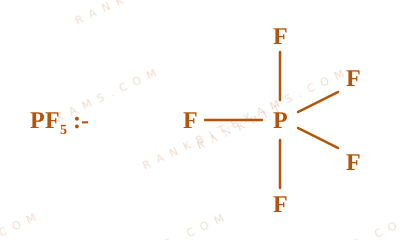
1. mathrmPF_5$\mathrm{PF}_5$:VSEPR Theory and Hybridization
- Central atom: Phosphorus (V=5$V=5$).
- Steric Number = frac12(5 + 5) = 5 implies mathrmsp^3d$= \frac{1}{2}(5 + 5) = 5 \implies \mathrm{sp^3d}$ hybridization.
- Lone pairs = 5 - 5 = 0$= 5 - 5 = 0$.
- Geometry: Trigonal bipyramidal. It has different axial and equatorial bond lengths, but no lone pair on the central atom.
2. mathrmXeF_4$\mathrm{XeF}_4$:
- Central atom: Xenon (V=8$V=8$).
- Steric Number = frac12(8 + 4) = 6 implies mathrmsp^3d^2$= \frac{1}{2}(8 + 4) = 6 \implies \mathrm{sp^3d^2}$ hybridization (fails condition a).
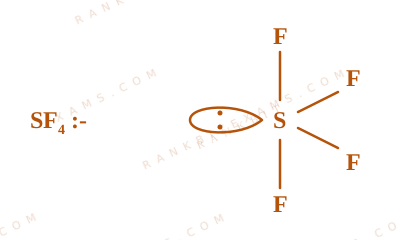
3. mathrmSF_4$\mathrm{SF}_4$:VSEPR Theory and Hybridization
- Central atom: Sulfur (V=6$V=6$).
- Steric Number = frac12(6 + 4) = 5 implies mathrmsp^3d$= \frac{1}{2}(6 + 4) = 5 \implies \mathrm{sp^3d}$ hybridization.
- Lone pairs = 5 - 4 = 1$= 5 - 4 = 1$ lone pair on sulfur.
- Shape: See-saw. It contains axial and equatorial bonds which have distinct lengths (1.64~mathrmmathringA$1.64~\mathrm{\mathring{A}}$ vs 1.54~mathrmmathringA$1.54~\mathrm{\mathring{A}}$ due to lone pair-bond pair repulsion). This satisfies all three conditions.
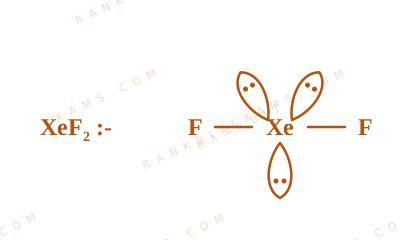
4. mathrmXeF_2$\mathrm{XeF}_2$:
- Central atom: Xenon (V=8$V=8$).
- Steric Number = frac12(8 + 2) = 5 implies mathrmsp^3d$= \frac{1}{2}(8 + 2) = 5 \implies \mathrm{sp^3d}$ hybridization.
- Lone pairs = 5 - 2 = 3$= 5 - 2 = 3$ lone pairs on Xe.
- Shape: Linear. Both Xe-F bonds are identical in length (fails condition b).
VSEPR Theory and Hybridization
### Step 1: Conclusion
Hence, only mathrmSF_4$\mathrm{SF}_4$ satisfies all the given parameters.
### Pattern Recognition
For any trigonal bipyramidal molecular geometry (steric number 5), the axial bonds suffer more repulsion (from 3 equatorial bonds at 90^circ$90^\circ$) than the equatorial bonds (which have only 2 axial neighbors at 90^circ$90^\circ$). Consequently, the axial bonds are always longer and weaker than equatorial bonds.
### Evaluation Rubric / Model Answer
null
### Chapter Mix
Class 11 Chemistry: Chemical Bonding and Molecular Structure
More Chemical Bonding and Molecular Structure Previous-Year Questions — Page 7
Q85jee_main_2024_31_jan_morningHybridization
The number of species from the following in which the central atom uses sp^3$sp^3$ hybrid orbitals in its bonding is
NH_3, SO_2, SiO_2, BeCl_2, CO_2, H_2O, CH_4, BF_3$NH_3, SO_2, SiO_2, BeCl_2, CO_2, H_2O, CH_4, BF_3$
Numerical Answer.Answer: 4 to 4
Solution
### Core Logic
Analyzing the hybridization of the central atom in each species:
- NH_3$NH_3$: 3 bp + 1 lp = 4 electron domains rightarrow sp^3$\rightarrow sp^3$
- SO_2$SO_2$: 2 bp + 1 lp = 3 electron domains rightarrow sp^2$\rightarrow sp^2$
- SiO_2$SiO_2$: A giant covalent network where each Si is bonded to 4 oxygens tetrahedrally rightarrow sp^3$\rightarrow sp^3$
- BeCl_2$BeCl_2$: 2 bp + 0 lp = 2 electron domains rightarrow sp$\rightarrow sp$
- CO_2$CO_2$: 2 bp + 0 lp = 2 electron domains rightarrow sp$\rightarrow sp$
- H_2O$H_2O$: 2 bp + 2 lp = 4 electron domains rightarrow sp^3$\rightarrow sp^3$
- CH_4$CH_4$: 4 bp + 0 lp = 4 electron domains rightarrow sp^3$\rightarrow sp^3$
- BF_3$BF_3$: 3 bp + 0 lp = 3 electron domains rightarrow sp^2$\rightarrow sp^2$
Total species with sp^3$sp^3$ hybridization: NH_3, SiO_2, H_2O, CH_4$NH_3, SiO_2, H_2O, CH_4$. Total count = 4.
### Evaluation Rubric / Model Answer
null
### Chapter Mix
Class 11 Chemistry: Chemical Bonding and Molecular Structure
We Map Every Repeating Question in Competitive Exams.
Say goodbye to generic mock test fatigue. RankBit uses smart analysis to group past exam questions into their foundational Repeating Question Types. Find chapter weightage, track repeating questions, and score higher with targeted practice.
Select Your Target Exam
Choose an exam track below to find formulas per chapter and patterns.
Syncing Exam Intelligence
Mapping formulas and patterns across all tracks…
PATH A — FULL LENGTH PRACTICE
Full Mock Test Hub
Simulate real NTA exam conditions with fully tracked mocks. Time yourself against past papers.
Practice past-year questions one chapter at a time. Pick an exam → subject → chapter and get every PYQ for that topic — pulled together from all past papers — with the chapter's key formulas alongside.