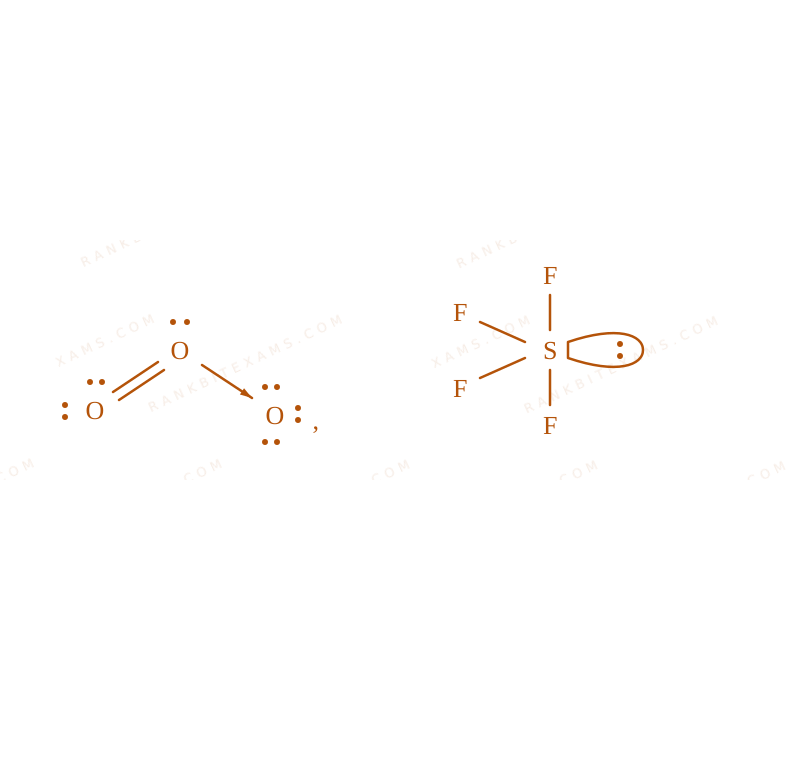
Which among the following molecules is
(a) involved in mathrmsp^3d$\mathrm{sp^3d}$ hybridization,
(b) has different bond lengths and
(c) has lone pair of electrons on the central atom?
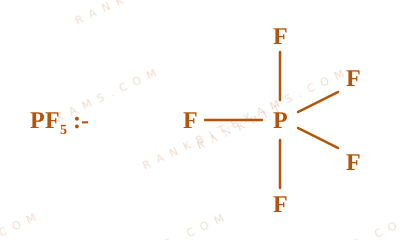
A.mathrmPF_5$\mathrm{PF}_5$
B.mathrmXeF_4$\mathrm{XeF}_4$
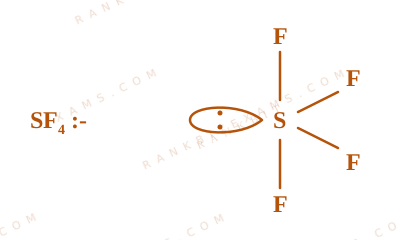
C.mathrmSF_4$\mathrm{SF}_4$
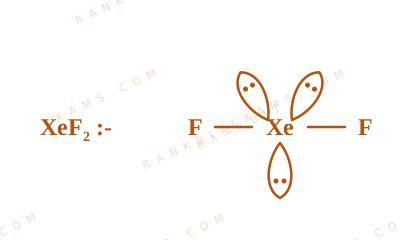
D.mathrmXeF_2$\mathrm{XeF}_2$
Solution & Explanation
### Related Formula
textSteric Number = frac12 left( V + M - C + A right)$$\text{Steric Number} = \frac{1}{2} \left( V + M - C + A \right)$$
where,
V$V$ = valence electrons of central atom
M$M$ = number of monovalent surrounding atoms
C$C$ = cationic charge, A$A$ = anionic charge
### Core Logic
Let's calculate the hybridization, shape, and lone pairs for each option:
1. mathrmPF_5$\mathrm{PF}_5$:VSEPR Theory and Hybridization
- Central atom: Phosphorus (V=5$V=5$).
- Steric Number = frac12(5 + 5) = 5 implies mathrmsp^3d$= \frac{1}{2}(5 + 5) = 5 \implies \mathrm{sp^3d}$ hybridization.
- Lone pairs = 5 - 5 = 0$= 5 - 5 = 0$.
- Geometry: Trigonal bipyramidal. It has different axial and equatorial bond lengths, but no lone pair on the central atom.
2. mathrmXeF_4$\mathrm{XeF}_4$:
- Central atom: Xenon (V=8$V=8$).
- Steric Number = frac12(8 + 4) = 6 implies mathrmsp^3d^2$= \frac{1}{2}(8 + 4) = 6 \implies \mathrm{sp^3d^2}$ hybridization (fails condition a).
3. mathrmSF_4$\mathrm{SF}_4$:VSEPR Theory and Hybridization
- Central atom: Sulfur (V=6$V=6$).
- Steric Number = frac12(6 + 4) = 5 implies mathrmsp^3d$= \frac{1}{2}(6 + 4) = 5 \implies \mathrm{sp^3d}$ hybridization.
- Lone pairs = 5 - 4 = 1$= 5 - 4 = 1$ lone pair on sulfur.
- Shape: See-saw. It contains axial and equatorial bonds which have distinct lengths (1.64~mathrmmathringA$1.64~\mathrm{\mathring{A}}$ vs 1.54~mathrmmathringA$1.54~\mathrm{\mathring{A}}$ due to lone pair-bond pair repulsion). This satisfies all three conditions.
4. mathrmXeF_2$\mathrm{XeF}_2$:
- Central atom: Xenon (V=8$V=8$).
- Steric Number = frac12(8 + 2) = 5 implies mathrmsp^3d$= \frac{1}{2}(8 + 2) = 5 \implies \mathrm{sp^3d}$ hybridization.
- Lone pairs = 5 - 2 = 3$= 5 - 2 = 3$ lone pairs on Xe.
- Shape: Linear. Both Xe-F bonds are identical in length (fails condition b).
VSEPR Theory and Hybridization
### Step 1: Conclusion
Hence, only mathrmSF_4$\mathrm{SF}_4$ satisfies all the given parameters.
### Pattern Recognition
For any trigonal bipyramidal molecular geometry (steric number 5), the axial bonds suffer more repulsion (from 3 equatorial bonds at 90^circ$90^\circ$) than the equatorial bonds (which have only 2 axial neighbors at 90^circ$90^\circ$). Consequently, the axial bonds are always longer and weaker than equatorial bonds.
### Evaluation Rubric / Model Answer
null
### Chapter Mix
Class 11 Chemistry: Chemical Bonding and Molecular Structure
More Chemical Bonding and Molecular Structure Previous-Year Questions — Page 5
Q89jee_main_2024_27_jan_morningMolecular Orbital Theory
Sum of bond order of textCO$\text{CO}$ and textNO^+$\text{NO}^+$ is textquadquad$\text{\quad\quad}$.
Numerical Answer.Answer: 6 to 6
Solution
### Step 1: Determine the bond order of textCO$\text{CO}$
Carbon monoxide (textCO$\text{CO}$) contains 6 + 8 = 14$6 + 8 = 14$ total electrons.
Its structural representation is textCequivtextO$\text{C}\equiv\text{O}$, matching a bond order value of 3.
### Step 2: Determine the bond order of textNO^+$\text{NO}^+$
The nitrosonium ion (textNO^+$\text{NO}^+$) contains 7 + 8 - 1 = 14$7 + 8 - 1 = 14$ total electrons.
Since it is isoelectronic with textN_2$\text{N}_2$ and textCO$\text{CO}$ (14text electrons$14\text{ electrons}$), its corresponding bond order value is also 3.
### Step 3: Sum the results
textSum = 3 + 3 = 6$$\text{Sum} = 3 + 3 = 6$$
### Pattern Recognition
Isoelectronic species possessing 14 total electrons consistently demonstrate a bond order value of 3.
### Chapter Mix
Class 11 Chemistry: Chemical Bonding and Molecular Structure
Q81jee_main_2024_29_jan_morningVSEPR Theory
Number of compounds with one lone pair of electrons on central atom amongst following is
O_3$O_3$, H_2O$H_2O$, SF_4$SF_4$, ClF_3$ClF_3$, NH_3$NH_3$, BrF_5$BrF_5$, XeF_4$XeF_4$
Numerical Answer.Answer: 4 to 4
Solution
### Core Logic
Let us determine the steric number (Z$Z$) and number of lone pairs (LP$LP$) for the central atom in each given molecule.
Formula: Z = frac12 (V + M - C + A)$Z = \frac{1}{2} (V + M - C + A)$
Where V$V$ = valence electrons on central atom, M$M$ = number of monovalent atoms, C$C$ = cationic charge, A$A$ = anionic charge.
LP = Z - textBond Pairs (B.P.)$LP = Z - \text{Bond Pairs (B.P.)}$
1. **O_3$O_3$**: Central atom O (V=6$V=6$). It forms one double bond and one dative bond. It has 1 lone pair remaining.
2. **H_2O$H_2O$**: Central atom O (V=6$V=6$). Z = frac12(6 + 2) = 4$Z = \frac{1}{2}(6 + 2) = 4$. LP = 4 - 2 = 2$LP = 4 - 2 = 2$.
3. **SF_4$SF_4$**: Central atom S (V=6$V=6$). Z = frac12(6 + 4) = 5$Z = \frac{1}{2}(6 + 4) = 5$. LP = 5 - 4 = 1$LP = 5 - 4 = 1$ (See-saw shape).
4. **ClF_3$ClF_3$**: Central atom Cl (V=7$V=7$). Z = frac12(7 + 3) = 5$Z = \frac{1}{2}(7 + 3) = 5$. LP = 5 - 3 = 2$LP = 5 - 3 = 2$ (T-shape).
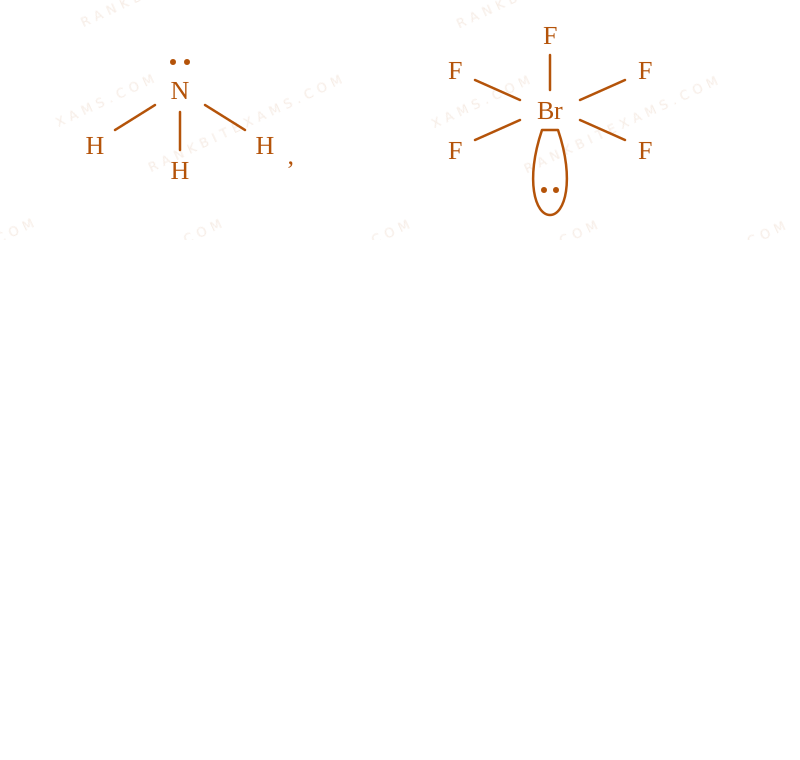
5. **NH_3$NH_3$**: Central atom N (V=5$V=5$). Z = frac12(5 + 3) = 4$Z = \frac{1}{2}(5 + 3) = 4$. LP = 4 - 3 = 1$LP = 4 - 3 = 1$ (Pyramidal).
6. **BrF_5$BrF_5$**: Central atom Br (V=7$V=7$). Z = frac12(7 + 5) = 6$Z = \frac{1}{2}(7 + 5) = 6$. LP = 6 - 5 = 1$LP = 6 - 5 = 1$ (Square Pyramidal).
7. **XeF_4$XeF_4$**: Central atom Xe (V=8$V=8$). Z = frac12(8 + 4) = 6$Z = \frac{1}{2}(8 + 4) = 6$. LP = 6 - 4 = 2$LP = 6 - 4 = 2$ (Square Planar).
### Step 1: Final Counting
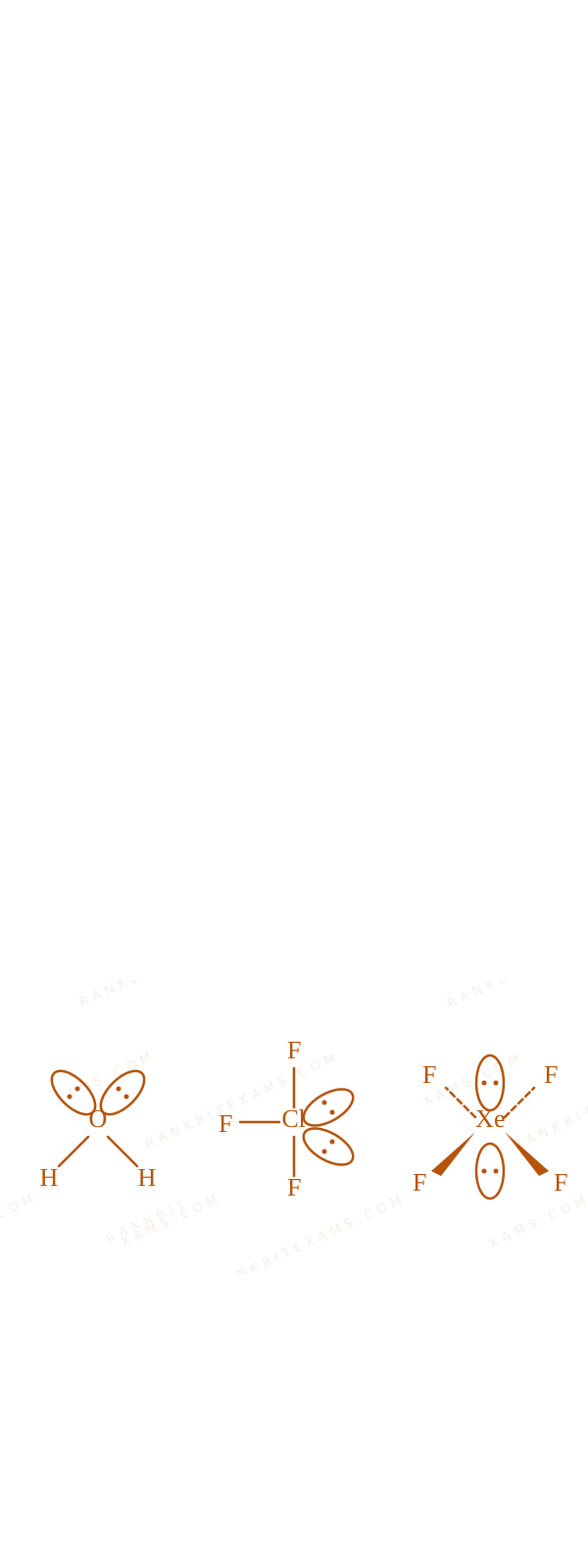
VSEPR Theory diagram for Q81 - JEE Main 2024 MorningVSEPR Theory diagram for Q81 - JEE Main 2024 MorningVSEPR Theory diagram for Q81 - JEE Main 2024 Morning
The compounds containing exactly ONE lone pair on the central atom are O_3$O_3$, SF_4$SF_4$, NH_3$NH_3$, and BrF_5$BrF_5$.
Total count = 4.
### Evaluation Rubric / Model Answer
null
### Chapter Mix
Class 11 Chemistry: Chemical Bonding and Molecular Structure
Q88jee_main_2024_29_jan_morningMolecular Orbital Theory
The number of species from the following which are paramagnetic and with bond order equal to one is
mathrm H_2, mathrmHe_2^+, mathrmO_2^+, mathrmN_2^2-, mathrmO_2^2-, mathrmF_2, mathrmNe_2^+, mathrmB_2$$\mathrm {H}_2, \mathrm{He}_2^+, \mathrm{O}_2^+, \mathrm{N}_2^{2-}, \mathrm{O}_2^{2-}, \mathrm{F}_2, \mathrm{Ne}_2^+, \mathrm{B}_2$$
Numerical Answer.Answer: 1 to 1
Solution
### Core Logic
Using Molecular Orbital (MO) Theory, we evaluate the bond order (BO = fracN_b - N_a2$BO = \frac{N_b - N_a}{2}$) and magnetic nature (unpaired electrons = paramagnetic, all paired = diamagnetic) for each species:
Species
Magnetic behaviour
Bond order
H_2$H_2$
Diamagnetic
1
He_2^+$He_2^+$
Paramagnetic
0.5
O_2^+$O_2^+$
Paramagnetic
2.5
N_2^2-$N_2^{2-}$
Paramagnetic
2
O_2^2-$O_2^{2-}$
Diamagnetic
1
F_2$F_2$
Diamagnetic
1
Ne_2^+$Ne_2^+$
Paramagnetic
0.5
B_2$B_2$
Paramagnetic
1
### Step 1: Final Selection
We need the species that satisfies BOTH conditions:
1. Paramagnetic
2. Bond Order = 1
Looking at the table, B_2$B_2$ is the only molecule that is paramagnetic (it has 2 unpaired electrons in degenerate pi_2p$\pi_{2p}$ orbitals) and has a bond order of 1.
Total number of such species = 1.
### Pattern Recognition
B_2$B_2$ (10 electrons) and O_2$O_2$ (16 electrons) are the classic exceptions in MO theory that are paramagnetic despite having an even number of electrons. B_2$B_2$ has BO = 1, and O_2$O_2$ has BO = 2.
### Evaluation Rubric / Model Answer
null
### Chapter Mix
Class 11 Chemistry: Chemical Bonding and Molecular Structure
Q69jee_main_2024_30_january_eveningVSEPR Theory and Molecular Shapes
### Core Logic
According to VSEPR theory:
1. [Ni(CN)_4]^2-$[Ni(CN)_4]^{2-}$: dsp^2$dsp^2$ hybridization rightarrow$\rightarrow$ Square Planar.
2. PCl_5$PCl_5$: sp^3d$sp^3d$ hybridization with 0 lone pairs rightarrow$\rightarrow$ Trigonal Bipyramidal.
3. BrF_5$BrF_5$: Bromine has 7 valence electrons. It forms 5 single bonds with Fluorine, leaving 1 lone pair. sp^3d^2$sp^3d^2$ hybridization rightarrow$\rightarrow$ geometry is octahedral, but shape is Square Pyramidal.
4. PF_5$PF_5$: sp^3d$sp^3d$ hybridization with 0 lone pairs rightarrow$\rightarrow$ Trigonal Bipyramidal.
Square Pyramidal structure of BrF5 diagram for Q69 - JEE Main 2024 Evening
### Pattern Recognition
AX_5E_1$AX_5E_1$ configuration (5 bond pairs + 1 lone pair) typically yields a Square Pyramidal shape.
### Evaluation Rubric / Model Answer
null
### Chapter Mix
Class 11 Chemistry: Chemical Bonding and Molecular Structure
Class 12 Chemistry: Coordination Compounds
Q75jee_main_2024_30_january_eveningDipole Moment
Given below are two statements:
Statement-I: Since fluorine is more electronegative than nitrogen, the net dipole moment of NF_3$NF_3$ is greater than NH_3$NH_3$.
Statement-II: In NH_3$NH_3$, the orbital dipole due to lone pair and the dipole moment of NH bonds are in opposite direction, but in NF_3$NF_3$ the orbital dipole due to lone pair and dipole moments of N-F bonds are in same direction.
In the light of the above statements. Choose the most appropriate from the options given below.
A.textStatement I is true but Statement II is false.$\text{Statement I is true but Statement II is false.}$
B.textBoth Statement I and Statement II are false.$\text{Both Statement I and Statement II are false.}$
C.textBoth statement I and Statement II is are true.$\text{Both statement I and Statement II is are true.}$
D.textStatement I is false but Statement II is are true.$\text{Statement I is false but Statement II is are true.}$
Solution
### Core Logic
Statement I: The net dipole moment of NH_3$NH_3$ (1.47\, D$1.47\, D$) is actually greater than that of NF_3$NF_3$ (0.23\, D$0.23\, D$). Therefore, Statement I is false.
Statement II: In NH_3$NH_3$, the N-H$N-H$ bond dipole moments (pointing towards the more electronegative N) reinforce the orbital dipole moment of the lone pair. In NF_3$NF_3$, the N-F$N-F$ bond dipole moments point away from N (towards the more electronegative F), opposing the orbital dipole moment of the lone pair. This partial cancellation in NF_3$NF_3$ makes its net dipole moment lower. Therefore, Statement II is also false, as it reverses the correct orientations.
Dipole moments in NH3 and NF3 diagram for Q75 - JEE Main 2024 EveningDipole moments in NH3 and NF3 diagram for Q75 - JEE Main 2024 Evening
### Step 1: Final Conclusion
Since both statements assert the opposite of established facts regarding NH_3$NH_3$ and NF_3$NF_3$, both are false.
### Evaluation Rubric / Model Answer
null
### Chapter Mix
Class 11 Chemistry: Chemical Bonding and Molecular Structure
We Map Every Repeating Question in Competitive Exams.
Say goodbye to generic mock test fatigue. RankBit uses smart analysis to group past exam questions into their foundational Repeating Question Types. Find chapter weightage, track repeating questions, and score higher with targeted practice.
Select Your Target Exam
Choose an exam track below to find formulas per chapter and patterns.
Syncing Exam Intelligence
Mapping formulas and patterns across all tracks…
PATH A — FULL LENGTH PRACTICE
Full Mock Test Hub
Simulate real NTA exam conditions with fully tracked mocks. Time yourself against past papers.
Practice past-year questions one chapter at a time. Pick an exam → subject → chapter and get every PYQ for that topic — pulled together from all past papers — with the chapter's key formulas alongside.