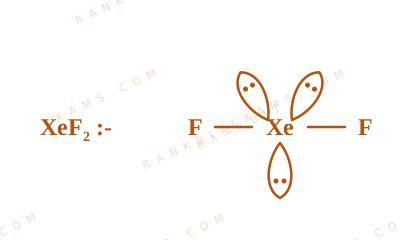
Which among the following molecules is (a) involved in mathrmsp^3d hybridization, (b) has different bond lengths and (c) has lone pair of electrons on the central atom?

Solution & Explanation

### Related Formula textSteric Number = frac12 left( V + M - C + A right) where, V = valence electrons of central atom M = number of monovalent surrounding atoms C = cationic charge, A = anionic charge ### Core Logic Let's calculate the hybridization, shape, and lone pairs for each option: 1. mathrmPF_5:
VSEPR Theory and Hybridization
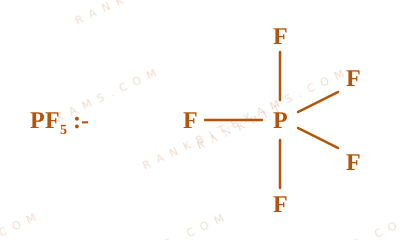
- Central atom: Phosphorus (V=5). - Steric Number = frac12(5 + 5) = 5 implies mathrmsp^3d hybridization. - Lone pairs = 5 - 5 = 0. - Geometry: Trigonal bipyramidal. It has different axial and equatorial bond lengths, but no lone pair on the central atom. 2. mathrmXeF_4: - Central atom: Xenon (V=8). - Steric Number = frac12(8 + 4) = 6 implies mathrmsp^3d^2 hybridization (fails condition a). 3. mathrmSF_4:
VSEPR Theory and Hybridization
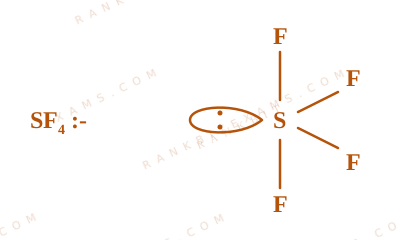
- Central atom: Sulfur (V=6). - Steric Number = frac12(6 + 4) = 5 implies mathrmsp^3d hybridization. - Lone pairs = 5 - 4 = 1 lone pair on sulfur. - Shape: See-saw. It contains axial and equatorial bonds which have distinct lengths (1.64~mathrmmathringA vs 1.54~mathrmmathringA due to lone pair-bond pair repulsion). This satisfies all three conditions. 4. mathrmXeF_2: - Central atom: Xenon (V=8). - Steric Number = frac12(8 + 2) = 5 implies mathrmsp^3d hybridization. - Lone pairs = 5 - 2 = 3 lone pairs on Xe. - Shape: Linear. Both Xe-F bonds are identical in length (fails condition b).
VSEPR Theory and Hybridization
### Step 1: Conclusion Hence, only mathrmSF_4 satisfies all the given parameters. ### Pattern Recognition For any trigonal bipyramidal molecular geometry (steric number 5), the axial bonds suffer more repulsion (from 3 equatorial bonds at 90^circ) than the equatorial bonds (which have only 2 axial neighbors at 90^circ). Consequently, the axial bonds are always longer and weaker than equatorial bonds. ### Evaluation Rubric / Model Answer null ### Chapter Mix Class 11 Chemistry: Chemical Bonding and Molecular Structure
More Chemical Bonding and Molecular Structure Previous-Year Questions — Page 3

Q28 jee_main_2025_04_april_morning Molecular Orbital Theory
Which of the following molecules(s) show/s paramagnetic behavior? (A) O_2 (B) N_2 (C) F_2 (D) S_2 (E) Cl_2 Choose the correct answer from the options given below:
  • A. textB only
  • B. textA \& C only
  • C. textA \& E only
  • D. textA \& D only

Solution

### Related Formula Paramagnetism implies Presence of at least one unpaired electron in the molecular orbitals. ### Core Logic According to Molecular Orbital Theory (MOT): * O_2 has 16 electrons. Its outer configuration contains two unpaired electrons in the anti-bonding orbitals: pi^*_2p_x = pi^*_2p_y. Thus, it is paramagnetic. * S_2 belongs to the same oxygen family group and shares an analogous valence configuration with two unpaired electrons in its anti-bonding pi^* orbitals. Hence, it is also paramagnetic. * N_2 (14e-), F_2 (18e-), and Cl_2 (34e-) have completely paired electronic systems and behave diamagnetically. ### Pattern Recognition Both O_2 and S_2 contain 2 unpaired electrons in their highest occupied molecular orbitals, making them classic examples of paramagnetic diatomic species. ### Evaluation Rubric / Model Answer null ### Chapter Mix Class 11 Chemistry: Chemical Bonding and Molecular Structure
Q39 jee_main_2025_07_april_evening Hybridization
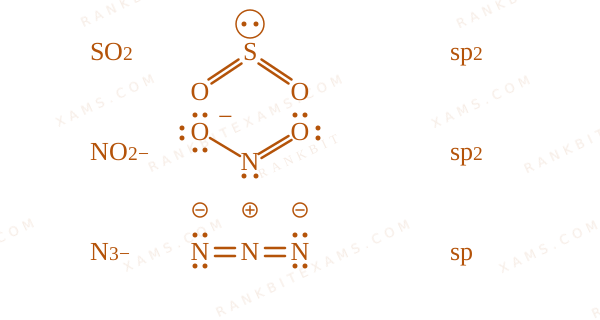
In textSO_2, textNO_2^- and textN_3^- the hybridizations at the central atom are respectively:
  • A. sp^2text, sp^2 text and sp
  • B. sp^2text, sp text and sp
  • C. sp^2text, sp^2 text and sp^2
  • D. sptext, sp^2 text and sp

Solution

### Related Formula textSteric Number (Steric count) = textNumber of lone pairs on central atom + textNumber of sigmatext-bonds ### Core Logic Let's perform steric calculations for each species: - textSO_2: Central sulfur atom has 6 valence electrons, forms 2\,sigma-bonds (and 2\,pi-bonds) with oxygen, leaving 1 lone pair. Steric number = 2 + 1 = 3 implies sp^2. - textNO_2^-: Central nitrogen atom has 5 valence electrons + 1 from negative charge = 6. It forms 2\,sigma-bonds, leaving 1 lone pair. Steric number = 2 + 1 = 3 implies sp^2. - textN_3^- (Azide ion): Linear configuration structure can be drawn as: overlinetextN=overset+textN=overlinetextN The central nitrogen has 2\,sigma-bonds and 0 lone pairs. Steric number = 2 + 0 = 2 implies sp. ### Step 1: Geometry Outlines The individual orbital fields are represented visually:
Hybridization diagram for Q39 - JEE Main 2025 Evening
Hence, hybridizations follow the order: sp^2, sp^2, and sp. ### Pattern Recognition Steric short tracking: Species with linear structures like textCO_2, textN_2O, textN_3^- possess central atoms that are always sp hybridized due to the requirement of two opposing sigma-bonds. ### Evaluation Rubric / Model Answer null ### Chapter Mix Class 11 Chemistry: Chemical Bonding and Molecular Structure
Q32 jee_main_2025_24_jan_evening Resonance and Bond Parameters
Given below are two statements: Statement (I) : Experimentally determined oxygen-oxygen bond lengths in the mathrmO_3 are found to be same and the bond length is greater than that of a mathrmO=O (double bond) but less than that of a single (mathrmO-O) bond. Statement (II) : The strong lone pair-lone pair repulsion between oxygen atoms is solely responsible for the fact that the bond length in ozone is smaller than that of a double bond (mathrmO=O) but more than that of a single bond (mathrmO-O). In the light of the above statements, choose the correct answer from the options given below:
  • A. \text{Statement I is true but Statement II is false}
  • B. \text{Both Statement I and Statement II are true}
  • C. \text{Both Statement I and Statement II are false}
  • D. \text{Statement I is false but Statement II is true}

Solution

### Core Logic Analysis of Statement I: Ozone (mathrmO_3) exhibits resonance. The two major canonical forms contribute equally to the resonance hybrid, meaning both oxygen-oxygen bonds are identical. Their bond order is 1.5, making the bond length intermediate between a true single bond and a true double bond. Thus, Statement I is completely true. Analysis of Statement II: Statement II claims that lone pair-lone pair repulsion is solely responsible for this intermediate bond length. This is incorrect. The intermediate bond parameter is fundamentally a direct consequence of resonance delocalization, not lone-pair repulsions. Thus, Statement II is false. ### Pattern Recognition Whenever a molecule has identical intermediate bond lengths instead of distinct single and double bonds, resonance delocalization is almost always the core underlying reason. ### Evaluation Rubric / Model Answer null ### Chapter Mix Class 11 Chemistry: Chemical Bonding and Molecular Structure
Q30 jee_main_2025_24_jan_morning Molecular Orbital Theory
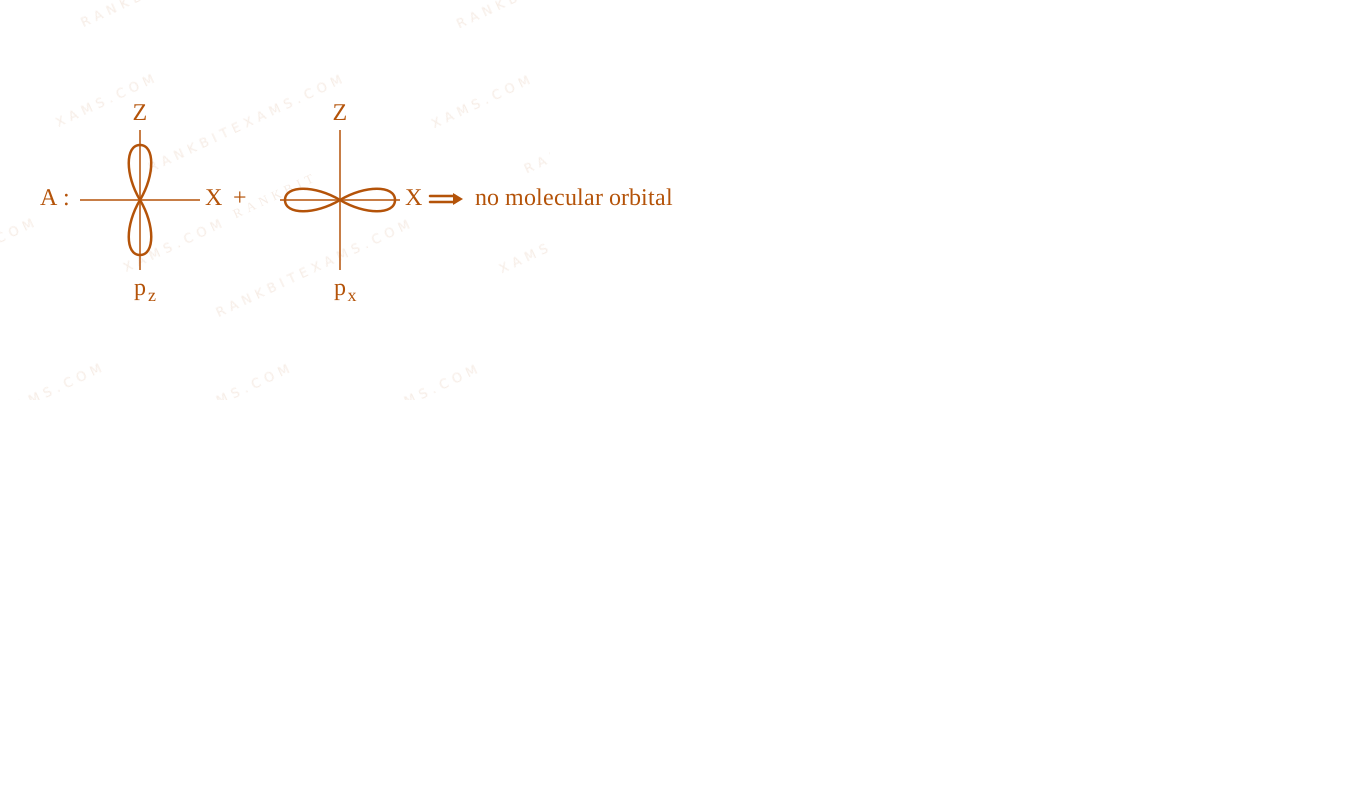
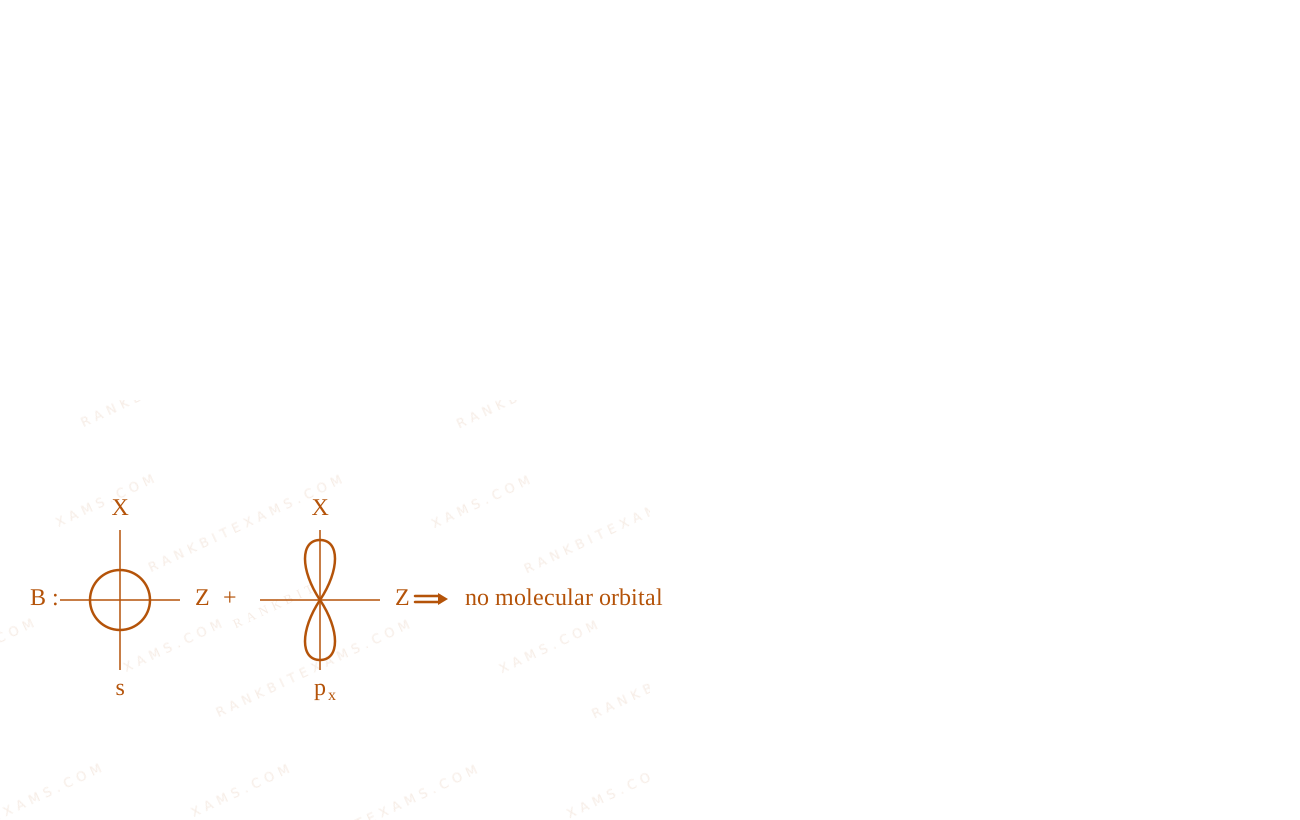
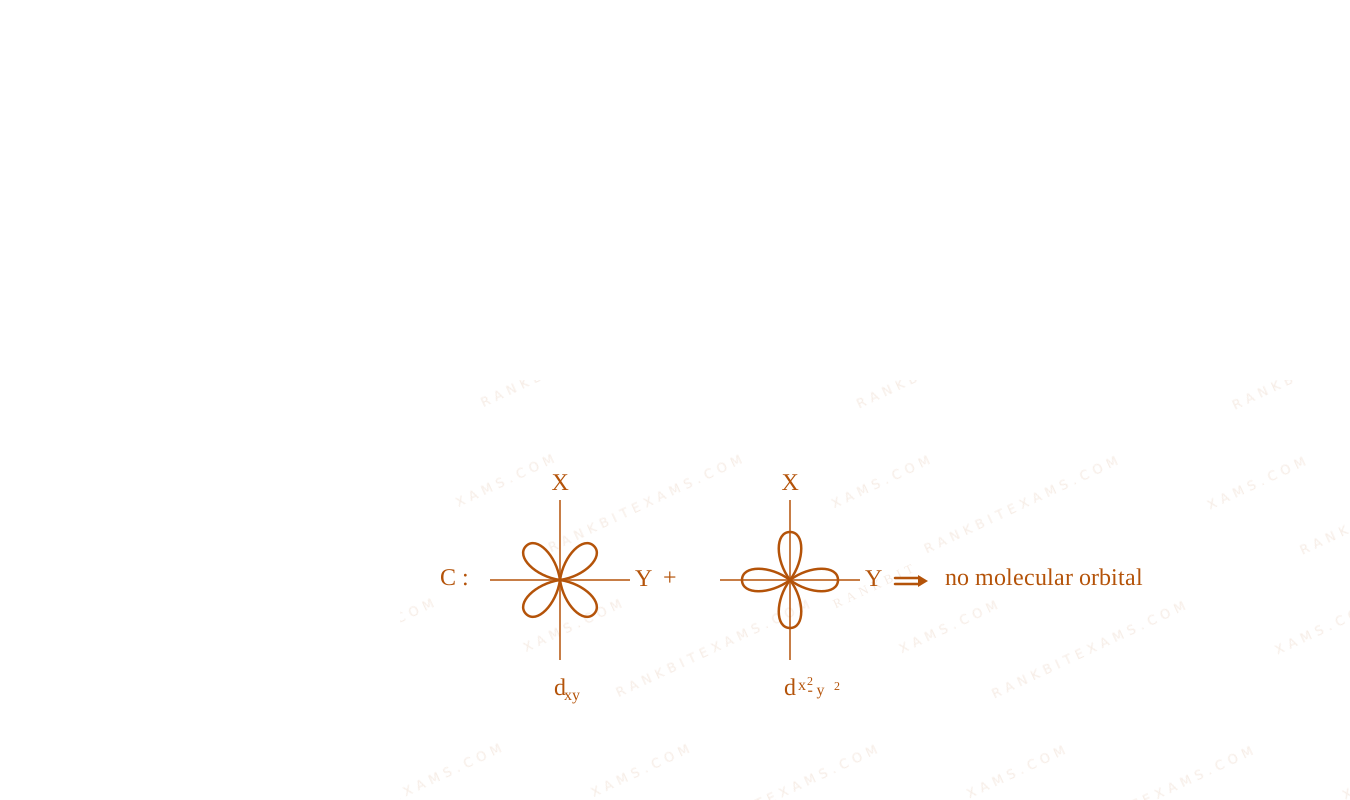
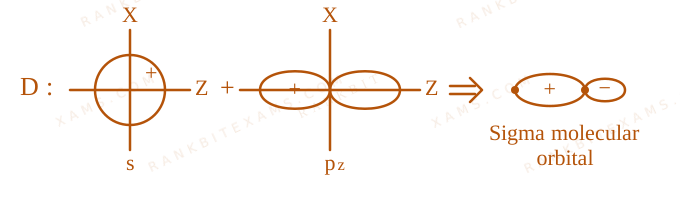
Which of the following linear combination of atomic orbitals will lead to formation of molecular orbitals in homonuclear diatomic molecules [internuclear axis in z-direction]? A. 2p_z and 2p_x B. 2s and 2p_x C. 3d_xy and 3d_x^2-y^2 D. 2s and 2p_z E. 2p_z and 3d_x^2-y^2 Choose the correct answer from the options given below:
  • A. E Only
  • B. A and B Only
  • C. D Only
  • D. C and D Only

Solution

### Core Logic For atomic orbitals to successfully combine into molecular orbitals, they must share appropriate spatial symmetry relative to the internuclear axis (z-axis). - Combination A, B, C, and E involve orbitals with mismatching symmetry planes, resulting in a net zero overlap integral. - Combination D (2s and 2p_z) preserves continuous spatial alignment along the z-axis, allowing effective frontal overlap to synthesize a stable sigma molecular orbital. Visual symmetry breakdowns: -
Molecular Orbital Theory diagram 1 for Q30
(Symmetry mismatch for A) -
Molecular Orbital Theory diagram 1 for Q30
(Symmetry mismatch for C) -
Molecular Orbital Theory diagram 1 for Q30
(Valid overlapping leading to Sigma molecular orbital for D) -
Molecular Orbital Theory diagram 1 for Q30
(Symmetry mismatch for E) ### Pattern Recognition Verify orbital symmetry signs across the designated internuclear reference line. Mismatched symmetries cancel out completely (I_textoverlap = 0). ### Evaluation Rubric / Model Answer null ### Chapter Mix Class 11 Chemistry: Chemical Bonding and Molecular Structure
Q43 jee_main_2025_24_jan_morning Hybridization and Molecular Geometry
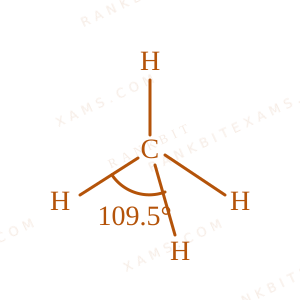
Which of the following statement is true with respect to mathrmH_2mathrmO, mathrmNH_3 and mathrmCH_4 ? A. The central atoms of all the molecules are mathfraksp^3 hybridized. B. The H-O-H, H-N-H and H-C-H angles in the above molecules are 104.5^circ , 107.5^circ and 109.5^circ respectively. C. The increasing order of dipole moment is mathrmCH_4 < mathrmNH_3 < mathrmH_2mathrmO . D. Both mathrmH_2mathrmO and mathrmNH_3 are Lewis acids and mathrmCH_4 is a Lewis base E. A solution of mathrmNH_3 in mathrmH_2mathrmO is basic. In this solution mathrmNH_3 and mathrmH_2mathrmO act as Lowry-Bronsted acid and base respectively. Choose the correct answer from the options given below:
  • A. A, B and C only
  • B. C, D and E only
  • C. A, D and E only
  • D. A, B, C and E only

Solution

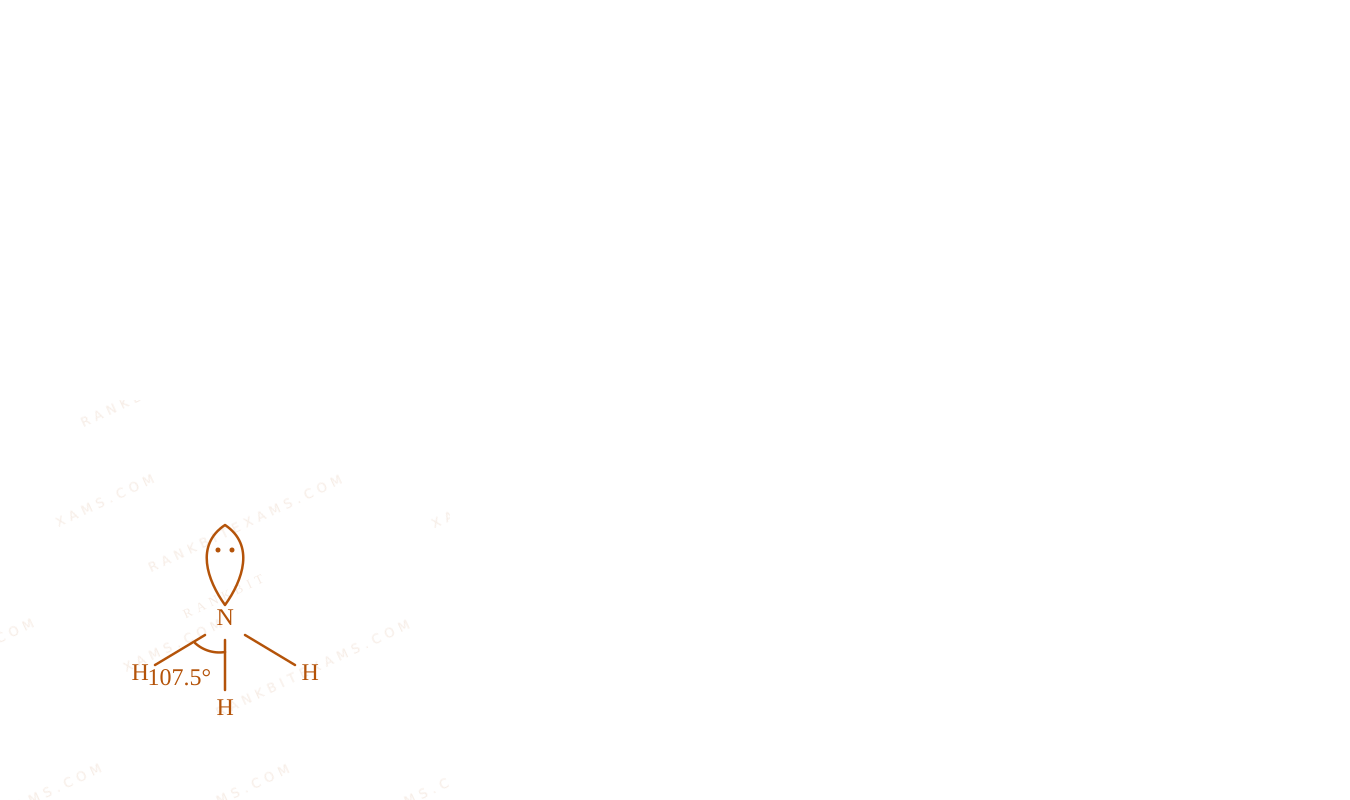
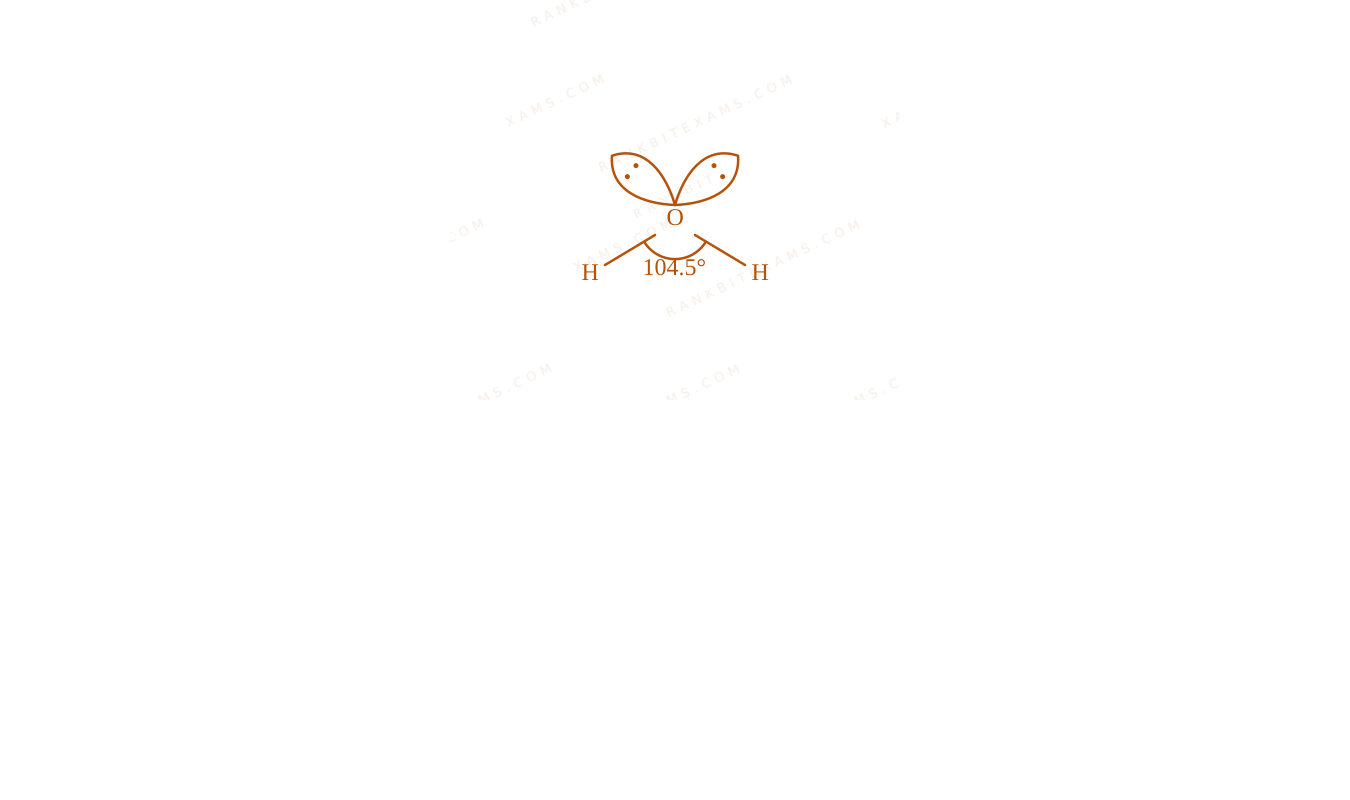
### Core Logic Analyzing each statement individually: - **Statement A is true**: The central atoms (O, N, C) all possess an electron steric number equal to 4, indicating mathfraksp^3 hybridization state pathways. - **Statement B is true**: Due to valence shell electron pair repulsions, the bond angles decrease from the ideal tetrahedral angle (109.5^circ in CH_4,
Water molecule structural bond configuration shape representation
) as lone pairs are added (107.5^circ in NH_3 with 1 lone pair,
Water molecule structural bond configuration shape representation
; 104.5^circ in H_2O with 2 lone pairs,
Water molecule structural bond configuration shape representation
). - **Statement C is true**: The dipole moment increases alongside central atom electronegativity and asymmetric lone pair configurations, following the sequence mathrmCH_4 (0text D) < mathrmNH_3 (1.47text D) < mathrmH_2mathrmO (1.85text D). ### Pattern Recognition Lone pairs repel bonding electron pairs more strongly than bonding pairs repel each other, systematically compressing adjacent bond angles. ### Evaluation Rubric / Model Answer null ### Chapter Mix Class 11 Chemistry: Chemical Bonding and Molecular Structure
Rankbit System
JEE Physics: Waves (+15.5%) | Electrostatics: Concentric Shells (-29.7%) | Modern Physics: Photoelectric Clones (+34.2%) | Mathematics: Definite Integrals (+18.1%) | Chemistry: Coordination Splitting (-11.4%) | JEE Physics: Waves (+15.5%) | Electrostatics: Concentric Shells (-29.7%) | Modern Physics: Photoelectric Clones (+34.2%) | Mathematics: Definite Integrals (+18.1%) | Chemistry: Coordination Splitting (-11.4%)