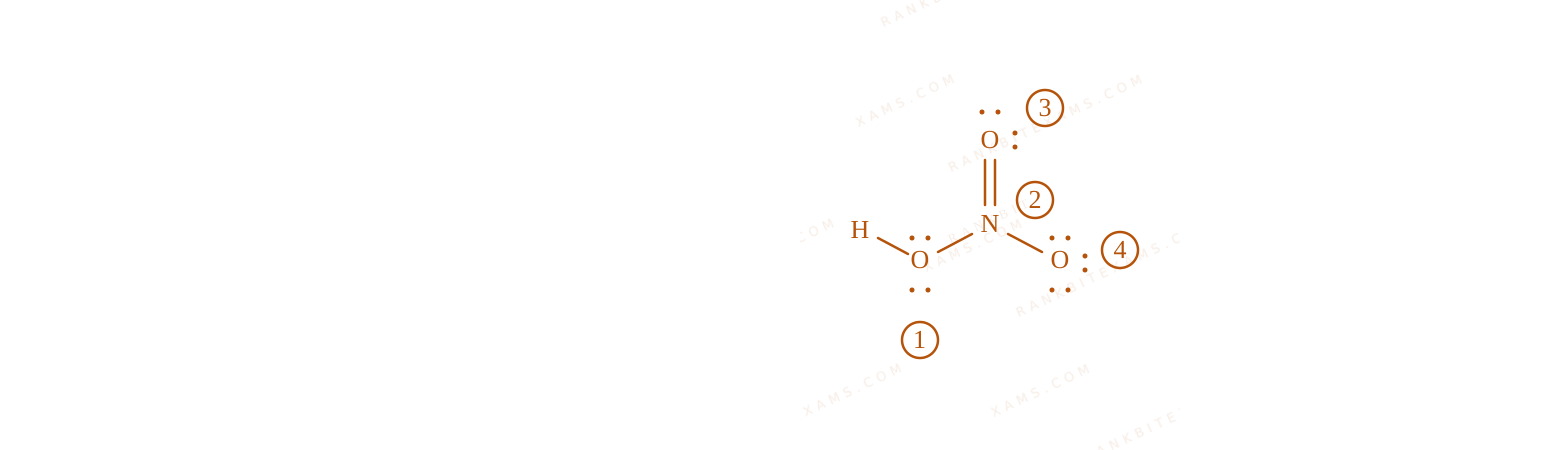
Which among the following molecules is (a) involved in mathrmsp^3d hybridization, (b) has different bond lengths and (c) has lone pair of electrons on the central atom?

Solution & Explanation

### Related Formula textSteric Number = frac12 left( V + M - C + A right) where, V = valence electrons of central atom M = number of monovalent surrounding atoms C = cationic charge, A = anionic charge ### Core Logic Let's calculate the hybridization, shape, and lone pairs for each option: 1. mathrmPF_5:
VSEPR Theory and Hybridization
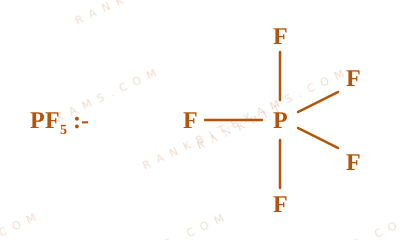
- Central atom: Phosphorus (V=5). - Steric Number = frac12(5 + 5) = 5 implies mathrmsp^3d hybridization. - Lone pairs = 5 - 5 = 0. - Geometry: Trigonal bipyramidal. It has different axial and equatorial bond lengths, but no lone pair on the central atom. 2. mathrmXeF_4: - Central atom: Xenon (V=8). - Steric Number = frac12(8 + 4) = 6 implies mathrmsp^3d^2 hybridization (fails condition a). 3. mathrmSF_4:
VSEPR Theory and Hybridization
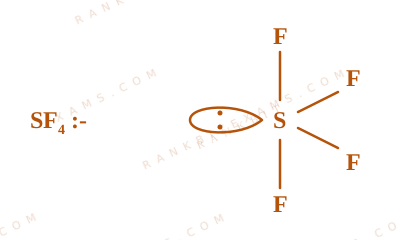
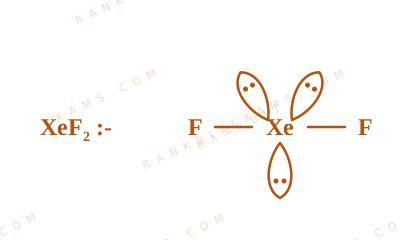
- Central atom: Sulfur (V=6). - Steric Number = frac12(6 + 4) = 5 implies mathrmsp^3d hybridization. - Lone pairs = 5 - 4 = 1 lone pair on sulfur. - Shape: See-saw. It contains axial and equatorial bonds which have distinct lengths (1.64~mathrmmathringA vs 1.54~mathrmmathringA due to lone pair-bond pair repulsion). This satisfies all three conditions. 4. mathrmXeF_2: - Central atom: Xenon (V=8). - Steric Number = frac12(8 + 2) = 5 implies mathrmsp^3d hybridization. - Lone pairs = 5 - 2 = 3 lone pairs on Xe. - Shape: Linear. Both Xe-F bonds are identical in length (fails condition b).
VSEPR Theory and Hybridization
### Step 1: Conclusion Hence, only mathrmSF_4 satisfies all the given parameters. ### Pattern Recognition For any trigonal bipyramidal molecular geometry (steric number 5), the axial bonds suffer more repulsion (from 3 equatorial bonds at 90^circ) than the equatorial bonds (which have only 2 axial neighbors at 90^circ). Consequently, the axial bonds are always longer and weaker than equatorial bonds. ### Evaluation Rubric / Model Answer null ### Chapter Mix Class 11 Chemistry: Chemical Bonding and Molecular Structure

More Chemical Bonding and Molecular Structure Previous-Year Questions

Q64 jee_main_2026_21_jan_morning VSEPR Theory
Given below are two statements: Statement I: The number of species among mathrmSF_4, mathrmNH_4^+, [mathrmNiCl_4]^2-, mathrmXeF_4, [mathrmPtCl_4]^2-, mathrmSeF_4 and [mathrmNi(CN)_4]^2-, that have tetrahedral geometry is 3. Statement II: In the set [NO_2, BeH_2, BF_3, AlCl_3], all the molecules have incomplete octet around central atom. In the light of the above statements, choose the correct answer from the options given below:
  • A. textStatement I is true but Statement II is false
  • B. textBoth Statement I and Statement II are false
  • C. textStatement I is false but Statement II is true
  • D. textBoth Statement I and Statement II are true

Solution

### Core Logic Evaluating Statement I: - mathrmSF_4: sp^3d (1 lone pair) rightarrow See-saw - mathrmXeF_4: sp^3d^2 (2 lone pairs) rightarrow Square planar - [mathrmPtCl_4]^2-: dsp^2 rightarrow Square planar - [mathrmNiCl_4]^2-: sp^3 rightarrow Tetrahedral - [mathrmNi(CN)_4]^2-: dsp^2 rightarrow Square planar - mathrmSeF_4: sp^3d (1 lone pair) rightarrow See-saw - mathrmNH_4^+: sp^3 (0 lone pairs) rightarrow Tetrahedral Total tetrahedral species = 2 ([mathrmNiCl_4]^2- and mathrmNH_4^+). Statement I says 3, so it is false. Evaluating Statement II: - NO_2: Central N has 7 valence electrons (odd-electron molecule, incomplete octet). - BeH_2: Central Be has 4 electrons (incomplete octet). - BF_3: Central B has 6 electrons (incomplete octet). - AlCl_3 (monomer): Central Al has 6 electrons (incomplete octet). Therefore, all molecules have incomplete octets. Statement II is true. ### Step 1: Final Conclusion Statement I is false, Statement II is true. ### Evaluation Rubric / Model Answer null ### Chapter Mix Class 11 Chemistry: Chemical Bonding and Molecular Structure Class 12 Chemistry: Coordination Compounds
Q jee_main_2025_02_april_morning Interhalogen Molecular Geometry
A molecule with the formula mathrmAX_4mathrmY has all its elements from p-block. Element A is rarest, monoatomic, non-radioactive from its group and has the lowest ionization enthalpy value among A, X and Y. Elements X and Y have first and second highest electronegativity values respectively among all the known elements. The shape of the molecule is :
  • A. (1)\ textSquare pyramidal
  • B. (2)\ textOctahedral
  • C. (3)\ textPentagonal planar
  • D. (4)\ textTrigonal bipyramidal

Solution

### Related Formula Total valence shell electron pair system equation: textValence Pairs = textBond Pairs (BP) + textLone Pairs (LP) ### Core Logic Let's decode individual identities based on the descriptive properties: * The elements with the first and second highest electronegativity values across the entire periodic table are Fluorine (mathrmF) and Oxygen (mathrmO), matching labels mathrmX and mathrmY. * Element mathrmA is a rare, monoatomic, non-radioactive p-block element with low ionization energy, identifying it as Xenon (mathrmXe). * Substituting these components into the target layout formula yields mathrmXeOF_4: - Xenon brings 8 valence electrons. It forms 4 single bonds with F and 1 double bond with O, consuming 6 electrons and leaving 1 lone pair on the central atom. - Steric Number = 5 text bond regions + 1 text lone pair = 6 (Octahedral electronic arrangement). ### Step 1: Geometry Determination Placing the double-bonded oxygen and lone pair along vertical spatial axes yields a stable square pyramidal molecular shape layout:
XeOF4 square pyramidal spatial geometry diagram for Q45
### Pattern Recognition In mathrmsp^3d^2 architectures containing an explicit lone pair along with an asymmetric double bond (like mathrmXeOF_4), the lone pair always sits directly opposite the double bond to minimize electron repulsion, leaving a clean square pyramidal shape. ### Evaluation Rubric / Model Answer null ### Chapter Mix Class 11 Chemistry: Chemical Bonding and Molecular Structure Class 12 Chemistry: The p-Block Elements
Q35 jee_main_2025_02_april_morning VSEPR and Dipole Moments
Among mathrmSO_2, mathrmNF_3, mathrmNH_3, mathrmXeF_2, mathrmClF_3 and mathrmSF_4, the hybridization of the molecule with non-zero dipole moment and highest number of lone-pairs of electrons on the central atom is
  • A. (1)\ mathrmsp^3
  • B. (2)\ mathrmdsp^2
  • C. (3)\ mathrmsp^3mathrmd^2
  • D. (4)\ mathrmsp^3mathrmd

Solution

### Related Formula Steric Number system equation for identifying electronic configurations: textSteric Number (SN) = frac12[mathrmV + mathrmM - mathrmC + mathrmA] ### Core Logic Let's list parameters using a detailed structural grid:
MoleculeHybridisationDipole MomentLone pair on the central atom
mathrmSO_2mathrmsp^2Non-zero1
mathrmNF_3mathrmsp^3Non-zero1
mathrmNH_3mathrmsp^3Non-zero1
mathrmXeF_2mathrmsp^3mathrmdZero3
mathrmClF_3mathrmsp^3mathrmdNon-zero2
mathrmSF_4mathrmsp^3mathrmdNon-zero1
Comparing items: mathrmXeF_2 has 3 lone pairs but its linear architecture enforces mu = 0. Therefore, mathrmClF_3 has the highest count of lone pairs (2) with a net non-zero asymmetric dipole configuration. ### Step 1: Selection The hybridization of mathrmClF_3 is mathrmsp^3mathrmd. ### Pattern Recognition Watch out for symmetry traps! mathrmXeF_2 contains the absolute maximum lone pairs, but its symmetric planar positioning perfectly cancels out the dipole vectors. Thus, the correct candidate slips down to mathrmClF_3. ### Evaluation Rubric / Model Answer null ### Chapter Mix Class 11 Chemistry: Chemical Bonding and Molecular Structure
Q jee_main_2025_07_april_morning VSEPR Theory
Match the LIST-I with LIST-II.
LIST-I (Molecule/ion)LIST-II (Bond pair : lone pair on the central atom)
(A) mathrmICl_2^-(I) 4 : 2
(B) mathrmH_2mathrmO(II) 4 : 1
(C) mathrmSO_2(III) 2 : 3
(D) mathrmXeF_4(IV) 2 : 2
Choose the correct answer from the options given below:
  • A. (A)-(IV), (B)-(III), (C)-(II), (D)-(I)
  • B. (A)-(III), (B)-(IV), (C)-(II), (D)-(I)
  • C. (A)-(III), (B)-(IV), (C)-(I), (D)-(II)
  • D. (A)-(II), (B)-(I), (C)-(IV), (D)-(III)

Solution

### Core Logic Let's find the number of bond pairs (sigma-bonds or regions) and lone pairs on the central atom of each species: 1. **mathrmICl_2^-**: - Central atom Iodine has 7 valence electrons + 1 negative charge = 8 electrons. - Forms 2 single bonds (bond pairs = 2). - Remaining 6 electrons form 3 lone pairs. - Ratio is 2 : 3 (Matches LIST-II, III).
VSEPR linear shape of ICl2-
2. **mathrmH_2mathrmO**: - Oxygen has 6 valence electrons. - Forms 2 bond pairs with Hydrogens. - Remaining 4 electrons form 2 lone pairs. - Ratio is 2 : 2 (Matches LIST-II, IV).
VSEPR linear shape of ICl2-
3. **mathrmSO_2**: - Sulfur has 6 valence electrons. - Forms 2 double bonds (which are counted as 4 bonding pairs of electrons/bond pairs in typical VSEPR representations here). - Remaining 2 electrons form 1 lone pair. - Ratio is 4 : 1 (Matches LIST-II, II).
VSEPR linear shape of ICl2-
4. **mathrmXeF_4**: - Xenon has 8 valence electrons. - Forms 4 bond pairs with Fluorines. - Remaining 4 electrons form 2 lone pairs. - Ratio is 4 : 2 (Matches LIST-II, I).
VSEPR linear shape of ICl2-
Thus, the correct mapping is: A-III, B-IV, C-II, D-I. ### Pattern Recognition For match-the-column with VSEPR structures: - Always find steric number: textSteric Number = frac12(V + M - C + A). - Water is 2 bond pairs, 2 lone pairs (sp^3) rightarrow B-IV. This alone helps eliminate multiple incorrect options immediately. ### Evaluation Rubric / Model Answer null ### Chapter Mix Class 11 Chemistry: Chemical Bonding and Molecular Structure
Rankbit System
JEE Physics: Waves (+15.5%) | Electrostatics: Concentric Shells (-29.7%) | Modern Physics: Photoelectric Clones (+34.2%) | Mathematics: Definite Integrals (+18.1%) | Chemistry: Coordination Splitting (-11.4%) | JEE Physics: Waves (+15.5%) | Electrostatics: Concentric Shells (-29.7%) | Modern Physics: Photoelectric Clones (+34.2%) | Mathematics: Definite Integrals (+18.1%) | Chemistry: Coordination Splitting (-11.4%)