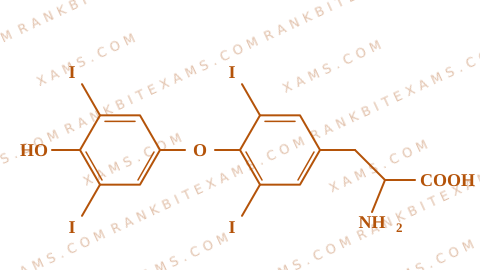
A tetrapeptide "x" on complete hydrolysis produced glycine (Gly), alanine (Ala), valine (Val), leucine (Leu) in equimolar proportion each. The number of tetrapeptides (sequences) possible involving each of these amino acids is
A.16
B.32
C.8
D.24
Solution & Explanation
### Related Formula
textNumber of unique sequences = n!$$\text{Number of unique sequences} = n!$$
### Core Logic
A **tetrapeptide** is formed by connecting four amino acids through three peptide linkages.
Since the problem specifies that complete hydrolysis of the tetrapeptide produces Gly, Ala, Val, and Leu in *equimolar proportions*, the peptide must contain exactly one molecule of each of these four distinct amino acids.
### Step 1: Calculate the Permutations
The number of unique peptide sequences corresponds to the number of ways we can arrange these 4 distinct amino acids:
textNumber of permutations = 4! = 4 times 3 times 2 times 1 = 24$$\text{Number of permutations} = 4! = 4 \times 3 \times 2 \times 1 = 24$$
### Pattern Recognition
Combinatorics in Chemistry: If we have n$n$ unique, non-repeating amino acids, the number of linear isomeric peptides is n!$n!$. If repetition were permitted, the number of possible peptides would be n^n$n^n$ (which would be 4^4 = 256$4^4 = 256$ in this case).
### Evaluation Rubric / Model Answer
null
### Chapter Mix
Class 12 Chemistry: Biomolecules
Keywords:#tetrapeptide permutations gly ala val leu#JEE Main 2025 Evening Q44#amino acid sequences isomers#biomolecules protein structures
More Biomolecules Previous-Year Questions — Page 2
Qjee_main_2025_07_april_morningHormones Structure
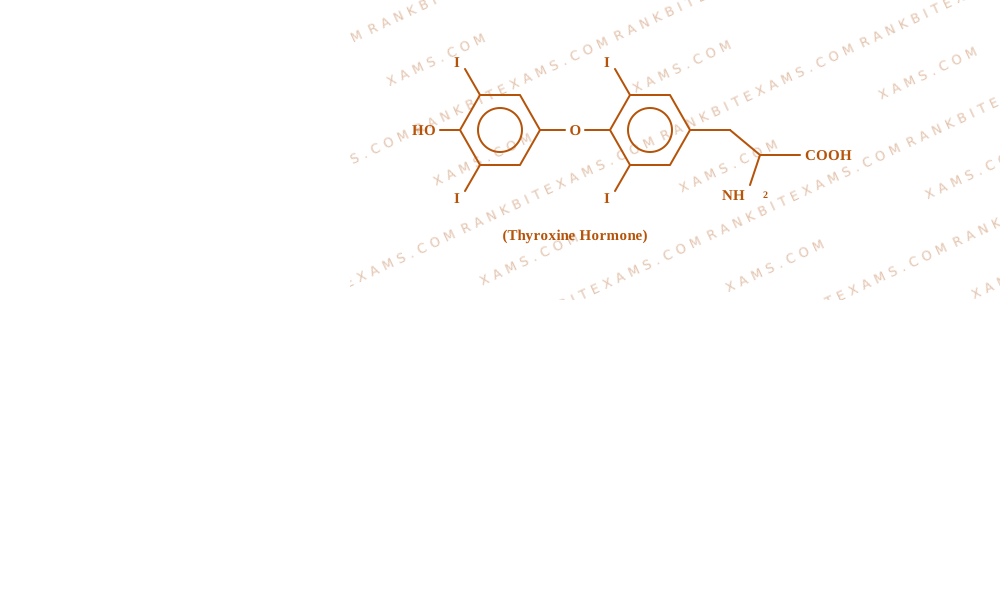
Thyroxine, the hormone has the structure given below:
The structural formula of Thyroxine shows four iodine atoms attached to the aromatic benzene rings.
The percentage of iodine in thyroxine is ______ %. (nearest integer)
(Given molar mass in mathrmg\ mol^-1$\mathrm{g\ mol}^{-1}$ of mathrmC: 12$\mathrm{C}: 12$, mathrmH: 1$\mathrm{H}: 1$, mathrmO: 16$\mathrm{O}: 16$, mathrmN: 14$\mathrm{N}: 14$, mathrmI: 127$\mathrm{I}: 127$)
Numerical Answer.Answer: 65 to 65
Solution
### Related Formula
\% mathrmI = frac4 times M_mathrmIM_textThyroxine times 100$$\% \mathrm{I} = \frac{4 \times M_{\mathrm{I}}}{M_{\text{Thyroxine}}} \times 100$$
### Core Logic
Let's first determine the molecular formula of Thyroxine from its structure shown in below :
The structural formula of Thyroxine shows four iodine atoms attached to the aromatic benzene rings.
- Formula: mathrmC_15mathrmH_11mathrmO_4mathrmNmathrmI_4$\mathrm{C}_{15}\mathrm{H}_{11}\mathrm{O}_4\mathrm{N}\mathrm{I}_4$
Now, compute the molecular mass:
- Carbon: 15 times 12 = 180$15 \times 12 = 180$
- Hydrogen: 11 times 1 = 11$11 \times 1 = 11$
- Oxygen: 4 times 16 = 64$4 \times 16 = 64$
- Nitrogen: 1 times 14 = 14$1 \times 14 = 14$
- Iodine: 4 times 127 = 508$4 \times 127 = 508$textTotal Molecular Mass = 180 + 11 + 64 + 14 + 508 = 777 text g mol^-1$$\text{Total Molecular Mass} = 180 + 11 + 64 + 14 + 508 = 777 \text{ g mol}^{-1}$$
Now, calculate the percentage of Iodine:
\% mathrmI = frac508777 times 100 approx 65.38 \% approx 65 \%$$\% \mathrm{I} = \frac{508}{777} \times 100 \approx 65.38 \% \approx 65 \%$$
Hence, the percentage of iodine in thyroxine is 65$65$.
### Pattern Recognition
Thyroxine molecular mass (777$777$) is composed mostly of Iodine (508$508$), making up approximately 508/777 approx 65\%$508/777 \approx 65\%$ of its entire mass. Always carefully account for the four phenyl-bound iodines.
### Evaluation Rubric / Model Answer
Accurate molecular weight summation leading to 65\%$65\%$ nearest integer Iodine composition.
### Chapter Mix
Class 12 Chemistry: Biomolecules
Class 12 Chemistry: Organic Chemistry - Oxygen containing compounds
Q43jee_main_2025_07_april_morningHydrolysis of Sucrose
Given below are two statements:
Statement I: textD-(+)-glucose + textD-(+)-fructose xrightarrow-mathrmH_2mathrmO textsucrose qquad textsucrose xrightarrowtextHydrolysis textD-(+)-glucose + textD-(+)-fructose$\text{D-(+)-glucose} + \text{D-(+)-fructose} \xrightarrow{-\mathrm{H}_2\mathrm{O}} \text{sucrose} \qquad \text{sucrose} \xrightarrow{\text{Hydrolysis}} \text{D-(+)-glucose} + \text{D-(+)-fructose}$
Statement II: Invert sugar is formed during sucrose hydrolysis.
In the light of given statements, choose the correct answer from the options given below:
A.textBoth Statement I and Statement II are true.$\text{Both Statement I and Statement II are true.}$
B.textStatement I is false but Statement II is true.$\text{Statement I is false but Statement II is true.}$
C.textStatement I is true but Statement II is false.$\text{Statement I is true but Statement II is false.}$
D.textBoth Statement I and Statement II are false.$\text{Both Statement I and Statement II are false.}$
Solution
### Core Logic
Statement I: Sucrose is formed by condensation of textD-(+)-glucose$\text{D-(+)-glucose}$ and textD-(-)-fructose$\text{D-(-)-fructose}$ (levorotatory fructose, not dextrorotatory as claimed). Hydrolysis of sucrose yields textD-(+)-glucose$\text{D-(+)-glucose}$ and textD-(-)-fructose$\text{D-(-)-fructose}$. Thus, Statement I is false.
Statement II: Hydrolysis of dextrorotatory sucrose (+66.5^circ$+66.5^{\circ}$) yields a mixture of dextrorotatory glucose (+52.5^circ$+52.5^{\circ}$) and highly levorotatory fructose (-92.4^circ$-92.4^{\circ}$). Because the overall specific rotation of the mixture becomes levorotatory (-39.9^circ$-39.9^{\circ}$), the hydrolyzed mixture is called **invert sugar**. Thus, Statement II is true.
### Pattern Recognition
Natural fructose is always levorotatory, textD-(-)-fructose$\text{D-(-)-fructose}$. Dextrorotatory fructose mentioned in Statement I is an immediate giveaway that the statement is false.
### Evaluation Rubric / Model Answer
null
### Chapter Mix
Class 12 Chemistry: Biomolecules
Qjee_main_2025_08_april_eveningAmino Acids
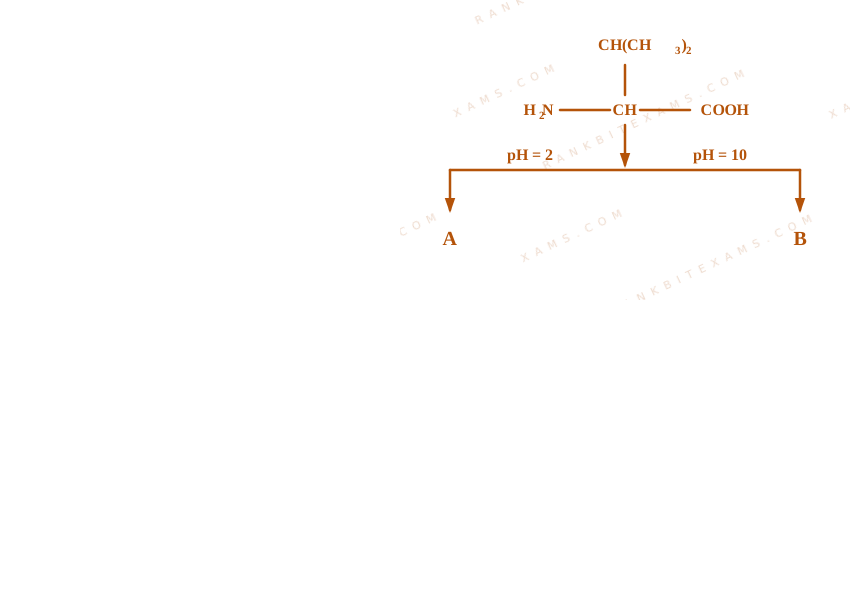
The chemical structure of the amino acid Valine is monitored across different environments:
Choose the correct option depicting the structures of products A and B under pH = 2 and pH = 10 conditions respectively.
The flowchart maps the structural modifications of Valine when treated at strongly acidic (pH = 2) versus basic (pH = 10) conditions.The flowchart maps the structural modifications of Valine when treated at strongly acidic (pH = 2) versus basic (pH = 10) conditions.
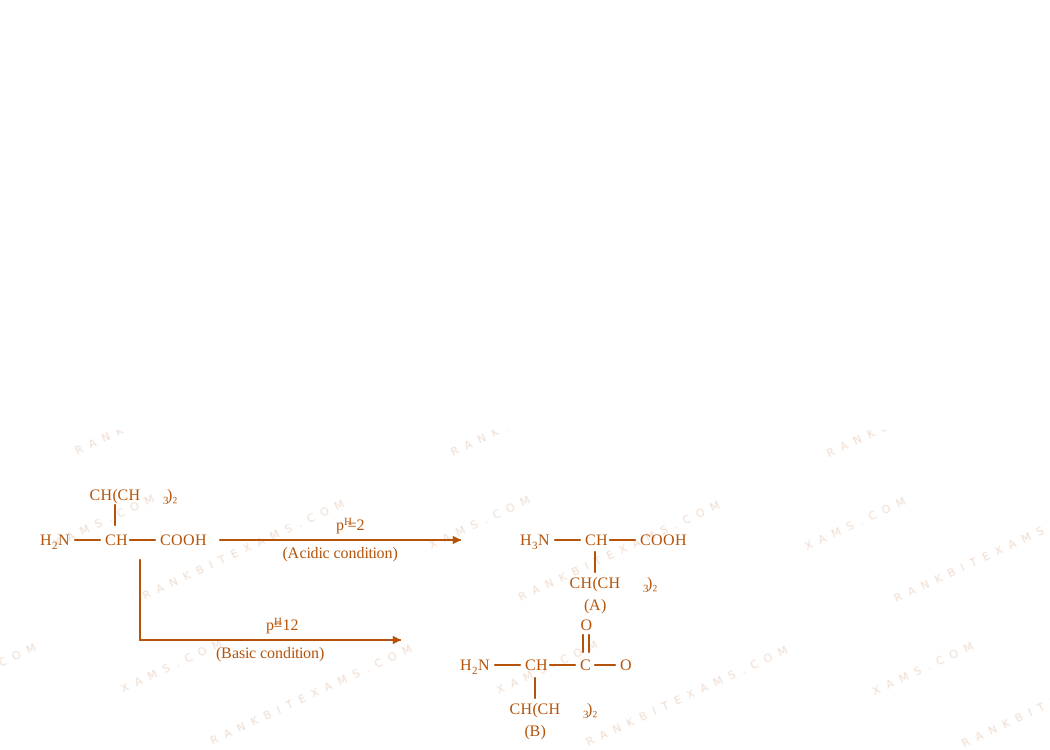
A.
B.
C.
D.
Solution
### Core Logic
Amino acids exhibit amphoteric behavior due to the simultaneously present basic amino (-textNH_2$-\text{NH}_2$) and acidic carboxyl (-textCOOH$-\text{COOH}$) functional groups:
1. **At pH = 2 (Highly Acidic Medium)**:
The abundant concentration of hydronium ions (H^+$H^+$) protonates the carboxylate ion back into its non-ionized acid state (-textCOO^- rightarrow -textCOOH$-\text{COO}^- \rightarrow -\text{COOH}$), while the amine group remains securely protonated as an ammonium ion (-textNH_3^+$-\text{NH}_3^+$). Hence, product **A** exists purely as a **cation**.
2. **At pH = 10 (Highly Basic Medium)**:
The high concentration of hydroxide ions (OH^-$OH^-$) abstracts protons from the system, deprotonating the carboxyl group into a carboxylate anion (-textCOO^-$-\text{COO}^-$) and neutralizing the ammonium group back into a free amine fraction (-textNH_2$-\text{NH}_2$). Hence, product **B** exists purely as an **anion**. The flowchart maps the structural modifications of Valine when treated at strongly acidic (pH = 2) versus basic (pH = 10) conditions.
### Pattern Recognition
Acidic environments (low pH) force positive overall charges onto amino structures (cation form). Basic environments (high pH) drive a net negative structure (anion form). This simple rule makes picking Option (1) immediate.
### Evaluation Rubric / Model Answer
null
### Chapter Mix
Class 12 Chemistry: Biomolecules
Q29jee_main_2025_29_jan_eveningAmino Acids and Proteins
Identify the essential amino acids from below:
(A) Valine
(B) Proline
(C) Lysine
(D) Threonine
(E) Tyrosine
Choose the correct answer from the options given below:
A. (A), (C) and (D) only
B. (A), (C) and (E) only
C. (B), (C) and (E) only
D. (C), (D) and (E) only
Solution
### Core Logic
Essential amino acids cannot be synthesized by the body and must be obtained from diet. From the given choices:
* Valine (Essential)
* Proline (Non-essential)
* Lysine (Essential)
* Threonine (Essential)
* Tyrosine (Non-essential)
Hence, (A), (C), and (D) are the essential amino acids.
### Pattern Recognition
Mnemonic for essential amino acids: TV TILL PM MALL (Threonine, Valine, Tryptophan, Isoleucine, Leucine, Lysine, Phenylalanine, Methionine, Arginine, Histidine).
### Evaluation Rubric / Model Answer
null
### Chapter Mix
Class 12 Chemistry: Biomolecules
Q45jee_main_2025_28_jan_morningReactions of Glucose and Starch
Given below are two statements :
Statement I : D-glucose pentaacetate reacts with 2, 4-dinitrophenylhydrazine.
Statement II : Starch, on heating with concentrated sulfuric acid at 100^circmathrmC$100^{\circ}\mathrm{C}$ and 2-3 atmosphere pressure produces glucose.
In the light of the above statements, choose the correct answer from the options given below
A.textBoth Statement I and Statement II are false$\text{Both Statement I and Statement II are false}$
B.textStatement I is false but Statement II is true.$\text{Statement I is false but Statement II is true.}$
C.textStatement I is true but Statement II is false.$\text{Statement I is true but Statement II is false.}$
D.textBoth Statement I and Statement II are true.$\text{Both Statement I and Statement II are true.}$
Solution
### Core Logic
Statement I is false because glucose pentaacetate fixes the cyclic hemiacetal system structure securely into an unreactive ester configuration. As a result, it cannot revert to an open-chain form containing a free aldehyde group, meaning it does not react with carbonyl reagents like 2,4-DNP.
Statement II is true because starch, a polysaccharide composed of glucose monomer blocks, undergoes acid-catalyzed hydrolysis to yield glucose when heated under pressure.
### Pattern Recognition
Sees: Pentacetate reactivity vs polysaccharide hydrolysis.
Shortcut: Acetylation locks the cyclic structure of glucose, preventing reactions that require an open-chain carbonyl group (like 2,4-DNP).
### Evaluation Rubric / Model Answer
null
### Chapter Mix
Class 12 Chemistry: Biomolecules
More Biomolecules Questions — jee_main_2025_02_april_evening
We Map Every Repeating Question in Competitive Exams.
Say goodbye to generic mock test fatigue. RankBit uses smart analysis to group past exam questions into their foundational Repeating Question Types. Find chapter weightage, track repeating questions, and score higher with targeted practice.
Select Your Target Exam
Choose an exam track below to find formulas per chapter and patterns.
Syncing Exam Intelligence
Mapping formulas and patterns across all tracks…
PATH A — FULL LENGTH PRACTICE
Full Mock Test Hub
Simulate real NTA exam conditions with fully tracked mocks. Time yourself against past papers.
Practice past-year questions one chapter at a time. Pick an exam → subject → chapter and get every PYQ for that topic — pulled together from all past papers — with the chapter's key formulas alongside.