Consider the following reactions. From these reactions which reaction will give carboxylic acid as a major product?
(A) mathrmR - C equiv N xrightarrow[textmild condition]mathrm(i) H^+ / H_2O$\mathrm{R - C \equiv N} \xrightarrow[\text{mild condition}]{\mathrm{(i) H^+ / H_2O}}$
(B) mathrmR - MgX xrightarrow[mathrm(ii) H_3O^+]mathrm(i) CO_2$\mathrm{R - MgX} \xrightarrow[\mathrm{(ii) H_3O^+}]{{\mathrm{(i) CO_2}}}$
(C) mathrmR - C equiv N xrightarrow[mathrm(ii) H_3O^+]mathrm(i) SnCl_2 / HCl$\mathrm{R - C \equiv N} \xrightarrow[\mathrm{(ii) H_3O^+}]{{\mathrm{(i) SnCl_2 / HCl}}}$
(D) mathrmR cdot CH_2 cdot OH xrightarrowmathrmPCC$\mathrm{R \cdot CH_2 \cdot OH} \xrightarrow{\mathrm{PCC}}$
(E)Preparation of Carboxylic Acids
Choose the correct answer from the options given below:
A.textA and D only$\text{A and D only}$
B.textA, B and E only$\text{A, B and E only}$
C.textB, C and E only$\text{B, C and E only}$
D.textB and E only$\text{B and E only}$
Solution & Explanation
### Related Formula
mathrmR-MgX + CO_2 rightarrow R-COOMgX xrightarrowH_3O^+ R-COOH$$\mathrm{R-MgX + CO_2 \rightarrow R-COOMgX \xrightarrow{H_3O^+} R-COOH}$$
### Core Logic
Let's analyze each reaction path to determine the major organic product:
- **Reaction (A)**: Acidic hydrolysis of a nitrile under *mild conditions* yields an amide:
mathrmR-Cequiv N rightarrow R-CONH_2$$\mathrm{R-C\equiv N \rightarrow R-CONH_2}$$
(Full conversion to carboxylic acid requires strong conditions and extended heating).
- **Reaction (B)**: Carbonation of Grignard reagent using solid carbon dioxide (dry ice) followed by acid hydrolysis yields a carboxylic acid:
mathrmR-MgX + CO_2 rightarrow R-COOMgX xrightarrowH_3O^+ R-COOH$$\mathrm{R-MgX + CO_2 \rightarrow R-COOMgX \xrightarrow{H_3O^+} R-COOH}$$
- **Reaction (C)**: Stephen reduction converts nitrile to aldehyde:
mathrmR-Cequiv N xrightarrowSnCl_2/HCl R-CH=NH xrightarrowH_3O^+ R-CHO$$\mathrm{R-C\equiv N \xrightarrow{SnCl_2/HCl} R-CH=NH \xrightarrow{H_3O^+} R-CHO}$$
- **Reaction (D)**: Pyridinium chlorochromate (PCC) is a mild oxidising agent that converts primary alcohols selectively to aldehydes:
mathrmR-CH_2-OH xrightarrowPCC R-CHO$$\mathrm{R-CH_2-OH \xrightarrow{PCC} R-CHO}$$
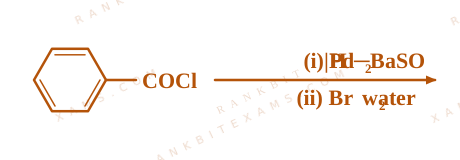
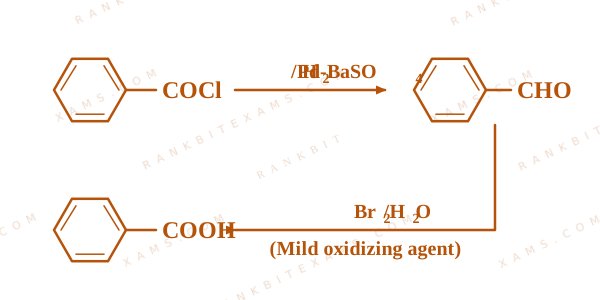
- **Reaction (E)**
Preparation of Carboxylic Acids : Rosenmund reduction reduces acid chloride to aldehyde first:
rightarrow$\rightarrow$ R-CHO
Subsequent oxidation with bromine water (which is a mild oxidising agent that selective oxidizes aldehydes but does not affect ketones) converts the aldehyde to carboxylic acid:
mathrmR-CHO xrightarrowBr_2/water R-COOH$$\mathrm{R-CHO \xrightarrow{Br_2/water} R-COOH}$$
### Step 1: Final Tally
Thus, reactions (B) and (E) successfully yield carboxylic acid as the major organic product.
### Pattern Recognition
Remember: Bromine water (mathrmBr_2/H_2O$\mathrm{Br_2/H_2O}$) is a mild, selective oxidising agent commonly used to oxidise aldoses and other aldehydes to monocarboxylic acids without degrading carbon-carbon chains.
### Evaluation Rubric / Model Answer
null
### Chapter Mix
Class 12 Chemistry: Aldehydes, Ketones and Carboxylic Acids
More Aldehydes, Ketones and Carboxylic Acids Previous-Year Questions — Page 7
### Related Formula
CH_3-CHO + H_2N-NH-CO-NH_2 rightarrow CH_3-CH=N-NH-CO-NH_2 + H_2O$$CH_3-CHO + H_2N-NH-CO-NH_2 \rightarrow CH_3-CH=N-NH-CO-NH_2 + H_2O$$
### Core Logic
Ethanal (CH_3CHO$CH_3CHO$) reacts with semicarbazide (H_2N-NH-CO-NH_2$H_2N-NH-CO-NH_2$) via nucleophilic addition followed by elimination of water to form a semicarbazone.
### Step 1: Product Analysis
The product is Ethanal semicarbazone: CH_3-CH=N-NH-CO-NH_2$CH_3-CH=N-NH-CO-NH_2$.
Counting the nitrogen atoms in this structure:
1. The imine nitrogen (=N-$=N-$)
2. The amine nitrogen (-NH-$-NH-$)
3. The amide nitrogen (-NH_2$-NH_2$)
Total = 3 Nitrogen atoms.
### Evaluation Rubric / Model Answer
null
### Chapter Mix
Class 12 Chemistry: Aldehydes, Ketones and Carboxylic Acids
Q73jee_main_2024_31_jan_eveningPreparation of Aldehydes and Ketones
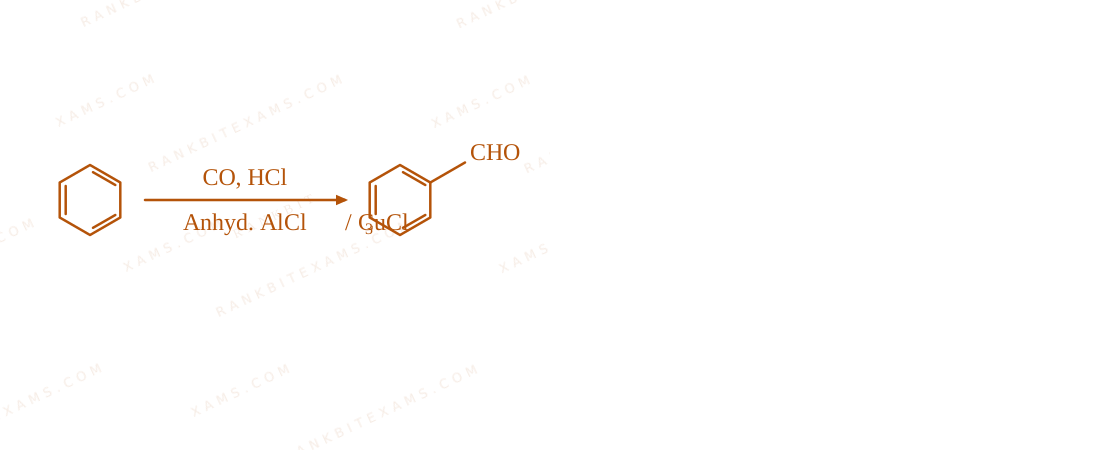
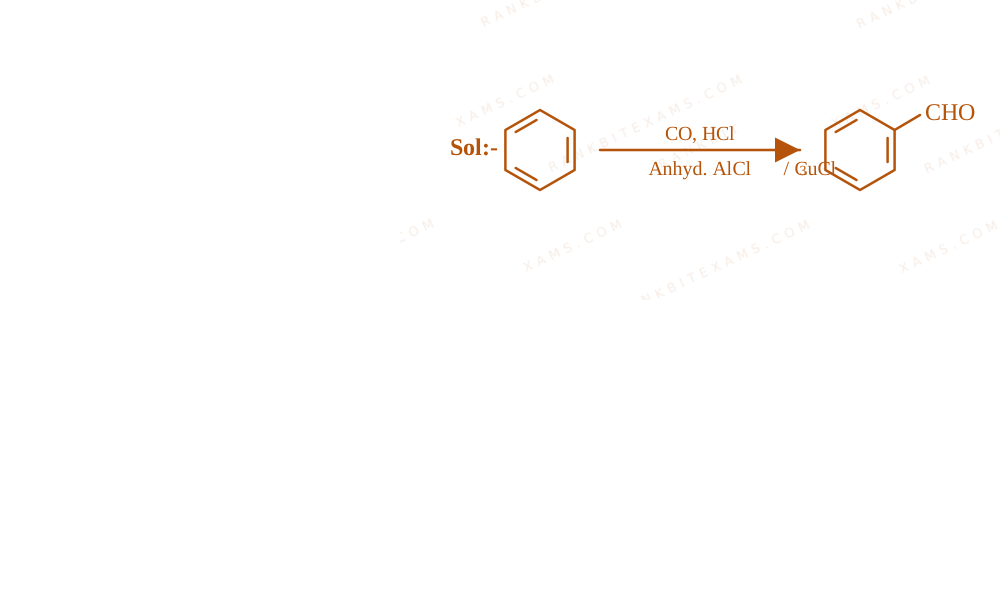
Identify the name reaction.
The image shows the conversion of benzene to benzaldehyde using CO, HCl, and Anhydrous AlCl3/CuCl.
A.text(1) Stephen reaction$\text{(1) Stephen reaction}$
### Core Logic
The reaction of benzene with carbon monoxide (CO$CO$) and hydrogen chloride (HCl$HCl$) in the presence of anhydrous aluminium chloride (AlCl_3$AlCl_3$) and cuprous chloride (CuCl$CuCl$) to give benzaldehyde is known as the Gatterman-Koch reaction.
The image shows the conversion of benzene to benzaldehyde using CO, HCl, and Anhydrous AlCl3/CuCl.
### Pattern Recognition
CO + HCl rightarrow$CO + HCl \rightarrow$ Formyl chloride intermediate (in situ) with Lewis acid rightarrow$\rightarrow$ formylation of benzene. This is definitively the Gatterman-Koch formylation.
### Evaluation Rubric / Model Answer
null
### Chapter Mix
Class 12 Chemistry: Aldehydes, Ketones and Carboxylic Acids
Q84jee_main_2024_31_jan_morningReactions with Grignard Reagent
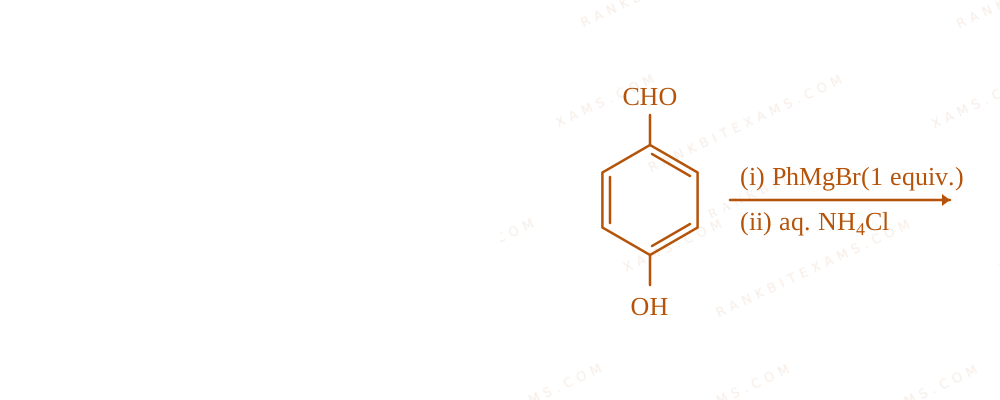
The product of the following reaction is P.
The image shows p-hydroxybenzaldehyde reacting with one equivalent of PhMgBr followed by aqueous ammonium chloride.
The number of hydroxyl groups present in the product P is
Numerical Answer.Answer: 0 to 0
Solution
### Core Logic
The given reactant is p-hydroxybenzaldehyde, which contains both a phenolic -OH$-OH$ group (acidic) and an aldehyde group (electrophilic).
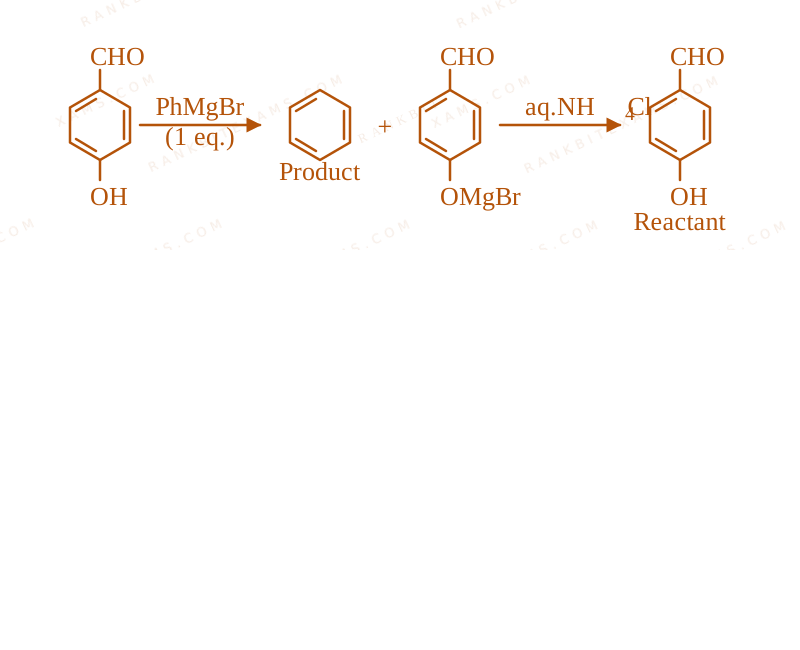
When one equivalent of Grignard reagent (PhMgBr$PhMgBr$) is added, it behaves primarily as a strong base due to the presence of an acidic proton. Acid-base reactions are extremely fast compared to nucleophilic additions.
The acidic phenolic -OH$-OH$ reacts with PhMgBr$PhMgBr$:
PhMgBr + HO-C_6H_4-CHO rightarrow Ph-H (Benzene) + BrMg-O-C_6H_4-CHO$$PhMgBr + HO-C_6H_4-CHO \rightarrow Ph-H (Benzene) + BrMg-O-C_6H_4-CHO$$
Upon workup with aq. NH_4Cl$aq. NH_4Cl$, the phenoxide ion simply regenerates the starting p-hydroxybenzaldehyde. However, the question asks for the number of hydroxyl groups present in the formed product (Benzene).
The image shows p-hydroxybenzaldehyde reacting with one equivalent of PhMgBr followed by aqueous ammonium chloride.
The distinct product formed in the reaction is Benzene. Benzene has 0 hydroxyl groups.
### Pattern Recognition
Whenever a Grignard reagent encounters a molecule with an acidic hydrogen (alcohol, phenol, amine, alkyne), it will invariably act as a base first. If only 1 equivalent is used, nucleophilic addition to carbonyls will NOT happen.
### Evaluation Rubric / Model Answer
null
### Chapter Mix
Class 12 Chemistry: Aldehydes, Ketones and Carboxylic Acids
Class 12 Chemistry: Alcohols, Phenols and Ethers
We Map Every Repeating Question in Competitive Exams.
Say goodbye to generic mock test fatigue. RankBit uses smart analysis to group past exam questions into their foundational Repeating Question Types. Find chapter weightage, track repeating questions, and score higher with targeted practice.
Select Your Target Exam
Choose an exam track below to find formulas per chapter and patterns.
Syncing Exam Intelligence
Mapping formulas and patterns across all tracks…
PATH A — FULL LENGTH PRACTICE
Full Mock Test Hub
Simulate real NTA exam conditions with fully tracked mocks. Time yourself against past papers.
Practice past-year questions one chapter at a time. Pick an exam → subject → chapter and get every PYQ for that topic — pulled together from all past papers — with the chapter's key formulas alongside.