Consider the following reactions. From these reactions which reaction will give carboxylic acid as a major product?
(A) mathrmR - C equiv N xrightarrow[textmild condition]mathrm(i) H^+ / H_2O$\mathrm{R - C \equiv N} \xrightarrow[\text{mild condition}]{\mathrm{(i) H^+ / H_2O}}$
(B) mathrmR - MgX xrightarrow[mathrm(ii) H_3O^+]mathrm(i) CO_2$\mathrm{R - MgX} \xrightarrow[\mathrm{(ii) H_3O^+}]{{\mathrm{(i) CO_2}}}$
(C) mathrmR - C equiv N xrightarrow[mathrm(ii) H_3O^+]mathrm(i) SnCl_2 / HCl$\mathrm{R - C \equiv N} \xrightarrow[\mathrm{(ii) H_3O^+}]{{\mathrm{(i) SnCl_2 / HCl}}}$
(D) mathrmR cdot CH_2 cdot OH xrightarrowmathrmPCC$\mathrm{R \cdot CH_2 \cdot OH} \xrightarrow{\mathrm{PCC}}$
(E)Preparation of Carboxylic Acids
Choose the correct answer from the options given below:
A.textA and D only$\text{A and D only}$
B.textA, B and E only$\text{A, B and E only}$
C.textB, C and E only$\text{B, C and E only}$
D.textB and E only$\text{B and E only}$
Solution & Explanation
### Related Formula
mathrmR-MgX + CO_2 rightarrow R-COOMgX xrightarrowH_3O^+ R-COOH$$\mathrm{R-MgX + CO_2 \rightarrow R-COOMgX \xrightarrow{H_3O^+} R-COOH}$$
### Core Logic
Let's analyze each reaction path to determine the major organic product:
- **Reaction (A)**: Acidic hydrolysis of a nitrile under *mild conditions* yields an amide:
mathrmR-Cequiv N rightarrow R-CONH_2$$\mathrm{R-C\equiv N \rightarrow R-CONH_2}$$
(Full conversion to carboxylic acid requires strong conditions and extended heating).
- **Reaction (B)**: Carbonation of Grignard reagent using solid carbon dioxide (dry ice) followed by acid hydrolysis yields a carboxylic acid:
mathrmR-MgX + CO_2 rightarrow R-COOMgX xrightarrowH_3O^+ R-COOH$$\mathrm{R-MgX + CO_2 \rightarrow R-COOMgX \xrightarrow{H_3O^+} R-COOH}$$
- **Reaction (C)**: Stephen reduction converts nitrile to aldehyde:
mathrmR-Cequiv N xrightarrowSnCl_2/HCl R-CH=NH xrightarrowH_3O^+ R-CHO$$\mathrm{R-C\equiv N \xrightarrow{SnCl_2/HCl} R-CH=NH \xrightarrow{H_3O^+} R-CHO}$$
- **Reaction (D)**: Pyridinium chlorochromate (PCC) is a mild oxidising agent that converts primary alcohols selectively to aldehydes:
mathrmR-CH_2-OH xrightarrowPCC R-CHO$$\mathrm{R-CH_2-OH \xrightarrow{PCC} R-CHO}$$
- **Reaction (E)**
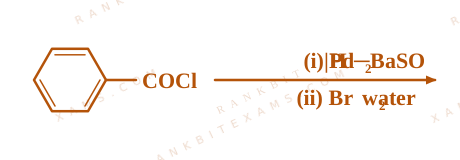
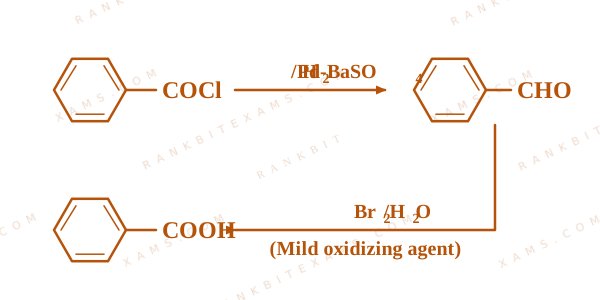
Preparation of Carboxylic Acids : Rosenmund reduction reduces acid chloride to aldehyde first:
rightarrow$\rightarrow$ R-CHO
Subsequent oxidation with bromine water (which is a mild oxidising agent that selective oxidizes aldehydes but does not affect ketones) converts the aldehyde to carboxylic acid:
mathrmR-CHO xrightarrowBr_2/water R-COOH$$\mathrm{R-CHO \xrightarrow{Br_2/water} R-COOH}$$
### Step 1: Final Tally
Thus, reactions (B) and (E) successfully yield carboxylic acid as the major organic product.
### Pattern Recognition
Remember: Bromine water (mathrmBr_2/H_2O$\mathrm{Br_2/H_2O}$) is a mild, selective oxidising agent commonly used to oxidise aldoses and other aldehydes to monocarboxylic acids without degrading carbon-carbon chains.
### Evaluation Rubric / Model Answer
null
### Chapter Mix
Class 12 Chemistry: Aldehydes, Ketones and Carboxylic Acids
More Aldehydes, Ketones and Carboxylic Acids Previous-Year Questions — Page 2
Q30jee_main_2025_08_april_eveningReactions of Cycloalkenes and Alkynes
Identify the major product 'P' in the given reaction sequence starting from 1,2-dibromocyclooctane:
text1,2-dibromocyclooctane xrightarrowtext(i) KOH (alc.) xrightarrowtext(ii) NaNH_2 xrightarrowtext(iii) Hg^2+/H^+ xrightarrowtext(iv) Zn-Hg/HCl text'P (Major product)'$$\text{1,2-dibromocyclooctane} \xrightarrow{\text{(i) KOH (alc.)}} \xrightarrow{\text{(ii) NaNH}_2} \xrightarrow{\text{(iii) Hg}^{2+}/H^+} \xrightarrow{\text{(iv) Zn-Hg/HCl}} \text{'P (Major product)'}$$
### Core Logic
Let us systematically follow the transformation steps:
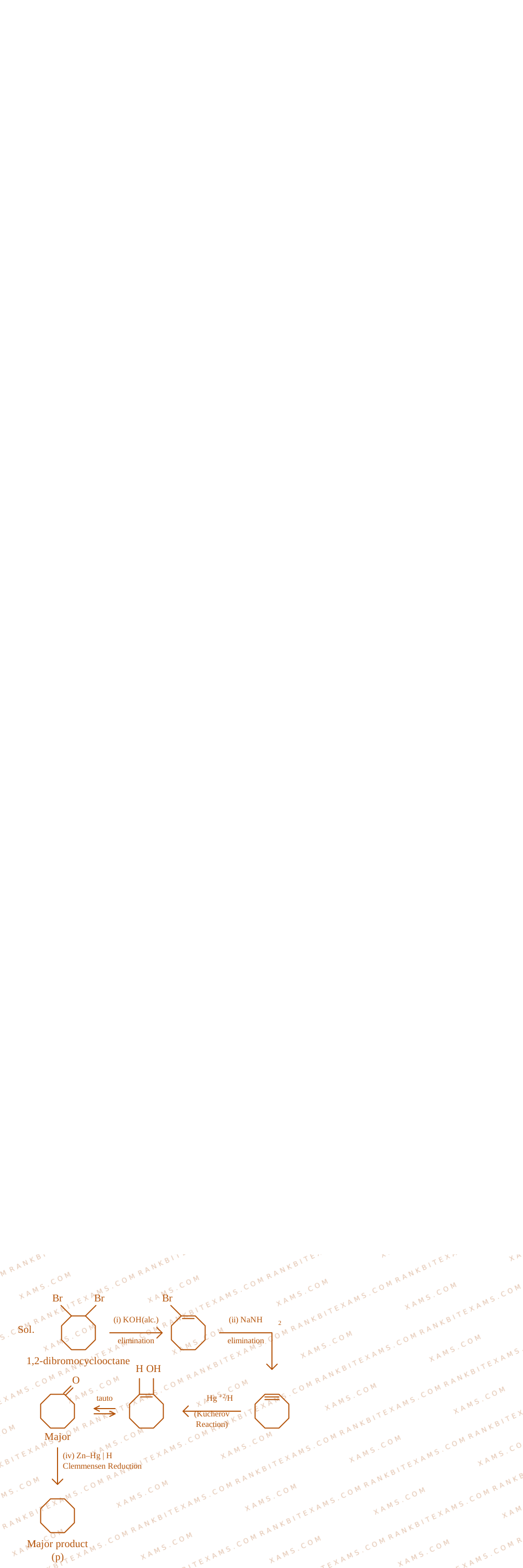
1. **First Elimination**: 1,2-dibromocyclooctane reacts with alcoholic textKOH$\text{KOH}$ to remove one molecule of textHBr$\text{HBr}$, resulting in a bromocyclooctene intermediate.
2. **Second Elimination**: Treatment with the stronger base textNaNH_2$\text{NaNH}_2$ removes the second molecule of textHBr$\text{HBr}$, forming an alkyne inside the 8-membered ring: **cyclooctyne**.
3. **Kucherov Reaction**: Hydration of cyclooctyne using textHg^2+/H^+$\text{Hg}^{2+}/H^+$ creates an enol intermediate that undergoes tautomerization to form a stable ketone: **cyclooctanone**.
4. **Clemmensen Reduction**: Subjecting cyclooctanone to zinc amalgam and hydrochloric acid (textZn-Hg/HCl$\text{Zn-Hg/HCl}$) completely reduces the carbonyl group (>C=O$>C=O$) to a methylene group (-textCH_2-$-\text{CH}_2-$), finishing with **cyclooctane**. Complete mechanistic sequence mapping for cyclooctane product formation
### Pattern Recognition
A vicinal dihalide treated with sequential strong bases creates an alkyne path. Alkyne hydration creates a ketone body. Finally, Clemmensen reduction takes the ketone down to a simple hydrocarbon skeleton. Recognizing this terminal reduction loop establishes cyclooctane as the undisputed answer.
### Evaluation Rubric / Model Answer
null
### Chapter Mix
Class 12 Chemistry: Aldehydes, Ketones and Carboxylic Acids
Class 11 Chemistry: Hydrocarbons
In the Claisen-Schmidt reaction to prepare dibenzalacetone from 5.3text g$5.3\text{ g}$ of benzaldehyde, a total of 3.51text g$3.51\text{ g}$ of product was obtained.
The percentage yield in this reaction was __%.
Numerical Answer.Answer: 60 to 60
Solution
### Core Logic
The balanced chemical equation for the synthesis of dibenzalacetone is:
2 Ph-CHO + CH3COCH3 xrightarrowtextStrong Base Ph-CH=CH-CO-CH=CH-Ph + 2H2O$$2 Ph-CHO + CH{3}COCH{3} xrightarrow{\text{Strong Base}} Ph-CH=CH-CO-CH=CH-Ph + 2H{2}O$$
Let's calculate the moles of reactants:
textMolar mass of benzaldehyde (PhCHO) = 106text g/mol$$\text{Molar mass of benzaldehyde } (PhCHO) = 106\text{ g/mol}$$textMoles of benzaldehyde used = frac5.3106 = 0.05text mol = frac120text mol$$\text{Moles of benzaldehyde used} = \frac{5.3}{106} = 0.05\text{ mol} = \frac{1}{20}\text{ mol}$$Claisen-Schmidt Condensation diagram for Q48 - JEE Main 2025 Evening
According to the reaction stoichiometry, 2text moles of PhCHO$2\text{ moles of } PhCHO$ yield 1text mole of dibenzalacetone$1\text{ mole of dibenzalacetone}$.
textTheoretical moles of product = frac0.052 = 0.025text mol$$\text{Theoretical moles of product} = \frac{0.05}{2} = 0.025\text{ mol}$$
### Step 1: Yield Evaluation
$textMolar mass of dibenzalacetone (C17H14O) = 234text g/mol$$$\text{Molar mass of dibenzalacetone } (C{17}H{14}O) = 234\text{ g/mol}$$textTheoretical mass = 0.025 times 234 = 5.85text g$$\text{Theoretical mass} = 0.025 \times 234 = 5.85\text{ g}$$textPercentage yield = fractextActual masstextTheoretical mass times 100 = frac3.515.85 times 100 = 60%$$\text{Percentage yield} = \frac{\text{Actual mass}}{\text{Theoretical mass}} \times 100 = \frac{3.51}{5.85} \times 100 = 60%$$
### Pattern Recognition
Always remember the stoichiometric ratio: It takes 2 moles of benzaldehyde to condense with 1 mole of acetone to form the symmetrical dibenzalacetone product.
### Evaluation Rubric / Model Answer
null
### Chapter Mix
Class 12 Chemistry: Aldehydes, Ketones and Carboxylic Acids
Q33jee_main_2025_28_jan_morningRearrangement and Ozonolysis
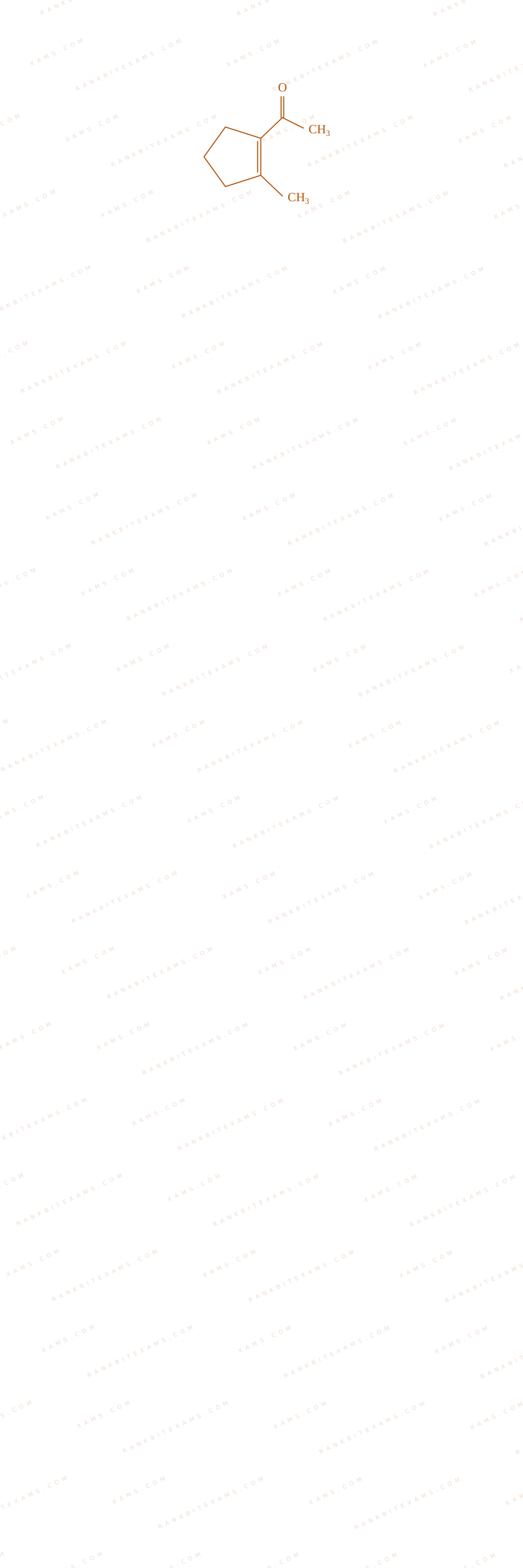
A molecule ("P") on treatment with acid undergoes rearrangement and gives ("Q") ("Q") on ozonolysis followed by reflux under alkaline condition gives ("R"). The structure of ("R") is given below:
The image displays the chemical structure of product R obtained from rearrangement and subsequent reaction steps.
The structure of (mathbfPi^prime primemathbfP^prime prime)$(\mathbf{\Pi}^{\prime \prime}\mathbf{P}^{\prime \prime})$ is
A. (1)
B. (2)
C. (3)
D. (4)
Solution
### Core Logic
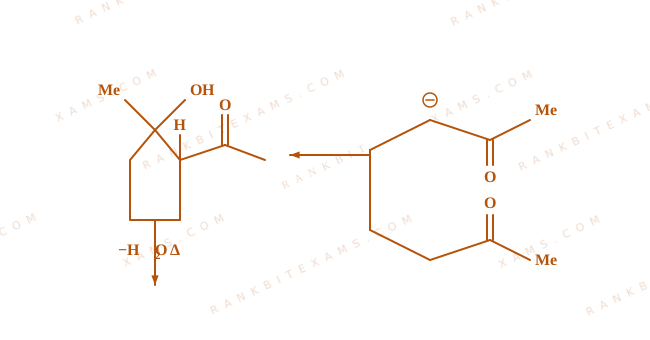
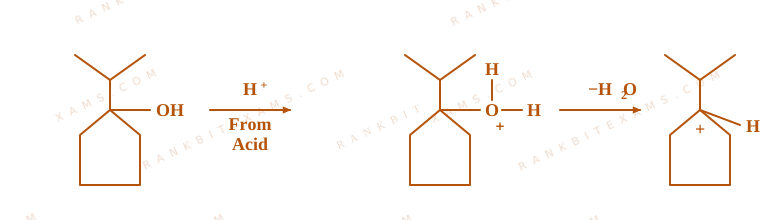
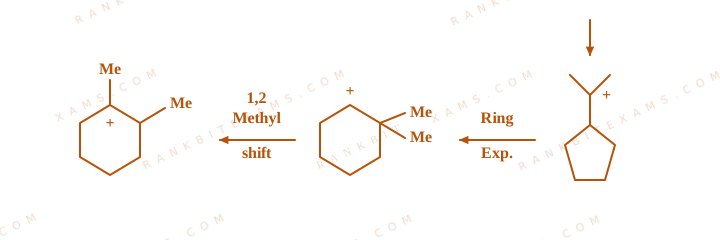
The reaction sequence indicates that molecule "P" undergoes an acid-catalyzed rearrangement to produce alkene/alcohol intermediate "Q". Subsequent ozonolysis breaks down the double bond system, and alkaline reflux sets up an intramolecular aldol condensation sequence to form the cyclic ketone system "R". Following the detailed ring contraction/expansion step templates outlined below:
The image displays the chemical structure of product R obtained from rearrangement and subsequent reaction steps.The image displays the chemical structure of product R obtained from rearrangement and subsequent reaction steps.The image displays the chemical structure of product R obtained from rearrangement and subsequent reaction steps.The image displays the chemical structure of product R obtained from rearrangement and subsequent reaction steps.The image displays the chemical structure of product R obtained from rearrangement and subsequent reaction steps.The image displays the chemical structure of product R obtained from rearrangement and subsequent reaction steps.The image displays the chemical structure of product R obtained from rearrangement and subsequent reaction steps.The image displays the chemical structure of product R obtained from rearrangement and subsequent reaction steps.
### Pattern Recognition
Sees: Acidic rearrangement rightarrow$\rightarrow$ ozonolysis rightarrow$\rightarrow$ intramolecular aldol condensation.
Shortcut: Work backwards from the dicarbonyl fragments formed after opening the final product ring system.
### Evaluation Rubric / Model Answer
null
### Chapter Mix
Class 12 Chemistry: Aldehydes, Ketones and Carboxylic Acids
Q37jee_main_2025_28_jan_morningReactions of Carbonyl Compounds
Both acetaldehyde and acetone (individually) undergo which of the following reactions?
A. Iodoform Reaction
B. Cannizaro Reaction
C. Aldol condensation
D. Pollen's Test
E. Clemmensen Reduction
Choose the correct answer from the options given below:
A.textA, B and D only$\text{A, B and D only}$
B.textA, C and E only$\text{A, C and E only}$
C.textC and E only$\text{C and E only}$
D.textB, C and D only$\text{B, C and D only}$
Solution
### Core Logic
Let us check each option pathway:
- **A. Iodoform Reaction:** Positive for both because both contain the mathrmCH_3-mathrmC=mathrmO$\mathrm{CH}_3-\mathrm{C}=\mathrm{O}$ methyl ketone fragment.
- **B. Cannizaro Reaction:** Negative for both because both contain alpha$\alpha$-hydrogens.
- **C. Aldol Condensation:** Positive for both because they have alpha$\alpha$-hydrogens available for enolization.
- **D. Pollen's Test (Tollen's Test):** Positive only for acetaldehyde (aldehyde); negative for acetone (ketone).
- **E. Clemmensen Reduction:** Positive for both as they contain reducible carbonyl groups.
Thus, both react via A, C, and E.
### Pattern Recognition
Sees: Functional comparison of Acetaldehyde and Acetone.
Shortcut: Ketones do not respond to Tollen's test, which instantly eliminates choices featuring statement D.
### Evaluation Rubric / Model Answer
null
### Chapter Mix
Class 12 Chemistry: Aldehydes, Ketones and Carboxylic Acids
Q36jee_main_2025_03_april_morningIodoform Test
Number of molecules from below which cannot give iodoform reaction is:
Ethanol, Isopropyl alcohol, Bromoacetone, 2-Butanol, 2-Butanone, Butanal, 2-Pentanone, 3-Pentanone, Pentanal and 3-Pentanol
A. 5
B. 4
C. 3
D. 2
Solution
### Core Logic
The iodoform test requires compounds containing either a methyl ketone group (textCH_3textCO-$\text{CH}_3\text{CO}-$) or a methyl carbinol structural unit (textCH_3textCH(OH)-$\text{CH}_3\text{CH(OH)}-$).
Let us audit the provided compounds:
1. **Ethanol** (textCH_3textCH_2textOH$\text{CH}_3\text{CH}_2\text{OH}$): Contains textCH_3textCH(OH)-$\text{CH}_3\text{CH(OH)}-$
ightarrow$
ightarrow$ **Positive**
2. **Isopropyl alcohol** (textCH_3textCH(OH)CH_3$\text{CH}_3\text{CH(OH)CH}_3$): Contains textCH_3textCH(OH)-$\text{CH}_3\text{CH(OH)}-$
ightarrow$
ightarrow$ **Positive**
3. **Bromoacetone** (textCH_3textCOCH_2textBr$\text{CH}_3\text{COCH}_2\text{Br}$): Contains textCH_3textCO-$\text{CH}_3\text{CO}-$
ightarrow$
ightarrow$ **Positive**
4. **2-Butanol** (textCH_3textCH(OH)CH_2textCH_3$\text{CH}_3\text{CH(OH)CH}_2\text{CH}_3$): Contains textCH_3textCH(OH)-$\text{CH}_3\text{CH(OH)}-$
ightarrow$
ightarrow$ **Positive**
5. **2-Butanone** (textCH_3textCOCH_2textCH_3$\text{CH}_3\text{COCH}_2\text{CH}_3$): Contains textCH_3textCO-$\text{CH}_3\text{CO}-$
ightarrow$
ightarrow$ **Positive**
6. **Butanal** (textCH_3textCH_2textCH_2textCHO$\text{CH}_3\text{CH}_2\text{CH}_2\text{CHO}$): **Negative**
7. **2-Pentanone** (textCH_3textCOCH_2textCH_2textCH_3$\text{CH}_3\text{COCH}_2\text{CH}_2\text{CH}_3$): Contains textCH_3textCO-$\text{CH}_3\text{CO}-$
ightarrow$
ightarrow$ **Positive**
8. **3-Pentanone** (textCH_3textCH_2textCOCH_2textCH_3$\text{CH}_3\text{CH}_2\text{COCH}_2\text{CH}_3$): **Negative**
9. **Pentanal** (textCH_3textCH_2textCH_2textCH_2textCHO$\text{CH}_3\text{CH}_2\text{CH}_2\text{CH}_2\text{CHO}$): **Negative**
10. **3-Pentanol** (textCH_3textCH_2textCH(OH)CH_2textCH_3$\text{CH}_3\text{CH}_2\text{CH(OH)CH}_2\text{CH}_3$): **Negative**
### Step 1: Summation
The molecules that **cannot** give the iodoform reaction are: Butanal, 3-Pentanone, Pentanal, and 3-Pentanol. This gives a total count of exactly 4 molecules.
### Pattern Recognition
Shortcut: Filter for names ending with '-anal' or having ketones/alcohols at positions higher than 2 (e.g., 3-pentanone, 3-pentanol). These lack the vital terminal methyl group adjacent to the functional group.
### Evaluation Rubric / Model Answer
null
### Chapter Mix
Class 12 Chemistry: Aldehydes, Ketones and Carboxylic Acids
We Map Every Repeating Question in Competitive Exams.
Say goodbye to generic mock test fatigue. RankBit uses smart analysis to group past exam questions into their foundational Repeating Question Types. Find chapter weightage, track repeating questions, and score higher with targeted practice.
Select Your Target Exam
Choose an exam track below to find formulas per chapter and patterns.
Syncing Exam Intelligence
Mapping formulas and patterns across all tracks…
PATH A — FULL LENGTH PRACTICE
Full Mock Test Hub
Simulate real NTA exam conditions with fully tracked mocks. Time yourself against past papers.
Practice past-year questions one chapter at a time. Pick an exam → subject → chapter and get every PYQ for that topic — pulled together from all past papers — with the chapter's key formulas alongside.
)