JEE Main · Chemistry → Steady

Aldehydes, Ketones and Carboxylic Acids appeared 46 times across 3 years — 5.3% of Chemistry. This question is from Preparation of Carboxylic Acids.

Year 2026 2025 2024 Total
Questions 14 21 11 46

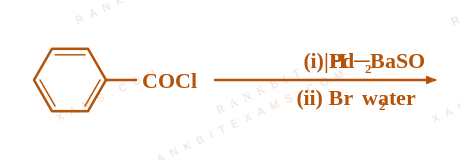
Consider the following reactions. From these reactions which reaction will give carboxylic acid as a major product? (A) R - C ≡ N [mild condition](i) H^+ / H₂O (B) R - MgX [(ii) H₃O^+](i) CO₂ (C) R - C ≡ N [(ii) H₃O^+](i) SnCl₂ / HCl (D) R · CH₂ · OH PCC (E)
Preparation of Carboxylic Acids
Choose the correct answer from the options given below:

Solution & Explanation

Related Formula
R-MgX + CO₂ arrow R-COOMgX H₃O^+ R-COOH
Core Logic

Let's analyze each reaction path to determine the major organic product:

  • Reaction (A): Acidic hydrolysis of a nitrile under mild conditions yields an amide:
R-C≡ N arrow R-CONH₂

(Full conversion to carboxylic acid requires strong conditions and extended heating).

  • Reaction (B): Carbonation of Grignard reagent using solid carbon dioxide (dry ice) followed by acid hydrolysis yields a carboxylic acid:
R-MgX + CO₂ arrow R-COOMgX H₃O^+ R-COOH
  • Reaction (C): Stephen reduction converts nitrile to aldehyde:
R-C≡ N SnCl₂/HCl R-CH=NH H₃O^+ R-CHO
  • Reaction (D): Pyridinium chlorochromate (PCC) is a mild oxidising agent that converts primary alcohols selectively to aldehydes:
R-CH₂-OH PCC R-CHO
  • Reaction (E)
  • Preparation of Carboxylic Acids
    Preparation of Carboxylic Acids

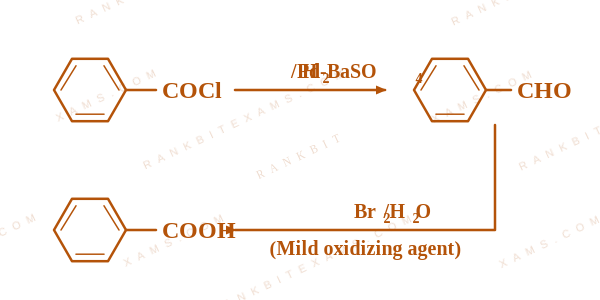
    : Rosenmund reduction reduces acid chloride to aldehyde first: arrow R-CHO Subsequent oxidation with bromine water (which is a mild oxidising agent that selective oxidizes aldehydes but does not affect ketones) converts the aldehyde to carboxylic acid:

R-CHO Br₂/water R-COOH
Step 1: Final Tally

Thus, reactions (B) and (E) successfully yield carboxylic acid as the major organic product.

Pattern Recognition

Remember: Bromine water (Br₂/H₂O) is a mild, selective oxidising agent commonly used to oxidise aldoses and other aldehydes to monocarboxylic acids without degrading carbon-carbon chains.

Chapter Mix

Class 12 Chemistry: Aldehydes, Ketones and Carboxylic Acids

More Aldehydes, Ketones and Carboxylic Acids Previous-Year Questions — Page 10

Q jee_main_2024_31_jan_morning Reactions with Grignard Reagent
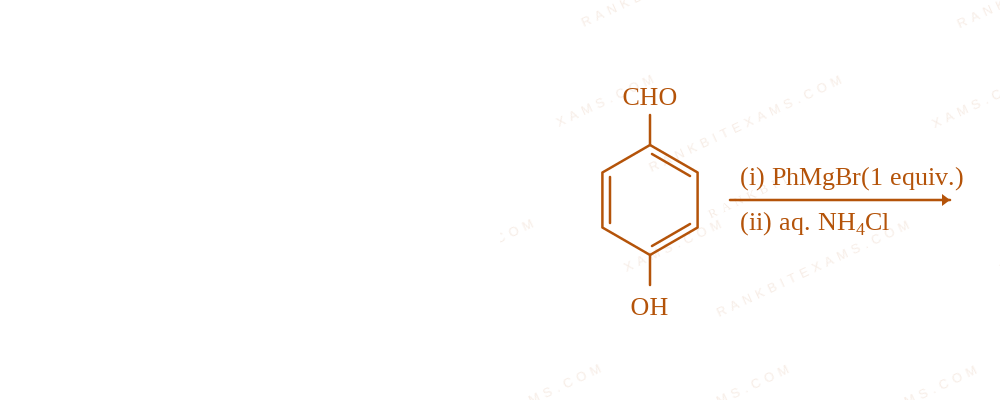
The product of the following reaction is P.
Reactions with Grignard Reagent diagram for Q84 - JEE Main 2024 Morning
The image shows p-hydroxybenzaldehyde reacting with one equivalent of PhMgBr followed by aqueous ammonium chloride.
The number of hydroxyl groups present in the product P is
Numerical Answer. Answer: 0 to 0

Solution

Core Logic

The given reactant is p-hydroxybenzaldehyde, which contains both a phenolic -OH group (acidic) and an aldehyde group (electrophilic).

When one equivalent of Grignard reagent (PhMgBr) is added, it behaves primarily as a strong base due to the presence of an acidic proton. Acid-base reactions are extremely fast compared to nucleophilic additions.

The acidic phenolic -OH reacts with PhMgBr:

PhMgBr + HO-C₆H₄-CHO arrow Ph-H (Benzene) + BrMg-O-C₆H₄-CHO

Upon workup with aq. NH₄Cl, the phenoxide ion simply regenerates the starting p-hydroxybenzaldehyde. However, the question asks for the number of hydroxyl groups present in the formed product (Benzene).
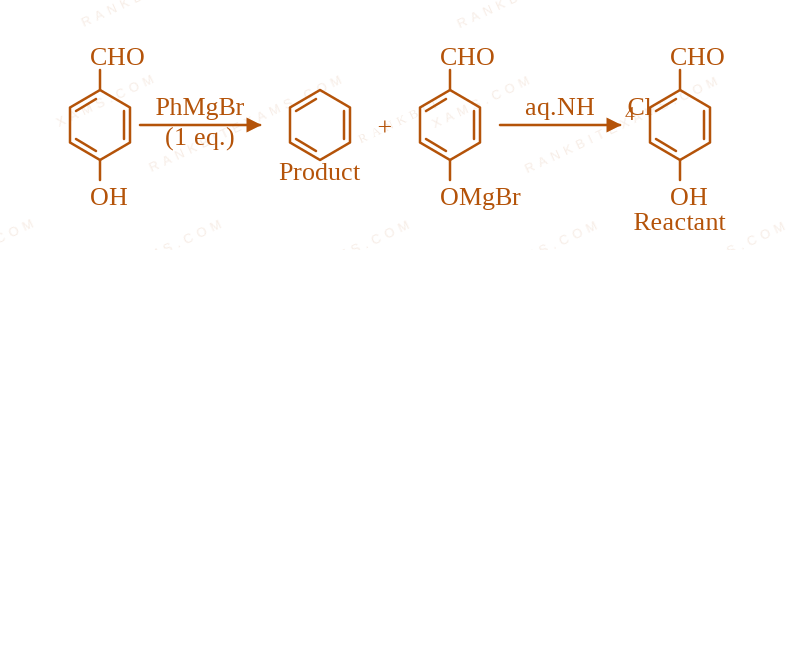
Reactions with Grignard Reagent diagram for Q84 - JEE Main 2024 Morning
The image shows p-hydroxybenzaldehyde reacting with one equivalent of PhMgBr followed by aqueous ammonium chloride.

The distinct product formed in the reaction is Benzene. Benzene has 0 hydroxyl groups.

Pattern Recognition

Whenever a Grignard reagent encounters a molecule with an acidic hydrogen (alcohol, phenol, amine, alkyne), it will invariably act as a base first. If only 1 equivalent is used, nucleophilic addition to carbonyls will NOT happen.

Chapter Mix

Class 12 Chemistry: Aldehydes, Ketones and Carboxylic Acids Class 12 Chemistry: Alcohols, Phenols and Ethers

Rankbit System
JEE Physics: Waves (+15.5%) | Electrostatics: Concentric Shells (-29.7%) | Modern Physics: Photoelectric Clones (+34.2%) | Mathematics: Definite Integrals (+18.1%) | Chemistry: Coordination Splitting (-11.4%) | JEE Physics: Waves (+15.5%) | Electrostatics: Concentric Shells (-29.7%) | Modern Physics: Photoelectric Clones (+34.2%) | Mathematics: Definite Integrals (+18.1%) | Chemistry: Coordination Splitting (-11.4%)