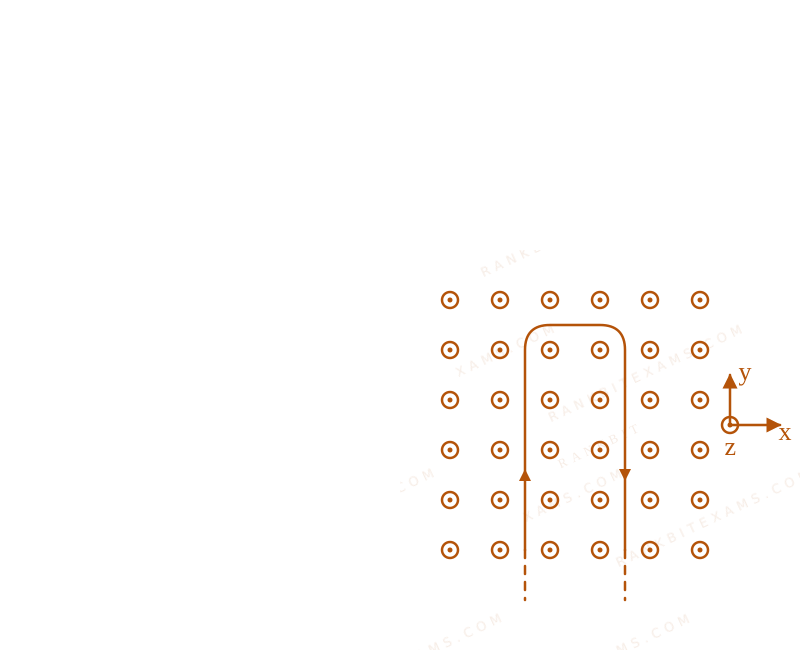
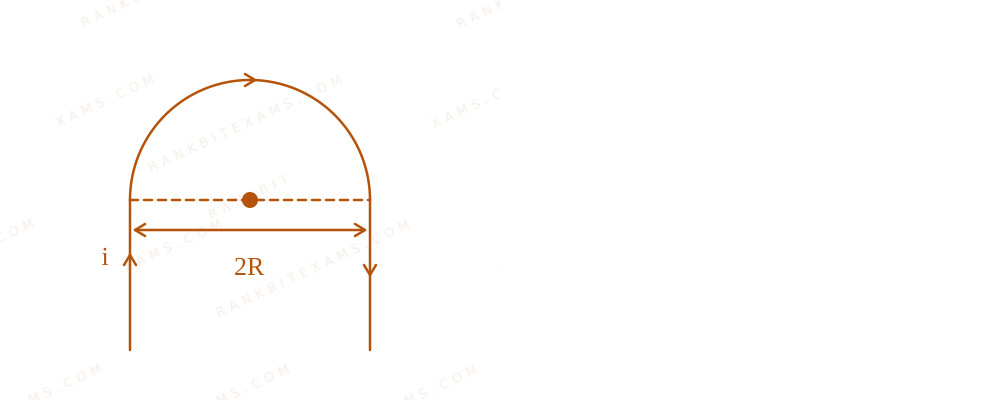
A rigid wire consists of a semicircular portion of radius R$R$ and two straight sections. The wire is partially immersed in a perpendicular magnetic field B = B₀ j$B = B_0 \hat{j}$ as shown in figure. The magnetic force on the wire if it has a current i$i$ is:
A U-shaped current wire is placed in a uniform magnetic field with outward field lines.
A.-iBR j$-iBR \hat{j}$
B.2iBR j$2iBR \hat{j}$
C.iBR j$iBR \hat{j}$
D.-2iBR j$-2iBR \hat{j}$
Solution & Explanation
Related Formula
F = i ( × B)$$\vec{F} = i (\vec{\ell} \times \vec{B})$$
Core Logic
A U-shaped current wire is placed in a uniform magnetic field with outward field lines.
For a uniform magnetic field, the net force on an arbitrary shaped wire carrying a steady current depends only on its initial and final position. It is equivalent to the force on a straight wire connecting its ends.
The effective length $\vec{\ell}$ is a straight line joining the entry and exit points in the magnetic field.
Length of equivalent straight wire, | | = 2R$|\vec{\ell}| = 2R$.
Based on the current direction, it points in the +x$+x$ direction, so = 2R i$\vec{\ell} = 2R\hat{i}$.
Step 2: Cross Product Calculation
The magnetic field is given as B = B₀ k$\vec{B} = B_0 \hat{k}$ (from the visual diagram showing dot outwards along the z$z$-axis, though text incorrectly labeled it j$\hat{j}$, the intended field matches the standard coordinate system for such setups where force pushes up/down. Wait, following the PDF's solution logic explicitly:)
Solution specifies: Note: Direction of magnetic field is in +k$+k$ due to visual dot convention.
So B = B k$\vec{B} = B \hat{k}$.
F = i (2R i × B k)$$\vec{F} = i (2R\hat{i} \times B\hat{k})$$F = 2iRB ( i × k)$$\vec{F} = 2iRB (\hat{i} \times \hat{k})$$
Since i × k = - j$\hat{i} \times \hat{k} = -\hat{j}$:
F = -2iRB j$$\vec{F} = -2iRB\hat{j}$$
Pattern Recognition
Replace any semicircular current loop with its straight line displacement vector 2R$2R$. Then just take L × B$\vec{L} \times \vec{B}$. The visual dots clearly represent + k$+\hat{k}$.
Chapter Mix
Class 12 Physics: Moving Charges And Magnetism
Keywords:#semicircular wire#magnetic field lines#current loop
More Moving Charges And Magnetism Previous-Year Questions — Page 2
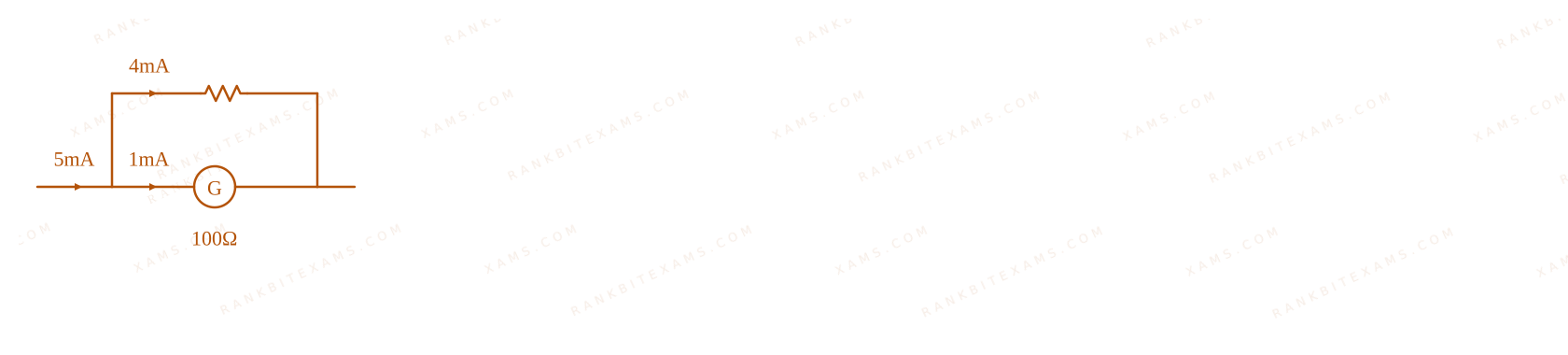
Q38jee_main_2026_24_january_eveningGalvanometer to Ammeter Conversion
When upgrading range n$n$ times (n = i / ig$n = i / i_g$), the required parallel shunt is simply G / (n - 1)$G / (n - 1)$.
Chapter Mix
Class 12 Physics: Moving Charges and Magnetism
Q34jee_main_2026_28_january_morningMagnetic Force between Two Parallel Currents
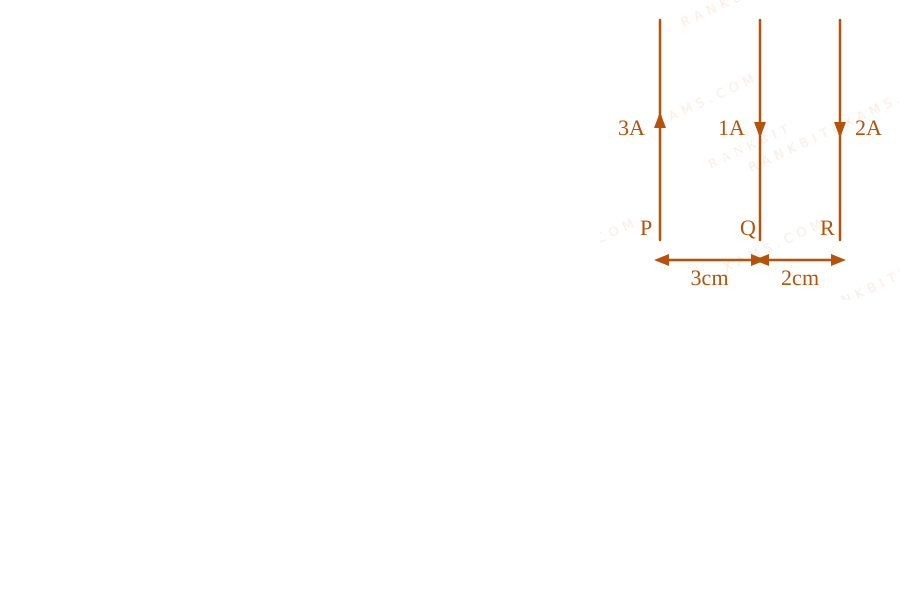
Three long straight wires carrying current are arranged mutually parallel as shown in the figure. The force experienced by 15 cm length of wire Q is ____.
Three vertical wires P, Q, R carrying 3A (up), 1A (down), and 2A (down) separated by 3cm and 2cm respectively.(μ₀ = 4π × 10⁻⁷T· m / A)$(\mu_{0} = 4\pi \times 10^{-7}\mathrm{T\cdot m / A})$
A.6 × 10⁻⁷ ~N towards P$6 \times 10^{-7} \mathrm{~N} \text{ towards P}$
B.6 × 10⁻⁶ ~N towards R$6 \times 10^{-6} \mathrm{~N} \text{ towards R}$
C.6 × 10⁻⁷ ~N towards R$6 \times 10^{-7} \mathrm{~N} \text{ towards R}$
D.6 × 10⁻⁶ ~N towards P$6 \times 10^{-6} \mathrm{~N} \text{ towards P}$
Wires with current in opposite directions repel each other. Wires with current in the same direction attract each other. Calculate the individual force vectors on wire Q due to wires P and R.
Step 1: Force due to Wire P
Wire P (3A up) and Wire Q (1A down) carry current in opposite directions. So, P repels Q towards the right (towards R).
The net force is 6 × 10⁻⁶ ~N$6 \times 10^{-6} \mathrm{~N}$ towards R.
Pattern Recognition
Always map the direction (attract/repel) before plugging in numbers. Same direction = Attract. Opposite direction = Repel.
Chapter Mix
Class 12 Physics: Moving Charges and Magnetism
Q43jee_main_2026_28_january_morningMagnetic Field on the Axis of a Circular Loop
The magnetic field at the centre of a current carrying circular loop of radius R is 16$16 \,\mu\mathrm{T}$ . The magnetic field at a distancex = √(3) R$x = \sqrt{3} R$ on its axis from the centre is ____ $\mu\mathrm{T}$ .
A.2√(2)$2\sqrt{2}$
B.4$4$
C.2$2$
D.8$8$
Solution
Related Formula
Bcentre = (μ₀ I)/(2R)$$B_{\text{centre}} = \frac{\mu_0 I}{2R}$$Bₐₓᵢₛ = μ₀ I R²2(x² + R²)3/2$$B_{\text{axis}} = \frac{\mu_0 I R^2}{2(x^2 + R^2)^{3/2}}$$
Core Logic
Substitute the expression for Bcentre$B_{\text{centre}}$ into the equation for Bₐₓᵢₛ$B_{\text{axis}}$ by evaluating the denominator with x = √(3)R$x = \sqrt{3}R$.
A classic standard derivation: at x = √(3)R$x = \sqrt{3}R$, the field is 1/8$1/8$ of the center field. At x = R$x = R$, it's 1/(2√(2))$1/(2\sqrt{2})$. Committing these to memory saves 60 seconds.
Chapter Mix
Class 12 Physics: Moving Charges and Magnetism

Q39jee_main_2026_28_january_eveningMagnetic Field of a Cylindrical Conductor
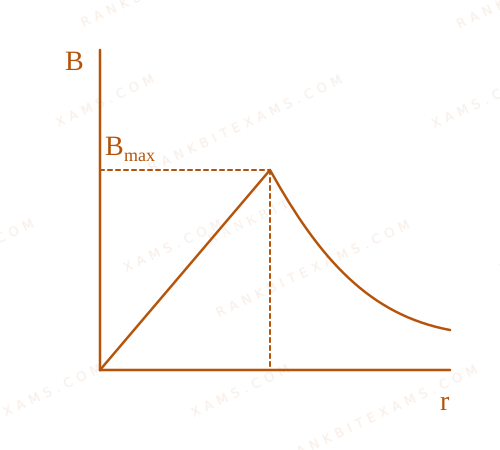
A long cylindrical conductor with large cross section carries an electric current distributed uniformly over its cross-section. Magnetic field due to this current is:
A. maximum at either ends of the conductor and minimum at the midpoint
B. maximum at the axis of the conductor
C. minimum at the surface of the conductor
D. minimum at the axis of the conductor
E. same at all points in the cross-section of the conductor
Choose the correct answer from the options given below:
A.D Only$\text{D Only}$
B.A, D Only$\text{A, D Only}$
C.B, C Only$\text{B, C Only}$
D.E Only$\text{E Only}$
Solution
Related Formula
For a solid cylinder carrying uniform current density:
Inside (r < R$r < R$):
B = (μ₀ I r)/(2π R²)$$B = \frac{\mu_0 I r}{2\pi R^2}$$
Outside (r ≥ R$r \geq R$):
B = (μ₀ I)/(2π r)$$B = \frac{\mu_0 I}{2\pi r}$$
Core Logic
Solution for Magnetic Field of a Cylindrical Conductor
From the formula for the magnetic field inside the solid cylinder, B$B$ is directly proportional to the radial distance r$r$ from the axis. Thus, at the axis (r = 0$r = 0$), B = 0$B = 0$ (which is its absolute minimum).
At the surface (r = R$r = R$), B$B$ reaches its maximum value B = (μ₀ I)/(2π R)$B_{\max} = \frac{\mu_0 I}{2\pi R}$.
Step 1: Evaluating the Statements
Statement A: Incorrect (B depends on radial distance, not longitudinal position).
Statement B: Incorrect (B is minimum at the axis).
Statement C: Incorrect (B is maximum at the surface).
Statement D: Correct (B is zero at the axis).
Statement E: Incorrect (B varies with r$r$).
Pattern Recognition
Graph of B vs r for a uniform solid cylinder is a straight line passing through origin up to r=R$r=R$, then a hyperbola 1/r$1/r$ outside. Zero at axis, max at surface.
In a moving coil galvanometer, two moving coils M₁$M_1$ and M₂$M_2$ have the following particulars:
aligned R₁ &= 5 Ω, N₁ = 15, A₁ = 3.6 × 10⁻³ m², B₁ = 0.25 T R₂ &= 7 Ω, N₂ = 21, A₂ = 1.8 × 10⁻³ m², B₂ = 0.50 T aligned$$\begin{aligned} R_1 &= 5 \ \Omega, \quad N_1 = 15, \quad A_1 = 3.6 \times 10^{-3} \ \mathrm{m}^2, \quad B_1 = 0.25 \ \mathrm{T} \\ R_2 &= 7 \ \Omega, \quad N_2 = 21, \quad A_2 = 1.8 \times 10^{-3} \ \mathrm{m}^2, \quad B_2 = 0.50 \ \mathrm{T} \end{aligned}$$
Assuming that torsional constant of the springs are same for both coils, what will be the ratio of voltage sensitivity of M₁$M_1$ and M₂$M_2$ ?
A.1:1$1:1$
B.1:4$1:4$
C.1:3$1:3$
D.1:2$1:2$
Solution
Related Formula
Voltage Sensitivity (Vₛ) = (θ)/(V) = (N B A)/(C R)$$\text{Voltage Sensitivity } (V_s) = \frac{\theta}{V} = \frac{N B A}{C R}$$
where:
N$N$ = number of turns
B$B$ = magnetic field
A$A$ = area of the coil
C$C$ = torsional constant of the spring
R$R$ = resistance of the coil
Core Logic
Since the torsional constant C$C$ is the same for both coils, the ratio of voltage sensitivities of M₁$M_1$ and M₂$M_2$ is:
Sees: Galvanometer sensitivity comparison with different parameters.
Trap: Confusing Current Sensitivity with Voltage Sensitivity. Current sensitivity is (NBA)/(C)$\frac{NBA}{C}$ (independent of R$R$), while voltage sensitivity is (NBA)/(C R)$\frac{NBA}{C R}$ (depends on R$R$).
Shortcut: Write the ratio as ((Iₛ)₁)/((Iₛ)₂) × (R₂)/(R₁)$\frac{(I_s)_1}{(I_s)_2} \times \frac{R_2}{R_1}$ to keep calculations clean.
Chapter Mix
Class 12 Physics: Moving Charges and Magnetism
More Moving Charges And Magnetism Questions — jee_main_2024_31_jan_morning
Practice past-year questions one chapter at a time. Pick an exam → subject → chapter and get every PYQ for that topic — pulled together from all past papers — with the chapter's key formulas alongside.