The area of the region left\(x,y): y^2 le 4x, x < 4, fracxy(x - 1)(x - 2)(x - 3)(x - 4) > 0, x neq 3right\$\left\{(x,y): y^2 \le 4x, x < 4, \frac{xy(x - 1)(x - 2)}{(x - 3)(x - 4)} > 0, x \neq 3\right\}$ is
A.frac163$\frac{16}{3}$
B.frac643$\frac{64}{3}$
C.frac83$\frac{8}{3}$
D.frac323$\frac{32}{3}$
Solution & Explanation
### Core Logic
Given y^2 le 4x$y^2 \le 4x$ and x < 4$x < 4$.
Analyze the inequality fracxy(x-1)(x-2)(x-3)(x-4) > 0$\frac{xy(x-1)(x-2)}{(x-3)(x-4)} > 0$ considering y > 0$y > 0$ and y < 0$y < 0$ separately.
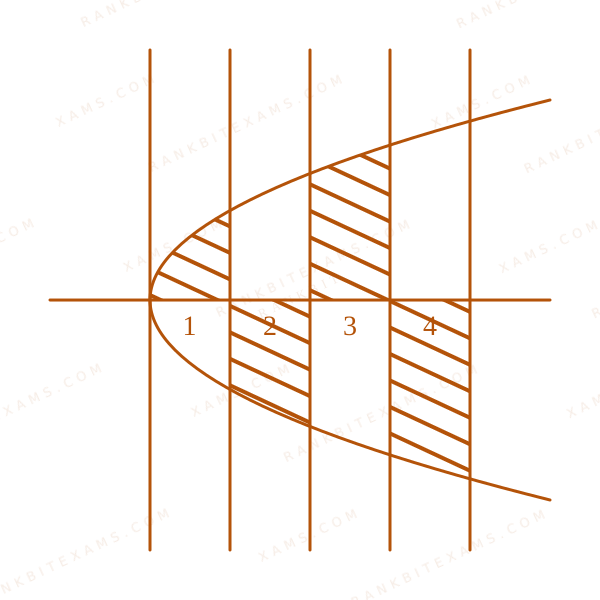
Area bounded by Parabolas and Inequalities diagram for Q5 - JEE Main 2024 Morning
### Step 1: Case I (y > 0)
If y > 0$y > 0$, the inequality reduces to fracx(x-1)(x-2)(x-3)(x-4) > 0$\frac{x(x-1)(x-2)}{(x-3)(x-4)} > 0$.
Using wavy curve method and given x in (0, 4)$x \in (0, 4)$:
x in (0, 1) cup (2, 3)$x \in (0, 1) \cup (2, 3)$.
### Step 2: Case II (y < 0)
If y < 0$y < 0$, the inequality reduces to fracx(x-1)(x-2)(x-3)(x-4) < 0$\frac{x(x-1)(x-2)}{(x-3)(x-4)} < 0$.
Using wavy curve method and given x in (0, 4)$x \in (0, 4)$:
x in (1, 2) cup (3, 4)$x \in (1, 2) \cup (3, 4)$.
### Step 3: Area Computation
Because the regions map perfectly without overlap in opposite quadrants relative to the x-axis, they form complete parabolic strips when combined:
Area = 2 int_0^4 sqrtx dx = 2 cdot frac23[x^3/2]_0^4 = frac43 cdot 8 = frac323$= 2 \int_{0}^{4} \sqrt{x} dx = 2 \cdot \frac{2}{3}[x^{3/2}]_{0}^{4} = \frac{4}{3} \cdot 8 = \frac{32}{3}$.
### Evaluation Rubric / Model Answer
null
### Chapter Mix
Class 12 Maths: Area Under Curves
Class 11 Maths: Linear Inequalities
Keywords:#wavy curve method#JEE Main 2024 Morning Q5#Area Under Curves JEE Main 2024#Area bounded by Parabolas and Inequalities JEE Main 2024
More Area Under Curves Previous-Year Questions — Page 3
Q57jee_main_2025_29_jan_morningArea Under Curves
Let the area of the region \(x, y) : 2y leq x^2 + 3$\{(x, y) : 2y \leq x^2 + 3$ , y + |x| leq 3$y + |x| \leq 3$ , y geq |x - 1|\$y \geq |x - 1|\}$ be A. Then 6A is equal to:
A. 16
B. 12
C. 18
D. 14
Solution
### Related Formula
textArea = int_a^b (y_textupper - y_textlower) \, dx$\text{Area} = \int_{a}^{b} (y_{\text{upper}} - y_{\text{lower}}) \, dx$
### Core Logic
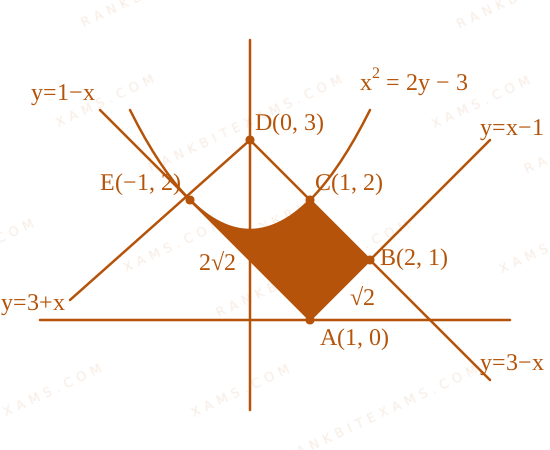
Plotting the boundary lines and tracking intersection points yields a composite geometric region bounding a central area.
Area Under Curves diagram for Q57 - JEE Main 2025 Morning
### Step 1: Set up the integral pieces
The bounded region A$A$ can be conceptualized as a total bounding box/rectangle minus specific external integrals:
A = 4 - 2 int_0^1 left[ (3 - x) - left( fracx^2 + 32 right) right] \, dx$A = 4 - 2 \int_{0}^{1} \left[ (3 - x) - \left( \frac{x^2 + 3}{2} \right) \right] \, dx$
### Step 2: Evaluate the Integral
A = 4 - 2 left[ 3x - fracx^22 - fracx^36 - frac32x right]_0^1$A = 4 - 2 \left[ 3x - \frac{x^2}{2} - \frac{x^3}{6} - \frac{3}{2}x \right]_{0}^{1}$A = 4 - 2 left[ 3 - frac12 - frac16 - frac32 right] = 4 - 2 left[ frac56 right] = 4 - frac53 = frac73$A = 4 - 2 \left[ 3 - \frac{1}{2} - \frac{1}{6} - \frac{3}{2} \right] = 4 - 2 \left[ \frac{5}{6} \right] = 4 - \frac{5}{3} = \frac{7}{3}$
### Step 3: Calculate 6A
6A = 6 times frac73 = 14$6A = 6 \times \frac{7}{3} = 14$
### Pattern Recognition
When dealing with multiple absolute functions (|x|$|x|$, |x-1|$|x-1|$), check for coordinate mirror symmetry across vertical axes to slash total required calculus computations in half.
### Evaluation Rubric / Model Answer
null
### Chapter Mix
Class 12 Mathematics: Application of Integrals
Q10jee_main_2024_01_february_morningArea Between Curves
The area enclosed by the curves xy+4y=16$xy+4y=16$ and x+y=6$x+y=6$ is equal to:
A.28-30 log_e2$28-30 \log_{e}2$
B.30-28 log_e2$30-28 \log_{e}2$
C.30-32 log_e2$30-32 \log_{e}2$
D.32-30 log_e2$32-30 \log_{e}2$
Solution
### Related Formula
Area enclosed between two intersecting curves y_1 = f(x)$y_1 = f(x)$ and y_2 = g(x)$y_2 = g(x)$ from boundary limits x = a$x = a$ to x = b$x = b$:
textArea = int_a^b (y_textupper - y_textlower) \, dx$\text{Area} = \int_{a}^{b} (y_{\text{upper}} - y_{\text{lower}}) \, dx$
### Core Logic
Given the two boundary curves:
1. xy + 4y = 16 implies y(x+4) = 16 implies y = frac16x+4$xy + 4y = 16 \implies y(x+4) = 16 \implies y = \frac{16}{x+4}$
2. x + y = 6 implies y = 6 - x$x + y = 6 \implies y = 6 - x$
Find the intersection points by equating the two expressions for y$y$:
frac16x+4 = 6 - x implies 16 = (6-x)(x+4)$\frac{16}{x+4} = 6 - x \implies 16 = (6-x)(x+4)$16 = 6x + 24 - x^2 - 4x implies x^2 - 2x - 8 = 0$16 = 6x + 24 - x^2 - 4x \implies x^2 - 2x - 8 = 0$(x-4)(x+2) = 0 implies x = 4, \, x = -2 $(x-4)(x+2) = 0 \implies x = 4, \, x = -2 $
### Step 1: Integral Formulation
Between x = -2$x = -2$ and x = 4$x = 4$, the line y = 6 - x$y = 6 - x$ lies above the curve y = frac16x+4$y = \frac{16}{x+4}$.
Therefore, the required enclosed area is:
textArea = int_-2^4 left( (6-x) - frac16x+4 right) dx $\text{Area} = \int_{-2}^{4} \left( (6-x) - \frac{16}{x+4} \right) dx $textArea = left[ 6x - fracx^22 - 16 ln|x+4| right]_-2^4$\text{Area} = \left[ 6x - \frac{x^2}{2} - 16 \ln|x+4| \right]_{-2}^{4}$The diagram displays the shaded region enclosed between the straight line and the hyperbola between limits minus two and four.
### Step 2: Apply Limits and Simplify
Substitute the upper limit x = 4$x = 4$:
U = 6(4) - frac4^22 - 16 ln|4+4| = 24 - 8 - 16 ln 8 = 16 - 16 ln 8$U = 6(4) - \frac{4^2}{2} - 16 \ln|4+4| = 24 - 8 - 16 \ln 8 = 16 - 16 \ln 8$
Substitute the lower limit x = -2$x = -2$:
L = 6(-2) - frac(-2)^22 - 16 ln|-2+4| = -12 - 2 - 16 ln 2 = -14 - 16 ln 2$L = 6(-2) - \frac{(-2)^2}{2} - 16 \ln|-2+4| = -12 - 2 - 16 \ln 2 = -14 - 16 \ln 2$
Subtract the lower limit value from the upper limit value:
textArea = U - L = (16 - 16 ln 8) - (-14 - 16 ln 2)$\text{Area} = U - L = (16 - 16 \ln 8) - (-14 - 16 \ln 2)$textArea = 30 - 16 ln(2^3) + 16 ln 2 = 30 - 48 ln 2 + 16 ln 2$\text{Area} = 30 - 16 \ln(2^3) + 16 \ln 2 = 30 - 48 \ln 2 + 16 \ln 2$textArea = 30 - 32 ln 2 = 30 - 32 log_e2 $\text{Area} = 30 - 32 \ln 2 = 30 - 32 \log_{e}2 $
### Pattern Recognition
Sees: Area bounded by a straight line and a shifting rectangular hyperbola.
Shortcut: The roots of the difference equation x^2 - 2x - 8 = 0$x^2 - 2x - 8 = 0$ directly give the limits. Always check graph orientations to place the upper linear equation before the curve equation inside the integral bracket to preserve absolute area values.
### Evaluation Rubric / Model Answer
null
### Chapter Mix
Class 12 Mathematics: Application of Integrals
Class 11 Mathematics: Conic Sections (Hyperbola)
Q25jee_main_2024_29_january_eveningArea Under Curves
Let the area of the region \(x,y):0leq xleq 3,0leq yleq min \x^2 +2,2x + 2\ \$\{(x,y):0\leq x\leq 3,0\leq y\leq \min \{x^2 +2,2x + 2\} \}$ be A$A$. Then 12A$12A$ is equal to
Numerical Answer.Answer: 164 to 164
Solution
### Related Formula
textArea A = int min\f(x), g(x)\\, dx$\text{Area } A = \int \min\{f(x), g(x)\}\, dx$
### Core Logic
Let us find the point of intersection of the curves y = x^2 + 2$y = x^2 + 2$ and y = 2x + 2$y = 2x + 2$:
x^2 + 2 = 2x + 2 implies x^2 - 2x = 0 implies x = 0 text or x = 2$x^2 + 2 = 2x + 2 \implies x^2 - 2x = 0 \implies x = 0 \text{ or } x = 2$
Evaluating behaviors over boundaries:
* For 0 leq x leq 2$0 \leq x \leq 2$: x^2 + 2 leq 2x + 2 implies min = x^2 + 2$x^2 + 2 \leq 2x + 2 \implies \min = x^2 + 2$
* For 2 leq x leq 3$2 \leq x \leq 3$: 2x + 2 leq x^2 + 2 implies min = 2x + 2$2x + 2 \leq x^2 + 2 \implies \min = 2x + 2$
### Step 1: Integration Resolution
Setting up continuous area integral steps:
A = int_0^2 (x^2 + 2)\, dx + int_2^3 (2x + 2)\, dx$A = \int_{0}^{2} (x^2 + 2)\, dx + \int_{2}^{3} (2x + 2)\, dx$A = left[ fracx^33 + 2x right]_0^2 + left[ x^2 + 2x right]_2^3$A = \left[ \frac{x^3}{3} + 2x \right]_{0}^{2} + \left[ x^2 + 2x \right]_{2}^{3}$A = left( frac83 + 4 right) + left( (9 + 6) - (4 + 4) right)$A = \left( \frac{8}{3} + 4 \right) + \left( (9 + 6) - (4 + 4) \right)$A = frac203 + (15 - 8) = frac203 + 7 = frac413$A = \frac{20}{3} + (15 - 8) = \frac{20}{3} + 7 = \frac{41}{3}$Area Under Curves diagram for Q25 - JEE Main 2024 Evening
### Step 2: Scaling the Output Value
We need to compute 12A$12A$:
12A = 12 times frac413 = 4 times 41 = 164$12A = 12 \times \frac{41}{3} = 4 \times 41 = 164$
### Pattern Recognition
For min/max boundary sets, always compute intersections first to accurately split integration domains into separate regions.
### Evaluation Rubric / Model Answer
null
### Chapter Mix
Class 12 Mathematics: Application of Integrals
Q24jee_main_2024_27_jan_morningArea Under Curve
Let the area of the region\(x, y): x^2y + 4 ge 0, x+2y^2ge0, x+4y^2le8, yge0\$\{(x, y): x^2y + 4 \ge 0, x+2y^{2}\ge0, x+4y^{2}\le8, y\ge0\}$ be fracmn$\frac{m}{n}$ where m$m$ and n$n$ are coprime numbers. Then m+n$m+n$ is equal to:
Numerical Answer.Answer: 119 to 119
Solution
### Related Formula
textArea = int_y_1^y_2 (x_textright - x_textleft) dy$\text{Area} = \int_{y_1}^{y_2} (x_{\text{right}} - x_{\text{left}}) dy$
### Core Logic
We need to find the area bounded by the curves in the first quadrant (since y ge 0$y \ge 0$). Note that the first inequality x^2y + 4 ge 0$x^2y + 4 \ge 0$ is trivially satisfied for all x, y ge 0$x, y \ge 0$.
So we focus on bounding x$x$ using:
Right curve: x = 8 - 4y^2$x = 8 - 4y^2$
Left curve: x = -2y^2$x = -2y^2$
However, there might be constraints where these cross or hit the axes. We must inspect intersections.
### Step 1: Finding Intersection Points
Where do the left and right parabolas intersect?
8 - 4y^2 = -2y^2 Rightarrow 2y^2 = 8 Rightarrow y^2 = 4 Rightarrow y = 2$8 - 4y^2 = -2y^2 \Rightarrow 2y^2 = 8 \Rightarrow y^2 = 4 \Rightarrow y = 2$ (Since y ge 0$y \ge 0$).
Wait, does x$x$ have boundaries? Since x$x$ can't drop arbitrarily into negative territory if it's restricted by other axes. Let's check x^2y + 4 ge 0$x^2y + 4 \ge 0$. If x = -2y^2$x = -2y^2$, then y$y$ must be bounded, but wait - the question limits are actually split into two regions depending on x^2y+4 ge 0$x^2y+4 \ge 0$? Wait, the first inequality x^2y+4 ge 0$x^2y+4 \ge 0$ might not be trivial if x$x$ is negative.
If x = -2y^2$x = -2y^2$, then (-2y^2)^2 y + 4 ge 0 Rightarrow 4y^5 + 4 ge 0$(-2y^2)^2 y + 4 \ge 0 \Rightarrow 4y^5 + 4 \ge 0$, which is true for all y ge 0$y \ge 0$.
Wait, there seems to be a misinterpretation of the first inequality. Let's look closer at the PDF solution boundaries.
The integration is broken at y=1$y=1$.
Why? x+2y^2 ge 0 Rightarrow x ge -2y^2$x+2y^2 \ge 0 \Rightarrow x \ge -2y^2$. Wait, the solution states another left curve: 2y-4$2y-4$. Is x^2y+4 ge 0$x^2y+4 \ge 0$ actually x + 2y - 4 ge 0$x + 2y - 4 \ge 0$?
Yes, OCR shows `x^2y+4` but the solution integrates `(2y-4)`. Thus the original condition is likely x - 2y + 4 ge 0 Rightarrow x ge 2y - 4$x - 2y + 4 \ge 0 \Rightarrow x \ge 2y - 4$!
Let's assume the left boundary splits between x = -2y^2$x = -2y^2$ and x = 2y - 4$x = 2y - 4$.
### Step 2: Region Bounds
Intersection of x = -2y^2$x = -2y^2$ and x = 2y - 4$x = 2y - 4$:
-2y^2 = 2y - 4 Rightarrow y^2 + y - 2 = 0 Rightarrow (y+2)(y-1) = 0 Rightarrow y = 1$-2y^2 = 2y - 4 \Rightarrow y^2 + y - 2 = 0 \Rightarrow (y+2)(y-1) = 0 \Rightarrow y = 1$.
Intersection of x = 2y - 4$x = 2y - 4$ and x = 8 - 4y^2$x = 8 - 4y^2$:
2y - 4 = 8 - 4y^2 Rightarrow 4y^2 + 2y - 12 = 0 Rightarrow 2y^2 + y - 6 = 0 Rightarrow (2y-3)(y+2) = 0 Rightarrow y = 3/2$2y - 4 = 8 - 4y^2 \Rightarrow 4y^2 + 2y - 12 = 0 \Rightarrow 2y^2 + y - 6 = 0 \Rightarrow (2y-3)(y+2) = 0 \Rightarrow y = 3/2$.
So the region shifts left boundary at y=1$y=1$ and closes entirely at y=3/2$y=3/2$.
### Step 3: Setting up the Integration
Region 1 (from y=0$y=0$ to y=1$y=1$):
A_1 = int_0^1 ((8 - 4y^2) - (-2y^2)) dy = int_0^1 (8 - 2y^2) dy$A_1 = \int_0^1 ((8 - 4y^2) - (-2y^2)) dy = \int_0^1 (8 - 2y^2) dy$A_1 = left[ 8y - frac2y^33 right]_0^1 = 8 - frac23 = frac223$A_1 = \left[ 8y - \frac{2y^3}{3} \right]_0^1 = 8 - \frac{2}{3} = \frac{22}{3}$
Region 2 (from y=1$y=1$ to y=3/2$y=3/2$):
A_2 = int_1^3/2 ((8 - 4y^2) - (2y - 4)) dy = int_1^3/2 (12 - 2y - 4y^2) dy$A_2 = \int_1^{3/2} ((8 - 4y^2) - (2y - 4)) dy = \int_1^{3/2} (12 - 2y - 4y^2) dy$A_2 = left[ 12y - y^2 - frac4y^33 right]_1^3/2$A_2 = \left[ 12y - y^2 - \frac{4y^3}{3} \right]_1^{3/2}$A_2 = left( 12left(frac32right) - frac94 - frac43left(frac278right) right) - left( 12 - 1 - frac43 right)$A_2 = \left( 12\left(\frac{3}{2}\right) - \frac{9}{4} - \frac{4}{3}\left(\frac{27}{8}\right) \right) - \left( 12 - 1 - \frac{4}{3} \right)$A_2 = left( 18 - frac94 - frac92 right) - left( 11 - frac43 right) = left( 18 - frac274 right) - frac293 = frac454 - frac293 = frac135 - 11612 = frac1912$A_2 = \left( 18 - \frac{9}{4} - \frac{9}{2} \right) - \left( 11 - \frac{4}{3} \right) = \left( 18 - \frac{27}{4} \right) - \frac{29}{3} = \frac{45}{4} - \frac{29}{3} = \frac{135 - 116}{12} = \frac{19}{12}$
### Step 4: Final Output
Total Area A = A_1 + A_2$A = A_1 + A_2$:
A = frac223 + frac1912 = frac88 + 1912 = frac10712$A = \frac{22}{3} + \frac{19}{12} = \frac{88 + 19}{12} = \frac{107}{12}$
This implies m = 107$m = 107$ and n = 12$n = 12$.
Since 107 and 12 are coprime, m + n = 107 + 12 = 119$m + n = 107 + 12 = 119$.
### Pattern Recognition
When dealing with multiple inequalities bounded by y ge 0$y \ge 0$, always project horizontally (integrate wrt y$y$) as the bounds natively trace left-to-right distances. Find intersection nodes to partition the integral correctly.
### Evaluation Rubric / Model Answer
null
### Chapter Mix
Class 12 Maths: Application of Integrals
Q28jee_main_2024_29_jan_morningArea Under Curves
The area (in sq. units) of the part of circle x^2+y^2=169$x^2+y^2=169$ which is below the line 5x-y=13$5x-y=13$ is fracpialpha2beta-frac652+fracalphabetasin^-1(frac1213)$\frac{\pi\alpha}{2\beta}-\frac{65}{2}+\frac{\alpha}{\beta}\sin^{-1}(\frac{12}{13})$ where alpha,beta$\alpha,\beta$ are coprime numbers. Then alpha+beta$\alpha+\beta$ is equal to
Numerical Answer.Answer: 171 to 171
Solution
### Related Formula
textStandard Integral: int sqrta^2-y^2 dy = fracy2sqrta^2-y^2 + fraca^22sin^-1left(fracyaright) + C$\text{Standard Integral: } \int \sqrt{a^2-y^2} dy = \frac{y}{2}\sqrt{a^2-y^2} + \frac{a^2}{2}\sin^{-1}\left(\frac{y}{a}\right) + C$textArea of right triangle = frac12 times textbase times textheight$\text{Area of right triangle } = \frac{1}{2} \times \text{base} \times \text{height}$
### Core Logic
First, find the points of intersection between the circle x^2+y^2=169$x^2+y^2=169$ and the line 5x-y=13 Rightarrow y = 5x-13$5x-y=13 \Rightarrow y = 5x-13$.
Substitute y$y$ into the circle equation:
x^2 + (5x-13)^2 = 169$x^2 + (5x-13)^2 = 169$x^2 + 25x^2 - 130x + 169 = 169$x^2 + 25x^2 - 130x + 169 = 169$26x^2 - 130x = 0 Rightarrow 26x(x - 5) = 0$26x^2 - 130x = 0 \Rightarrow 26x(x - 5) = 0$
The solutions are x=0$x=0$ and x=5$x=5$.
When x=0, y=-13$x=0, y=-13$. Point is (0, -13)$(0, -13)$.
When x=5, y=12$x=5, y=12$. Point is (5, 12)$(5, 12)$.
The required area is bounded below the line x = fracy+135$x = \frac{y+13}{5}$ and above the right-hand boundary of the circle x = sqrt169-y^2$x = \sqrt{169-y^2}$ across the y-axis boundaries [-13, 12]$[-13, 12]$.
Area Under Curves
### Step 1: Setup Area Integral
Integrate with respect to y$y$ (from left to right curves, bounded horizontally):
Area = int_-13^12 left( sqrt169-y^2 - fracy+135 right) dy$Area = \int_{-13}^{12} \left( \sqrt{169-y^2} - \frac{y+13}{5} \right) dy$
Split the integral into two parts:
Part A (Circle): int_-13^12 sqrt169-y^2 dy$\int_{-13}^{12} \sqrt{169-y^2} dy$
Part B (Line): int_-13^12 fracy+135 dy$\int_{-13}^{12} \frac{y+13}{5} dy$
### Step 2: Evaluate Integrals
Part A (Circle Integral):
= left[ fracy2sqrt169-y^2 + frac1692sin^-1left(fracy13right) right]_-13^12$= \left[ \frac{y}{2}\sqrt{169-y^2} + \frac{169}{2}\sin^{-1}\left(\frac{y}{13}\right) \right]_{-13}^{12}$
Evaluate at upper limit 12:
= frac122sqrt169-144 + frac1692sin^-1left(frac1213right) = 6(5) + frac1692sin^-1left(frac1213right) = 30 + frac1692sin^-1left(frac1213right)$= \frac{12}{2}\sqrt{169-144} + \frac{169}{2}\sin^{-1}\left(\frac{12}{13}\right) = 6(5) + \frac{169}{2}\sin^{-1}\left(\frac{12}{13}\right) = 30 + \frac{169}{2}\sin^{-1}\left(\frac{12}{13}\right)$
Evaluate at lower limit -13:
= 0 + frac1692sin^-1(-1) = -frac169pi4$= 0 + \frac{169}{2}\sin^{-1}(-1) = -\frac{169\pi}{4}$
Value of Part A = 30 + frac169pi4 + frac1692sin^-1left(frac1213right)$30 + \frac{169\pi}{4} + \frac{169}{2}\sin^{-1}\left(\frac{12}{13}\right)$
Part B (Line Integral - matches the area of the bounded triangle geometric region):
= frac110 left[ (y+13)^2 right]_-13^12$= \frac{1}{10} \left[ (y+13)^2 \right]_{-13}^{12}$= frac110(12+13)^2 - 0 = frac25^210 = frac62510 = frac1252 = 62.5$= \frac{1}{10}(12+13)^2 - 0 = \frac{25^2}{10} = \frac{625}{10} = \frac{125}{2} = 62.5$
### Step 3: Map to Requested Format
Subtract Part B from Part A:
Area = frac169pi4 + 30 - frac1252 + frac1692sin^-1left(frac1213right)$Area = \frac{169\pi}{4} + 30 - \frac{125}{2} + \frac{169}{2}\sin^{-1}\left(\frac{12}{13}\right)$Area = frac169pi4 - frac652 + frac1692sin^-1left(frac1213right)$Area = \frac{169\pi}{4} - \frac{65}{2} + \frac{169}{2}\sin^{-1}\left(\frac{12}{13}\right)$
Comparing this exactly with the given format fracpialpha2beta - frac652 + fracalphabetasin^-1(frac1213)$\frac{\pi\alpha}{2\beta} - \frac{65}{2} + \frac{\alpha}{\beta}\sin^{-1}(\frac{12}{13})$:
We see that fracalphabeta = frac1692$\frac{\alpha}{\beta} = \frac{169}{2}$.
Since 169 and 2 are coprime, alpha = 169$\alpha = 169$ and beta = 2$\beta = 2$.
Calculate alpha + beta$\alpha + \beta$:
169 + 2 = 171$169 + 2 = 171$
### Pattern Recognition
When evaluating line integrals forming a triangle with horizontal bounds, bypass algebraic integration and visually calculate frac12 cdot b cdot h$\frac{1}{2} \cdot b \cdot h$. Here, base=25 along y-axis, height=5 along x-axis, area = 125/2$125/2$. Instantly saves integration time.
### Evaluation Rubric / Model Answer
null
### Chapter Mix
Class 12 Mathematics: Application of Integrals
Class 11 Mathematics: Straight Lines
More Area Under Curves Questions — jee_main_2024_31_jan_morning
We Map Every Repeating Question in Competitive Exams.
Say goodbye to generic mock test fatigue. RankBit uses smart analysis to group past exam questions into their foundational Repeating Question Types. Find chapter weightage, track repeating questions, and score higher with targeted practice.
Select Your Target Exam
Choose an exam track below to find formulas per chapter and patterns.
Syncing Exam Intelligence
Mapping formulas and patterns across all tracks…
PATH A — FULL LENGTH PRACTICE
Full Mock Test Hub
Simulate real NTA exam conditions with fully tracked mocks. Time yourself against past papers.
Under Development
PATH B — TARGETED PRACTICE
Topic-wise Practice Hub
Practice past-year questions one chapter at a time. Pick an exam → subject → chapter and get every PYQ for that topic — pulled together from all past papers — with the chapter's key formulas alongside.