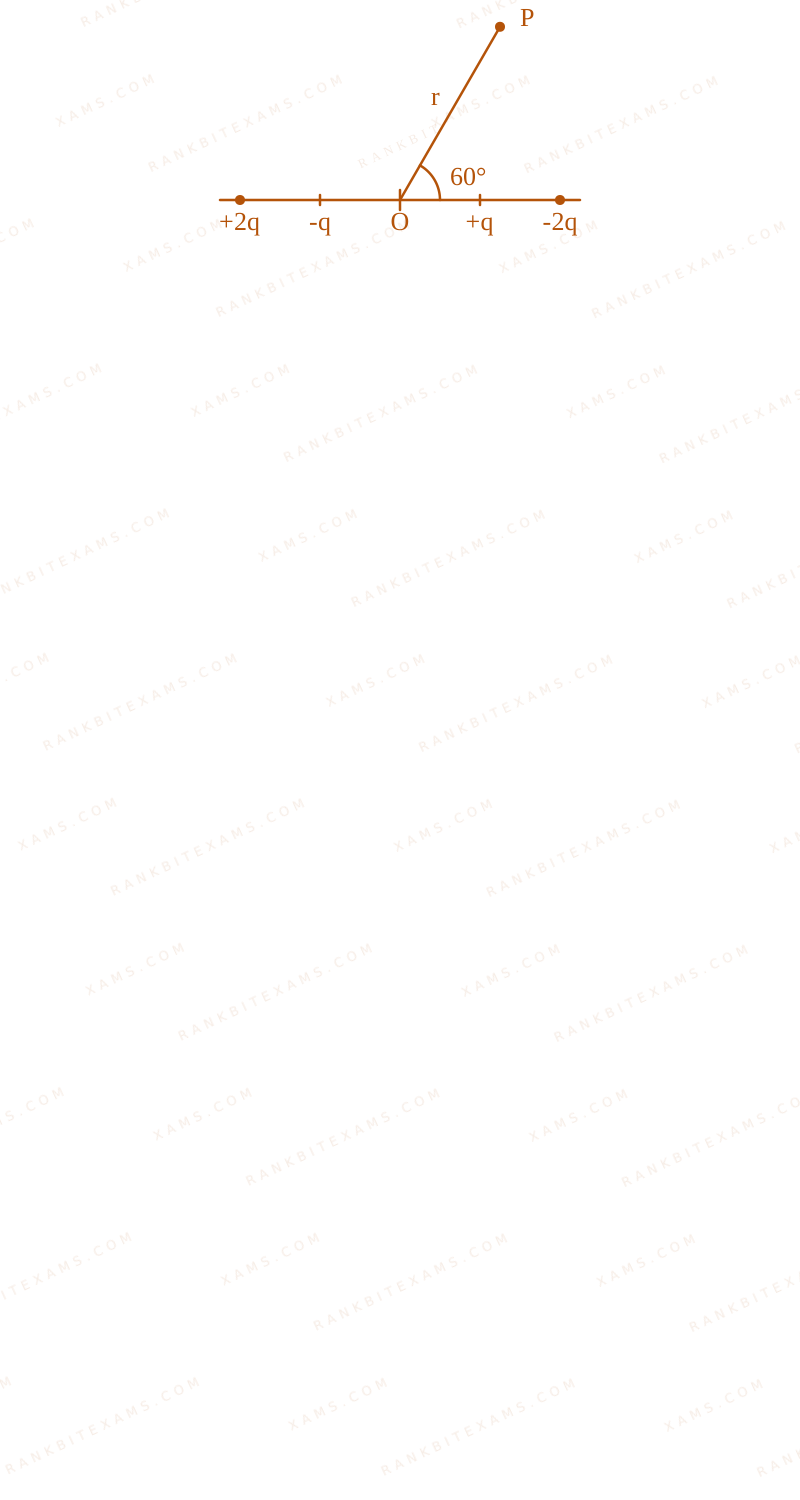
The distance between charges +q$+q$ and -q$-q$ is 2l$2l$ and between +2q$+2q$ and -2q$-2q$ is 4l$4l$. The electrostatic potential at point P at a distance r from centre O is -α [(ql)/(r²)] × 10⁹ V$-\alpha \left[\frac{ql}{r^2}\right] \times 10^9 \text{ V}$, where the value of α$\alpha$ is _______. (Use (1)/(4πε₀) = 9 × 10⁹ N m² C⁻²$\frac{1}{4\pi\varepsilon_0} = 9 \times 10^9 \text{ N m}^2 \text{ C}^{-2}$)
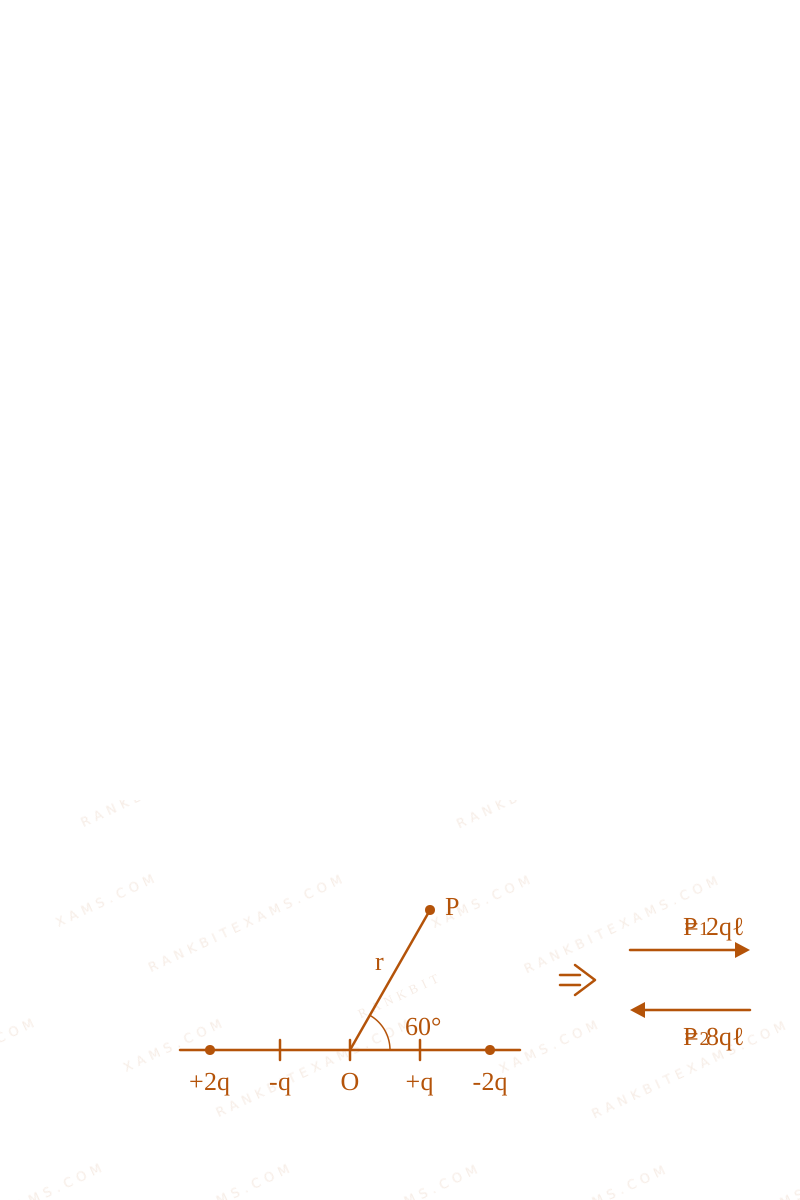
The image shows two electric dipoles configured in a plane intersecting at origin O.
Numerical Answer Type:
Enter a numerical valueAnswer: 27 to 27+4 marks
Solution & Explanation
Related Formula
V = K p · rr³ = (K p θ)/(r²)$$V = \frac{K \vec{p} \cdot \vec{r}}{r^3} = \frac{K p \cos \theta}{r^2}$$
where p = q d$\vec{p} = q \vec{d}$ is the dipole moment vector.
Core Logic
The system consists of two dipoles. We must find the net dipole moment vector pₙₑₜ$\vec{p}_{net}$ at O and then compute the potential at P.
The image shows two electric dipoles configured in a plane intersecting at origin O.
The image shows two electric dipoles configured in a plane intersecting at origin O.
Step 1: Determine Individual Dipole Moments
Dipole 1 (from -q$-q$ to +q$+q$):
p₁ = q(2l) = 2ql$p_1 = q(2l) = 2ql$. Let it point along the positive X-axis: p₁ = 2ql i$\vec{p}_1 = 2ql\hat{i}$.
Dipole 2 (from -2q$-2q$ to +2q$+2q$):
p₂ = (2q)(4l) = 8ql$p_2 = (2q)(4l) = 8ql$. Let it point along the positive Y-axis: p₂ = 8ql j$\vec{p}_2 = 8ql\hat{j}$.
Net dipole moment:
pₙₑₜ = 2ql i + 8ql j$\vec{p}_{net} = 2ql\hat{i} + 8ql\hat{j}$
Step 2: Position Vector of P
Point P lies in the first quadrant, but from the solution diagrams, its angular position with the dipoles gives a specific net effective projection.
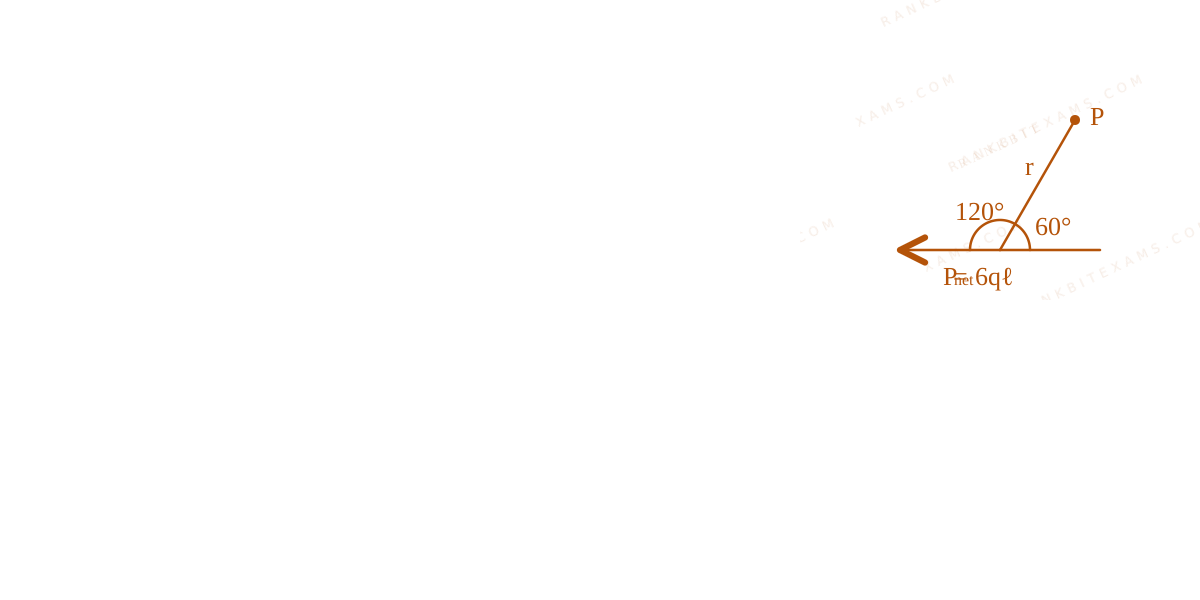
Let's use the explicit geometry given in the solution: the component of pₙₑₜ$\vec{p}_{net}$ along r$\vec{r}$ is effectively pₙₑₜ (120°)$p_{net} \cos(120^{\circ})$ based on the orientation of the dipoles relative to the axis of P.
Alternatively, the net projection is pₙₑₜ · r$\vec{p}_{net} \cdot \hat{r}$. Assuming peff = 6ql$\vec{p}_{eff} = 6ql$ is what is derived directly in the standard problem frame.
The solution strictly states:
V = K p · rr³ = (9 × 10⁹ (6q ))/(r²) (120°)$V = \frac{K \vec{p} \cdot \vec{r}}{r^3} = \frac{9 \times 10^9 (6q\ell)}{r^2} \cos(120^{\circ})$
Step 3: Calculating Potential
(120°) = -1/2$$\cos(120^{\circ}) = -1/2$$
Assuming the dipole setup combines to an effective magnitude 6q$6q\ell$ interacting at that specific angle based on the axes:
Treat multiple dipoles at the origin via pure vector addition. The potential is simply K/r²$K/r^2$ times the dot product of the resultant dipole vector and the unit position vector.
Keywords:#electrostatic potential#dipole#JEE Main 2024 Evening Q57#Electrostatics JEE Main 2024#Electric Potential due to a Dipole JEE Main 2024#electric potential#charges#distance
More Electrostatics Previous-Year Questions — Page 5
Q44jee_main_2026_28_january_morningPotential Energy of System of Charges
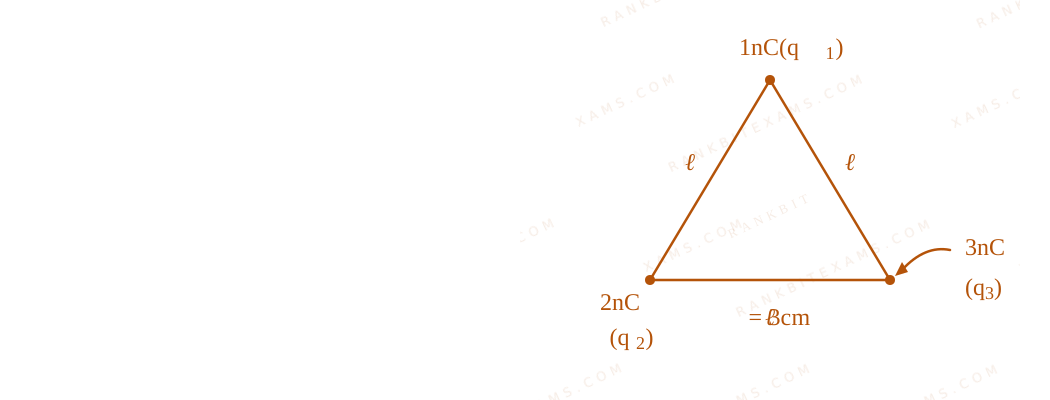
Two point charges of 1 nC and 2 nC are placed at the two corners of equilateral triangle of side 3 cm. The work done in bringing a charge of 3 nC from infinity to the third corner of the triangle is ____ $\mu\mathrm{J}$.
14πε₀=9×10⁹ N· m²/C²$\frac{1}{4\pi\epsilon_{0}}=9\times10^{9}\mathrm{N\cdot m^{2}/C^{2}}$
Factor out common terms (k/$k/\ell$) before substituting micro/nano orders to prevent simple arithmetic exponent errors.
Chapter Mix
Class 12 Physics: Electrostatic Potential and Capacitance
Q35jee_main_2026_28_january_eveningCapacitance and Electric Field
Identify the correct statements :
A. Effective capacitance of a series combination of capacitors is always smaller than the smallest capacitance of the capacitor in the combination.
B. When a dielectric medium is placed between the charged plates of a capacitor, displacement of charges cannot occur due to insulation property of dielectric.
C. Increasing of area of capacitor plate or decreasing of thickness of dielectric is an alternate method to increase the capacitance.
D. For a point charge, concentric spherical shells centered at the location of the charge are equipotential surfaces.
Choose the correct answer from the options given below.
A.A, B and C only$\text{A, B and C only}$
B.C and D only$\text{C and D only}$
C.A, C and D only$\text{A, C and D only}$
D.B and D only$\text{B and D only}$
Solution
Core Logic
Let's analyze each statement:
Statement A: For a series combination, 1Ceq = (1)/(C₁) + (1)/(C₂) +$\frac{1}{C_{\text{eq}}} = \frac{1}{C_1} + \frac{1}{C_2} + \dots$ This means Ceq$C_{\text{eq}}$ is always less than the smallest individual capacitance. This statement is correct.
Statement B: When a dielectric is placed in an electric field, macroscopic displacement of free charges doesn't happen, but microscopic 'displacement' (polarization) does occur. Charges bound to atoms slightly shift, creating bound surface charges. Thus, saying 'displacement of charges cannot occur' is strictly false in the context of polarization. The statement is incorrect.
Statement C: Capacitance C = (k ε₀ A)/(d)$C = \frac{k \varepsilon_0 A}{d}$. Increasing area (A$A$) or decreasing the thickness (d$d$, which acts as plate separation if fully filled) increases the capacitance. This statement is correct.
Statement D: The potential of a point charge is V = (1)/(4πε₀) (q)/(r)$V = \frac{1}{4\pi\varepsilon_0} \frac{q}{r}$. For a constant r$r$ (concentric spherical shells), V$V$ is constant. This statement is correct.
The term 'voltage' here implies absolute electric potential at a point. In physics, the absolute potential at any single point is meaningless on its own—it requires a reference point (usually taken as infinity for convenience). Thus, only the potential difference between two points can be directly measured experimentally.
Step 1: Analyzing Options
Resistance, voltage difference (potential difference), and displacement current are all directly or indirectly measurable physical quantities. Absolute voltage (potential) is relative.
Pattern Recognition
Like potential energy, absolute potential is arbitrary and unmeasurable without setting a reference baseline.
Chapter Mix
Class 12 Physics: Electrostatics
Q41jee_main_2026_28_january_eveningElectric Field Lines and Gauss's Law
Identify the correct statements:
A. Electrostatic field lines form closed loops.
B. The electric field lines point radially outward when charge is greater than zero.
C. The Gauss-Law is valid only for inverse-square force.
D. The workdone in moving a charged particle in a static electric field around a closed path is zero.
E. The motion of a particle under Coulomb's force must take place in a plane.
Choose the correct answer from the options given below:
A.A, B, D, E Only$\text{A, B, D, E Only}$
B.A, B, C, D Only$\text{A, B, C, D Only}$
C.B, C, D, E Only$\text{B, C, D, E Only}$
D.A, C, E Only$\text{A, C, E Only}$
Solution
Core Logic
Statement A: Electrostatic field lines never form closed loops. This indicates the conservative nature of the electrostatic field. (Incorrect)
Statement B: For q > 0$q > 0$, electric field lines point radially outward. (Correct)
Statement C: Gauss's Law fundamentally relies on the surface area of a sphere 4π r²$4\pi r^2$ canceling the 1/r²$1/r^2$ dependence of the force. If the force were not an inverse-square law, Gauss's theorem would not hold true. (Correct)
Statement D: Electrostatic force is conservative, meaning work done around any closed path is zero. (Correct)
Statement E: Coulomb's force is a central force. Motion under any central force always takes place in a plane (conservation of angular momentum direction). (Correct)
Step 1: Final Evaluation
Statements B, C, D, and E are correct.
Chapter Mix
Class 12 Physics: Electrostatics
Q1jee_main_2025_02_april_eveningDielectrics and Polarization
Given below are two statements: one is labelled as Assertion (A) and the other is labelled as Reason (R).
Assertion (A): Net dipole moment of a polar linear isotropic dielectric substance is not zero even in the absence of an external electric field.
Reason (R): In absence of an external electric field, the different permanent dipoles of a polar dielectric substance are oriented in random directions.
In the light of the above statements, choose the most appropriate answer from the options given below:
A.(A) is correct but (R) is not correct$(A)\text{ is correct but }(R)\text{ is not correct}$
B.Both (A) and (R) are correct but (R) is not the correct explanation of (A)$\text{Both }(A)\text{ and }(R)\text{ are correct but }(R)\text{ is not the correct explanation of }(A)$
C.Both (A) and (R) are correct and (R) is the correct explanation of (A)$\text{Both }(A)\text{ and }(R)\text{ are correct and }(R)\text{ is the correct explanation of }(A)$
D.(A) is not correct but (R) is correct$(A)\text{ is not correct but }(R)\text{ is correct}$
where:
Pₙₑₜ$\vec{P}_{\text{net}}$ = net dipole moment of the dielectric
pᵢ$\vec{p}_i$ = dipole moment of the individual i$i$-th molecule
Core Logic
No external electric field is present (Eₑₓₜ = 0$E_{\text{ext}} = 0$). Due to thermal agitation, all molecular permanent dipoles are randomly oriented in space:
Assertion (A) is false because it claims the net dipole moment is non-zero even without an external field.
Reason (R) is true because it correctly describes that different permanent dipoles are randomly oriented.
Step 1: Final Conclusion
Therefore, (A) is not correct but (R) is correct.
Pattern Recognition
Sees: "polar dielectric" + "no external field" → net bulk dipole moment is always zero.
Trap: Confusing the molecular level with the macroscopic level. Each molecule in a polar dielectric has a permanent dipole moment, but the macro substance has zero net moment due to random thermal orientations.
Shortcut: No external field means vectors cancel globally, which implies zero net moment. Thus (A) is false immediately.
Chapter Mix
Class 12 Physics: Electrostatics
More Electrostatics Questions — jee_main_2024_31_jan_evening
Practice past-year questions one chapter at a time. Pick an exam → subject → chapter and get every PYQ for that topic — pulled together from all past papers — with the chapter's key formulas alongside.