Rankbit System
JEE Physics: Waves (+15.5%) | Electrostatics: Concentric Shells (-29.7%) | Modern Physics: Photoelectric Clones (+34.2%) | Mathematics: Definite Integrals (+18.1%) | Chemistry: Coordination Splitting (-11.4%) | JEE Physics: Waves (+15.5%) | Electrostatics: Concentric Shells (-29.7%) | Modern Physics: Photoelectric Clones (+34.2%) | Mathematics: Definite Integrals (+18.1%) | Chemistry: Coordination Splitting (-11.4%)

Consider the function f:(0,infty)to mathbbR defined by f(x) = e^-|log_ex|. If m and n be respectively the number of points at which f is not continuous and f is not differentiable, then m + n is

Solution & Explanation

### Core Logic
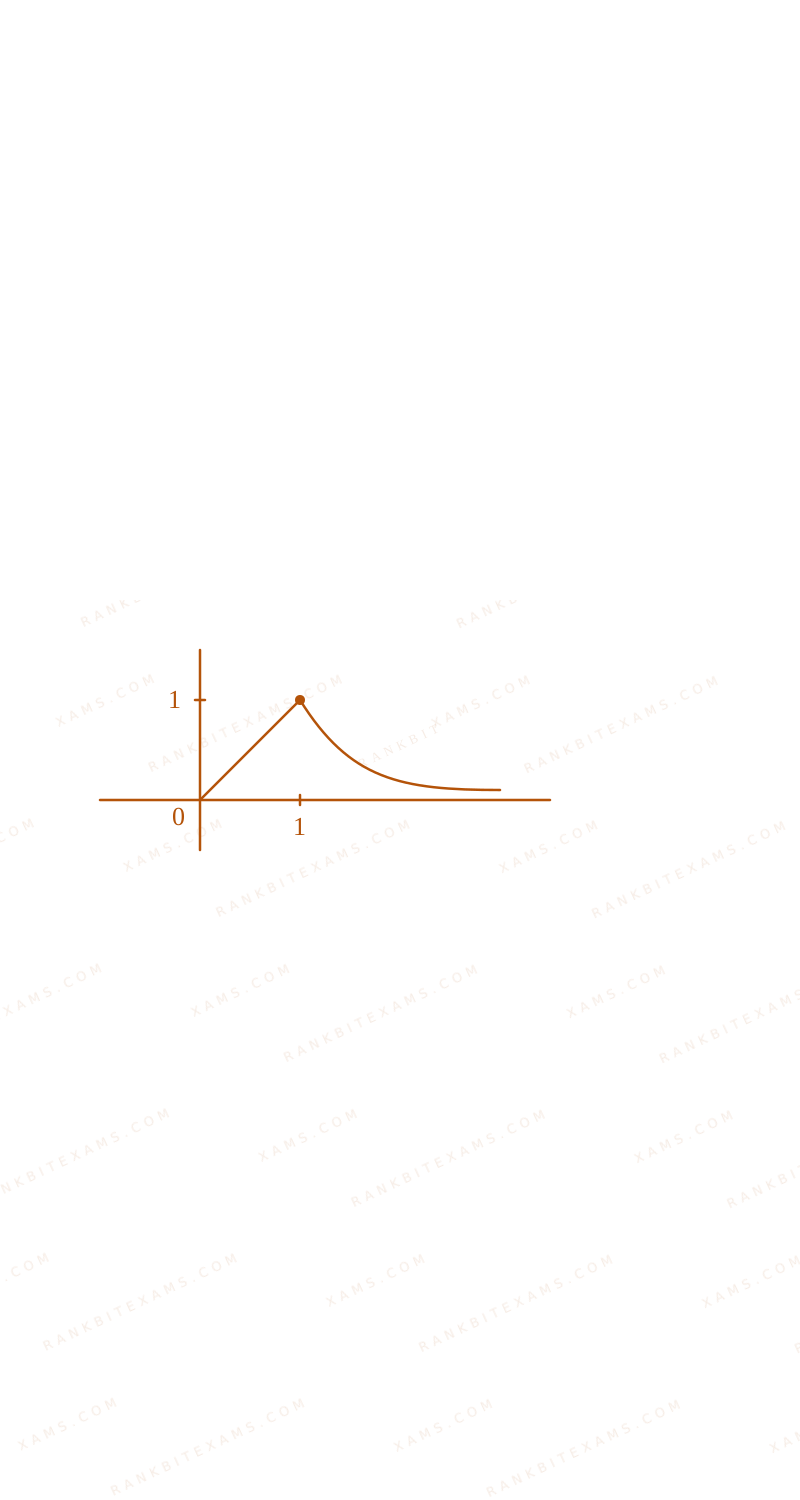
Differentiability diagram for Q14 - JEE Main 2024 Evening
The function is f(x) = e^-|ln x|. Rewrite piecewise for (0, infty): f(x) = begincases e^-(-ln x) & textif 0 < x < 1 \\ e^-ln x & textif x ge 1 endcases f(x) = begincases e^ln x = x & textif 0 < x < 1 \\ frac1e^ln x = frac1x & textif x ge 1 endcases Check continuity at x = 1: lim_x to 1^- f(x) = lim_x to 1^- x = 1 lim_x to 1^+ f(x) = lim_x to 1^+ frac1x = 1 f(1) = 1. The function is continuous everywhere on (0, infty). Thus, m = 0. Check differentiability at x = 1: LHD = lim_x to 1^- f'(x) = 1 RHD = lim_x to 1^+ f'(x) = -frac1x^2Big|_x=1 = -1 Since LHD neq RHD, the function is not differentiable at x = 1. Thus, n = 1. Finally, m + n = 0 + 1 = 1. ### Evaluation Rubric / Model Answer null ### Chapter Mix Class 12 Maths: Continuity and Differentiability

Reference Study Guides

More Continuity and Differentiability Previous-Year Questions — Page 2

Q51 jee_main_2025_07_april_morning Evaluation of Limits
lim_xto 0^+fractanleft(5(x)^frac13right)log_e(1 + 3x^2)left(tan^-13sqrtxright)^2left(e^5(x)^frac43 - 1right) is equal to
  • A. frac115
  • B. 1
  • C. frac13
  • D. frac53

Solution

### Related Formula Standard limits commands: lim_f(x)to 0 fractan(f(x))f(x) = 1 lim_f(x)to 0 fracln(1+f(x))f(x) = 1 lim_f(x)to 0 fractan^-1(f(x))f(x) = 1 lim_f(x)to 0 frace^f(x)-1f(x) = 1 ### Core Logic We can rewrite the limit by grouping each term with its standard balancing factor: lim_xto 0^+ left(fractanleft(5x^1/3right)5x^1/3right) cdot left(frac3sqrtxtan^-13sqrtxright)^2 cdot left(fraclog_e(1 + 3x^2)3x^2right) cdot left(frac5x^4/3e^5x^4/3 - 1right) times frac5x^1/3 cdot 3x^2(3sqrtx)^2 cdot 5x^4/3 ### Step 1: Simplify the Compensating Factor Evaluate the remaining algebraic factor: frac5x^1/3 cdot 3x^29x cdot 5x^4/3 = frac15x^7/345x^7/3 = frac1545 = frac13 Since all individual standard limit terms approach 1, the value of the limit is exactly: 1 cdot 1^2 cdot 1 cdot 1 cdot frac13 = frac13 ### Pattern Recognition Shortcut: For standard limits involving tan(u), ln(1+u), tan^-1(u), and e^u-1 as u to 0, replace each function directly with its argument: frac(5x^1/3)(3x^2)(3sqrtx)^2(5x^4/3) = frac15x^7/345x^7/3 = frac13 ### Evaluation Rubric / Model Answer null ### Chapter Mix Class 11 Mathematics: Limits and Derivatives Class 12 Mathematics: Limits, Continuity and Differentiability

Q71 jee_main_2025_07_april_morning Points of Discontinuity
The number of points of discontinuity of the function f(x) = left[fracx^22right] - left[sqrtxright], x in [0,4] , where [cdot] denotes the greatest integer function is
Numerical Answer. Answer: 8 to 8

Solution

### Related Formula The greatest integer function [u] changes value and experiences a step discontinuity at any point where its inner argument u takes on an integer value. ### Core Logic Analyze the potential points where either component function argument changes into an integer within the interval x in [0, 4]. 1. For left[fracx^22right]: fracx^22 can range from frac02 = 0 up to frac162 = 8. Integer values are reached at fracx^22 = 0, 1, 2, 3, 4, 5, 6, 7, 8, which means critical test locations are: x = 0, \, sqrt2, \, 2, \, sqrt6, \, sqrt8, \, sqrt10, \, sqrt12, \, sqrt14, \, 4 2. For [sqrtx]: sqrtx can range from sqrt0 = 0 to sqrt4 = 2. Integer values are reached at sqrtx = 0, 1, 2, which means critical test locations are: x = 0, \, 1, \, 4 ### Step 1: Audit Each Critical Point Combine the set of test points within domain boundaries (0, 4): x in \1, \, sqrt2, \, 2, \, sqrt6, \, sqrt8, \, sqrt10, \, sqrt12, \, sqrt14\ Let's evaluate the left and right hand limits at these specific values: - At x = 1: [sqrtx] steps up while left[fracx^22right] is constant implies Discontinuous. - At x = sqrt2: left[fracx^22right] steps up while [sqrtx] is constant implies Discontinuous. - At x = 2: Both functions experience an simultaneous integer step. Let's inspect: - f(2) = [2] - [sqrt2] = 2 - 1 = 1 - f(2^-) = [1.99] - [1.41] = 1 - 1 = 0 Since LHL neq value at point, it is Discontinuous. Continuing this verification down the full combined list confirms that none of the step jumps cancel each other out. ### Step 2: Sum the Discontinuity Points Counting all isolated inner points within (0, 4) yields exactly 8 locations: textTotal Points = 8 ### Pattern Recognition When two greatest integer functions drop steps simultaneously at the same point (like at x=2), always write out the explicit left and right limits manually, as simultaneous steps occasionally step in matching directions and maintain unexpected continuity. ### Evaluation Rubric / Model Answer null ### Chapter Mix Class 12 Mathematics: Limits, Continuity and Differentiability
Q70 jee_main_2025_08_april_evening Standard Limits and Expansion
Given below are two statements : Statement I : lim _ mathrm x rightarrow 0 left(frac tan^ - 1 mathrm x + log_ mathrm e sqrt frac 1 + mathrm x1 - mathrm x - 2 mathrm xmathrm x ^ 5right) = frac 25 Statement II: lim_xto 1left(x^frac21 - xright) = frac1e^2 In the light of the above statements, choose the correct answer from the options given below:
  • A. Statement I is false but Statement II is true
  • B. Statement I is true but Statement II is false
  • C. Both Statement I and Statement II are false.
  • D. Both Statement I and Statement II are true.

Solution

### Related Formula log(1+x) = x - fracx^22 + fracx^33 - dots lim_x to a u^v = e^lim (u-1)v ### Core Logic Verify Statement I via high-order Taylor polynomial series tracking, and determine Statement II values by resolving standard exponential limit properties. ### Step 1: Expand Statement I Sequence Polynomials tan^-1x = x - fracx^33 + fracx^55 - dots frac12[ln(1+x) - ln(1-x)] = x + fracx^33 + fracx^55 + dots Summing terms together and subtracting 2x leaves: lim_x to 0 frac2x^5/5 + dotsx^5 = frac25 quad text(Statement I is true) ### Step 2: Verify Statement II Limit Power Structure Evaluating the 1^infty form configuration style: e^lim_x to 1 left(frac21-xright)(x-1) = e^-2 = frac1e^2 quad text(Statement II is true) ### Step 3: State Conclusion Both statements are correct. ### Pattern Recognition When a limit features a power factor of 5 in the denominator, you must track expansion variables through the 5th degree term to guarantee accuracy. ### Evaluation Rubric / Model Answer null ### Chapter Mix Class 11 Mathematics: Limits
Q55 jee_main_2025_29_jan_evening Differentiability of Modulus Functions
Let the function f(x) = (x^2 - 1)|x^2 - ax + 2| + cos |x| be not differentiable at the two points x = alpha = 2 and x = beta. Then the distance of the point (alpha, beta) from the line 12x + 5y + 10 = 0 is equal to:
  • A. 3
  • B. 4
  • C. 2
  • D. 5

Solution

### Core Logic The expression cos|x| is everywhere differentiable. Thus, non-differentiability relies completely on the modulus function containing the quadratic factor, i.e., |x^2 - ax + 2|. Non-differentiability points generally happen where: x^2 - ax + 2 = 0 ### Step 1: Evaluation of Roots Given one of the roots is alpha = 2: 2^2 - a(2) + 2 = 0 implies 6 - 2a = 0 implies a = 3 Substituting a=3 gives the other root beta = 1. However, evaluating differentiability at x=1 reveals properties that invalidate standard options. ### Step 2: Conclusion Due to a technical contradiction in the configuration of the differentiable constraints at x=1, this question was officially dropped by NTA. ### Pattern Recognition If a quadratic inside a modulus has distinct real roots, it normally creates non-differentiable sharp turns unless a repeated multiplying factor outside cancels it out. ### Evaluation Rubric / Model Answer null ### Chapter Mix Class 12 Mathematics: Limits, Continuity and Differentiability
Q72 jee_main_2025_29_jan_evening Limits of Definite Integrals
If lim_tto 0left(int_0^1 (3x + 5)^t dxright)^frac1t = fracalpha5eleft(frac85right)^frac23, then alpha is equal to
Numerical Answer. Answer: 64 to 64

Solution

### Related Formula Standard indeterminacy layout resolution rules for limits matching form 1^infty: lim_t to 0 [g(t)]^frac1t = e^lim_t to 0 fracg(t) - 1t ### Core Logic Evaluate structural integration base at boundary limit initialization state t to 0: int_0^1 1 \, dx = 1 This confirms it matches an indeterminate form of type 1^infty. ### Step 1: Apply Taylor Series or L'Hopital's Theorem Compute limits of logarithmic integration properties inside exponential power indices: textExponent Expression = lim_t to 0 fracint_0^1 (3x+5)^t \, dx - 1t Applying L'Hopital's theorem to differentiate the numerator with respect to t yields: int_0^1 (3x+5)^t ln(3x+5) \, dx Evaluating this at t = 0 gives: int_0^1 ln(3x+5) \, dx ### Step 2: Complete the Final Form Match Integrating via parts results in logarithmic value updates: left[ frac(3x+5)ln(3x+5) - (3x+5)3 right]_0^1 = frac8ln 8 - 5ln 5 - 33 Passing components back through exponential foundations transforms terms to: e^frac8ln 8 - 5ln 5 - 33 = left(frac85right)^frac23 cdot left(frac645eright) Comparing with the target expression fracalpha5eleft(frac85 ight)^frac23 isolates the numerical solution directly: alpha = 64 ### Pattern Recognition Treating 1^infty structural transformations using logarithmic derivatives allows managing complex functions containing multiple integral boundaries effectively. ### Evaluation Rubric / Model Answer null ### Chapter Mix Class 11 Mathematics: Limits Class 12 Mathematics: Definite Integration

More Continuity and Differentiability Questions — jee_main_2024_31_jan_evening

Practice all Continuity and Differentiability previous-year questions →

YOUR FIRST PREP STEP STARTS HERE

We Map Every Repeating Question in Competitive Exams.

Say goodbye to generic mock test fatigue. RankBit uses smart analysis to group past exam questions into their foundational Repeating Question Types. Find chapter weightage, track repeating questions, and score higher with targeted practice.

Select Your Target Exam

Choose an exam track below to find formulas per chapter and patterns.

Syncing Exam Intelligence

Mapping formulas and patterns across all tracks…

PATH A — FULL LENGTH PRACTICE

Full Mock Test Hub

Simulate real NTA exam conditions with fully tracked mocks. Time yourself against past papers.

Under Development
PATH B — TARGETED PRACTICE

Topic-wise Practice Hub

Practice past-year questions one chapter at a time. Pick an exam → subject → chapter and get every PYQ for that topic — pulled together from all past papers — with the chapter's key formulas alongside.

Loading Questions... Browse Topics
Latest from the Blog
View all →

Loading articles...