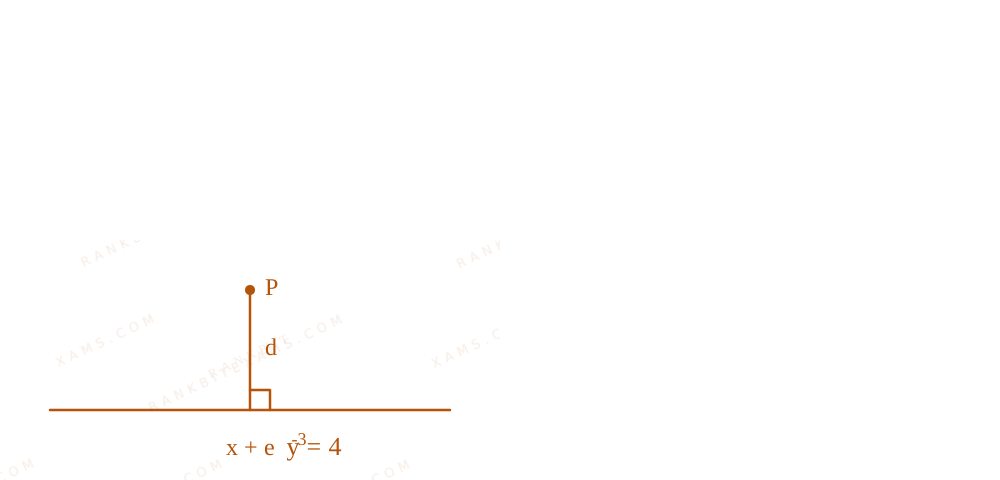
If the function f: (-∞, -1] → (a, b] defined by f(x) = ex³ - 3x + 1 is one-one and onto, then the distance of the point P(2b + 4, a + 2) from the line x + e⁻³y = 4 is :

Solution & Explanation

Related Formula
Distance of point (x₁, y₁) from line Ax+By+C=0 is d = |Ax₁ + By₁ + C|√(A² + B²)
Core Logic

Monotonicity and Distances diagram for Q13 - JEE Main 2024 Evening

Given f(x) = ex³ - 3x + 1. Check monotonicity on (-∞, -1]:

f'(x) = ex³ - 3x + 1 · (3x² - 3) = 3(x-1)(x+1)ex³ - 3x + 1

For x ≤ -1, (x+1) ≤ 0 and (x-1) < 0, making f'(x) ≥ 0. Hence f(x) is strictly increasing. Since f is onto (a,b], the range is dictated by the domain boundaries:

a = x→-∞ f(x) = e-∞ = 0 b = f(-1) = e-1 + 3 + 1 = e³

Point P(2b + 4, a + 2) ≡ P(2e³ + 4, 2). Find distance from line x + e⁻³y - 4 = 0:

d = |2e³ + 4 + e⁻³(2) - 4| 1² + (e⁻³)² = 2e³ + 2e⁻³ 1 + e⁻⁶ d = 2e³(1 + e⁻⁶) 1 + e⁻⁶ = 2e³ 1 + e⁻⁶ = 2√(e⁶ + 1)
Chapter Mix

Class 12 Maths: Applications of Derivatives Class 11 Maths: Straight Lines

Reference Study Guides

More Applications of Derivatives Previous-Year Questions — Page 4

Q16 jee_main_2024_29_january_evening Increasing and Decreasing Functions
The function f(x) = (x)/(x² - 6x - 16), x in R - -2, 8,
  • A. decreases in (-2, 8) and increases in (-∞, -2) (8, ∞)
  • B. decreases in (-∞, -2) (-2, 8) (8, ∞)
  • C. decreases in (-∞, -2) and increases in (8, ∞)
  • D. increases in (-∞, -2) (-2, 8) (8, ∞)

Solution

Related Formula

Using the quotient rule:

f'x = (u'v - uv')/(v²)

If f'(x) < 0, the function decreases.

Core Logic

Let us compute f'(x):

f'(x) = (1(x² - 6x - 16) - x(2x - 6))/((x² - 6x - 16)²) f'(x) = (x² - 6x - 16 - 2x² + 6x)/((x² - 6x - 16)²) = (-x² - 16)/((x² - 6x - 16)²) = -(x² + 16)/((x² - 6x - 16)²)
Step 1: Sign Assessment

Observe that x² + 16 > 0 for all real x and the denominator (x² - 6x - 16)² > 0 everywhere except at the excluded boundary asymptotes x = -2 and x = 8. Therefore:

f'(x) < 0 x in R - -2, 8

Thus, the function decreases throughout its domain intervals:

(-∞, -2) (-2, 8) (8, ∞)
Pattern Recognition

When the numerator of the derivative simplifies to a strictly negative or positive constant/expression (like -x² - 16), the function exhibits monotonic behavior over all continuous subsets.

Chapter Mix

Class 12 Mathematics: Application of Derivatives

Q22 jee_main_2024_27_jan_morning Monotonicity
Let for a differentiable function f:(0,∞)arrow R, f(x)-f(y)≥ ₑ((x)/(y))+x-y, x, y in (0,∞). Then Σn=1²⁰f'( 1n²) is equal to:
Numerical Answer. Answer: 2890 to 2890

Solution

Related Formula
f'(x) = y → x (f(x)-f(y))/(x-y) Σn=1^k n² = (k(k+1)(2k+1))/(6)
Core Logic

Expand the given logarithmic inequality:

f(x) - f(y) ≥ ln x - ln y + x - y

Divide both sides by (x - y). The inequality sign will behave differently based on whether (x - y) is positive or negative. Case 1: Let x > y (so x - y > 0).

(f(x)-f(y))/(x-y) ≥ (ln x - ln y)/(x-y) + 1

Taking the limit as y → x^-:

f'(x) ≥ (d)/(dx)(ln x) + 1 ⇒ f'(x) ≥ (1)/(x) + 1
Step 1: Analyzing the second case

Case 2: Let x < y (so x - y < 0). Dividing flips the inequality sign:

(f(x)-f(y))/(x-y) ≤ (ln x - ln y)/(x-y) + 1

Taking the limit as y → x^+:

f'(x) ≤ (d)/(dx)(ln x) + 1 ⇒ f'(x) ≤ (1)/(x) + 1
Step 2: Squeeze Theorem deduction

Since f is given as a differentiable function, both the left-hand and right-hand limits must yield the exact same derivative. Thus, it is sandwiched between the bounds:

f'(x) = (1)/(x) + 1
Step 3: Evaluating the Summation

We need to compute Σn=1²⁰ f'((1)/(n²)). Substitute x = (1)/(n²) into the derivative:

f'((1)/(n²)) = (1)/(1/n²) + 1 = n² + 1

Apply the summation:

Σn=1²⁰ (n² + 1) = Σn=1²⁰ n² + Σn=1²⁰ 1 = (20 × 21 × 41)/(6) + 20 = 2870 + 20 = 2890
Pattern Recognition

Symmetric functional inequalities bounded by identical structural forms always compress down to an equality via the Sandwich/Squeeze theorem. Create the difference quotient limit to extract the derivative directly.

Chapter Mix

Class 12 Maths: Application of Derivatives Class 11 Maths: Sequences and Series Class 11 Maths: Limits and Derivatives

Q28 jee_main_2024_27_jan_morning Higher Order Derivatives
Let f(x)=x³+x²f'(1)+xf''(2)+f'''(3), xin R. Then f'(10) is equal to:
Numerical Answer. Answer: 202 to 202

Solution

Related Formula
(d)/(dx)(xⁿ) = nxⁿ⁻¹
Core Logic

Since f'(1), f''(2), and f'''(3) are evaluated at specific points, they act strictly as numerical constants. Let's differentiate the function sequentially:

f'(x) = 3x² + 2x f'(1) + f''(2) f''(x) = 6x + 2f'(1)

f'''(x) = 6

Step 1: Finding Unknown Constants

From the third derivative, evaluate it at x=3: f'''(3) = 6

Next, evaluate the second derivative at x=2:

f''(2) = 6(2) + 2f'(1) = 12 + 2f'(1)

Finally, evaluate the first derivative at x=1:

f'(1) = 3(1)² + 2(1)f'(1) + f''(2) f'(1) = 3 + 2f'(1) + f''(2)

Rearranging gives:

f'(1) + f''(2) = -3
Step 2: Solving the System

Substitute f''(2) = 12 + 2f'(1) into the rearranged equation:

f'(1) + (12 + 2f'(1)) = -3 3f'(1) = -15 ⇒ f'(1) = -5

Now find f''(2):

f''(2) = 12 + 2(-5) = 2
Step 3: Final Output Calculation

We now have the complete explicitly defined first derivative equation:

f'(x) = 3x² + 2x(-5) + 2 = 3x² - 10x + 2

Evaluate this at x=10:

f'(10) = 3(10)² - 10(10) + 2 f'(10) = 300 - 100 + 2 = 202
Pattern Recognition

Functional equations that contain derivatives evaluated at specific points are just polynomials with unknown coefficients. Treat those evaluations as scalar constants (A, B, C), differentiate systematically, and plug the anchors back in to build a basic system of linear equations.

Chapter Mix

Class 12 Maths: Application of Derivatives Class 11 Maths: Limits and Derivatives

Q14 jee_main_2024_29_jan_morning Roots of Polynomial Equations
Consider the function f:[(1)/(2),1]arrow R defined by f(x)=4√(2)x³-3√(2)x-1. Consider the statements (I) The curve y=f(x) intersects the x-axis exactly at one point (II) The curve y=f(x) intersects the x-axis at x= (π)/(12) Then
  • A. Only (II) is correct
  • B. Both (I) and (II) are incorrect
  • C. Only (I) is correct
  • D. Both (I) and (II) are correct

Solution

Related Formula
3θ = 4 ³θ - 3 θ

Intermediate Value Theorem (IVT): If a function is continuous and monotonic on [a,b], and f(a) and f(b) have opposite signs, there is exactly one root in (a,b).

Core Logic

Analyze the derivative of f(x) on the interval [(1)/(2), 1]:

f'(x) = 12√(2)x² - 3√(2)

For x in [(1)/(2), 1], the minimum value of x² is (1)/(4).

f'(x) ≥ 12√(2)((1)/(4)) - 3√(2) = 3√(2) - 3√(2) = 0

Thus, f'(x) ≥ 0 for all x in [(1)/(2), 1], meaning the function is strictly increasing on this interval.

Now, check the boundary values:

f((1)/(2)) = 4√(2)((1)/(8)) - 3√(2)((1)/(2)) - 1 = √(2)2 - 3√(2)2 - 1 = -√(2) - 1 lt 0 f(1) = 4√(2)(1) - 3√(2)(1) - 1 = √(2) - 1 gt 0

Since f((1)/(2)) lt 0 and f(1) gt 0 and the function is strictly increasing, it must cross the x-axis exactly once. Statement (I) is correct.

Step 1: Evaluate Statement II

To find where f(x) = 0:

4√(2)x³ - 3√(2)x - 1 = 0 √(2)(4x³ - 3x) = 1 4x³ - 3x = 1√(2)

Recognizing the trigonometric identity 4 ³θ - 3 θ = 3θ, substitute x = θ (which is valid since x in [1/2, 1] implies θ in [0, π/3]):

3θ = 1√(2) 3θ = (π)/(4) θ = (π)/(12)

Hence, the root is x = (π)/(12). Statement (II) is correct.

Pattern Recognition

The structural polynomial form 4x³ - 3x is an immediate trigger for the 3θ substitution. Proving monotonicity first guarantees that the single trig root found is the only root in the constrained domain.

Chapter Mix

Class 12 Mathematics: Application of Derivatives Class 11 Mathematics: Trigonometric Functions
Q24 jee_main_2024_29_jan_morning Graphing and Intersections
Let f(x)=2^x-x²,xin R. If m and n are respectively the number of points at which the curves y=f(x) and y=f'(x) intersects the x-axis, then the value of m+n is
Numerical Answer. Answer: 5 to 5

Solution

Related Formula

To find points where a curve intersects the x-axis, set y = 0.

Core Logic

First, evaluate m, the number of roots for f(x) = 0:

2^x - x² = 0 ⇒ 2^x = x²

Plotting the exponential curve y = 2^x against the parabola y = x²:

  • At x = 2, 2² = 4 and 2² = 4 (Intersection 1).
  • At x = 4, 2⁴ = 16 and 4² = 16 (Intersection 2).
  • For x lt 0, y=2^x decays to 0 while y=x² grows to infinity. They strictly cross exactly once at x = α (where α ≈ -0.76).
  • Hence, the total number of intersections is 3. Therefore, m = 3.

    Graphing and Intersections
    Graphing and Intersections

Step 1: Evaluate n for derivative roots

Now, evaluate n, the number of roots for f'(x) = 0:

f'(x) = 2^x ln 2 - 2x

Set f'(x) = 0 ⇒ 2^x ln 2 = 2xPlotting the scaled exponential curvey = 2^x \ln 2against the liney = 2x:

  • The line
Step 2: Final Computation

Sum the variables:

$m + n = 3 + 2 = 5
Pattern Recognition

The transcendental equation

Pattern Recognition

The transcendental equation $a^x = x^ptypically produces exactly 3 intersections ifa \gt 1, p \gt 1(two positive, one negative). When differentiating toa^x \ln a = px$, you strip away the left-sided negative quadratic wall, reducing it to a linear intersection which yields only 2 roots.

Chapter Mix

Class 12 Mathematics: Application of Derivatives Class 11 Mathematics: Sets, Relations and Functions

More Applications of Derivatives Questions — jee_main_2024_31_jan_evening

Practice all Applications of Derivatives previous-year questions →

Rankbit System
JEE Physics: Waves (+15.5%) | Electrostatics: Concentric Shells (-29.7%) | Modern Physics: Photoelectric Clones (+34.2%) | Mathematics: Definite Integrals (+18.1%) | Chemistry: Coordination Splitting (-11.4%) | JEE Physics: Waves (+15.5%) | Electrostatics: Concentric Shells (-29.7%) | Modern Physics: Photoelectric Clones (+34.2%) | Mathematics: Definite Integrals (+18.1%) | Chemistry: Coordination Splitting (-11.4%)
