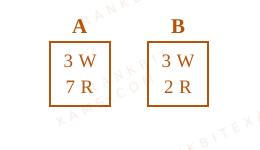
Solution
Related Formula
P(E) = Number of favorable outcomesTotal number of possible outcomesCore Logic
Total possible selections for (x, y) with replacement from 0, 1, , 10 is 11 × 11 = 121. We need pairs (x, y) such that |x - y| > 5, which means x - y > 5 or y - x > 5.
Step 1: Counting Favorable Cases
Assume x < y, so we need y - x ≥ 6. If x = 0 ⇒ y in 6, 7, 8, 9, 10 (5 ways) If x = 1 ⇒ y in 7, 8, 9, 10 (4 ways) If x = 2 ⇒ y in 8, 9, 10 (3 ways) If x = 3 ⇒ y in 9, 10 (2 ways) If x = 4 ⇒ y in 10 (1 way) If x ≥ 5, there are no possible values for y strictly greater than x satisfying the condition.
Step 2: Total Probability
The number of cases for y > x is 5 + 4 + 3 + 2 + 1 = 15. By symmetry, the number of cases for x > y is also 15. Total favorable cases = 15 × 2 = 30. Required probability = (30)/(121).
Pattern Recognition
Absolute difference conditions |x - y| > k on discrete sets cleanly split into symmetric additive series 1+2+...+n. Calculate one half and multiply by 2.
Chapter Mix
Class 12 Maths: Probability
